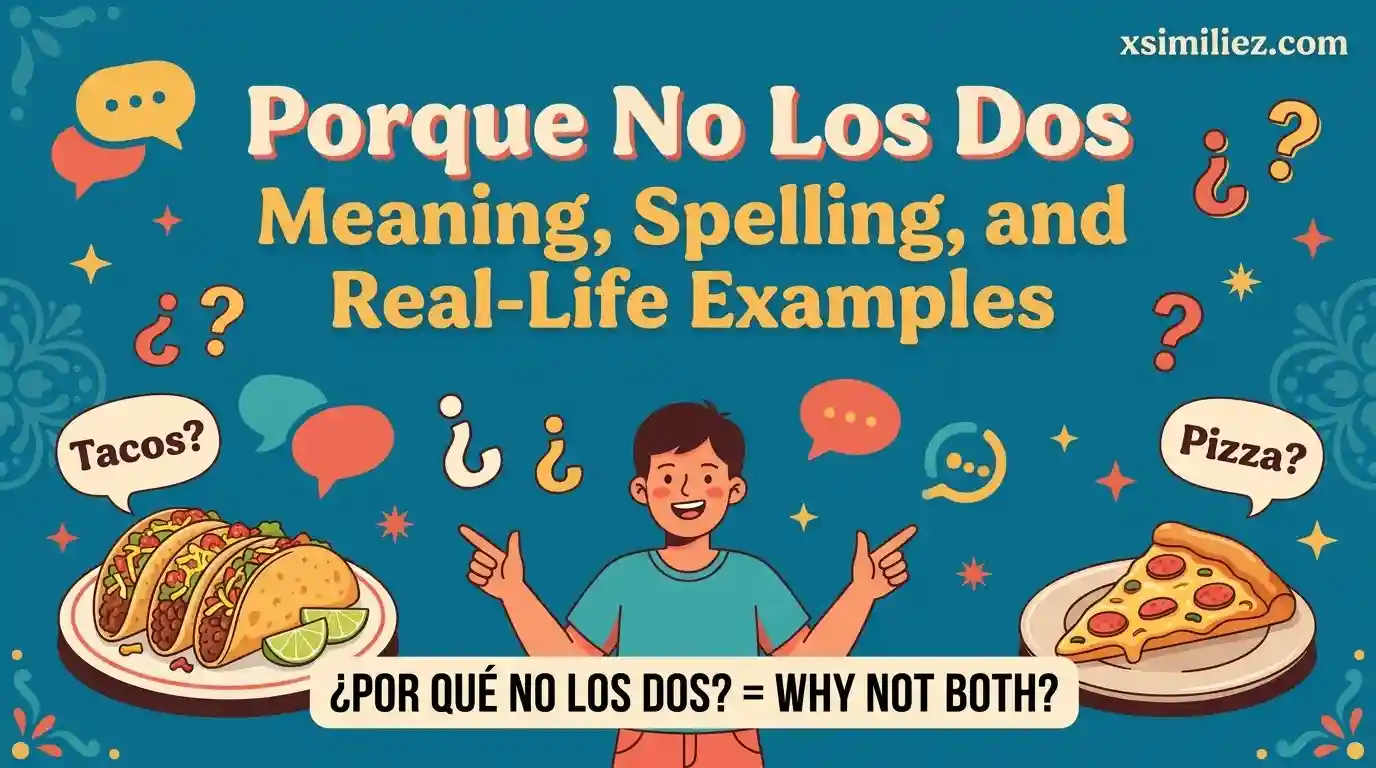
“Porque no los dos” is a Spanish phrase that people usually write as “Por qué no los dos” The porque no los dos meaning in English is “Why not both” You use it when someone asks you to pick one thing, and you want to say yes to two things instead.
You may have seen it in a meme, a social media comment, a song, or a chat with a friend. Many people type it fast and skip the accent marks. That is why so many people search for the porque no los dos meaning online.
This guide explains what the phrase means, how to write it, and how to use it. You will also see real examples, common mistakes, and easy tips. By the end, you can use it with confidence.
Quick Answer: Porque No Los Dos Meaning in Plain English
The porque no los dos meaning is “why not both?” It is a short question that suggests you do not have to choose between two options. You can have both of them.
Here is a simple way to think about it. Someone asks, “Do you want pizza or tacos?” You smile and say, “Por qué no los dos?” That means, “Why not both?” You are saying you want pizza and tacos.
The phrase is friendly and a little playful. It often sounds like a joke, but it can also be a real suggestion. A boss might ask a team if to pick plan A or plan B. One person might say, “Why not both?” and offer a way to do each plan in small steps.
In writing, the correct form has two words for “por qué” and two question marks. The first one is upside down, like this: Por qué no los dos? Many people on phones skip the upside-down mark, and that is very common.
Meaning of Porque No Los Dos Word by Word
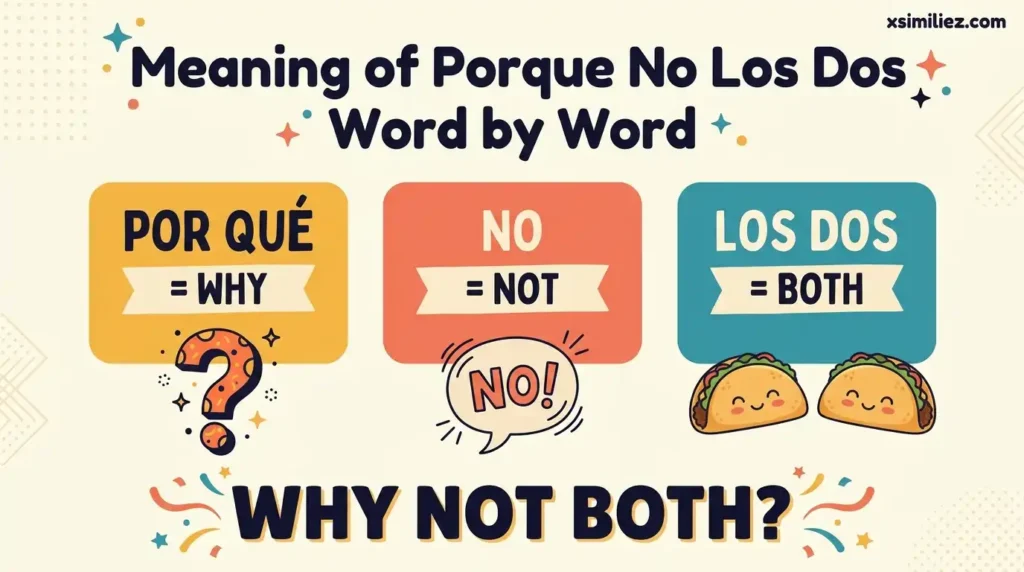
Let us break the phrase into small parts. This makes the porque no los dos meaning even easier to see.
“Por qué” means “why.” “No” means “not.” “Los dos” means “the two” or “both.” When you put them together, you get “why not the two?” In normal English, we say “why not both?”
The words “los dos” are a very useful pair. In Spanish, “dos” is the number two. “Los” is the word “the” for plural masculine nouns. Together they mean “both of them” or “the two of them.” Spanish speakers use this a lot. You might hear “los dos son amigos,” which means “both of them are friends.”
The phrase also holds a small attitude. It says, “I do not think we need a rule that makes us pick one.” That is why it feels so cheerful. It takes a hard choice and turns it into a happy answer.
The table below shows each piece of the phrase and how it works.
| Spanish Word | English Meaning | Job in the Phrase |
| Por qué | Why | Starts the question |
| No | Not | Says there is no reason to limit yourself |
| Los dos | Both (the two) | Points to the two options |
Grammar and Correct Usage of Porqué No Los Dos
The biggest grammar issue in this phrase is the word “porque.” In a question, Spanish uses two separate words: “por qué.” So the correct form is “Por qué no los dos?” and not “porque no los dos.”
The word “porque” as one word means “because.” So “porque no los dos” would sound like “because not both.” That does not make sense as a question. It can make sense in a longer answer, though. For example, “No quiero elegir porque no los dos pueden caber.” That means, “I do not want to choose because both cannot fit.” This is a different sentence, and the meaning changes.
Spanish has four forms that look alike, and they confuse many learners. The table below shows them side by side.
| Form | Meaning | Example |
| Por qué | Why (in questions) | Por qué no los dos? |
| Porque | Because | Voy porque quiero. |
| Porqué | The reason (a noun) | No entiendo el porqué. |
| Por que | A different use, such as “for which” | La razón por la que vine es simple. |
Next, think about “los dos” and “las dos.” If you talk about two things that are all feminine, Spanish uses “las dos.” For example, if you must choose between two pizzas, “pizza” is feminine, so you could say “Por qué no las dos?” If the group is mixed or masculine, you use “los dos.” Most people use “los dos” for general choices, so that is the version you see most often.
You can also change the phrase a little. “Y por qué no ambos?” is another way to say it. “Ambos” also means “both,” and it sounds a bit more formal. Spanish speakers might use it in an office or in school writing.
Common Mistakes People Make With This Phrase
Mistakes are normal, and they are easy to fix. Here are the most common ones with this phrase.
The first mistake is writing “porque no los dos” as one word, as we saw above. In a chat or a comment, it is not a big deal, because friends will understand you. In school, work, or a formal text, use “por qué.”
The second mistake is dropping the accent. “Por que” without the accent mark is not the same as “por qué.” The accent on “qué” tells you it is a question word. Without it, the word can change meaning. On a phone, accents are easy to skip, but they matter in careful writing.
The third mistake is leaving out the question marks. Spanish uses a pair: at the start and ? at the end. English only uses the one at the end. If you write for a Spanish reader, try to include both.
The fourth mistake is using it for more than two options. “Los dos” means exactly two. If you have three choices and want them all, Spanish speakers say “Por qué no los tres?” which means “Why not all three?” Or they say “Por qué no todos?” which means “Why not all of them?”
The fifth mistake is using the phrase in a serious moment where it sounds rude. If a friend is sad and must choose between two hard paths, joking “Why not both?” may feel careless. Tone matters, so read the room first.
Real-Life Examples of Porqué No Los Dos in Use
Examples make the porque no los dos meaning come alive. Below are a few situations where you might hear or say the phrase.
At a restaurant, a waiter asks, “Would you like soup or salad?” A hungry customer smiles and says, “Por qué no los dos?” The waiter laughs and brings both.
In a family talk, a mom asks, “Should we visit Grandma on Saturday or Sunday?” A kid says, “Por qué no dos días?” That means, “Why not both days?” It is a fun way to get more time with Grandma.
At work, a team can’t decide between two ideas for a new product. One person says, “Por qué no los dos?” and suggests testing one idea first and the other next month. Here the phrase is not a joke. It is a helpful idea.
In school, a student must choose between joining the art club or the soccer team. A friend says, “Why not both?” The student checks the schedule and finds that the clubs meet on different days. Now the phrase has solved a real problem.
Online, people often use it in memes. Someone posts a picture of two things, such as coffee and tea, and asks which one is better. The top comment says, “Por qué no los dos?” The joke works because many people feel that way about their favorite things.
Here are some short lines you can copy and learn.
| Spanish | English |
| Café o té? ¿Por qué no los dos? | Coffee or tea? Why not both? |
| Playa o montaña? ¿Por qué no los dos? | Beach or mountain? Why not both? |
| ¿Dulce o salado? ¿Por qué no los dos? | Sweet or salty? Why not both? |
| Estudiar o descansar? ¿Por qué no los dos? | Study or rest? Why not both? |
Current Usage and Trends Around the Phrase
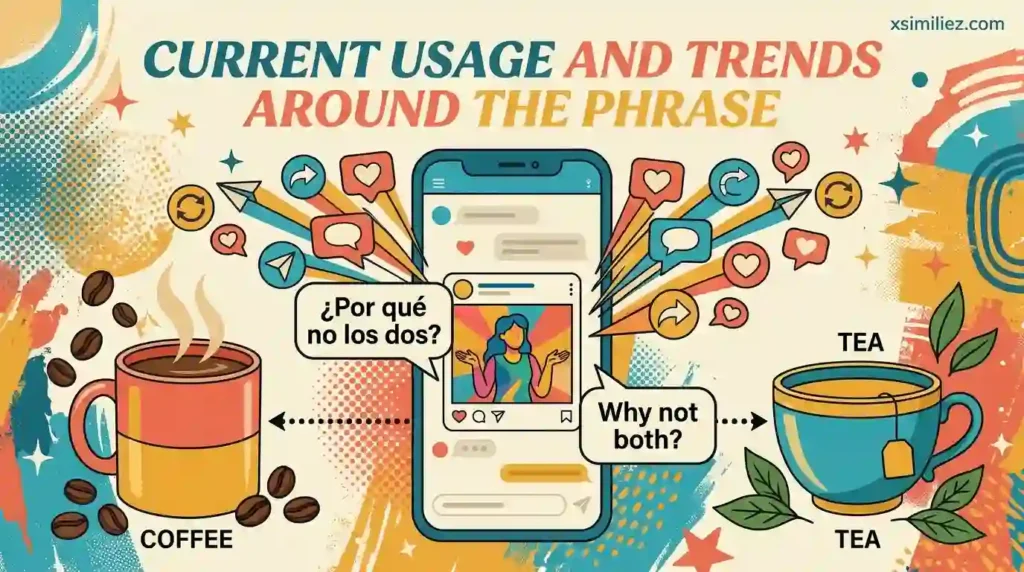
In recent years, short phrases like this have spread fast on social media. People share them as captions, comments, and replies. “Why not both?” is one of those ideas that works in many languages, so the Spanish version travels well.
I could not find a trusted source that names one single starting point for the phrase. The idea of saying “why not both?” is very old and very simple, so many people have likely come up with it on their own. For that reason, it is better not to claim a special origin story. If you read an article that gives a clear date or a clear person, check the source before you trust it.
What we can say is how people use it today. It shows up in memes, video captions, and group chats. It is also common in everyday talk, because it solves a small problem in a happy way. Spanish speakers in many countries understand it right away, and English speakers who learn it often like how short and clear it is.
The phrase also fits modern life. Many people today like having more than one option. They want to work and travel, or save money and enjoy life. “Why not both?” feels like a small voice of permission. It says you do not always have to pick a side.
Tips and Best Practices for Using the Phrase
If you want to use this phrase well, a few simple tips can help.
First, match the tone to the moment. Use it with friends, family, and in casual talk. In a work email, a softer line may work better, such as “Could we do both?” In Spanish, that would be “Podríamos hacer los dos?”
Second, say it with a smile. The phrase works best when it sounds light. A warm voice makes it clear that you are being friendly and not pushy.
Third, back it up when it matters. If you suggest “both” at work or in school, add a short plan. For example, say, “Why not both? We can start with the first one this week and the second one next week.” This shows you thought about the details and makes the idea easier to accept.
Fourth, practice the sound. In simple English letters, you can say it like “por-KEH noh lohs DOHS.” The stress falls on “qué” and on “dos.” Saying it out loud a few times will help you remember it.
Fifth, learn a few matching phrases. “Ambos” means both. “Los dos” means both of them. “Todo” means everything. “Las dos” is the feminine form. Knowing these makes you sound more natural.
Finally, check the spelling when you write for others. If you are texting a friend, a quick “porque no los dos” is fine. If you are writing a post, a school task, or a business message, use “Por qué no los dos?” with the accent and both question marks.
Related Spanish and English Phrases You Can Learn Next
Once you know the meaning of “porque no los dos”, you can build on it. Other phrases carry a similar idea, and they can help you sound more fluent.
In English, “why not both?” has close cousins. People say “have your cake and eat it too” when someone wants two things that seem to clash. They also say “the best of both worlds” when one choice gives you the good parts of two things. These are not exact matches, but they share the same spirit.
In Spanish, you can say “lo mejor de los dos mundos,” which means “the best of both worlds.” You can also say “las dos cosas,” which means “both things.” For example, “Quiero las dos cosas” means “I want both things.” And “tanto uno como el otro” means “both one and the other,” which sounds a bit more formal.
There is also the opposite idea. When you must pick only one, Spanish speakers say “o uno o el otro,” meaning “either one or the other.” Or they say “no se puede tener todo,” which means “you can’t have everything.” It is a good reminder that “why not both?” does not always work. Sometimes a time limit, a budget, or a rule means you really must choose.
Knowing both sides makes your Spanish richer. You can offer a fun “why not both?” when it fits, and you can understand a “pick one” when it does not.
FAQs About Porque No Los Dos Meaning
What does “porque no los dos” mean in English?
It means “why not both?” The correct Spanish form is “Por qué no los dos?” People use it when they want to say yes to two options instead of choosing just one.
Is “porque no los dos” spelled correctly?
Not exactly. In a question, Spanish uses two words and an accent: “por qué.” The one-word “porque” means “because.” Still, many people write it the short way in texts and comments.
What is the difference between “por qué” and “porque”?
“Por qué” is for asking why. “Porque” is for giving a reason, like “because.” There is also “porqué,” which is a noun that means “the reason.” Each one has its own job.
Can I use “los dos” for more than two things?
No. “Los dos” means exactly two. For three things, say “los tres.” For all of them, say “todos.” Use the number that matches your list.
When should I say “las dos” instead of “los dos”?
Use “las dos” when both things are feminine in Spanish, such as two pizzas or two ideas. Use “los dos” for masculine or mixed groups. In casual talk, “los dos” is the most common.
Is the phrase formal or casual?
It is mostly casual and friendly. It fits chats, jokes, and everyday talk. In formal writing, a longer line such as “Sería posible hacer ambos?” sounds more polite. That means “Would it be possible to do both?”
Conclusion:
The porque no los dos meaning is easy once you see it: “Why not both?” It is a short Spanish question that turns a hard choice into a happy answer. The correct spelling is “Por qué no los dos?” but you will often see the quick version online.
Remember the main parts. “Por qué” asks why, “no” means not, and “los dos” means both. Keep “porque” for “because,” and use “las dos” when both things are feminine. Watch your tone, since the phrase works best in friendly moments.
Next time you face two good choices, try it out loud. Say it with a smile and see what happens. If you can make both work, great. And if you can’t, you will at least have learned a useful phrase that Spanish speakers everywhere understand.

Hi, I’m Harper Blake, and I write for Xsimiliez.com. I enjoy sharing clear and friendly simile examples that students and beginners can understand easily. My goal is to make English learning simple and enjoyable.