The lease a car meaning is simple: you pay to use a car for a set time, like two or three years, but you do not own it. When the lease ends, you give the car back. Think of it like renting a home, only longer and with rules.
Many people search for this phrase because car shopping can feel confusing. Dealers use words like money factor, residual value, and mileage cap. It sounds like a foreign language at first. Is leasing a smart move, or is buying better? The answer depends on your life and your budget.
In this guide, you will learn what a car lease is, how it works, and what the common terms mean. You will also see real examples, common mistakes, and helpful tips before you sign anything.
Quick Answer: Lease a Car Meaning in Plain Words
To lease a car means to sign a contract that lets you drive a car for a fixed time. You make a monthly payment. You follow rules about how many miles you drive and how you care for the car. When the contract ends, you return the car. Some contracts also let you buy it.
Here is the big idea. A car loses value as it gets older. When you lease, you mostly pay for the value the car loses while you drive it. You do not pay for the whole car. That is why lease payments are often lower than loan payments on the same car.
A short way to remember it: lease means use, and buy means own.
Lease a Car Meaning and Definition
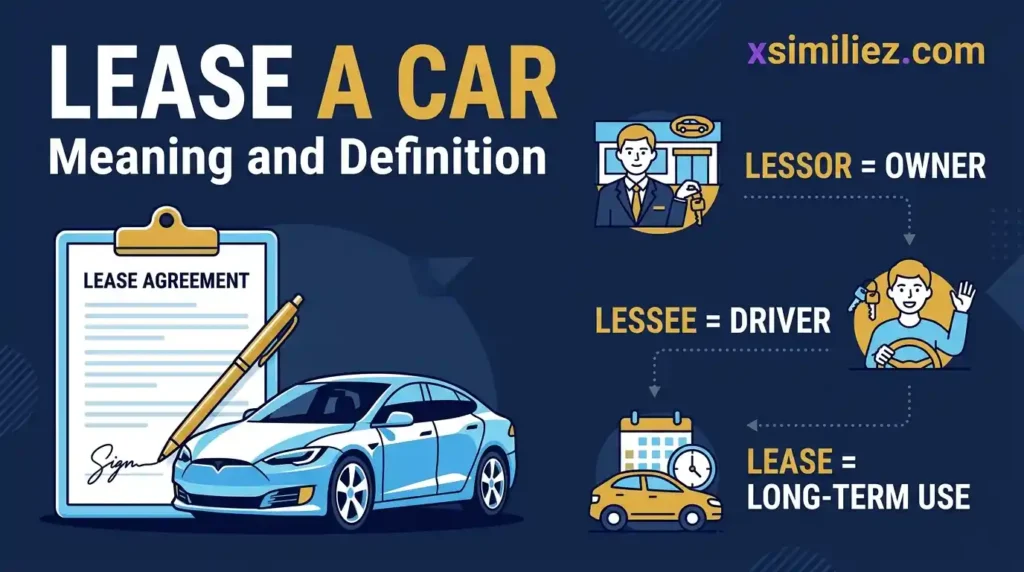
A car lease is a long-term rental contract. Two sides sign it. The first is the lessor. That is the company that owns the car, such as a bank or a car maker’s finance company. The second is the lessee. That is you, the driver.
The lessor keeps the title, which is the legal paper that shows who owns the car. You get the right to drive it. In return, you agree to pay each month, carry insurance, keep the car in good shape, and stay under the mileage limit.
Most personal leases in the United States are closed-end leases. That means the end date is fixed. If you stayed within the mileage limit and the car has only normal wear, you can usually hand over the keys and walk away. You still might owe a small fee when you return it.
There is also an open-end lease, which is more common for businesses. With this kind, you may owe extra money if the car is worth less than the contract expected. Most everyday drivers should look at closed-end leases first.
How a Car Lease Works From Start to Finish
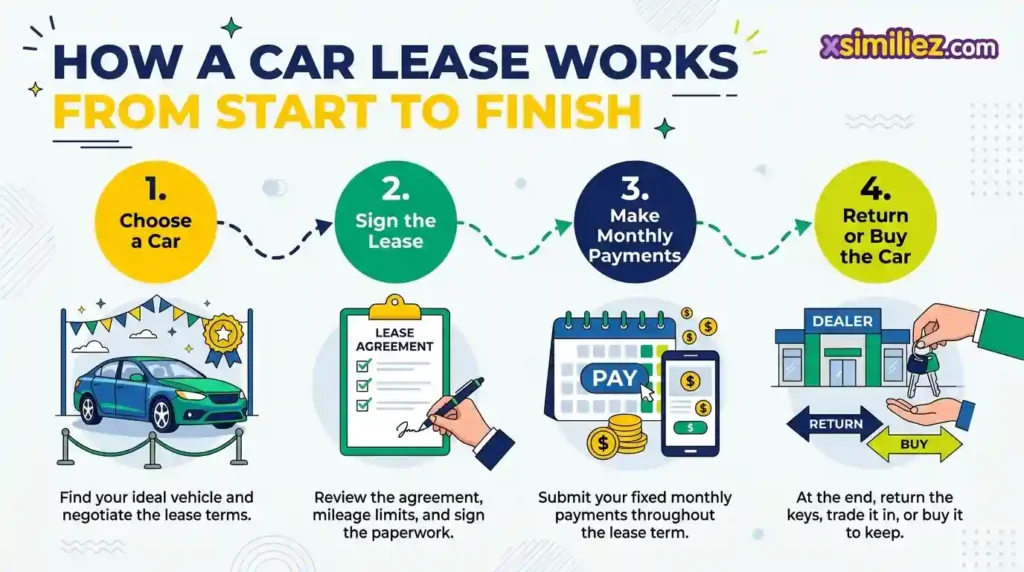
Leasing follows a clear path. Once you know the steps, the process feels much less scary.
First, you pick a car. Then you agree on a price for it, just like you would if you were buying. This price has a fancy name, the capitalized cost. A lower price means a lower monthly payment, so it pays to negotiate.
Next, you choose the lease length and mileage. Common lease lengths run from two to four years, and three years is very popular. Many contracts allow about 10,000 to 15,000 miles per year, though this changes from one deal to another.
After that, the company checks your credit. Better credit often means better terms and a lower rate. Then you sign the paperwork and pay the money due at signing. This may include the first payment, fees, and sometimes a down payment.
Now you drive the car. You make your payments on time, keep up with oil changes and repairs, and stay within the mileage limit. Near the end, the company will inspect the car. You then return it, buy it, or lease a new one. This is the full picture behind the lease a car meaning.
Key Lease Terms Every Driver Should Know
Lease papers are full of strange words. This table puts the most common ones in plain English.
| Term | Simple Meaning |
| Lessor | The company that owns the car |
| Lessee | You, the person who leases the car |
| Capitalized cost | The agreed price of the car in the lease |
| Residual value | What the car is expected to be worth when the lease ends |
| Money factor | The interest charge, shown as a small decimal number |
| Lease term | How long the lease lasts, such as 36 months |
| Mileage allowance | The number of miles you can drive without extra fees |
| Acquisition fee | A fee for setting up the lease |
| Disposition fee | A fee some companies charge when you return the car |
| Gap insurance | Coverage that pays the difference if the car is totaled or stolen |
Two of these deserve extra attention. The first is the residual value. A higher residual value usually means a lower payment, because the car loses less value while you drive it. The lessor sets this number, so it is not something you can usually bargain over.
The second is the money factor. It looks tiny, like 0.0025. A quick trick is to multiply it by 2,400. That gives you a rough yearly interest rate. In this case, 0.0025 times 2,400 equals about 6 percent. If a dealer will not tell you the money factor, that is a red flag.
What Does It Cost to Lease a Car?
Leasing has more than one cost, and some of them hide in the small print. Knowing them helps you compare deals fairly.
At signing, you may pay the first month’s payment, a down payment, an acquisition fee, taxes, and registration fees. Some dealers advertise very low monthly payments but need a large amount at signing. Always ask for the full “due at signing” number.
Every month, you pay the lease payment itself. It has two main parts. One part covers the car’s lost value. The other part is the finance charge, which works like interest. Sales tax rules differ from state to state, so ask how your state handles tax on leases.
You also pay for insurance. Lease companies often require higher coverage than a basic policy, so get an insurance quote before you sign. At the end, you may pay a disposition fee, extra mileage charges, and fees for damage beyond normal wear.
Lease vs. Buy: Which One Fits You Better?
Neither choice is always better. This table shows how they compare.
| Question | Leasing | Buying |
| Who owns the car? | The lessor | You, once it is paid off |
| Monthly payment | Often lower | Often higher |
| Mileage | Limited | No limit |
| Changes to the car | Usually not allowed | Allowed |
| Wear and tear | You may pay for extra damage | Only affects resale value |
| At the end | Return it, buy it, or lease another | Keep it, sell it, or trade it in |
| Long-term cost | Payments never end if you keep leasing | No payments after the loan is done |
Leasing tends to suit people who want a new car every few years, drive about the same distance each year, and like having a warranty most of the time. Buying tends to suit people who drive a lot, keep cars for many years, or want to customize their car. If you pay off a loan and keep driving the car for years, you often come out ahead on cost.
Grammar and Correct Usage of “Lease a Car”
“Lease” works as both a verb and a noun. As a verb, it means to rent something for a long time. You can say, “I want to lease a car.” As a noun, it means the contract itself. You can say, “I signed a lease yesterday.”
The word also works from both sides of the deal. The driver leases a car from a company. The company leases a car to the driver. The phrase “lease out” usually describes the owner’s side, as in “The dealer leases out new cars.”
People often mix up lease, rent, and finance. A rental is short, like a few days. A lease is long, often years. Financing is a loan that helps you buy and own the car. Keeping these three words straight makes the lease a car meaning much easier to understand.
You may also see “leasing” used for the whole process and “lessee” for the driver. These are the correct terms, and they are useful to know when you read your contract.
Origin of the Word Lease
The word “lease” came into English from old French, from a word that meant to let go or to allow. That fits well. A lessor lets you use something they own. The word was first used for land and buildings long before cars existed. Car leasing as we know it grew much later, in the twentieth century. Since I cannot confirm exact dates from a source here, it is best not to rely on a specific year.
British vs. American English for Leasing
In the United States, people say “lease a car.” In the United Kingdom, the common phrase is “contract hire,” or “personal contract hire” for everyday drivers. Both ideas are close. You pay monthly, you do not own the car, and you give it back at the end.
Be careful with other British terms. “Hire purchase” and “PCP” are ways to buy a car over time, so they work differently from a lease. If you read articles from the UK, check which term they use before you compare prices or rules.
Common Mistakes When You Lease a Car
The biggest mistake is guessing your mileage. Many people pick the lowest allowance to get a cheaper payment, then drive more than they planned. Extra miles can cost around 15 to 30 cents each, though it depends on your contract. Driving 3,000 extra miles a year over three years is 9,000 miles. At 20 cents a mile, that is $1,800.
Another mistake is looking only at the monthly payment. A low payment can hide a big amount due at signing or high fees. Compare the total cost over the whole lease, not just one month.
Many people also skip the negotiation. They think lease prices are fixed, but the car’s price can often be negotiated, just like when buying. A lower price lowers your payment.
Some drivers ignore wear and tear rules. Large dents, deep scratches, torn seats, and worn tires can cost money in return. Ask what counts as normal wear before you sign.
Finally, people forget that ending a lease early can be very costly. If your life might change soon, ask about early termination rules, and ask if the lease can be transferred to someone else.
Real-Life Examples of Leasing a Car
Here are a few made-up examples to show how leasing works. The numbers are only for learning, not real offers.
Imagine Maria agrees on a $30,000 price for a car. The lessor says the car will be worth $18,000 after 36 months. So she pays for $12,000 of lost value. Divide that by 36 months, and you get about $333 a month. Add a finance charge of about $120 a month, and her payment is about $453 before taxes.
Now picture Jake, who drives a long way to work. He picks a 10,000-mile limit to save money, then drives 14,000 miles a year. He ends up owing money at the end. A higher mileage plan would have been cheaper for him.
Finally, think of Ana, who likes a new car every three years and drives about 9,000 miles a year. She uses the car for work and likes having a car under warranty. A lease fits her life well.
Current Usage and Trends in Car Leasing
Leasing is still a common way to get a car in the United States, but how popular it is changes from year to year. It depends on car prices, interest rates, and what carmakers offer. I cannot give you exact current numbers here, so check a recent report before you quote one.
Electric cars have made leasing more talked about. Technology changes fast, and some drivers do not want to own an electric car that may feel old in a few years. Also, rules about tax incentives for electric cars have changed often, and they can affect lease deals. Check the latest rules before you decide.
Tips for Leasing a Car the Smart Way
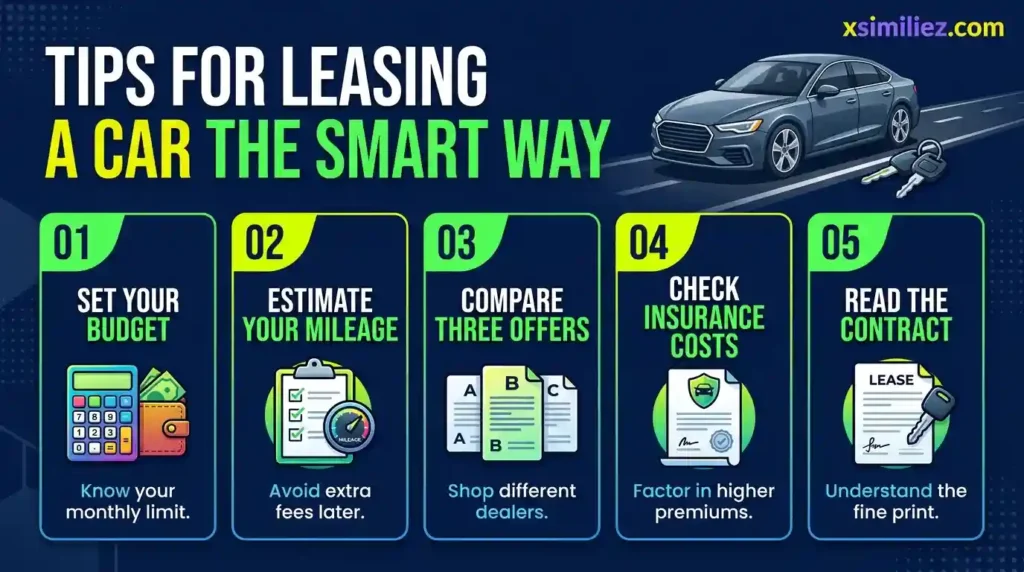
Start by deciding your budget and how many miles you drive. Look at your last year of driving and add a little extra. It is better to pay for a few extra miles up front than to pay a higher rate later.
Compare at least three offers. Ask each dealer for the capitalized cost, residual value, money factor, fees, and the total due at signing. Put them side by side.
Get your insurance quote early, because it changes your true monthly cost. Ask If gap insurance is included in the lease.
Read the end-of-lease rules before you sign. Find out the disposition fee, the wear and tear rules, and If you can buy the car at the end. Keep your service records, too.
Finally, take your time. Do not let anyone rush you. If something in the contract is unclear, ask them to explain it in plain words. If they cannot, that tells you something.
FAQs
What does it mean to lease a car?
It means you sign a contract to drive a car for a set time while making monthly payments. The company still owns the car. At the end, you return it, buy it, or start a new lease.
Do you own the car when you lease it?
No. The lessor owns the car during the lease. You only have the right to use it. At the end, you may be able to buy it, but only if your contract allows that.
Is it better to lease or buy a car?
It depends on your needs. Leasing often means lower payments and a newer car. Buying often costs less over many years, and there are no mileage limits. Pick the one that fits how you drive and how long you keep cars.
What happens at the end of a car lease?
You can return the car and pay any fees for extra miles or damage. You can buy it for the price in your contract. Or you can lease a new car. Many people do a mix of these over the years.
Can you end a car lease early?
Often yes, but it can be expensive. You may owe most of the remaining payments plus fees. Some lessors allow lease transfers to another person. Ask about this before you sign.
Does leasing a car need good credit?
Good credit usually gets you the best deals. Lower credit scores may mean a higher money factor, a bigger down payment, or a denial. Each company sets its own rules, so shop around.
Conclusion
Now you know the lease a car meaning in plain words. A lease lets you drive a car for a fixed time while you pay for the part of its value you use. You do not own the car at the end, and you must follow the mileage and care rules.
Leasing works best for people who like new cars, drive a steady number of miles, and want lower monthly payments. Buying often works better for people who drive a lot or keep cars for many years. Neither choice is wrong. It depends on how you live.
Before you sign, read every line, ask about every fee, and compare at least three offers. Take your time. A good deal should still look good tomorrow.

Hi, I’m Mason Avery, a content writer at Xsimiliez.com. I like writing about similes, figurative language, and creative expressions. I believe learning English becomes easier when examples feel natural and relatable.