
Needy meaning in a relationship is simple: it describes a person who asks for so much attention, reassurance, or time that their partner feels drained. Everyone needs love. Needy behavior starts when those needs feel constant, urgent, and hard to meet. It is not a bad character trait. It is usually a sign that something deeper needs care.
People search for this phrase for many reasons. Maybe a partner said, “You’re too needy,” and it stung. Maybe you notice these habits in yourself. Or maybe you wonder if your partner’s behavior is normal or a red flag.
This guide explains what needy means, the common signs, and the roots behind it. You will also see real examples, helpful tables, and kind, practical steps you can start using today.
Quick Answer: Needy Meaning in Relationship
The needy meaning in a relationship is a pattern of seeking too much reassurance, attention, or closeness from a partner. A needy person often feels unsafe unless the partner is always available. The partner may then feel pressured, tired, or unable to relax.
Here is the short version. Wanting love is healthy. Needing constant proof of love, every hour of every day, is what most people call needy. Also, “needy” is not a medical term. It is an everyday word that people use to describe a set of behaviors, and it often points to fear or insecurity underneath.
Needy Meaning in Relationship: A Full Definition
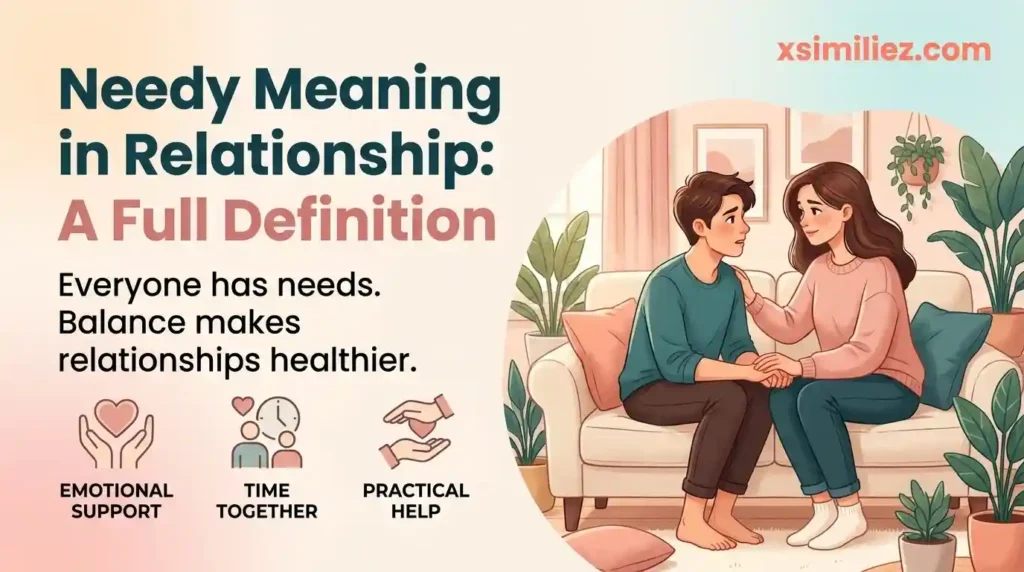
In plain terms, being needy means leaning on another person more than the relationship can comfortably hold. The need can be emotional, like wanting nonstop comfort. It can be practical, like asking a partner to solve every small problem. Or it can be about time, like feeling upset when the partner spends an evening with friends.
It helps to know that every person has needs. We need touch, kind words, support, and time together. Experts who study couples agree that depending on a partner is normal and healthy. The trouble starts when the need becomes so big that it crowds out the partner’s own life, feelings, and limits.
Another key idea is that neediness is about the pattern, not one bad day. Anyone can feel clingy after a stressful week or a hard loss. If you text a lot because your parents are in the hospital, that is not “being needy.” That is being human. The label fits best when the behavior is steady, hard to calm, and starts to hurt the relationship.
Finally, neediness often comes from fear. Deep down, a needy person may worry, “What if they leave?” or “What if I am not enough?” The behavior is an attempt to feel safe. It just tends to push the partner away, which makes the fear even stronger.
Common Signs of Neediness in a Relationship
No single sign proves someone is needy. Look for a group of signs that show up again and again. Here are the most common ones, explained in simple words.
The first sign is constant reassurance seeking. The person asks, “Do you still love me?” or “Are you mad at me?” many times a day, even when nothing is wrong. A kind answer helps for a few minutes, and then the worry returns.
The second sign is heavy texting and calling. Needy people may send many messages in a row and feel panic when there is no quick reply. A short delay can feel like rejection, even when the partner is simply at work or asleep.
The third sign is jealousy of time apart. Maybe a partner wants a night out with friends or a weekend with family. The needy person feels hurt, angry, or left behind, and may try to change the plan.
The fourth sign is a hard time being alone. Quiet evenings feel scary. The person may seem lost without the partner and may rely on them for all fun, comfort, and decisions.
The fifth sign is dropping other relationships. Over time, friends, hobbies, and goals slip away because the partner becomes the only source of happiness. This puts a lot of weight on one person.
The sixth sign is big mood swings tied to the partner’s attention. When the partner is warm, the person feels great. When the partner is busy, the person feels empty, angry, or sad. Their mood rises and falls with every small change.
The seventh sign is testing the partner. Some people pick fights or act cold to see if the partner will chase them. It feels like proof of love, but it wears both people out.
Why Neediness Happens: Common Causes
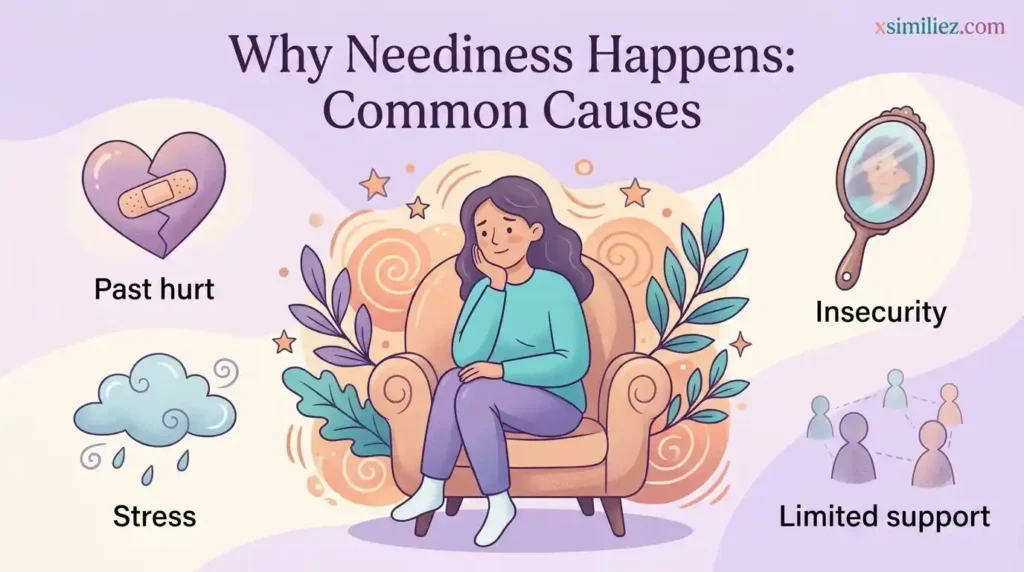
Needy behavior does not come from nowhere. Most of the time, there is a story behind it. Knowing the story can bring more kindness to both partners.
One big cause is early life experience. Psychologists who study attachment, starting with John Bowlby and Mary Ainsworth, found that children learn how safe love feels from their first caregivers. If care felt unpredictable, a child may grow into an adult who worries a lot about being left. This is often called an anxious attachment style. Researchers later showed that these patterns can show up in adult romance too.
Another cause is past hurt. If someone was cheated on, ghosted, or left suddenly, their mind may stay on guard. They may hold on tighter next time, hoping to prevent more pain.
Low self-esteem plays a part as well. When a person does not feel worthy, they may need a partner to prove their value again and again. Sadly, no amount of praise can fill a hole that only self-respect can fill.
Stress and big life changes can also trigger neediness. A job loss, a move, or a loss in the family can make someone lean on a partner more than usual. This is often temporary and fades as life settles down.
A lack of other support matters too. If a person has few friends, little family nearby, or no hobbies, the partner becomes the only place to get comfort. That is a lot to ask of one person.
It is worth saying that sometimes neediness is linked to deeper mental health concerns, like anxiety or a condition called dependent personality disorder. Only a trained professional can say for sure. Please do not diagnose yourself or your partner based on one article.
Healthy Needs vs. Needy Behavior
One of the hardest parts is telling the difference between a normal need and neediness. The table below shows how the same wish can look healthy or unhealthy, depending on how it is handled.
| Situation | Healthy Need | Needy Behavior |
| Wanting time together | Asks for a date night and accepts a “not this week.” | Gets upset or angry whenever the partner has other plans. |
| Feeling worried | Share the feeling and ask for a short talk. | Asks for the same reassurance again and again all day. |
| Texting | Send a sweet message and wait patiently. | Sends many texts and panics when there is no quick reply. |
| Making decisions | Asks for advice, then decides. | Cannot decide anything without the partner. |
| Social life | Keeps friends, hobbies, and goals. | Drops other connections and relies on one person. |
| After a fight | Talk calmly once both feel ready. | Demands an instant fix and cannot handle space. |
Notice the pattern. A healthy need is shared clearly and can survive a “no” or a “not now.” Needy behavior feels urgent, grows louder when it is not met, and leaves little room for the other person.
Real-Life Examples of Needy Behavior
Examples make this idea easier to see. These are made-up stories, but they match what many couples describe.
Maya and Jordan have dated for six months. Jordan goes to the gym three nights a week. Maya feels hurt every time and sends messages like, “Are you sure you want to go?” Jordan feels guilty and starts skipping workouts. Over time, Jordan feels trapped and a little resentful. The need was real. The way it showed up put a lot of pressure on Jordan.
Here is another one. Sam works long hours, and his wife, Priya, calls him six or seven times a day. If he does not answer, she worries that something is wrong or that he is ignoring her. Sam loves her, but he cannot focus at work. Both of them feel stressed, and neither knows how to stop the cycle.
Now think about a more hopeful example. Lena feels anxious when her partner travels. Instead of sending dozens of texts, she tells him, “I get nervous when you’re away. Can we set a time to talk each evening?” They agree on a short call. Lena’s fear did not vanish, but she turned it into a clear request. That small change protects the trust between them.
The third story shows the main lesson. Feelings are not the problem. The way we handle them decides if closeness grows or shrinks.
Common Mistakes When Dealing With Neediness
If you are the needy one or the partner of one, a few mistakes keep the cycle going. Spotting them early can save a lot of pain.
The first mistake is using the word as an insult. Saying “you’re so needy” in the middle of a fight rarely helps. It sounds like shame, and shame makes people cling harder or shut down. It is better to describe the behavior and your own feelings, such as, “I feel overwhelmed when I get many calls during work.”
The second mistake is giving endless reassurance. It feels kind, but it can act like a short-term fix. The worry comes back, and the person asks again. Real comfort comes from building steady trust and inner security, not from repeating the same words all day.
The third mistake is ignoring the problem and hoping it goes away. Silence can build resentment. Both partners need a calm talk, not a blow-up.
The fourth mistake is treating the partner as the only cure. No partner can fix old wounds. If you expect one person to heal your fear, the relationship will feel heavy.
The fifth mistake is pulling away too fast. Some partners respond to neediness by going cold. This often proves the needy person’s biggest fear, and the clinging gets worse.
The last mistake is blaming one person for everything. Most relationship patterns are a dance between two people. One may chase, and the other may pull away. Both can change their steps.
How to Stop Being Needy: Tips and Best Practices
The good news is that neediness can improve. It takes time, patience, and kindness toward yourself. Here are steps that many people find helpful.
Start by naming the feeling. Before you send that fifth text, pause and ask, “What am I afraid of right now?” Often the answer is simple, like “I feel lonely” or “I’m scared they’re upset.” Naming the fear takes away some of its power.
Next, build a life outside the relationship. Spend time with friends, return to old hobbies, and set goals that belong only to you. When your happiness has many sources, no single person has to carry it all.
It also helps to practice soothing yourself. Try slow breathing, a short walk, journaling, or calling a friend. These small habits teach your mind that you can get through a hard moment without instant proof from your partner.
Communication matters a great deal. Say what you need in clear, calm words. Use “I” statements, like “I feel anxious when plans change quickly. Could you give me a heads-up?” This is much easier to hear than blame.
Keep working on self-worth too. Make a list of things you are proud of. Treat yourself the way you would treat a close friend. Self-respect is the strongest cure for the need to be constantly proven worthy.
Finally, think about talking with a counselor or therapist. Therapy is not only for crises. A good therapist can help you understand your attachment patterns and learn new habits. Couples therapy can help both partners too.
The table below shows how a needy thought can turn into a healthier action.
| Needy Thought | Healthier Action |
| “They haven’t texted back. They must be mad.” | Remind yourself they may be busy, and do something you enjoy while you wait. |
| “I need to know they love me right now.” | Take a few slow breaths, then ask for a calm talk later. |
| “If they go out without me, I will be alone.” | Plan your own fun evening with a friend or hobby. |
| “I can’t make this choice without them.” | Write your own pros and cons first, then ask for their opinion. |
| “I’m not enough for them.” | List your strengths and talk to someone you trust about the fear. |
What to Do If Your Partner Seems Needy
Being with someone who feels needy can be tiring. You may feel guilty for wanting space, or worried that you are being unkind. Both feelings are normal. Here is how to handle it with care.
Begin with a calm, private talk at a good time, not in the middle of an argument. Start with something kind, like, “I care about you, and I want us both to feel good in this relationship.” Then describe the pattern and how it affects you, without name-calling.
Next, set clear and loving limits. For example, you could say, “I can’t answer calls during meetings, but I’ll call you at lunch.” A limit is not a punishment. It is a promise you can keep, and it helps both of you know what to expect.
Be steady and reliable where you can. If your partner knows you will call at six every evening, they may worry less. Predictable habits can calm an anxious mind more than random bursts of attention.
Encourage their independence gently. Cheer for their friendships, hobbies, and goals. You are not pushing them away. You are helping them build more support.
Also, take care of your own needs. You are allowed to rest, spend time alone, and see friends. A relationship works best when both people feel free and safe.
If the pattern is deep or causes real distress, suggest counseling in a kind way. You might say, “I’d love for us to get some help so we can both feel closer.” If a partner’s behavior becomes controlling, threatening, or scary, that is no longer simple neediness. In that case, please reach out to a trusted person or a local support service for help.
How the Word “Needy” Is Used Today
In everyday talk, “needy” has become a popular label on social media, in dating advice, and in group chats. You may see it in phrases like “needy partner,” “needy texts,” or “needy energy.” Often it is used as a quick put-down.
That is worth thinking about. Calling someone needy can sound harsh and can shut down a helpful talk. It can also unfairly judge normal feelings. Wanting closeness, comfort, and attention is not a flaw. Many people feel afraid to ask for anything, because they do not want to be called needy.
There is another point. The label is often used more against women, while men who ask for care may be told to “toughen up.” Both views can hurt. Everyone has emotional needs, no matter their gender.
A better path is to focus on specific behaviors and feelings. Instead of “you’re needy,” try “I’m feeling overwhelmed by the number of calls today.” This keeps the talk kind and gives your partner something clear to work on.
Many modern relationship experts also talk about “secure” relationships, where both partners can ask for support and also give each other space. That is a more helpful goal than trying to have no needs at all.
When Neediness Might Need Professional Help
Sometimes self-help is not enough, and that is okay. Think about reaching out to a licensed mental health professional if any of these are true.
The fear of being left feels huge and affects your sleep, work, or health. You feel panic or deep sadness whenever your partner is away. The same fights repeat and never get solved. You feel unable to make small choices on your own. Or you are in a relationship where you feel afraid, controlled, or unsafe.
A counselor can help you understand where the patterns began and teach you tools to feel calmer and more secure. Approaches like talk therapy, and methods that focus on attachment and thought patterns, are often used for this. Asking for help is a sign of strength, not weakness.
FAQs
What does needy mean in a relationship?
It means asking for more attention, reassurance, or closeness than the relationship can comfortably give. The behavior is steady and often comes from fear or insecurity. It is different from normal needs, which are shared clearly and can handle a “no.”
Is being needy a bad thing?
Not always. Having needs is normal and healthy. The problem starts when the needs feel urgent and constant, and they put heavy pressure on the other person. With awareness and kind effort, most people can learn healthier ways to ask for what they need.
What causes someone to be needy?
Common causes include early life experiences, past hurt, low self-esteem, stress, and a lack of other support. Some people have an anxious attachment style, which makes them worry more about being left. Sometimes anxiety or other mental health concerns play a part.
How can I tell if I am needy or just in love?
Love feels warm and can handle space. Neediness feels urgent and scary. If you panic when your partner is busy, need constant proof of love, or lose your own friends and hobbies, it may be more than normal love. A trusted friend or therapist can give you an honest view.
How do I talk to a needy partner without hurting them?
Choose a calm moment and start with care. Describe the behavior and how you feel, using “I” statements. Avoid labels like “needy,” since they can feel like shame. Offer clear limits and steady habits, such as a daily call, so your partner feels secure.
Can neediness in a relationship be fixed?
Yes, in many cases it can improve a lot. Building self-worth, creating a full life outside the relationship, practicing calm communication, and getting professional support can all help. Change takes time, so be patient with yourself and your partner.
Conclusion
The needy meaning in a relationship comes down to one idea: asking for more reassurance, time, or attention than a partner can comfortably give. It usually grows from fear, past hurt, or low self-worth. It is a pattern worth understanding, not a reason for shame.
Wanting love is healthy. What matters is how we handle our needs. When we name our feelings, share them calmly, and build a life with many sources of joy, closeness grows stronger. When we use harsh labels or demand constant proof, even the best love can feel heavy.
If you see these signs in yourself, be gentle and start small. Pause before you send that extra text, talk about your fears, and invest in your own friends and goals. If your partner is struggling, lead with kindness and clear limits. And if the pattern feels too big, a counselor can help both of you feel safe and secure.

Hi, I’m Harper Blake, and I write for Xsimiliez.com. I enjoy sharing clear and friendly simile examples that students and beginners can understand easily. My goal is to make English learning simple and enjoyable.