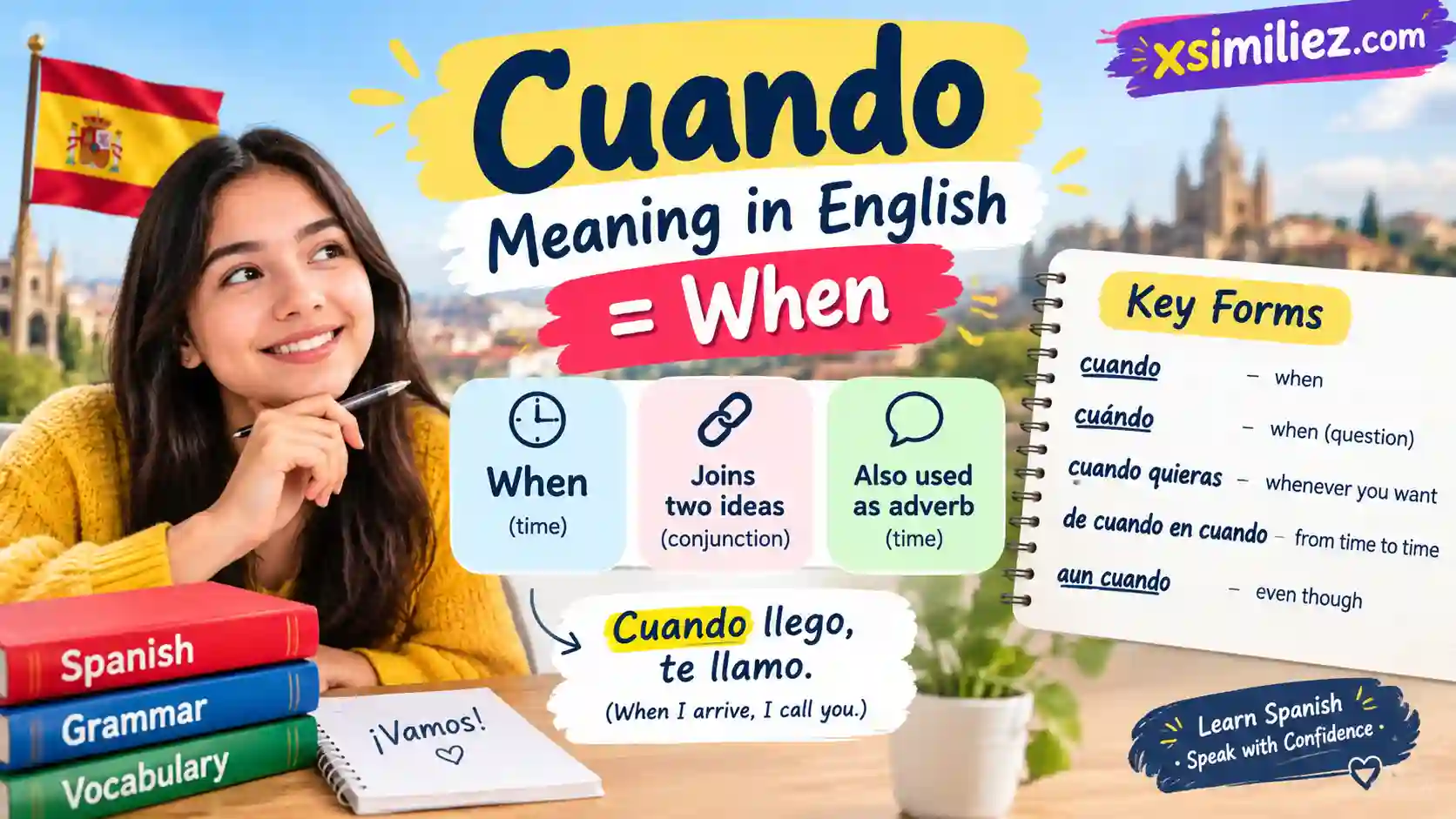
Cuando meaning in English is simple: it means “when.” Cuando is a Spanish word, not an English one. You use it to talk about time, like “when I eat” or “when she arrives.” You will see it in songs, menus, text messages, and school lessons.
Many people type this phrase into Google after hearing the word in a song or seeing it online. Some are learning Spanish. Others just want to know what a friend meant in a chat. Both reasons are good.
In this guide, you will learn the meaning, spelling, grammar, and history of cuando. You will also see easy examples, common mistakes, and helpful tips. By the end, you will use the word with confidence.
Quick Answer: Cuando Meaning in English
Cuando means “when” in English. It is a Spanish word that points to a time or a moment. If someone says “Cuando llego,” it means “When I arrive.” That is the whole idea in a nutshell.
Cuando works as a link word, called a conjunction. It joins two parts of a sentence together. It can also work like a time word on its own. The word is short, common, and easy to learn. Native Spanish speakers use it every day, at home, at school, in shops, and at work.
Here is a small table to show the main uses at a glance.
| Spanish | English | Example |
| cuando | when | Cuando llueve, me quedo en casa. (When it rains, I stay home.) |
| cuándo | when (in questions) | Cuándo vienes? (When are you coming?) |
| cuando quieras | whenever you want | Llámame cuando quieras. (Call me whenever you want.) |
| de cuando en cuando | from time to time | Lo veo de vez en cuando. (I see him from time to time.) |
| aun cuando | even though | Voy, aun cuando estoy cansado. (I go, even though I am tired.) |
Cuando Meaning in English: Definition and Pronunciation
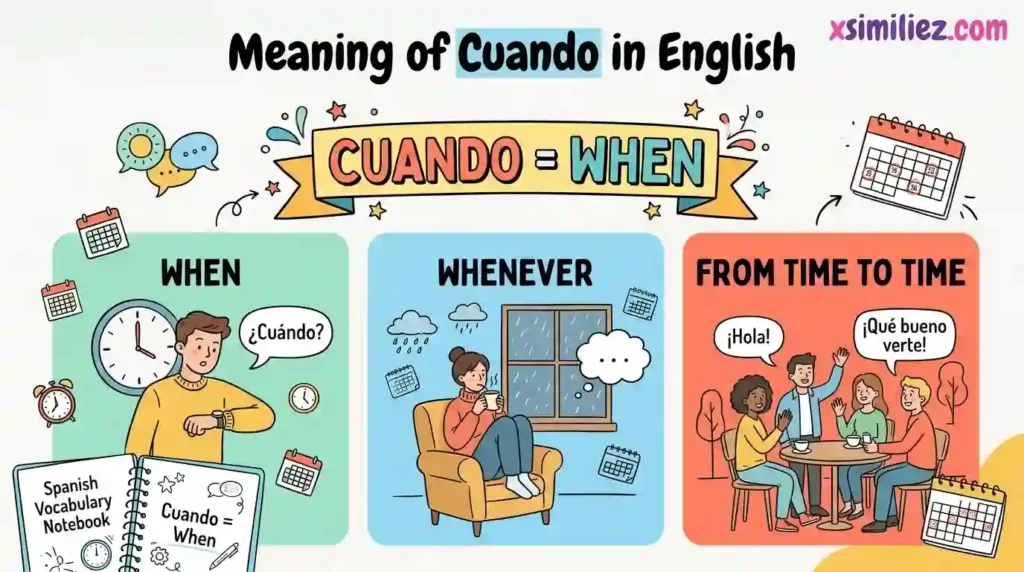
In Spanish, cuando is a conjunction. A conjunction is a small word that connects parts of a sentence, like “and” or “because.” Cuando connects an event to a moment in time. It tells the listener at what time something happens.
The main English meaning is “when.” Depending on the sentence, it can also feel like “whenever,” “while,” or “at the time that.” Sometimes it even sounds like “since” or “if.” Context is your guide. Read the whole sentence, and the right English word usually becomes clear.
To say it out loud, try “KWAN-doh.” The first part sounds like the start of “quantity.” The “d” in the middle is soft, a little like the “th” in “this.” The last sound is a short “oh,” not a long “oh-w” like English speakers often say. Say it slowly a few times, then speed up.
The table below shows the most common meanings, with a simple example for each.
| Spanish word | English meaning | Spanish example | English example |
| cuando | when | Cuando estudio, escucho música. | When I study, I listen to music. |
| cuando | whenever | Cuando quieras, vamos. | Whenever you want, we can go. |
| cuando | while, at the time | Cuando era niña, vivía en Lima. | When I was a girl, I lived in Lima. |
| cuando | if, since (less common) | Cuando tú lo dices, será verdad. | If you say it, it must be true. |
Cuando vs Cuándo: The Accent Mark Matters
One small mark can change a lot. In Spanish, “cuando” without an accent and “cuándo” with an accent are not used the same way. They sound the same, but they do different jobs.
Cuando with no accent joins ideas. It sits in the middle of a sentence. “Me llamas cuando llegues” means “You call me when you arrive.”
Cuándo with an accent asks a question or sits inside an indirect question. “Cuándo llegas?” means “When do you arrive?” Also, “No sé cuándo llega” means “I don’t know when he arrives.” The accent tells the reader that a question idea is hiding in the sentence, even if there is no question mark.
The table below shows the difference clearly.
| Form | Job | Spanish example | English meaning |
| cuando | joins two ideas | Cuando termino, te llamo. | When I finish, I call you. |
| cuándo | asks a direct question | Cuándo es tu cumpleaños? | When is your birthday? |
| cuándo | sits in an indirect question | No sé cuándo empieza. | I don’t know when it starts. |
| cuándo | used as a noun | Quiero saber el cuándo y el porqué. | I want to know the when and the why. |
A fast trick can help you. If you can swap the word with “at what time,” use the accent. If the word just links two parts, skip the accent. This trick is not perfect, but it works for most daily sentences.
Many people on phones skip accents when they type. You may see “cuando” in a text message even when the question form is meant. Do not be confused by that. Look at the whole sentence, and the meaning usually becomes clear.
Grammar and Correct Usage of Cuando
The good news is that cuando is easy to place in a sentence. It can come at the start or in the middle. When it starts the sentence, put a comma after the first part. When it sits in the middle, you usually do not need a comma. Both “Cuando llego, como” and “Como cuando llego” are fine. Both mean “I eat when I arrive.”
The tricky part is the verb that comes after it. Spanish uses different verb forms depending on the time you are talking about. Here are the three main patterns, in plain words.
First, for habits and facts, use the regular present tense. “Cuando hace frío, uso un abrigo” means “When it is cold, I wear a coat.” This is something that happens again and again, so the verb stays normal.
Second, for the past, use a past tense. “Cuando llegué, todos dormían” means “When I arrived, everyone was sleeping.” The event already happened, so there is no surprise in the verb.
Third, for the future, Spanish uses a special form called the subjunctive. “Cuando llegue, te llamo” means “When I arrive, I will call you.” The arrival has not happened yet, so Spanish treats it as uncertain. A big mistake is to say “cuando llegaré,” which sounds wrong to native speakers. After cuando, avoid the regular future tense.
If the subjunctive feels new, do not worry. Many learners take months to feel comfortable with it. Start by memorizing a few set sentences, like “Cuando puedas” (when you can) and “Cuando quieras” (when you want). They will give you a feel for the pattern.
Origin and History of Cuando
Where did cuando come from? The story is clear and fairly well known. Spanish grew out of Latin, the language of ancient Rome. The Latin word for “when” was “quando.” Over many years, the “qua” sound changed to “cua,” and that gave us “cuando.”
Look at the cousins of this word in other languages. Italian says “quando.” Portuguese says “quando.” French says “quand.” Catalan says “quan.” All of them come from the same Latin word. It is a nice example of how one old word can spread into many modern languages.
English “when” has a different path. It comes from Old English, from a word like “hwenne.” Still, language experts link “when” and the Latin “quando” to a very old shared root. That root also gave us words like “who” and “what.” So, even though cuando does not look like “when,” the two words are far-off cousins. This part of the story goes back thousands of years, so details are not always fully known. It is safest to say they share a deep family tie.
This also explains why Spanish and English question words feel alike in a hidden way. English words such as “who,” “what,” “when,” and “where” all begin with “wh.” Spanish words such as “quién,” “qué,” “cuándo,” and “cuál” often begin with “qu” or “cu.” These are two sets of relatives that took different roads.
Common Mistakes With Cuando
Learners often make a few small slips. The good news is that each one is easy to fix once you know about it.
The first mistake is mixing up cuando and cuanto. They look almost the same, but they are different words. “Cuanto” relates to amount, and it means “how much.” “Cuando” relates to time, and it means “when.” One letter changes the whole meaning. “Cuánto cuesta?” asks “How much does it cost?” But “Cuándo llega?” asks “When does it arrive?”
The second mistake is forgetting the accent in questions. Writing “Cuando vienes?” is a very common slip, even among native speakers. The correct form is “Cuándo vienes?” In casual text chats, people may forgive it. In school work or formal writing, add the mark.
The third mistake is using the future tense after cuando. Many English speakers want to say, “Cuando llegaré, te llamo.” That sounds wrong. The better sentence is “Cuando llegue, te llamo.” Remember that Spanish uses the subjunctive after cuando when the action is still to come.
The fourth mistake is thinking cuando means “where.” Some beginners confuse it with “donde,” which does mean “where.” A short memory trick helps here: “cuando” has the letter “c” like “clock,” and “donde” has a “d” like “door.” Clock for time, door for place. It is silly, but silly tricks stick.
The fifth mistake is saying the word with the wrong sound. English speakers sometimes say “kwan-doe” with a heavy “oh.” In Spanish, the final sound is shorter and cleaner. We will cover this in the tips section.
Real-Life Examples of Cuando in English
Examples make a word come alive. Here are many everyday sentences, each with the English meaning next to it. These show how often cuando appears in normal talk.
At home, a parent might say, “Cuando termines la tarea, puedes jugar.” That means “When you finish your homework, you can play.” A grandmother might say, “Cuando era joven, bailaba mucho.” That means “When I was young, I danced a lot.”
At work, a boss might say, “Avísame cuando esté listo el informe.” That means “Let me know when the report is ready.” A coworker might reply, “Cuando termine la reunión, te escribo.” That means “When the meeting ends, I will write to you.”
With friends, you might hear “Llámame cuando quieras.” That means “Call me whenever you want.” Or a friend may text, “Cuándo nos vemos?” That means “When do we meet?” These are short, simple, and very common.
Here are a few more, shown in a table so you can compare them side by side.
| Spanish sentence | English meaning | Where you might hear it |
| Cuando llueve, hay tráfico. | When it rains, there is traffic. | A city street |
| Cuando tengas hambre, dime. | When you are hungry, tell me. | A kitchen |
| Cuándo abre la tienda? | When does the store open? | A shopping trip |
| Cuando llegué, todos dormían. | When I arrived, everyone was sleeping. | A story |
| De vez en cuando voy al cine. | I go to the movies once in a while. | A chat about hobbies |
| Aun cuando llueva, iremos. | Even if it rains, we will go. | Plans for a trip |
Notice that the English side often uses “when,” but not always. Some phrases need “whenever,” “once in a while,” or “even if.” Good translators look at the full idea, not just one word at a time.
Current Usage of Cuando Today
Cuando is alive and well. It is one of the most common time words in Spanish, and it appears across all Spanish-speaking places, from Mexico to Spain to Argentina. The basic meaning stays the same everywhere, so a learner does not have to worry about big local changes.
In songs, cuando shows up often. Love songs love time words, such as “when you come back” or “when the night ends.” A well-known song called “Quando, Quando, Quando” uses the Italian spelling, but the word has the same “when” meaning. Many people search for the Spanish form after hearing it, which is one reason this topic gets so many searches.
Online, cuando is common in memes and short videos. A funny post might start with “Cuando tu amigo dice que llega en cinco minutos…” That means “When your friend says he arrives in five minutes…” This style is very popular on social media. It is the same as the English “when you…” meme style. Often the sentence is not finished, because the picture or video finishes the joke.
For English speakers, cuando also appears in bilingual signs, school books, and travel apps. People who work in customer service, health care, and education in the United States often meet it at work. Learning this one word can make a real difference in daily talks with Spanish-speaking neighbors and co-workers.
Tools like online dictionaries and translation apps handle cuando well. Still, they can miss the small accent mark or the subjunctive form. If you want to be sure, check a trusted source, such as the dictionary of the Royal Spanish Academy, called the Real Academia Española.
Tips to Remember Cuando
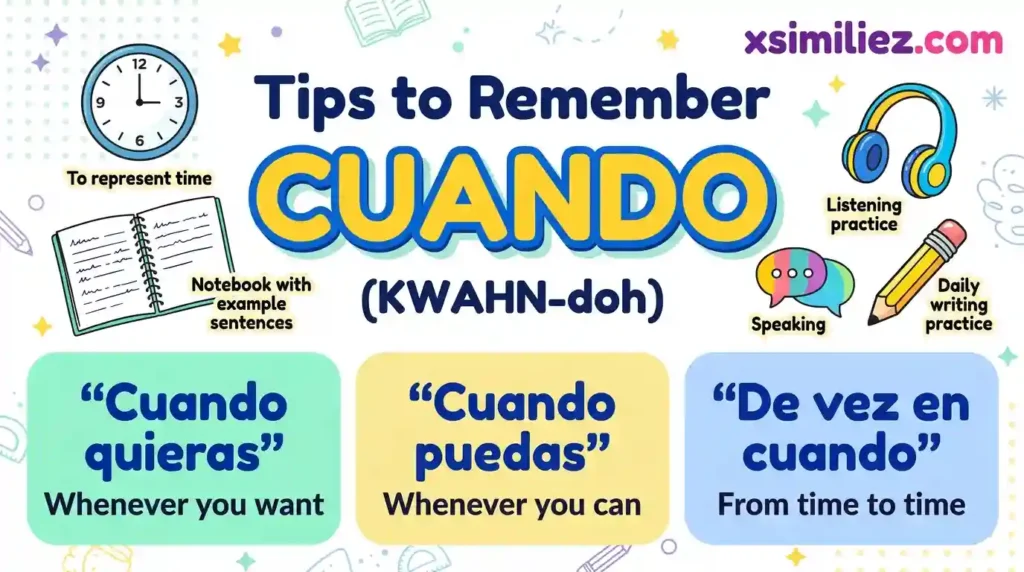
Here are some simple ways to make this word stick. Pick the ones that feel natural to you.
Start with the sound. Say “KWAHN-doh.” The first part sounds like “kwahn,” and the second part is a short “doh.” Say it out loud five times. Speaking a word helps your brain hold on to it much better than just reading it.
Next, tie it to a picture. Imagine a clock with the word “cuando” written on it. Clock means time, and cuando means when. A small mental picture works better than a long rule.
Then, learn it in chunks. Do not learn only a single word. Learn small groups, such as “cuando quieras,” “cuando puedas,” and “de vez en cuando.” These chunks help you speak without thinking too hard. They also teach you the right verb forms by feel.
Try a small daily habit, too. Each day, write one sentence using cuando. It could be about your day, your family, or your plans. “Cuando me despierto, tomo café.” That means “When I wake up, I drink coffee.” Within a month, you will have thirty sentences, and the word will feel like an old friend.
Finally, listen for it. Watch a short Spanish video or play a song. Each time you hear cuando, give yourself a point. This turns learning into a small game. You will be surprised how often the word appears.
FAQs
What does cuando mean in English?
Cuando means “when.” It is a Spanish word used to talk about time. For example, “Cuando llego” means “When I arrive.”
Is cuando a Spanish or Italian word?
Cuando is Spanish. The Italian word is “quando,” spelled with a “q.” Both come from the same Latin word and both mean “when.”
What is the difference between cuando and cuándo?
Cuando without an accent joins two ideas, like “when I finish.” Cuándo with an accent is used in questions, like “When are you coming?” The accent tells the reader a question is present.
How do you pronounce cuando?
Say “KWAHN-doh.” The first sound is like “kw,” the middle is a short “ah,” and the end is a soft “doh.” The stress falls on the first part.
Does cuando mean “whenever” too?
Yes, it can. In phrases like “Ven cuando quieras,” cuando means “whenever.” The meaning depends on the full sentence, so always look at the words around it.
Why do Spanish speakers use the subjunctive after cuando?
They use it when the action has not happened yet. “Cuando llegue” means the arrival is still in the future. For past events and habits, the normal verb form is used instead.
Conclusion
Now you know that cuando means “when.” It is a small word with a big job. It links ideas, asks questions, and shows time. It also appears in fun phrases like “de vez en cuando,” which means “once in a while.”
We also saw that the accent mark matters. Cuando joins ideas, and cuándo asks questions. We learned that the word comes from the Latin “quando,” which is why it looks like its cousins in Italian, Portuguese, and French. And we looked at common mistakes, like mixing it up with “cuanto,” so you can avoid them.
The best next step is practice. Write one sentence a day, say it out loud, and listen for the word in songs and videos. Start with easy chunks such as “cuando quieras” and “cuando puedas.” Little by little, cuando will feel natural, and your Spanish will grow with it.

Hi, I’m Harper Blake, and I write for Xsimiliez.com. I enjoy sharing clear and friendly simile examples that students and beginners can understand easily. My goal is to make English learning simple and enjoyable.