On another note meaning is simple: the phrase tells your reader or listener that you are changing the topic. People use it to move from one subject to a new one. It works like a small bridge between two ideas. You can use it in emails, speeches, texts, and everyday talk.
Why do so many people search for this phrase? Because it shows up everywhere. You may see it in a work email, a news show, or a friend’s message. It sounds smart, but the rules can feel unclear. Is it formal? Is it rude? Can you use it in a text?
This guide answers all of that in plain words. You will learn the meaning, the correct use, common mistakes, and real examples. You will also get tips to sound natural every time.
Quick Answer: On Another Note Meaning in One Minute
On another note meaning, in the shortest form, is “let’s talk about something different now.” That is the whole idea. You finish one subject, and you start a new one.
The phrase is a “transition.” A transition is a word or group of words that helps you move from one thought to the next. Think of it like a road sign. It tells the reader, “We are turning here.”
Here is a quick example. Imagine you are writing to your team. First, you talk about a sales report. Then you want to mention the office party. You could write, “The sales report is done. On another note, the office party is on Friday.”
The words “on another note” tell your team that the topic has changed. They do not have to guess. That is why the phrase is so handy. It keeps your message clear and smooth.
One more thing to remember: the new topic does not have to be unrelated. Sometimes it is only a little different. Other times it is totally new. The phrase works in both cases.
On Another Note Meaning and Definition
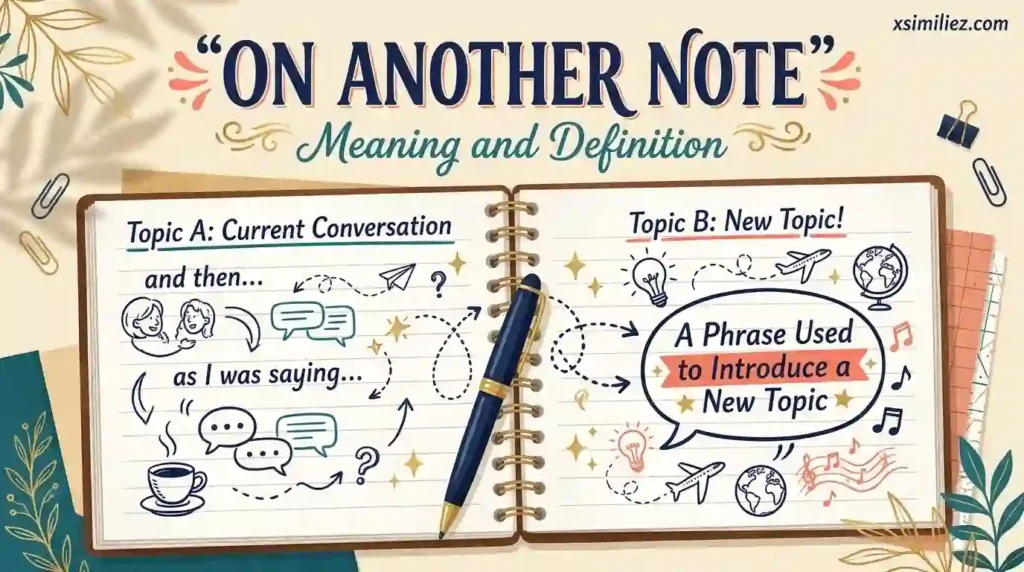
Let’s break the phrase into partsThe word “on” points to a spot or a subject, “another” means a different one, and “note” here means a point, a topic, or a thing worth mentioning. Put them together, and you get “on a different point.”
So the full definition looks like this: “On another note” is a phrase used to shift a conversation or a piece of writing to a new topic.
Most dictionaries treat it as an idiom or a “discourse marker.” Those are fancy names. A discourse marker is just a small phrase that guides the flow of talk. Other examples are “by the way,” “speaking of,” and “anyway.”
The tone of “on another note” is fairly neutral. It is not too stiff, and it is not too casual. That is one reason people like it. You can use it with your boss, your teacher, or your friend, and it usually fits.
It also carries a polite feeling. When you say it, you are showing respect for the old topic. You are saying, “We are done with that, and here is something new.” That is gentler than just jumping to a new subject with no warning.
Here is a small table that shows how the phrase compares with close cousins.
| Phrase | Simple Meaning | Tone |
| On another note | Moving to a different topic | Neutral |
| On a different note | Moving to a different topic | Neutral |
| On a side note | Adding a small extra point | Casual |
| By the way | Adding something that just came to mind | Casual |
| Speaking of | Linking to something just mentioned | Casual |
| Moving on | Leaving the old topic behind | Neutral |
As you can see, “on another note” and “on a different note” mean nearly the same thing. The others have small shades of difference, which we will cover later.
Grammar and Correct Usage of “On Another Note”
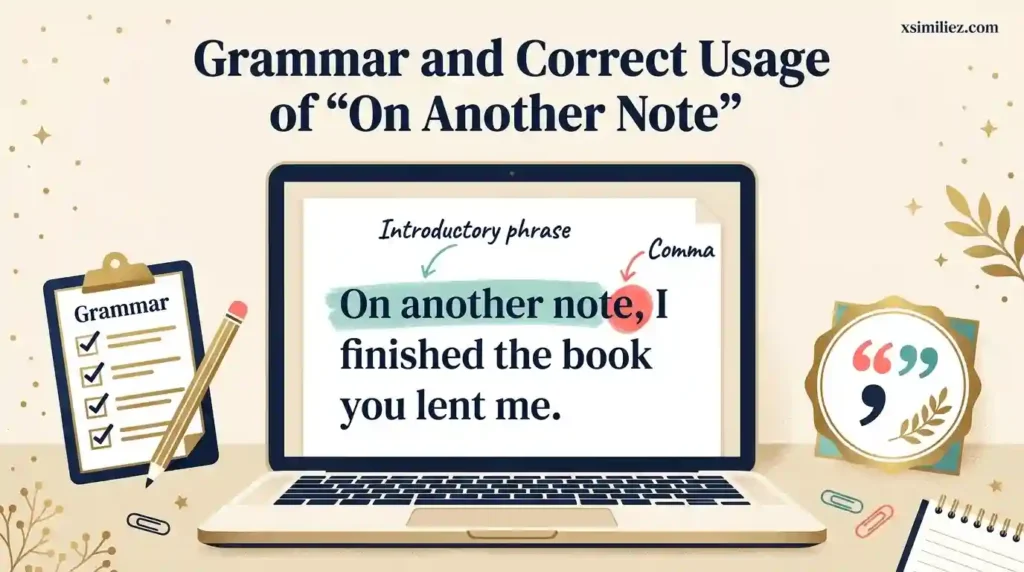
Good news: the grammar is easy. “On another note” is an introductory phrase. It usually sits at the start of a sentence. After it, you put a comma.
Here is the pattern: On another note, + new topic.
For example: “On another note, I finished the book you lent me.” The comma after “note” gives the reader a tiny pause. It also keeps the sentence neat.
Capital letters matter too. When the phrase starts a sentence, capitalize the first word. So write “On another note,” with a big “O.” If it comes in the middle of a sentence, keep it small. This is rare, but it happens. For example: “I could talk about prices all day, but, on another note, I have news.”
You can also place it after a period, a dash, or even a paragraph break. In long emails, many people start a new paragraph with it. That makes the shift easy to see.
The phrase does not need a special verb or tense. It simply introduces the next sentence. That sentence can be in any tense. “On another note, we moved last week.” “On another note, we are moving next week.” Both work.
Be careful about one thing: do not stack too many transitions together. Writing “Anyway, on another note, by the way,” sounds clumsy. Pick one. Your reader will thank you.
Also, keep the phrase honest. Use it when the topic really changes. If the new idea is closely tied to the old one, a different phrase, like “also” or “in addition,” may fit better.
Origin of “On Another Note”: What We Know
Many readers ask where the phrase came from. The honest answer is that there is no clear record of who first said it or when. No trusted source names a single starting point, so we should not invent one.
What we can say is this. The word “note” has many meanings in English.The word can mean a short written message, a sound in music, or a point or idea in a talk, like “a note of caution.”
The phrase seems to use that last meaning, where “note” stands for a topic or point.
Some people guess that the phrase may have grown from the music idea. In music, you can shift from one note to another. That could fit the picture of changing topics. But this is only a guess. There is no solid proof for it.
Similar phrases, like “on a different note” and “on a lighter note,” follow the same pattern. They also use “note” to mean a point or a mood. This tells us the pattern is common in modern English.
So the safe takeaway is that “on another note” is a natural, everyday phrase with a clear meaning. Its exact birth date is unknown. If a website gives you a very exact story about its origin, be careful. Check the source before you trust it.
On Another Note Meaning in British vs American English
Does the phrase change across the ocean? Not really. People in the United States and the United Kingdom both use “on another note.” The meaning stays the same, and the grammar stays the same.
There are small differences in taste, though. In the U.S., people often use “on another note” in emails, speeches, and news talk. It feels clear and friendly. In British English, you may hear “on a different note” a little more, along with phrases like “right, moving on” or “on a separate matter.” These are habits, not rules.
Spelling is not an issue here, since none of the words have different spellings. Punctuation is also the same, with a comma after the phrase.
Here is a simple table to show the small differences in style.
| Feature | American English | British English |
| Meaning of “on another note” | Changing the topic | Changing the topic |
| Common alternative | On a different note | On a different note, on a separate matter |
| Typical setting | Emails, talks, texts | Emails, talks, meetings |
| Punctuation | Comma after phrase | Comma after phrase |
| Tone | Neutral and friendly | Neutral and polite |
The big lesson is that you do not need to worry. If you write for a U.S. reader or a U.K. reader, the phrase works. Just keep your tone fitting for the situation.
Common Mistakes With On Another Note Meaning
Even simple phrases can trip us up. Here are the mistakes people make most often with the on another note meaning and how to fix them.
The first mistake is using it when the topic has not changed. If you are still talking about the same thing, the phrase will confuse your reader. They will expect something new and get more of the old.
The second mistake is forgetting the comma. “On another note I have news” looks a bit rough. Add the comma after “note.”
The third mistake is using it for sad or serious shifts without care. Imagine someone shares bad news, and you reply, “On another note, what’s for lunch?” That can feel cold. In emotional moments, take a pause or use a softer lead-in.
The fourth mistake is using it too often. If every second paragraph starts with the phrase, it loses its power. It starts to sound like a habit.
The fifth mistake is mixing it up with “on the other hand.” These two are not twins. “On the other hand” shows a contrast within the same topic. “On another note” starts a new topic.
Here is a table to make these fixes clear.
| Mistake | Weak Example | Better Example |
| Topic did not change | “I love pizza. On another note, pizza is great.” | “I love pizza. It is great with extra cheese.” |
| Missing comma | “On another note I got a new job.” | “On another note, I got a new job.” |
| Cold timing | “I’m so sorry you’re sick. On another note, can you send the file?” | “I’m so sorry you’re sick. Rest up. When you feel better, please send the file.” |
| Mixed with “on the other hand” | “On another note, cats are calm, but dogs are active.” | “On the other hand, dogs are active.” |
| Overuse | Using it three times in one email | Use it once, then use simple links like “Also” |
Avoid these five slips, and your writing will feel much smoother.
Real-Life Examples of On Another Note
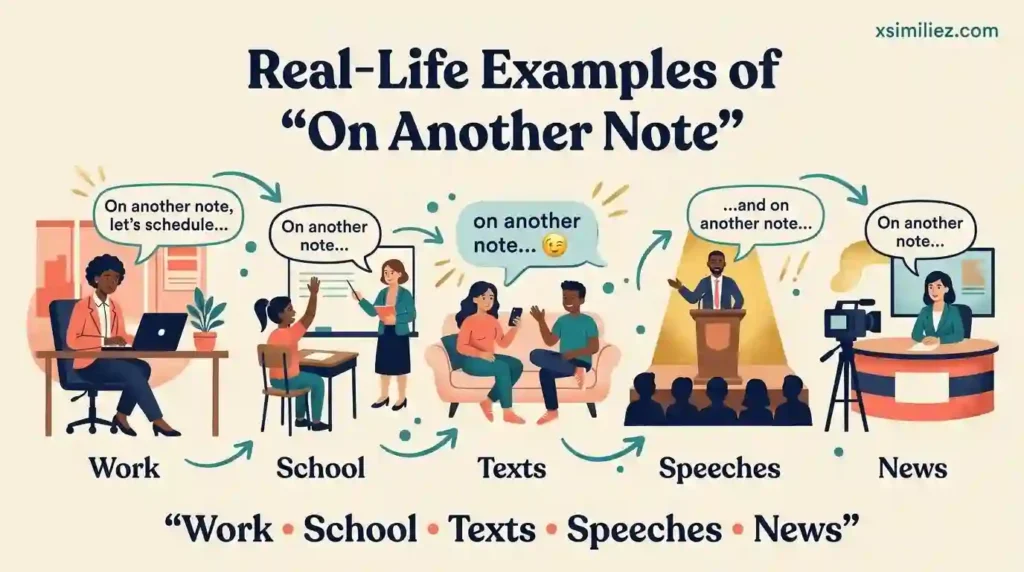
Examples make everything clearer. Let’s look at how people use the phrase in daily life.
At work. Say you are writing a team update. You might say, “The budget meeting went well. On another note, please send me your holiday dates by Monday.” The first part covers the budget. The second part moves to holiday dates. The phrase tells the team a new task has started.
In school. A teacher might say, “Great job on the science quiz, everyone. On another note, don’t forget the field trip forms.” The class understands that the quiz talk is over.
In a text with a friend. You might write, “Congrats on the new puppy On another note, are we still on for Saturday?” It feels easy and natural.
In a speech. A speaker could say, “Thank you all for supporting our fundraiser. On another note, we need volunteers for next month.” The audience gets a clear signal that a new point is coming.
In the news. A news host may finish a weather report and say, “That’s the forecast for today. On another note, a new library is opening downtown.” This is a classic use. It moves the show from one story to the next.
In a blog or article. Writers use it to start a new section. For instance: “That covers how to save money on groceries. On another note, let’s talk about saving on gas.”
Notice something in all these examples. The first idea ends before the phrase appears. Then the new idea begins with a clear, fresh subject. That is the heart of good use.
You can also use the phrase to add a lighter or happier thought after a heavy one. For example: “The storm caused a lot of trouble. On another note, the neighbors are holding a cleanup day, and everyone is welcome.” Here, the shift helps point toward something helpful.
Current Usage and Trends of “On Another Note”
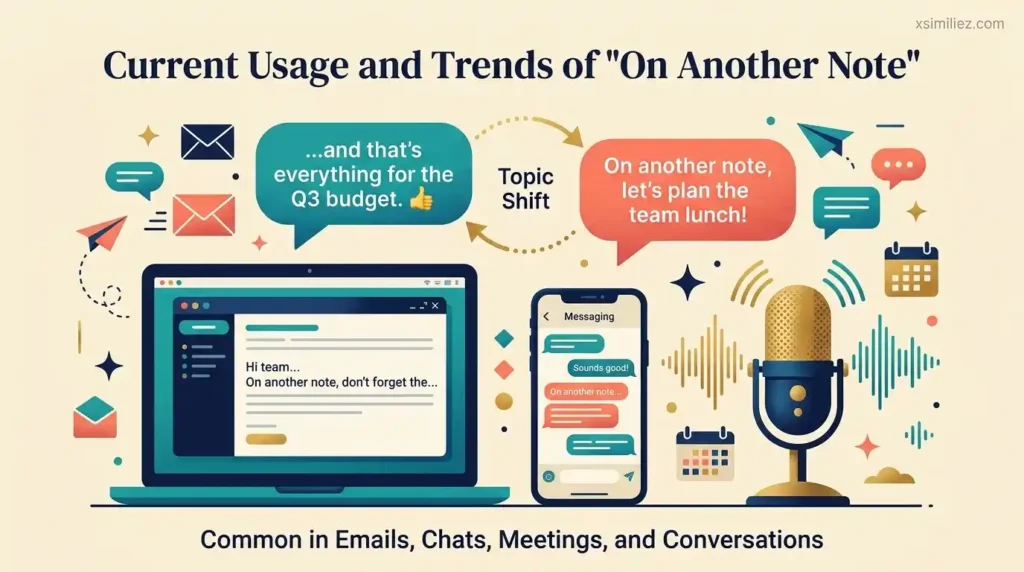
Today, “on another note” is very common in written English. You see it in work emails, online posts, newsletters, and chat messages. It fits the fast pace of modern life, where we jump between topics often.
Email is probably the biggest home for the phrase. Workers handle many subjects at once. A short transition helps the reader follow along. It is quick, clear, and polite.
Social media and messaging apps have also helped the phrase spread. People use it to switch topics in a long thread. Sometimes they shorten the thought to “on another note” and then add a new message. It is a handy way to keep a chat tidy.
In spoken English, you will hear it in meetings, podcasts, interviews, and TV shows. Hosts love it because it keeps the show moving.
There is one more trend worth noting. Many style coaches suggest using fewer filler transitions, since too many can make writing feel stiff. That does not mean you should stop using this phrase. It means you should use it with purpose. A good rule is to use it only when a real shift happens.
We do not have exact numbers on how often people use the phrase, so we will not make any up. But from everyday reading and listening, it is clearly a normal and accepted part of modern English. It is not slang, and it is not old-fashioned. It sits in a comfortable middle spot.
Tips and Best Practices for Using On Another Note
Ready to use the phrase like a pro? Here are practical tips that work.
Start by asking yourself, “Did the topic really change?” If yes, go ahead. If not, pick a simpler link such as “also,” “next,” or “then.”
Think about the mood of the moment. If the old topic was happy or neutral, the phrase fits well. If it is sad or serious, slow down. Maybe add a kind sentence first, or wait until later to change the subject.
Keep the shift smooth. A good way to do this is to end the old topic with a clear closing line. Then use the phrase. Then give a clear opening line about the new topic. That three-step flow helps readers feel safe.
Match the phrase to your audience. For a very formal letter, you might choose “Regarding another matter” or “Separately,” while “on another note” is perfect for a friendly email and “by the way” may be even better for a quick chat.
Do not use it more than once or twice in a short piece. Variety keeps writing lively. You can swap in other phrases when needed, like “on a different note,” “moving on,” “meanwhile,” or “turning to.”
Read your writing out loud. If the phrase sounds natural when you say it, it will likely read well too. If it sounds odd, try cutting it. Sometimes a new paragraph is enough to show a change.
Finally, keep your sentences short after the phrase. A long, tangled sentence right after the shift can confuse people. Start with a simple one. Then build from there.
FAQs
What does “on another note” mean?
It means you are moving to a new or different topic. It acts like a signal that tells the reader or listener the subject is about to change.
Is “on another note” formal or informal?
It sits in the middle. It is neutral, so you can use it in work emails, school, speeches, and friendly chats. For very formal papers, you might pick a phrase like “separately” or “regarding another matter.”
Do I need a comma after “on another note”?
Yes, in most cases. When the phrase starts a sentence, put a comma right after it. For example: “On another note, I have good news.”
Is “on another note” the same as “on a different note”?
Yes, they mean almost the same thing. Both shift the topic. People use them in the same ways, and you can swap one for the other without changing the meaning.
Can I use “on another note” in a text message?
Absolutely. It works well in texts, especially when you want to change the subject without sounding harsh. Just be kind if the last topic was sad or serious.
What can I say instead of “on another note”?
You can use “on a different note,” “by the way,” “speaking of,” “moving on,” “meanwhile,” or “separately.” Choose the one that matches your tone and your reader.
Conclusion
On another note, meaning is easy to remember: it means you are changing the topic. It is a small phrase with a big job, guiding your reader from one idea to the next without confusion.
To use it well, follow a few simple rules. Make sure the topic truly changes. Add a comma after the phrase. Be gentle when the last topic was heavy. Avoid using it too often, and do not mix it up with “on the other hand.”
Next time you write an email, a message, or a speech, try the phrase where it fits. Read it out loud and see how it flows. With a little practice, you will use it naturally, and your writing will feel clear, smooth, and friendly.

Hi, I’m Harper Blake, and I write for Xsimiliez.com. I enjoy sharing clear and friendly simile examples that students and beginners can understand easily. My goal is to make English learning simple and enjoyable.