The voulez-vous meaning is easy to learn. It is French for “do you want” or “would you like.” You say it as “voo-lay voo,” and you use it to ask one person politely, or a group of people, if they want something. It also became world famous thanks to a hit ABBA song.
Why do so many people search for it? Some heard it in a song. Others are learning French and keep seeing it in class or at a café. A few just want to know if it is safe to say out loud. That matters, because tone changes everything.
In this guide, you will learn what each word means, how to say it, and how the grammar works. You will also see where it comes from, how ABBA used it, and which mistakes to avoid.
Quick Answer: Voulez-Vous Meaning in English
Voulez-vous means “do you want?” in English. In many cases, “would you like?” sounds even more natural. French speakers use it when they talk to someone they should treat with respect, such as a customer, a teacher, an older person, or a new coworker. They also use it when they talk to more than one person.
Here is the short version. “Voulez-vous du thé?” means “Do you want some tea?” or “Would you like some tea?” “Voulez-vous venir?” means “Do you want to come?” The phrase is a question, so it almost always ends with a question mark and a rising voice.
The tone depends on the moment. Asking a guest if they want water is kind and polite. Using the same phrase in a flirty way, like in a song, is something else. We will talk about that later, because it is the main reason people get confused.
Voulez-Vous Meaning and Definition Word by Word
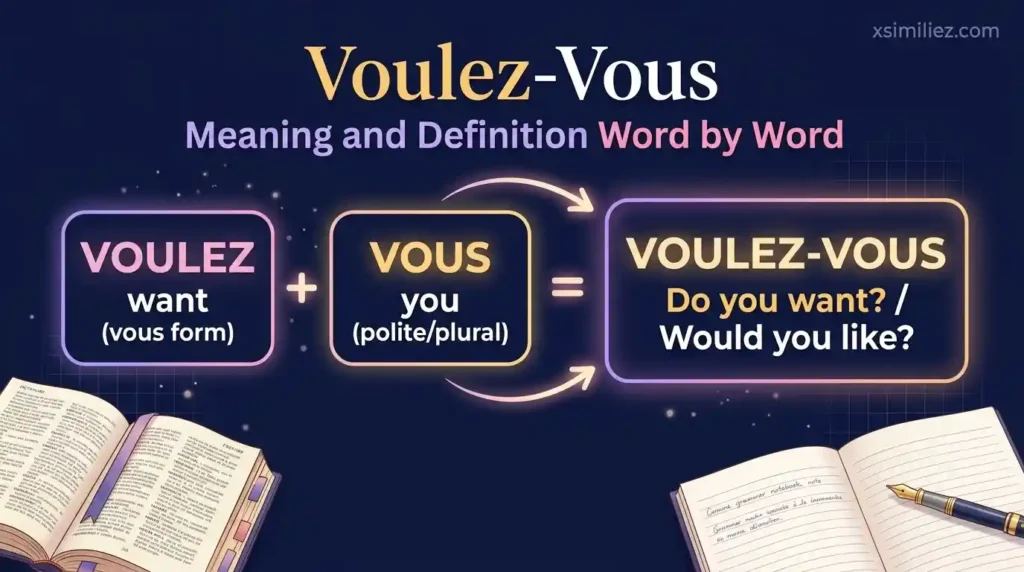
Voulez-vous has two small words joined by a hyphen. The first word is voulez. It comes from the verb vouloir, which means “to want.” The second word is vous, which means “you.” Put them together, and you get a question: “Do you want to?”
The word vous is special. It can mean “you” for one person you should speak to with respect. It can also mean “you all” for a group. That is why voulez-vous works for both a single stranger and a whole table of friends.
The table below breaks the phrase into parts so you can see how it works.
| Part | Meaning | Simple Note |
| Voulez | You want (from vouloir) | The verb form for “vous” |
| Vous | You (polite, or more than one person) | Moved after the verb to make a question |
| The hyphen (-) | Joins the verb and the word “vous” | Needed in this question style |
| Whole phrase | Do you want to? / Would you like to? | Used for polite offers and questions |
A good French dictionary, such as Larousse or Collins, lists this phrase under the verb vouloir. That is the best place to look if you want to see more forms and examples.
Grammar and Correct Usage of Voulez-Vous Meaning
To use voulez-vous the right way, it helps to know the verb vouloir. It is one of the most common verbs in French, and it changes shape for each person. Here is the present tense.
| Person | French | English |
| I | je veux | I want |
| You (friend, one person) | tu veux | you want |
| He / she | il veut / elle veut | he wants / she wants |
| We | nous voulons | we want |
| You (polite or group) | vous voulez | you want |
| They | ils veulent / elles veulent | they want |
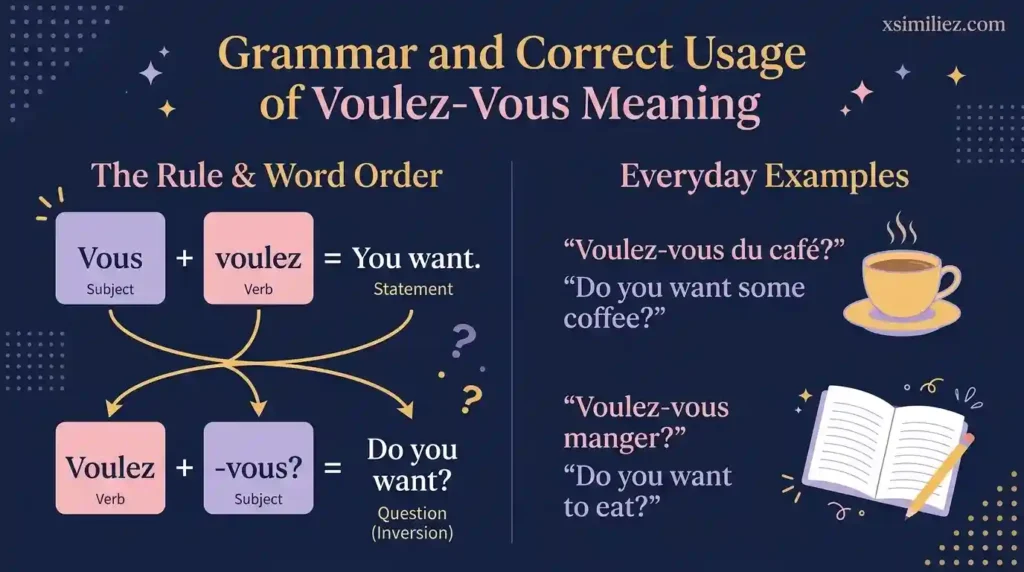
Notice that “vous voulez” is the normal statement: “You want.” To turn it into a question in careful French, you flip the order. “Vous voulez” becomes “voulez-vous.” This flip is called inversion, and the hyphen shows that the two words belong together.
After voulez-vous, you can add a verb or a thing. With a verb, use the short “to” form, called the infinitive: “Voulez-vous manger?” means “Do you want to eat?” With a thing, you often add du, de la, or des: “Voulez-vous de la soupe?” means “Do you want some soup?”
There are also other ways to ask the same question. The table shows how the tone changes.
| Style | French Example | Best Used With |
| Careful and polite | Voulez-vous du café ? | Guests, customers, strangers |
| Extra polite | Voudriez-vous du café ? | Very formal moments |
| Everyday spoken | Vous voulez du café ? | Most polite chats |
| Everyday spoken, with a helper | Est-ce que vous voulez du café ? | Classes, daily life |
| Friendly | Tu veux du café ? | Friends, family, kids |
A quick tip about sound: the final “z” in voulez is silent. Say “voo-LAY,” not “voo-LEZ.” Then add “voo,” and you are done.
Origin and History Behind Voulez-Vous Meaning
The roots of this phrase go back to Latin. The French verb vouloir comes from Latin, where the idea of wanting was shown by the verb velle and its later forms, such as volere. Over many years, Latin slowly turned into French, and the sounds and spellings changed along the way.
The word vous also comes from Latin. It grew out of the Latin word vos, which meant “you” for more than one person. In French, this plural word later took on a second job. People began using it to show respect to one person, too. That is why French has both tu and vous today.
The question style with a hyphen is also old and well known. It is taught in schools as the careful, formal way to ask a question in French. Writers, teachers, and news presenters still use it often.
There is no single date when voulez-vous was “invented,” and it would be wrong to guess one. It is simply a normal part of the French verb system, like “do you want” is in English. What made it famous outside of France was music, not grammar.
Voulez-Vous Meaning in the ABBA Song and Pop Culture
For many people, the phrase is tied to the Swedish pop group ABBA. Their song “Voulez-Vous” came out in 1979 and shares its name with their album from the same year. It is a disco song, built for dancing, and it is still played at parties around the world.
In the song, the phrase works as a playful, flirty question. Think of it as a friendly invitation to join the fun on the dance floor. The idea is more about a night out and a spark between people than about ordering a drink or asking for directions.
Other songs have also used French questions to sound romantic or bold. One famous example is the 1974 song “Lady Marmalade,” which made a very forward French question known to many English speakers. That question has a much stronger meaning than a simple “Do you want a cup of tea?” and it is not polite to say to a stranger.
This is why the context matters. In a song, the phrase can feel exciting. In a café, the same two words feel calm and polite. Both uses are real, but they are different moods.
Common Mistakes With Voulez-Vous Meaning
Learners often make small errors with this phrase. The good news is that they are easy to fix once you know them. Here are the most common ones.
| Mistake | Why It Is a Problem | Better Choice |
| Writing “voulez vous” with no hyphen | The hyphen shows the question flip | Voulez-vous |
| Saying “voo-LEZ” | The final “z” is silent | voo-LAY voo |
| Using it with a close friend | It can sound stiff | Tu veux ? |
| Saying “Est-ce que voulez-vous” | You are making the question twice | Est-ce que vous voulez or Voulez-vous |
| Thinking it always means flirting | It is usually just polite | Check the situation |
| Translating it as “want you” | The word order is different in English | Do you want to? |
The “double question” mistake is a sneaky one. You can use est-ce que or you can flip the words, but doing both at the same time is not correct. Pick one way and stay with it.
Another mistake is using the phrase in a way that sounds more personal than you meant. If you only want to offer help, add a clear thing or action after it, like “Voulez-vous de l’aide ?” That tells the listener exactly what you are asking, and it keeps the tone friendly and clean.
Real-Life Examples of Voulez-Vous Meaning
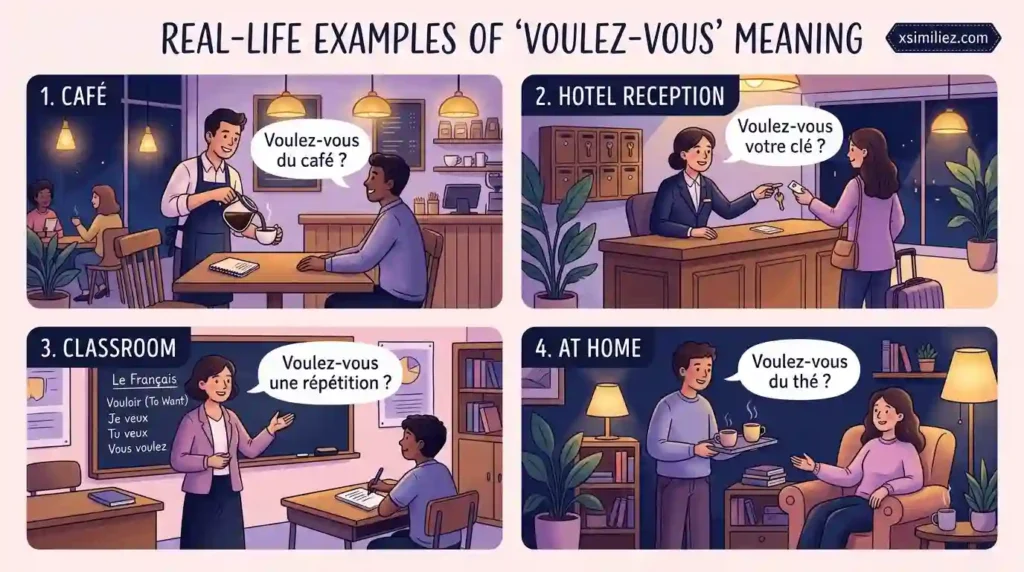
Examples make a phrase stick, so here are some you can picture in daily life. In a restaurant, a server might ask, “Voulez-vous voir le menu ?” That means, “Do you want to see the menu?” It is polite and normal, and it is just what a good server would say.
At a hotel, a worker might ask, “Voulez-vous une chambre avec vue ?” That means, “Would you like a room with a view?” At school, a teacher could say, “Voulez-vous répéter, s’il vous plaît ?” That means, “Would you like to repeat that, please?”
At home, you might host a guest and ask, “Voulez-vous vous asseoir ?” That means, “Would you like to sit down?” At work, a coworker could ask, “Voulez-vous un rendez-vous demain ?” That means, “Do you want a meeting tomorrow?”
In a group, the same phrase works for many people. Imagine you are at a party with five guests. You can say, “Voulez-vous de la musique ?” and everyone understands you are talking to all of them. This is one of the nicest things about vous: it handles one respected person and a crowd with the same words.
There is also the music side. If you hear “Voulez-vous” at a dance party, nobody is offering you soup. They are playing the ABBA hit, and the crowd is probably about to sing along.
Tips and Best Practices for Using Voulez-Vous
First, match the phrase to the person. If you do not know someone well, or the person is older than you, voulez-vous is a safe choice. If you are with friends or kids, “tu veux” sounds warmer and more natural.
Second, add a clear thing or action. “Voulez-vous” by itself is only half a question. Add words like du café, de l’eau, venir, or commencer, and the meaning becomes clear right away. This also protects you from sounding too forward.
Third, be kind with your voice. French questions often rise a little at the end. A warm smile and a soft tone do as much work as the grammar does.
Fourth, practice out loud. Say “voo-lay voo” five times, then add an easy ending, such as “voo-lay voo de l’eau.” Saying it with your mouth helps more than just reading it.
Finally, if you want to sound extra polite, try “voudriez-vous,” which is closer to “would you like.” It is a little longer, but it makes a great first impression in shops, hotels, and offices.
FAQs
What does voulez-vous mean in English?
It means “do you want?” or “would you like?” It is a polite question that you ask one respected person or a group.
How do you say voulez-vous?
Say “voo-lay voo.” The “z” at the end of voulez is silent, so do not add a “z” sound. Keep both parts short and smooth.
Is voulez-vous formal or informal?
It leans formal, because it uses vous. It is great for strangers, customers, and older people. With friends and family, most people say “tu veux” instead.
What is the difference between voulez-vous et que veux tu?
Both mean “do you want,” but the tone is different. Voulez-vous is polite and careful, while tu veux is friendly and relaxed. The first uses vous, and the second uses tu.
Does voulez-vous always mean something romantic?
No. In normal life, it is just a polite way to offer or ask something. The flirty feeling comes from songs and from other words added after it, not from the two words alone.
What does voulez-vous mean in the ABBA song?
In the song, it is a playful invitation, like asking someone if they want to join the fun and dance. The mood is lively and flirty, and the song comes from the late 1970s disco era.
Conclusion
Now you know the voulez-vous meaning from start to finish. It is French for “do you want” or “would you like.” It is made of the verb voulez and the word vous, joined with a hyphen to make a polite question.
You have also seen how the grammar works, where the words come from, and how the ABBA song made the phrase famous. The big lesson is that tone matters. In a café, it is polite and normal. In a disco song, it is playful and bold.
So here is a simple plan. Use voulez-vous with people you should treat with respect, add a clear thing or action after it, and say “voo-lay voo” with a warm smile. Practice a few of the examples above, and soon the phrase will feel as natural as saying “would you like” in English.

Hi, I’m Harper Blake, and I write for Xsimiliez.com. I enjoy sharing clear and friendly simile examples that students and beginners can understand easily. My goal is to make English learning simple and enjoyable.