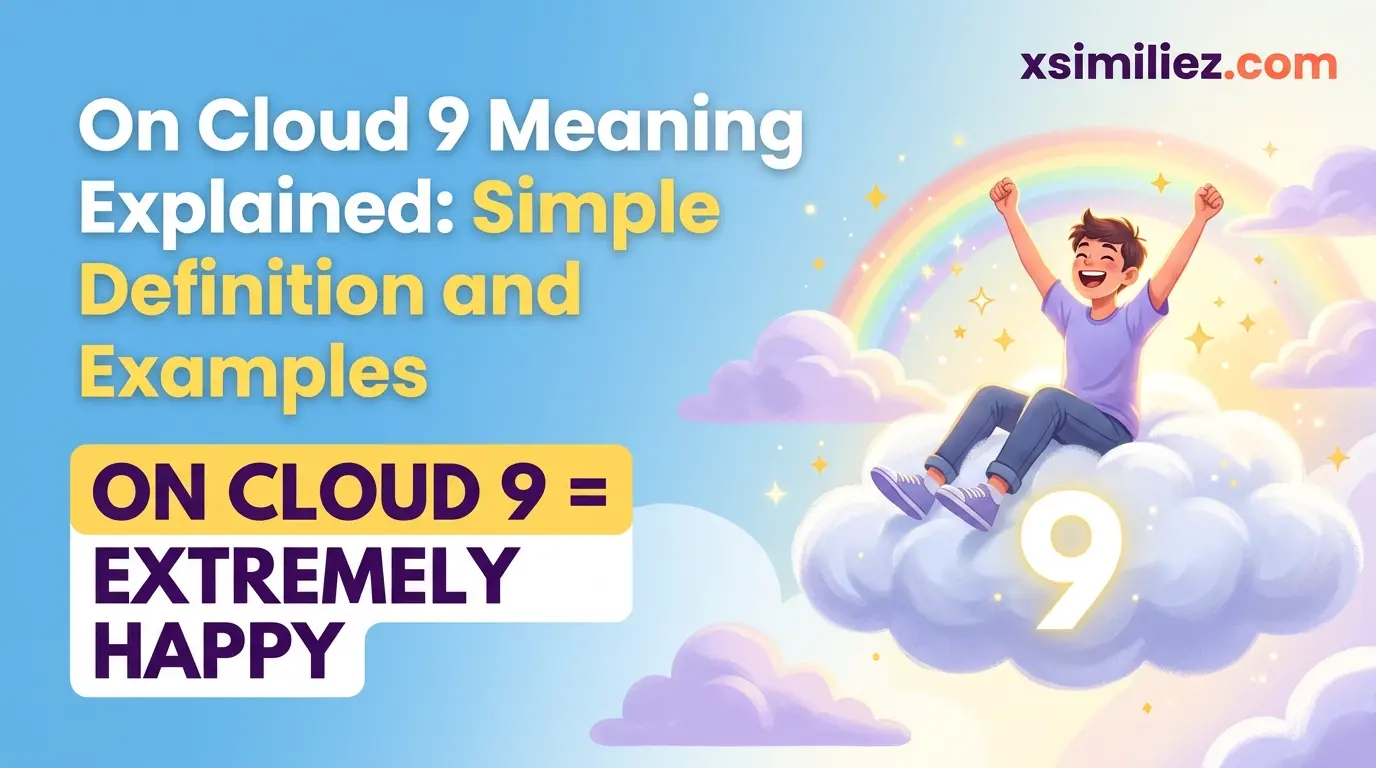
On cloud 9 meaning is simple: it describes a person who feels extremely happy, as if floating high above the world. People say it after great news, a big win, or a dream come true. It is a warm, upbeat idiom that Americans use every day.
You may have heard it in a movie, a song, or a chat with a friend. Maybe you wondered why clouds have anything to do with joy. That curiosity is why so many people search for this phrase.
In this guide, you will learn what the phrase means, how to use it, and where it may have come from. You will also see common mistakes, real examples, and answers to popular questions.
Quick Answer: On Cloud 9 Meaning in One Sentence
To be “on cloud 9” means to feel very, very happy. The happiness is usually strong and joyful, and it often comes from something good that just happened. Think of the feeling you get when you pass a hard test, get a big surprise, or hear the words “you got the job.”
It is an idiom, so it is not about real clouds. Nobody is standing on a cloud or flying in the sky. The phrase uses a picture of floating high above your problems to show how light and joyful you feel.
You can say it about yourself (“I’m on cloud 9”) or about someone else (“She’s been on cloud 9 all week”). It works in casual talk, in friendly emails, and in many kinds of stories.
On Cloud 9 Meaning and Definition
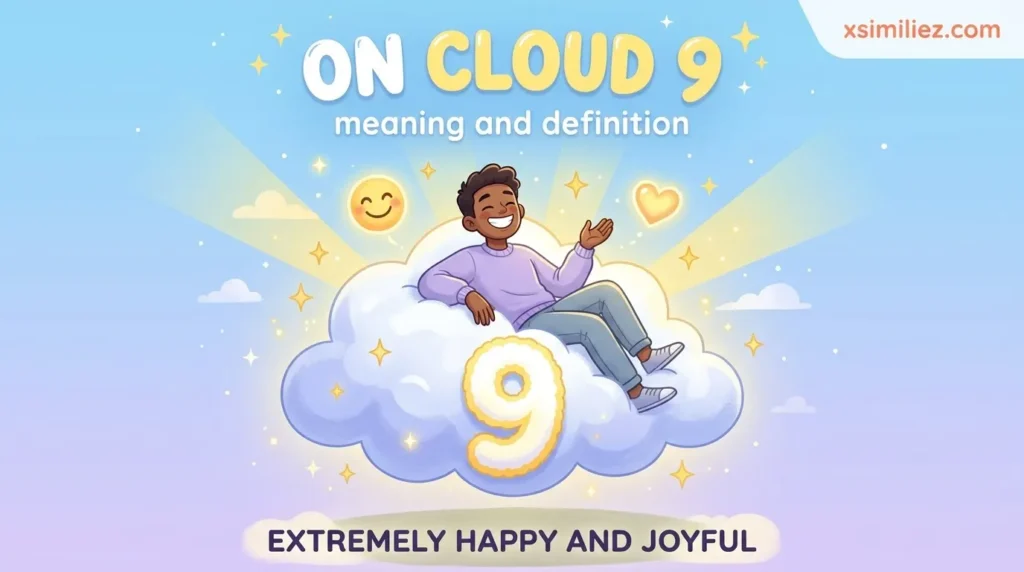
Dictionaries explain this idiom in a few short words. They say it means being in a state of great happiness, joy, or delight. The key idea is that the feeling is more than just “okay” or “pretty good.” It is a high, glowing kind of happiness.
Picture a child who just got a puppy. The child smiles all day, talks about nothing else, and can hardly sit still. That child is on cloud 9. The same goes for a bride at her wedding, a player who wins the big game, or a parent who holds a newborn baby for the first time.
There are two small ideas hidden inside the phrase. The first is height. Being up in the clouds suggests you are above worry, stress, and boring everyday things. The second is lightness. A person on a cloud feels soft, free, and weightless, just like a happy heart.
The feeling is also often temporary. Most people use the phrase for a moment or a short stretch of time, like an hour, a day, or a week. If someone is calm and content for years, you would more likely say they are “at peace” or “satisfied” with life.
Here is a quick look at how this idiom compares with other happy phrases. The table shows the strength of each one and when you might use it.
| Phrase | Meaning | Strength of Feeling | Best Time to Use It |
| On cloud 9 | Extremely happy, floating with joy | Very strong | After amazing news or a big success |
| Over the moon | Delighted and thrilled | Very strong | Hearing great news |
| Walking on air | Feeling light and joyful | Strong | After a happy event |
| Tickled pink | Pleased and amused | Medium | Small, fun surprises |
| Happy as a clam | Calm and content | Mild to medium | Relaxed, peaceful moments |
| In seventh heaven | Perfect, deep happiness | Very strong | Dream-like moments |
As you can see, “on cloud 9” sits near the top of the happiness scale. It is one of the strongest ways to say you feel great without using plain words like “very happy.”
How to Use On Cloud 9 Correctly in a Sentence
Grammar for this idiom is easy once you know the basic pattern. The most common form is a “be” verb plus “on cloud 9.” The “be” verb changes with the time and the person. You will often see “am,” “is,” “are,” “was,” and “were.”
For example, “I am on cloud 9” talks about right now. “He was on cloud 9 after the concert” talks about the past. “We will be on cloud 9 when the baby arrives” looks ahead to the future. The phrase itself never changes.
Another common pattern uses the verb “feel.” You can say, “I feel like I’m on cloud 9.” This version adds the word “like,” and it is a bit softer. It tells the listener that the feeling is so strong, it seems unreal.
You can also use verbs such as “stay,” “keep,” or “remain” when a happy mood lasts a while. A sentence like “She stayed on cloud 9 for days” shows that the joy did not fade fast.
The table below shows the most common ways to build sentences with this idiom.
| Pattern | Example Sentence | When It Fits |
| Subject + be + on cloud 9 | “Mia is on cloud 9 today.” | Simple facts about a mood |
| Subject + feel like + on cloud 9 | “I feel like I’m on cloud 9.” | Showing a dreamy feeling |
| Subject + stay/keep + on cloud 9 | “Dad stayed on cloud 9 all weekend.” | A long-lasting happy mood |
| Be + on cloud 9 + about/over something | “They’re on cloud 9 about the new house.” | Giving the reason |
| Be + on cloud 9 + after/since | “He’s been on cloud 9 since the win.” | Giving the time |
One more detail: writers use two spellings, “cloud 9” and “cloud nine.” Both are correct. In formal writing, such as school papers, books, and news stories, “cloud nine” with the word is more common. In texts, social media posts, and quick notes, the number is fine.
Where Does On Cloud 9 Come From? Origin and History
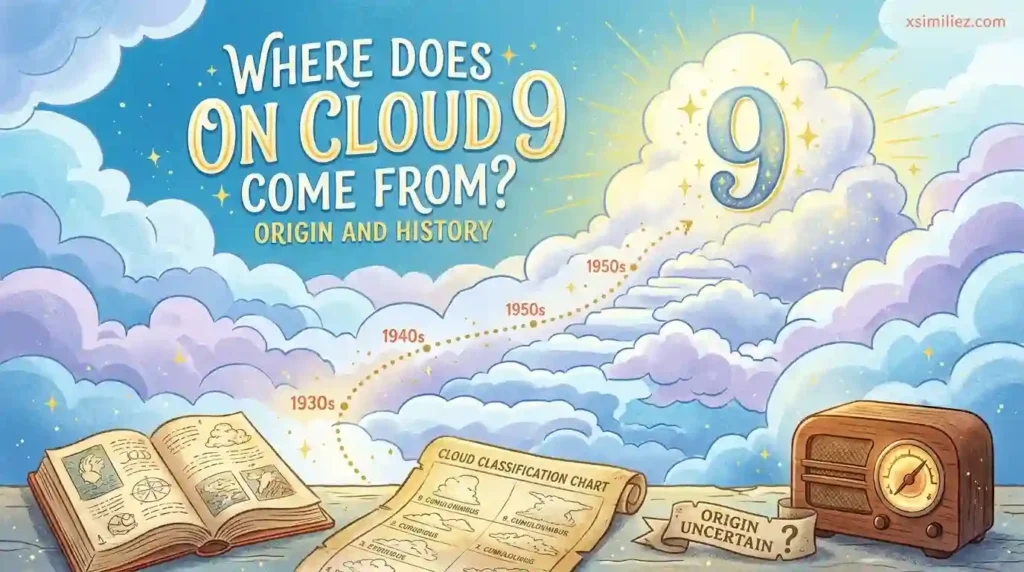
Here is where honesty matters. Word experts do not agree on exactly where this idiom started. Major dictionaries say the origin is uncertain, and anyone who claims to know the one true answer is probably guessing.
What we do know is that the phrase grew popular in the United States around the middle of the 1900s. Some language writers point to a radio comedy show from the 1930s and 1940s, in which the words “cloud nine” were used and heard by many listeners. That show may have helped spread the phrase, but it does not prove the phrase began there.
The most famous theory comes from weather science. In the late 1800s, experts made a system that sorted clouds into numbered types. In that system, the tall, towering storm cloud called the cumulonimbus is often described as the highest and biggest. If it was the ninth type, then being on “cloud nine” would mean being at the very top. This idea sounds neat and many people repeat it. Still, several language experts say there is not enough proof to call it fact.
Other guesses are even more colorful. One says the phrase connects to old ideas about nine levels of heaven. Another links it to boxing, where a ninth round or a count of nine might matter. These stories are fun, but there is no strong evidence behind them.
So what can we say for sure? The phrase is American in popularity, it became common in the 1900s, and it has stayed in use ever since. The exact starting point is still a bit of a mystery, and that is okay. Many of our favorite idioms have unclear roots.
On Cloud 9 Meaning in American vs British English
Good news for learners: this idiom travels well. Americans and British speakers both know “on cloud nine,” and both use it for the same joyful feeling. You will not get confused looks in either place.
The differences are small. In the United States, people often say “on cloud nine” or “on cloud 9” in everyday talk. In British English, the phrase is just as common, though speakers may choose other happy sayings, such as “over the moon,” more often. Both groups also use “cloud seven” now and then, although that version is rare.
Spelling and style can change a little, too. British writers are more likely to write out the word “nine.” American writers may use either form depending on how casual the writing is.
| Feature | American English | British English |
| Main phrase | On cloud nine / on cloud 9 | On cloud nine |
| Meaning | Extremely happy | Extremely happy |
| Popular partner phrase | Walking on air | Over the moon |
| Number style | Digit or word | Word is more common |
| Rare variant | Cloud seven | Cloud seven |
In short, you can use the idiom with both audiences and be understood.
Common Mistakes With On Cloud 9 Meaning
Even a simple idiom can trip people up. Here are the mistakes that show up most often, along with easy ways to fix them.
The first mistake is changing the words. Some learners say “in cloud 9” or “at cloud 9.” The correct word is “on.” Another change that does not work is “on a cloud 9.” Keep it as “on cloud 9,” with no “a” or “the.”
The second mistake is using the phrase for the wrong feeling. Because it has the word “cloud,” some people think it means being confused or daydreaming. That idea belongs to other sayings, such as “head in the clouds,” which means a person is not paying attention or is not being realistic. “On cloud 9” is only about strong happiness.
A third mistake is using it for mild feelings. If you are only a little glad that lunch was tasty, “on cloud 9” is too big. It would sound silly, like using a giant drum for a tiny song. Save it for real excitement.
The fourth mistake is taking it literally in a serious setting. For example, in a medical or safety report, you would not write that a person “was on cloud 9” to mean they were calm or stable. Idioms are best for friendly talk and stories, not for exact, technical writing.
Last, some writers mix up the number. You may see “cloud 8” or “cloud 10” in jokes, but the standard idiom uses nine. If you change it, readers may think you made an error unless you are clearly being playful.
The table below puts the main fixes in one place.
| Mistake | Wrong Example | Better Example |
| Wrong word | “She is on cloud 9.” | “She is on cloud 9.” |
| Extra article | “He is on cloud 9.” | “He is on cloud 9.” |
| Wrong feeling | “I’m on cloud 9 because I’m confused.” | “I’m on cloud 9 because I’m so happy.” |
| Too small a joy | “I’m on cloud 9 about my sandwich.” | “I’m really happy about my sandwich.” |
| Wrong number | “We’re on cloud 10.” | “We’re on cloud 9.” |
Real-Life Examples of On Cloud 9
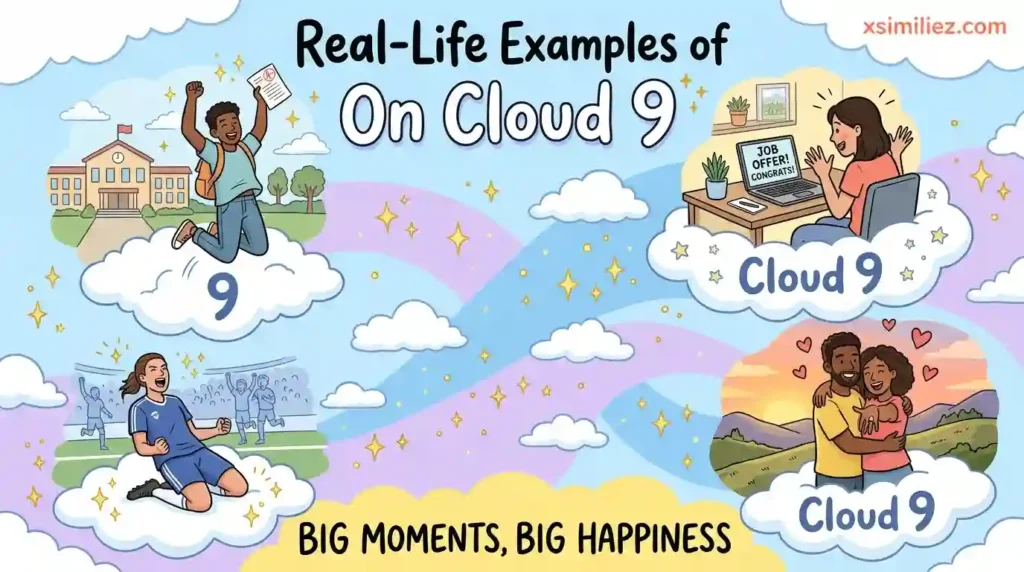
Examples make an idiom stick in your mind. Below are everyday situations where this phrase fits well, followed by a table with sample lines you can borrow.
Think about school first. A student studies for weeks and finally gets an A on a hard science test. She walks home smiling and tells her mom, “I’m on cloud 9” Her joy is big, and it comes from hard work paying off.
Now think about sports. A young soccer player scores the winning goal in the last minute. His teammates lift him up and cheer. Later he says he was on cloud 9 for the whole bus ride home.
At work, a person might get a promotion or a raise. A coworker could say, “Dave has been on cloud 9 since the boss shared the news.” That sentence tells you Dave’s happiness has lasted for some time.
Family moments count too. When a baby is born, a wedding is held, or a long trip finally begins, people often feel on cloud 9. Even a surprise visit from a loved one can lift someone this high.
| Situation | Sample Sentence |
| Passing an exam | “After I saw my grade, I was on cloud 9 all night.” |
| Getting a new job | “She’s on cloud 9 about her new job in Chicago.” |
| Winning a game | “Our team was on cloud 9 after the big win.” |
| Meeting a hero | “He was on cloud 9 after he met his favorite singer.” |
| Getting engaged | “They’ve been on cloud 9 since the proposal.” |
| Buying a first home | “We’re on cloud 9 about our new house.” |
Notice how each sentence names the event or the reason. That habit makes your writing clearer and more natural.
Current Usage and Trends for On Cloud 9
This idiom is far from old-fashioned. People still use it in speech, in text messages, and on social media. You can spot it in captions under happy photos, such as a graduation picture or a vacation selfie. A short caption like “On cloud 9 today” says a lot with just a few words.
The phrase also shows up in songs, book titles, and business names. Because the picture of a soft, bright cloud feels cheerful, brands such as bakeries, bedding shops, and travel companies sometimes use “Cloud 9” in their names. This helps keep the phrase fresh and familiar for new generations.
Younger speakers may mix it with newer slang. They might say, “I’m lowkey on cloud 9,” or pair it with emojis like a cloud, a star, or a smiling face. The meaning stays the same, even when the style changes.
In formal writing, the phrase is used less often. News stories and school reports may choose plainer words like “delighted” or “overjoyed.” Still, magazine writers and storytellers like it because it paints a quick picture without needing many words.
One more trend is worth a mention. Because many people now work and chat online, short, lively idioms are popular in messages. “On cloud 9” is only four words, yet it carries a big feeling. That makes it a great fit for the way we talk today.
Tips for Using On Cloud 9 Like a Native Speaker
A few simple habits will help you use this idiom with confidence.
Match the size of the feeling. Save the phrase for moments that truly feel big and joyful. When the happiness is smaller, pick a gentler phrase like “I’m pretty happy” or “I’m feeling good.”
Add the reason. A sentence like “I’m on cloud 9 because my sister is coming home” is stronger than the phrase alone. It gives the listener a story, and stories are easy to remember.
Pay attention to tone. Say the phrase with a smile in your voice. Because it is a playful idiom, a flat or serious tone can make it sound odd.
Know your audience. With friends, family, and coworkers you know well, it fits perfectly. In a formal letter or a legal paper, choose more direct words.
Try a few swaps to keep your speech fresh. If you have already used “on cloud 9” once in a chat, you could say “over the moon” or “walking on air” the next time. Mixing them keeps your talk lively instead of repetitive.
Finally, practice by writing three sentences about your own happy moments. Use the pattern from the grammar section. Reading them out loud will help the phrase feel natural in your mouth.
FAQs About On Cloud 9 Meaning
What does “on cloud 9” mean in simple words?
It means feeling extremely happy and joyful. You can think of it as floating above your worries because something wonderful just happened.
Is it “cloud 9” or “cloud nine”?
Both are correct. The word “nine” looks more polished in formal writing, while the number “9” is common in texts and social posts.
Where did the phrase “on cloud 9” come from?
Nobody knows for sure. It became popular in the United States in the 1900s, and there are several theories, such as one tied to old cloud charts. None of them has been proven.
Is “on cloud 9” the same as “head in the clouds”?
No, they are different. “On cloud 9” means very happy, while “head in the clouds” means someone is daydreaming or not being practical.
Can I use “on cloud 9” in a formal paper?
You can, but it may feel too casual. In formal writing, words like “delighted,” “thrilled,” or “overjoyed” are often a safer choice.
What are some phrases that mean the same thing?
Good matches include “over the moon,” “walking on air,” “in seventh heaven,” and “thrilled to bits.” Each one shows strong happiness in a slightly different way.
Conclusion
To sum up, the cloud 9 meaning is about a deep, glowing happiness. It describes the feeling you get when great news arrives or a big dream comes true. The phrase is friendly and easy to learn, and it works in both American and British English.
Remember a few key points. Use the word “on,” keep the number nine, and save the idiom for strong joy. Add a reason when you can, and know that its exact origin is still unclear. Those simple habits will help you avoid the common mistakes.
Now it is your turn. The next time something wonderful happens, try saying, “I’m on cloud 9” Using the phrase in real life is the best way to make it your own.

Hi, I’m Harper Blake, and I write for Xsimiliez.com. I enjoy sharing clear and friendly simile examples that students and beginners can understand easily. My goal is to make English learning simple and enjoyable.