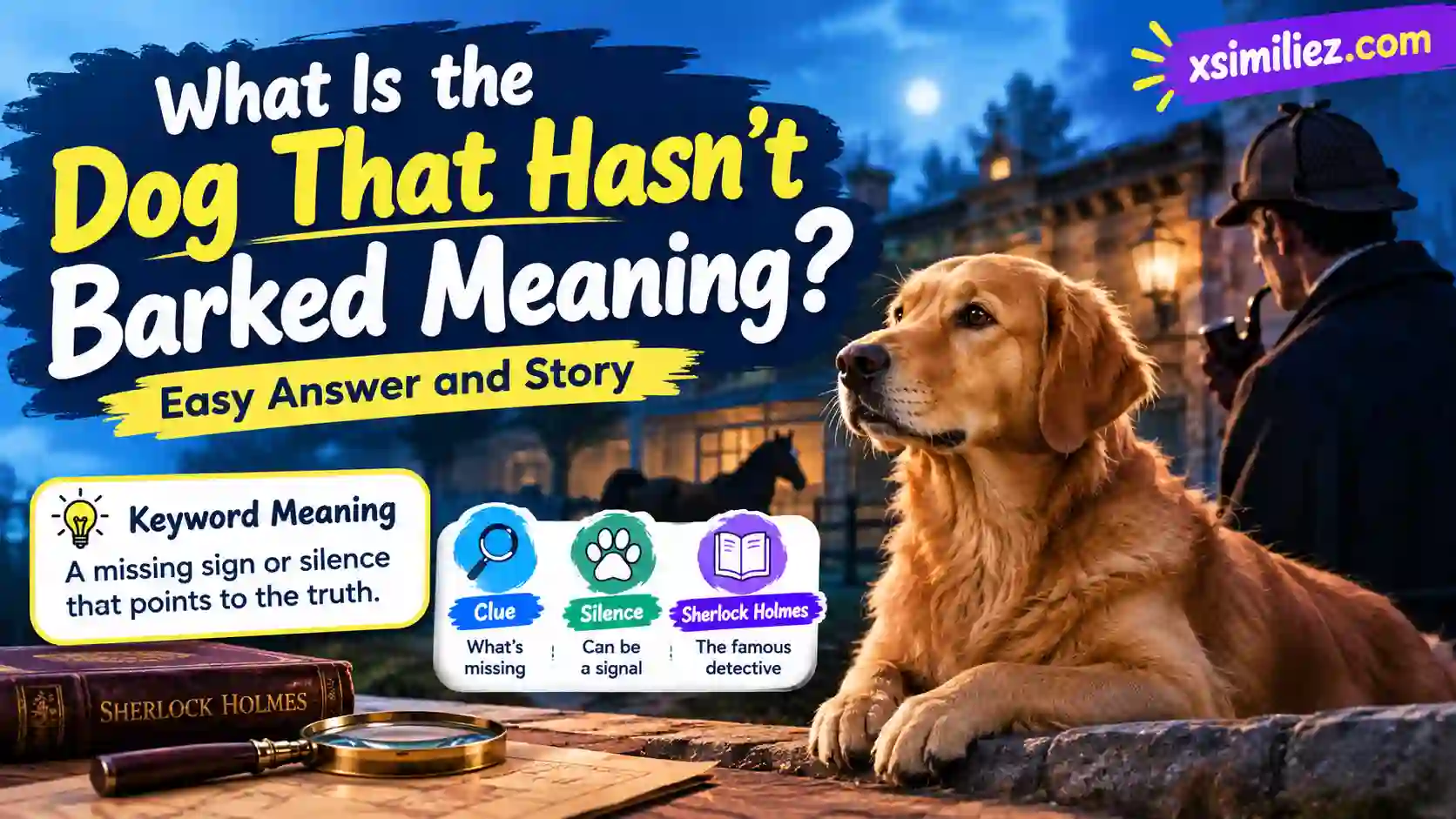
Thedog that hasn’t barked is easy to explain. It points to a clue that is missing. When something you expect to happen does not happen, that silence can tell you a lot. The phrase comes from a famous Sherlock Holmes story, and people still use it today.
Why do so many people search for this phrase? Often, they hear it on the news, in a business meeting, or in a mystery show. It sounds clever, but it can feel confusing. Why would a quiet dog matter at all?
In this guide, you will learn the meaning, the story behind it, and the right way to use it. You will also see simple examples, common mistakes, and answers to six popular questions.
Quick Answer: The Dog That Hasn’t Barked Meaning in Plain Words
Here is the shortest answer. The dog that hasn’t barked is a clue that comes from silence. Something should have happened, but it did not. That missing event tells you something important.
Think of a smoke alarm that stays quiet during a fire drill. If it never beeps, you know something is wrong with the alarm. The quiet is the clue.
The table below sums up the idea in a few quick lines.
| Question | Short Answer |
| What does it mean? | A missing sign that points to the truth |
| Where does it come from? | “Silver Blaze,” a Sherlock Holmes story by Arthur Conan Doyle |
| Who made the idea famous? | Sherlock Holmes, the detective |
| Is it a real dog today? | No, it is a figure of speech |
| What is the main lesson? | What does not happen can be evidence |
The Dog That Hasn’t Barked Meaning Explained for Everyday Life
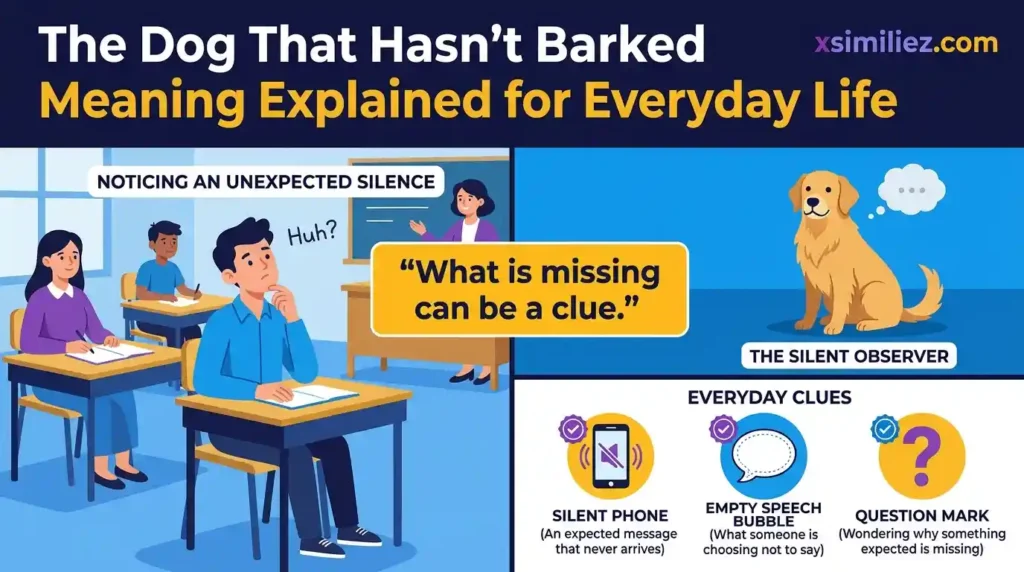
The dog that hasn’t barked meaning comes down to one smart idea: what is missing can matter as much as what is there. Most people look for clues they can see or hear. A good thinker also asks, “What should be here, but isn’t?”
Let’s use a simple picture. Imagine a classroom full of kids. It is usually loud. Today it is totally silent. A teacher would not think, “Wonderful, nothing is happening.” She would think, “Something is up.” The silence is the clue.
That is how the phrase works in daily life. A quiet dog may mean it saw nothing strange. Or it may mean it saw someone it knew well. A company that stays silent after bad news may be hiding something, or it may simply have nothing to say. A friend who never answers your text may just be busy. The silence points to a question, but it does not always give you the answer.
You may also see related words. People talk about “negative evidence,” “a telling silence,” or “a missing clue.” All of them describe nearly the same thing. The key point is that silence can be a signal. It is not proof by itself, but it shows you where to start looking.
Where the Dog That Hasn’t Barked Comes From: The Silver Blaze Story
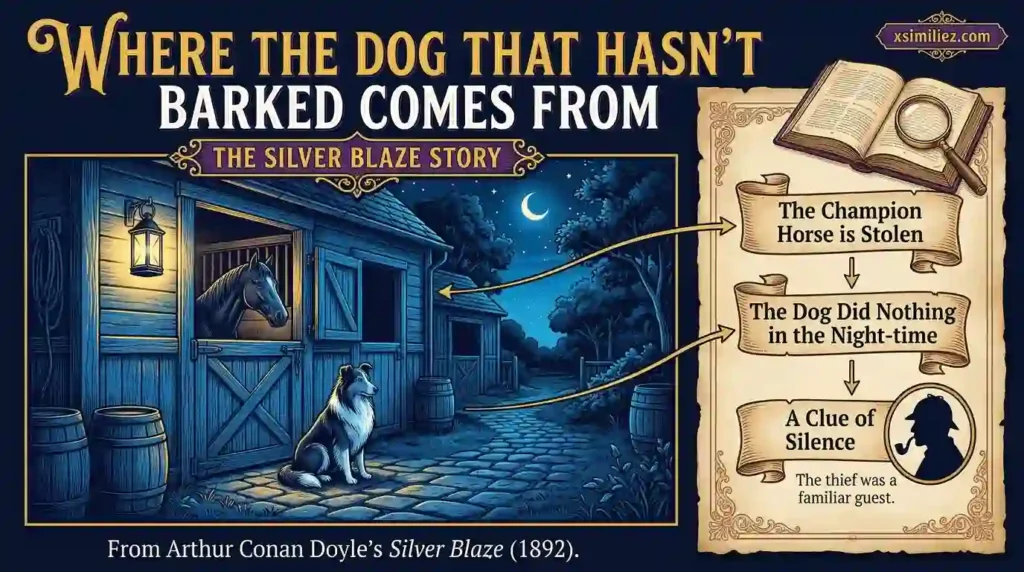
The phrase comes from “Silver Blaze,” a short story by Arthur Conan Doyle. It first appeared in The Strand Magazine in 1892. Later, it was collected in a book called The Memoirs of Sherlock Holmes, published in 1894. So the idea is well over a hundred years old.
In the story, a famous racehorse named Silver Blaze vanishes from his stable. His trainer, John Straker, is found dead on the moor nearby. A big race called the Wessex Cup is only days away, so everyone is in a panic. The police have already arrested a stranger who was near the stable that night. Sherlock Holmes is not convinced.
During the case, Holmes has a short talk with Inspector Gregory. Gregory asks if there is any other point Holmes wants him to notice. Holmes points to “the curious incident of the dog in the night-time.” Gregory says the dog did nothing in the night-time. Holmes replies that this was the curious incident.
Here is a fun detail. Holmes never says “the dog that didn’t bark” in the story. Doyle wrote about the dog doing nothing. Readers and writers later shortened it into the catchy line we know today. The “hasn’t barked” form is another modern twist. It is a spin on the idea, not a line from the book.
How Holmes Solved the Case: What the Silent Dog Really Meant
So why did a quiet dog matter? Holmes worked it out step by step. A guard dog barks at strangers. That night, it stayed silent. So whoever took the horse must have been someone the dog knew well. That did not fit the stranger the police had arrested. It pointed instead to someone close to the stable.
Other clues backed this up. The stable boy on duty was drugged with powdered opium hidden in his supper, a spicy curry. Only someone who knew what was on the menu could plan that. In the end, Holmes shows that the trainer himself, John Straker, led the horse out. Straker planned to hurt the horse’s leg with a tiny cut so it would lose the race. But the horse got scared and kicked him, and he died. Silver Blaze was found safe, and he went on to win the Wessex Cup.
The table below shows how one clue changed the whole picture.
| Clue | What It Seemed to Mean | What Holmes Saw |
| The silent dog | Nothing happened that night | The visitor was someone the dog knew |
| The drugged stable boy | An outsider did it | Someone knew about the curry supper |
| The missing horse | It looked like a theft | The horse went along calmly with a trusted person |
Hasn’t Barked vs. Didn’t Bark: Grammar and Correct Usage
Both forms are fine, but they say slightly different things. “Didn’t bark” is the simple past tense. It fits a story that is finished, like the one Doyle wrote. “Hasn’t barked” is the present perfect tense. It means the dog has been quiet up to now, and the story is not over. Something could still happen.
That small change is why people like “hasn’t barked” in news and work talk. It fits situations that are still moving. You might say, “The dog that hasn’t barked is the mayor. She has said nothing about the new plan so far.” Words like “yet” and “so far” go nicely with it.
The phrase usually starts with “the,” because it points to one special, missing voice. It works as a noun phrase, so it can sit in the middle of a sentence. For example: “The most important clue is the dog that hasn’t barked.” If you quote Doyle, put the story title in quotes and the book title in italics.
A quick spelling note helps, too. Doyle was British, so he wrote “night-time” with a hyphen. In American English, most writers use “nighttime” as one word. If you quote the original line, keep Doyle’s spelling. In your own sentences, use the style your readers expect.
| Form | Tense Idea | Best Used When | Example |
| The dog didn’t bark | Past, finished | The story is over | “The dog didn’t bark, so the visitor was a friend.” |
| The dog hasn’t barked | Up to now, not finished | You are still waiting | “The dog hasn’t barked yet, so keep watching.” |
| The dog that hasn’t barked | Figure of speech | Pointing to a telling silence | “The mayor is the dog that hasn’t barked.” |
Real-Life Examples of the Dog That Hasn’t Barked
The examples below are made up to show the idea. They are not reports about real people or real events. Still, you may notice they feel familiar.
Start with a workplace. Your team has a weekly meeting. Every week, one coworker shares a long list of problems. This week, she says nothing at all. That could mean everything is fine. It could also mean she gave up or found a bigger problem. Her silence is the dog that hasn’t barked, and it is a good reason to ask a gentle question.
Now think about a news story. A company is in the middle of a public fight, yet its biggest rival says nothing. Reporters may ask why. Maybe the rival has no opinion. Maybe it has a quiet deal. The missing comment becomes a clue worth checking.
Home life has its own examples. A toddler who is normally noisy goes quiet in the next room. Any parent knows what to do: go look. The silence is the signal.
| Setting | What You Expected | What Happened | What It Might Mean |
| Workplace | A long list of complaints | Total silence | Peace, or deep frustration |
| News story | A reply from a rival | No reply | No opinion, or a hidden plan |
| Home | Noisy play | Quiet room | Calm play, or trouble |
| School | Hands raised for a test question | No hands | The question is too hard or too easy |
Common Mistakes With the Dog That Hasn’t Barked Meaning
The biggest mistake is treating silence as proof. A quiet dog does not always point to a guilty person. It might point to a sleepy dog. Holmes did not stop at the silence. He added other clues, like the drugged supper and the calm horse. Silence works best as one piece of a bigger puzzle.
Another mistake is using the phrase when nothing was expected. The idea only works if you can say, “This should have happened, and it didn’t.” If you had no reason to expect a sound, the lack of a sound means nothing. A rock that doesn’t bark is not a clue.
People also misquote the story. Many say Holmes asked about “the dog that didn’t bark.” Those exact words are not in Doyle’s text. It is fine to use the popular line. Just do not put it in Holmes’s mouth as a direct quote.
Finally, some people mix it up with other dog sayings. “Barking up the wrong tree” means chasing the wrong idea. “Let sleeping dogs lie” means to leave trouble alone. “All bark and no bite” means loud but harmless. None of these means the same thing as the dog that hasn’t barked.
Tips for Spotting the Dog That Hasn’t Barked in Your Own Life
First, learn what normal looks like. You cannot notice a missing sound if you do not know the usual noise. Pay attention to habits, patterns, and routines. Then silence will stand out.
Second, ask the key question: “What should have happened here?” Write down the answer. It can be a reply, a sale, a complaint, or a sign on a chart. Anything that was due and did not show up counts.
Third, list more than one reason for the silence. Try to think of at least three.The person might be busy, the system could have broken, or someone may be hiding something.
A longer list keeps you from jumping to the first idea.
Fourth, look for more evidence. Holmes did not solve the case with the dog alone. Check dates, records, and other clues. If several clues point the same way, you can feel more sure.
Last, be kind and careful with people. A missing reply is not always a sign of bad behavior. Use the idea to ask better questions, not to blame others.
Current Usage of the Dog That Hasn’t Barked in News, Work, and Science

Today, the phrase shows up in many places. Writers use it in news commentary, politics, business, and finance. Teachers use it to explain careful thinking. Fans of detective stories still bring it up when they talk about Sherlock Holmes. I can’t give you exact numbers on how often it appears, since there is no single reliable count.
It also fits well with data work. When people study numbers, they often ask what is missing from the data. A hole in the records can say as much as a spike. That is the same habit of mind Holmes showed.
The idea is close to another well-known saying: “absence of evidence is not evidence of absence.” Scientist Carl Sagan helped make that line popular. The two ideas work together. One says a missing sign can be a clue. The other warns that a missing sign does not settle the case. Good thinkers keep both in mind.
FAQs
What is the dog that hasn’t barked meaning in one sentence?
It means a missing event or sign that, because it did not happen, gives you an important clue.
Which Sherlock Holmes story has the dog?
The dog appears in “Silver Blaze,” first published in 1892 and later included in The Memoirs of Sherlock Holmes.
Did Holmes really say “the dog that didn’t bark”?
No. In the story, he speaks of “the curious incident of the dog in the night-time.” The shorter line came later, from people retelling the tale.
Is it “hasn’t barked” or “didn’t bark”?
Both are fine. Use “didn’t bark” for a finished story. Use “hasn’t barked” when the situation is still going on and you are waiting to see what happens.
Is a missing clue always proof?
No. Silence is a hint, not a final answer. You still need other evidence before you decide what it means.
Can I use this phrase in school or work writing?
Yes. It works well in essays, reports, and talks. If your readers may not know it, add one short line about the Holmes story the first time you use it.
Conclusion:
The dog that hasn’t barked is about noticing what is not there. A quiet moment can be as loud as a shout when you expect noise. That is the lesson Sherlock Holmes taught in “Silver Blaze,” and it still holds up today.
Remember the key steps. Know what is normal. Ask what should have happened. Think of several reasons for the silence. Then look for more clues before you decide. Used this way, the idea makes you a sharper reader and a calmer thinker.
So the next time you hear this phrase, you will know exactly what it means. Try it in your own life. Look for the dog that hasn’t barked, ask a good question, and let the evidence lead you.

Hi, I’m Mason Avery, a content writer at Xsimiliez.com. I like writing about similes, figurative language, and creative expressions. I believe learning English becomes easier when examples feel natural and relatable.