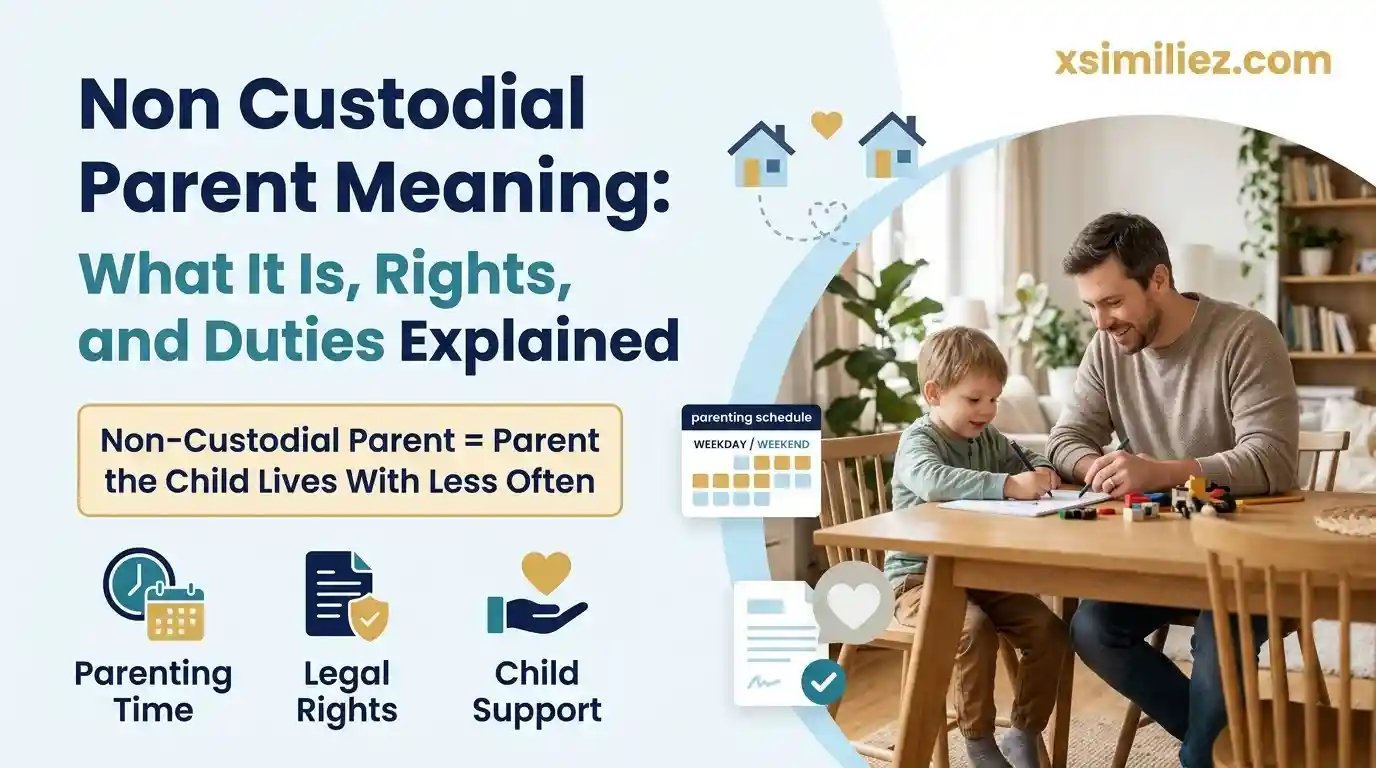
The non custodial parent meaning is simple. It describes the parent who does not have the child living with them most of the time. The other parent, called the custodial parent, has the child for most nights of the year. That is the short answer, but there is more to learn.
People search for this phrase for many reasons. Maybe a judge used it in court. Maybe it showed up on a school form, a tax page, or a child support letter. The label can affect where a child lives, who pays support, and even who claims a child on taxes. A wrong guess can lead to stress and costly mistakes.
This guide explains everything in plain, everyday words. You will learn the definition, the key differences between parents, the rights and duties of the role, common mistakes, real-life examples, and helpful tips. By the end, you will know exactly where you stand.
Quick Answer: Non Custodial Parent Meaning in One Minute
A non custodial parent is the parent whose child lives with the other parent for most of the time. The child may still visit, stay overnight, and spend holidays with this parent. The parent is still a parent in every way. Only the living schedule is different.
Think of it like a home base. One parent’s home is the main home, where the child sleeps most nights and goes to school from. The other parent’s home is the second home, where the child spends planned time. The parent at the second home is the non custodial parent.
Three key facts are worth remembering. First, the label is about where the child lives, not about how much the parent loves or cares for the child. Second, the non custodial parent often pays child support. Third, this parent usually keeps important rights, like spending time with the child and being part of big life choices.
The exact rules change from state to state. Courts in the United States decide custody based on what is best for the child. So the same situation can look a little different in Texas than it does in New York.
Non Custodial Parent Meaning and Definition in Family Law
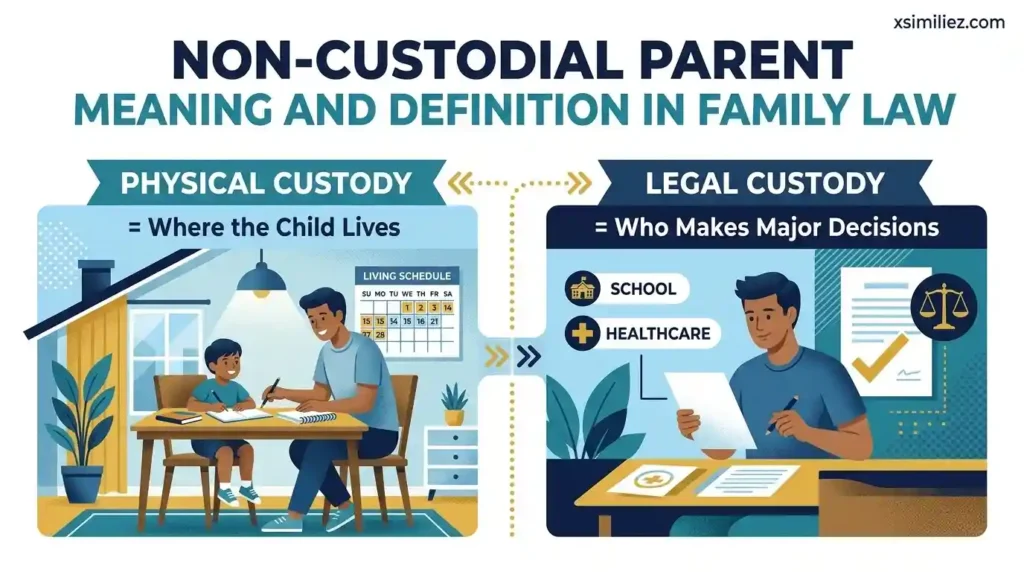
In family law, “custody” has two main parts. Understanding both parts makes the non custodial parent meaning much easier to follow.
The first part is physical custody. This means where the child lives and who handles daily care, like meals, bedtime, and rides to school. The parent with the child most of the time has primary physical custody. That parent is the custodial parent. The other parent is the non custodial parent.
The second part is legal custody. This means the power to make big decisions about the child’s life. Those decisions include health care, schooling, and religion. Here is the part that surprises many people: a non custodial parent can still share legal custody. Courts often give both parents joint legal custody, even when the child lives with one parent.
So a parent can be “non custodial” in the physical sense and still help make major choices. This is very common. The word “non custodial” does not mean “no rights.” It usually only points to the living arrangement.
You may also see the term spelled “noncustodial” or “non–custodial.” All three spellings mean the same thing. Government sites and court forms often use “noncustodial,” while many everyday articles use “non custodial.” You do not need to worry about which one to pick when you are searching or talking.
What about shared time? Some families split time almost evenly, such as week on, week off. In those cases, many states do not use the labels at all. Others pick the parent who has the child slightly more nights. Because laws differ, the court order itself is the best place to see how your state treats the labels.
Non Custodial Parent Meaning vs. Custodial Parent: Key Differences
Seeing the two roles side by side helps a lot. The table below shows how they usually compare. Remember that every court order is different, so use this as a general guide only.
| Topic | Custodial Parent | Non Custodial Parent |
| Where the child lives | Most nights of the year | Fewer nights, based on a schedule |
| Daily care | Handles most day-to-day tasks | Handles care during parenting time |
| Child support | Usually receives support | Usually pays support |
| Legal custody | May be sole or joint | May still share joint legal custody |
| Claiming the child on taxes | Usually allowed by IRS rules | Only with the custodial parent’s written release |
| School and medical records | Has full access | Often has access, unless a court says otherwise |
| Parenting time | Not applicable | Has a set schedule or visitation rights |
Notice how many rows show shared roles. Both parents matter. The custodial parent may handle more of the daily work. The non custodial parent often carries more of the money duty, and both can stay active in the child’s life.
One more point: these roles can change. If a child moves in with the other parent for good, a court may change the order. Then the labels can switch. Life changes, and the law has a way to adjust.
Rights of a Non Custodial Parent
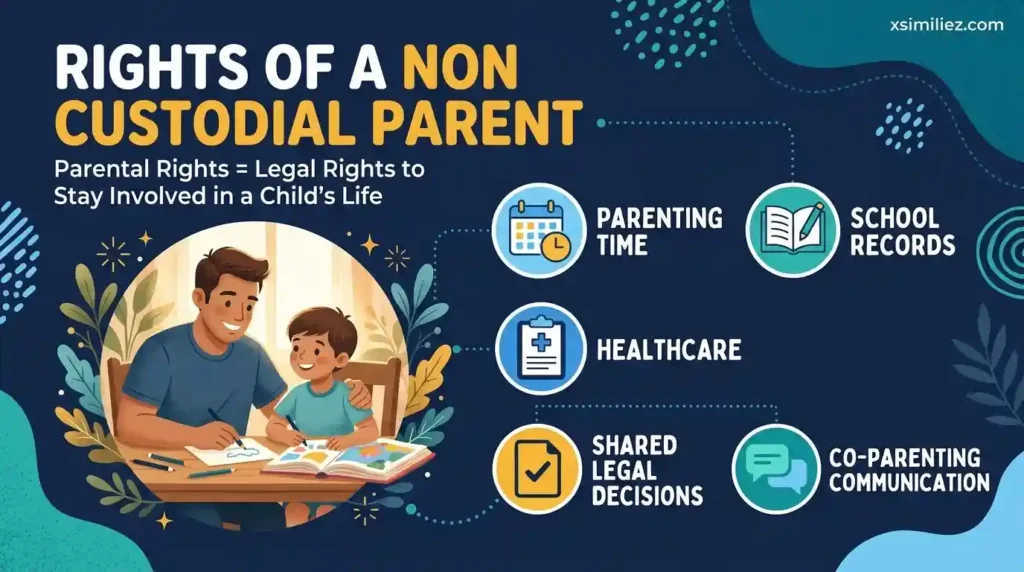
Many people think a non custodial parent has few rights. That is not true. Courts want children to have strong bonds with both parents, as long as it is safe. So most non custodial parents keep many important rights.
The most basic right is parenting time. This is often called visitation. A court order or a parenting plan sets the schedule. It might include weekends, a weeknight dinner, school breaks, summer weeks, and holidays. The custodial parent must follow this schedule and cannot simply cancel it.
Another key right is access to information. In most cases, the non custodial parent can get school records, report cards, and medical information. Schools and doctors usually share this with both parents. A court can limit access in rare cases, such as when safety is a concern.
There is also the right to be involved in major decisions, if the parent has joint legal custody. This means the parent has a voice in choices about schooling, health care, and sometimes religion. Parents are expected to talk and work things out together.
A non custodial parent also has the right to ask the court for changes. If life changes in a big way, such as a job move, a new work schedule, or a safety issue, the parent can file a request to change the order. Judges look at what helps the child most.
Finally, a non custodial parent has the right to follow due process. No one can take away parental rights without a legal process. Even when a parent has made mistakes, courts treat the loss of rights as a very serious step. When safety is at risk, a judge may limit time to supervised visits only. That is different from ending a parent’s role.
Duties of a Non Custodial Parent, Including Child Support

With rights come duties. The biggest duty for most non custodial parents is financial support. Every state has child support rules. Courts use formulas that look at both parents’ incomes, the number of nights each parent has the child, health insurance costs, and child care costs. The exact formula depends on the state.
Child support is meant to help cover a child’s basic needs. That includes food, housing, clothes, and school costs. It is the child’s money, not a payment to the other parent as a reward or a penalty. Because of this, a parent cannot skip payments just because of a disagreement.
Here is a rule that surprises many people: child support and visitation are separate issues. A parent who pays support cannot hold back payments because the other parent blocks visits. In the same way, a custodial parent cannot block visits because support is late. If either problem happens, the right step is to go back to court, not to take matters into your own hands.
What if a parent does not pay Courts and state agencies have strong tools. They can take money straight from a paycheck, which is called wage withholding. They can also hold back tax refunds, add late fees, suspend licenses, or in serious cases, bring contempt charges. Unpaid support also builds up as debt, and it does not simply disappear.
Other duties may include paying part of health insurance, medical costs, or child care, depending on the order. A non custodial parent should also follow the parenting schedule, show up on time, and tell the other parent about changes. Kids do best when the adults keep their promises.
If money gets tight, such as after a job loss, do not wait. Ask the court to change the order as soon as possible. Courts often can change support going forward, but they usually cannot erase past amounts owed.
Common Mistakes People Make About the Non Custodial Parent Meaning
Because the term sounds legal and a little cold, people misunderstand it often. Here are the mistakes that come up most.
The first mistake is thinking “non custodial” means “not a real parent.” It does not. The term only describes where the child lives most of the time. The parent still has a bond, and usually still has rights.
The second mistake is believing that only mothers are custodial parents. Courts do not pick by gender. Many fathers are custodial parents, and many mothers are non custodial parents. Judges look at what is best for the child.
The third mistake is mixing up legal custody and physical custody. A parent can be non custodial in the physical sense and still share decision-making. If you only read the word “non custodial,” you might miss that detail. Always read the full order.
The fourth mistake is making deals outside of court. For example, parents might agree that no one needs to pay support, or that visits will be “whenever.” These deals feel friendly at first. But they are not enforceable if the order says something else, and one parent can still be held responsible later. If you want a change, make it official.
The fifth mistake is claiming the child on taxes without permission. Under IRS rules, the custodial parent generally gets to claim the child. A non custodial parent can only claim the child if the custodial parent signs a written release, such as IRS Form 8332.
The last mistake is waiting too long to act. People often ignore a problem, like missed payments or a changed work schedule, and hope it fixes itself. Small problems get bigger when no one deals with them early.
Real-Life Examples of a Non Custodial Parent
Examples make the idea easier to see. Here are a few common situations. The names are made up, and the details will differ in real life.
Imagine a father named Marcus. His daughter lives with her mother during the school week. Marcus has her every other weekend, one dinner each week, and half of the summer. The court gave both parents joint legal custody. Marcus is the non custodial parent. He pays monthly child support, goes to her school events, and helps decide her doctor and school choices.
Now think of a mother named Elena. She travels often for work, so her two sons live mainly with their dad. Elena has the boys for holidays and part of the summer. She is the non custodial parent. She pays support and video calls the boys on school nights. Her job did not make her any less of a mom. It simply shaped the living plan.
Here is a case with a change. A teenager named Jordan has lived with his mom for years. At fifteen, he asks to live with his dad because the high school is better. After talking, both parents agree. They ask the court to update the order. Now the dad becomes the custodial parent, and the mom becomes the non custodial parent. The labels moved with the child.
Finally, picture parents with a nearly equal plan. Their son spends one week with each. Because the time is so even, the court may not name a custodial parent. Instead, support is based on income and the exact number of nights. This shows why reading your own court order matters more than any general label.
Taxes, Benefits, and Current Trends for the Non Custodial Parent
Money rules attached to the label are a major reason people search this topic. A few federal tax and benefit rules matter here. Always check the latest rules each year, since tax laws can change.
| Topic | General Rule | What to Know |
| Claiming the child as a dependent | Custodial parent usually claims | Non custodial parent needs a signed release, such as IRS Form 8332 |
| Head of household filing status | Usually only for the custodial parent | The child must live with that parent for more than half the year |
| Child support payments | Not tax-deductible for the payer | Support is also not taxable income for the person who receives it |
| Health insurance | Often set by the court order | The order says which parent covers the child |
| College financial aid (FAFSA) | Based on the parent who gave more financial support | This can differ from the parent with the most nights |
Besides taxes, one trend is worth noting. Courts in many states now lean toward shared parenting when both parents are fit and safe. Research has shown that children often do well when they have strong, steady bonds with both parents. As a result, more families use equal or near-equal schedules, and some states have changed their laws to encourage this.
Technology has also changed things. Video calls help parents who live far apart stay close. Co-parenting apps help track schedules, messages, and expenses. These tools reduce fights because everything is written down in one place.
One more point: state laws vary a lot, and rules change from time to time. If a specific tax, support, or custody question affects you, check with your state’s family court website or a licensed family law attorney. This article is general information, not legal advice.
Tips for a Non Custodial Parent to Stay Involved

Being a non custodial parent can feel hard. You may miss daily moments, and the schedule can feel short. The good news is that quality matters as much as quantity. Here are practical ways to build a strong bond.
Start by being reliable. Show up on time, every time. Children notice when a parent keeps their word, and it builds trust. If something truly comes up, call early and explain.
Make your time feel like a real home, not a vacation. Give your child a space, even if it is a small corner with a bed and a few of their things. Include normal routines too, like homework, chores, and family meals. Fun is great, but kids also need a steady life with you.
Stay connected between visits. A short call, a quick text, or a video chat before bed can mean a lot. Ask about school, friends, and small details. Little check-ins show that you are thinking about them.
Keep up with school and doctor information. Ask for report cards, sign up for school emails, and go to parent meetings when you can. Being informed helps you support your child and shows the other parent that you care.
Pay support on time and keep records. Use a method that leaves a paper trail, such as direct payment through your state’s system. Save receipts for any extra costs you cover. Good records protect you if a question comes up later.
Keep the adult conflict away from your child. Never speak badly about the other parent in front of the child, and never use your child to pass messages. Courts notice parents who act with respect, and children feel safer.
Last, get the right help. A family law attorney, a mediator, or a local legal aid office can explain your options. Many courts also offer free forms and help centers. Asking for help early is smart, not weak.
FAQs
What is the non custodial parent meaning in simple words?
It means the parent the child does not live with most of the time. The child lives mainly with the other parent, called the custodial parent. The non custodial parent usually has a set schedule of time with the child.
Does a non custodial parent have any rights?
Yes. Most non custodial parents have the right to parenting time, to see school and medical records, and sometimes to share big decisions through joint legal custody. A court can limit rights only for serious reasons, such as safety.
Does a non custodial parent always pay child support?
Not always, but usually. Child support depends on each parent’s income, the parenting schedule, and state rules. In some cases, such as nearly equal time, the amount may be small or the court may set it differently.
Can a non custodial parent claim the child on taxes?
Generally only with permission. The custodial parent usually claims the child. The non custodial parent may claim the child if the custodial parent signs a written release, such as IRS Form 8332. Check current IRS rules each year.
Can a non custodial parent become the custodial parent?
Yes. A parent can ask the court to change custody if there is a big change in life, such as a move, a safety concern, or the child’s needs. The judge decides based on what is best for the child.
Is a non custodial parent the same as an absent parent?
No. A non custodial parent may be very active and involved. An absent parent is one who does not take part in the child’s life. The two terms describe very different things.
Conclusion:
The non custodial parent meaning comes down to one idea: this is the parent the child lives with less than half the time. It is a living arrangement label, not a measure of love or value. The parent can still have rights, still make big decisions, and still play a major role in a child’s life.
With that role come duties, especially paying child support, following the parenting schedule, and treating the other parent with respect. Taxes, records, and court orders can be tricky, and rules change by state. Knowing the basics helps you avoid common mistakes and make smart choices.
If you are a non custodial parent, focus on what you can control. Show up, stay consistent, keep good records, and keep your child out of adult conflicts. If you have a question about your own case, talk to a family law attorney or your local court’s help center. Clear information and steady effort go a long way for your child.

Hi, I’m Mason Avery, a content writer at Xsimiliez.com. I like writing about similes, figurative language, and creative expressions. I believe learning English becomes easier when examples feel natural and relatable.