The ngl meaning in chat is simple. It stands for “not gonna lie.” People type it before they say something honest, like a small signal that real words are coming.
You have probably seen it in a text, a comment, or a group chat and wondered if you missed something. Don’t worry. Lots of people ask this, because chat slang moves fast and nobody hands out a guide.
In this article, you will learn what ngl means, how to use it in a sentence, and where it came from. You will also see real examples, common mistakes, and easy tips so you can use it with confidence.
Quick Answer: What Is the NGL Meaning in Chat?
NGL means “not gonna lie.” You use it when you want to be honest, open, or a little blunt. It can go at the start of a message, in the middle, or at the end.
The ngl meaning in chat is the same on most apps. That includes text messages, Snapchat, Instagram, TikTok, Discord, and WhatsApp. Some people type it in capital letters, and others use lowercase. Both are fine.
Here is a quick example: “ngl, that movie was way better than I thought.” The person is saying they were surprised, and they are being honest about it.
NGL Meaning in Chat: Full Definition and What It Really Says
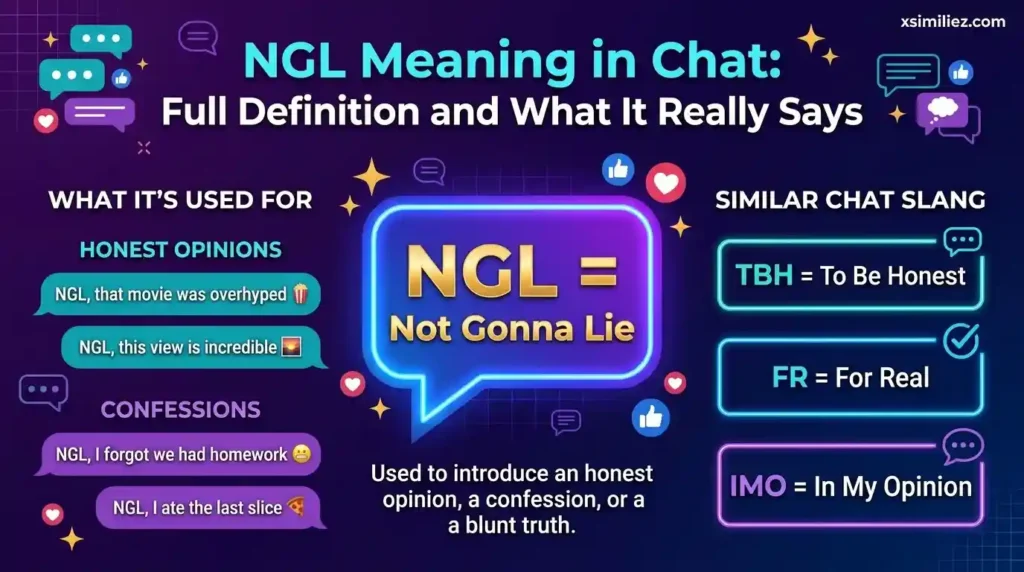
The full form of ngl is “not gonna lie.” It is a short way to type a spoken phrase. In real life, people say “not gonna lie” all the time. Online, they shrink it down to three letters because typing is slow and chats are fast.
But the ngl meaning in chat goes a bit deeper than the words alone. When someone writes ngl, they are doing one of three things. They may be sharing an honest opinion. They may be softening a hard truth. Or they may be adding a little drama before a big reveal.
Think of it like saying “I’ll be real with you.” It tells the reader to pay attention. It also makes the message sound more friendly and less harsh, because it shows the writer is not trying to be mean.
Here is how ngl compares to other slang that sounds alike.
| Slang | Full Form | What It Means | Example |
| ngl | not gonna lie | I am being honest | “ngl, I’m tired.” |
| tbh | to be honest | Same idea, a bit more casual | “tbh, I forgot.” |
| fr | for real | I mean it, or I agree | “That was funny fr.” |
| imo | in my opinion | This is my view | “imo, it’s too long.” |
| lowkey | quietly or a little | A small or secret feeling | “I love it.” |
As you can see, ngl and tbh are almost twins. Most people swap them without thinking. The small difference is in the feel. Ngl often sounds like a confession, while tbh sounds more like a plain fact.
How to Use NGL Correctly in a Sentence
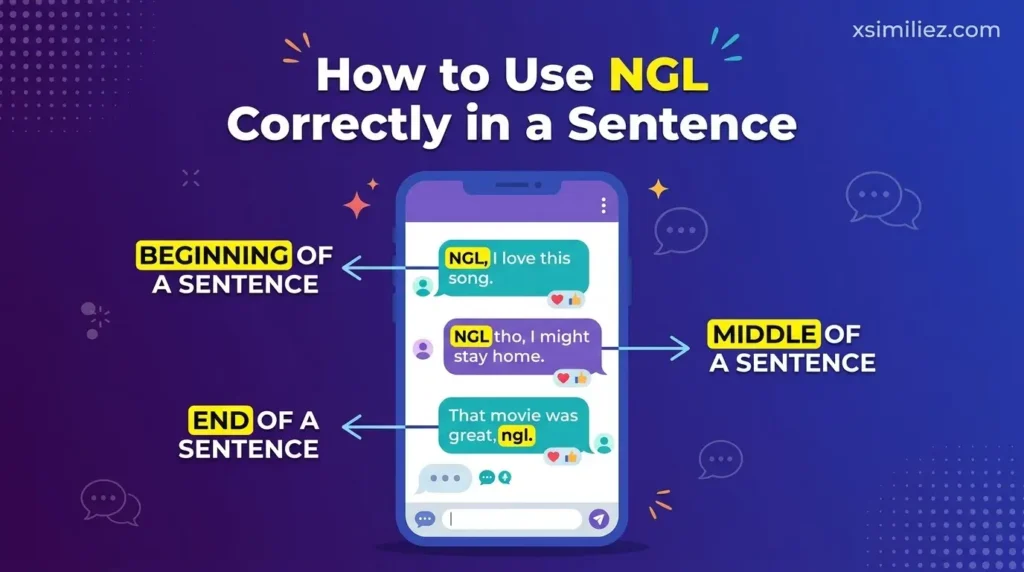
Using ngl is easy. There are no strict grammar rules, since it is slang. Still, a few patterns sound natural, and others feel odd.
The most common spot is at the start of a sentence. For example: “ngl, I didn’t expect to like this song.” The comma is optional in chat, so “ngl I didn’t expect to like this song” is fine too.
You can also put it at the end. For example: “That test was hard, ngl.” This version sounds a little more relaxed, as if the thought just popped into your head.
Some people stick it in the middle. For example: “I think, ngl, we should leave early.” This is less common, but it works when you want to stress one part of your message.
You can also pair it with other words. “You can mix it with other slang, too. “Tho” adds a small “however” feeling, “fr” adds extra weight, and “lowkey” makes a feeling sound softer and more private.”
One rule helps a lot. Ngl should come before something you truly believe. If you say “ngl, I love pizza” and you really do, that is a perfect use. Using it as a random filler word weakens the effect over time.
Where Did NGL Come From? The Story Behind the Slang
Here is the honest truth: nobody can name the exact day or person who first typed ngl. Chat slang rarely has a clear birth record. It grows slowly, passes from friend to friend, and spreads through apps.
What we do know is that “not gonna lie” was already a common spoken phrase long before phones had smart keyboards. People shortened it in texts and online chats the same way they shortened “laughing out loud” to “lol” and “be right back” to “brb.”
As social apps grew, short slang grew with them. Young people on Twitter, Instagram, Snapchat, and TikTok helped ngl spread. By the early 2020s, it was a regular part of casual online talk across the United States and many other countries.
There is one more thing worth knowing. A popular anonymous messaging app is also named NGL. It lets people collect anonymous questions from friends. That app is a separate thing from the slang, though the name comes from the same phrase. In 2024, U.S. regulators took action against the company behind it over how it marketed the app, so it is smart to check recent news if you are thinking of using it. Parents especially should look into it before letting kids sign up.
NGL Meaning in Chat in American vs British English
Good news: there is no big gap between American and British English here. People in both places know what ngl means, and they use it the same way.
The tiny differences are in the spoken form. Americans often say “not gonna lie” out loud, and the shortened “gonna” is very common in the United States. In the UK, you may hear “not going to lie” or “I’m not even going to lie” a little more often. In chat, though, both groups simply type ngl.
Other slang that pairs with ngl can differ a bit. A British speaker might write “ngl, that was proper good,” while an American might write “ngl, that was so good.” The core meaning stays the same.
If you write for a global audience, ngl is safe. It travels well because it is short, clear, and widely known among teens and young adults.
Common Mistakes People Make With NGL Meaning in Chat
Even simple slang can trip people up. Here are the mistakes I see most often.
The first mistake is thinking ngl means “no good luck” or something rude. It does not. It always comes from “not gonna lie.” Mixing it up can lead to awkward replies.
The second mistake is using it in serious writing. Ngl belongs in casual chats. It does not belong in school essays, job emails, or business reports. A boss will not love reading “ngl, the report is late.”
The third mistake is overusing it. When every message has English in it, the word stops sounding honest. It becomes background noise.
The fourth mistake is using it to be unkind. Some people write “ngl, you look bad today” and think the word makes it okay. It does not. Ngl can soften a message a little, but it cannot turn a mean comment into a kind one.
| Mistake | Why It Is a Problem | Better Choice |
| Using ngl in a work email | Sounds too casual | Write “To be honest” or “Frankly” |
| Saying ngl in every message | Loses its meaning | Save it for real opinions |
| Using ngl before an insult | Still hurts feelings | Be kind and clear instead |
| Thinking it means “no good luck” | Wrong meaning | It means “not gonna lie” |
Real-Life Examples of NGL Meaning in Chat
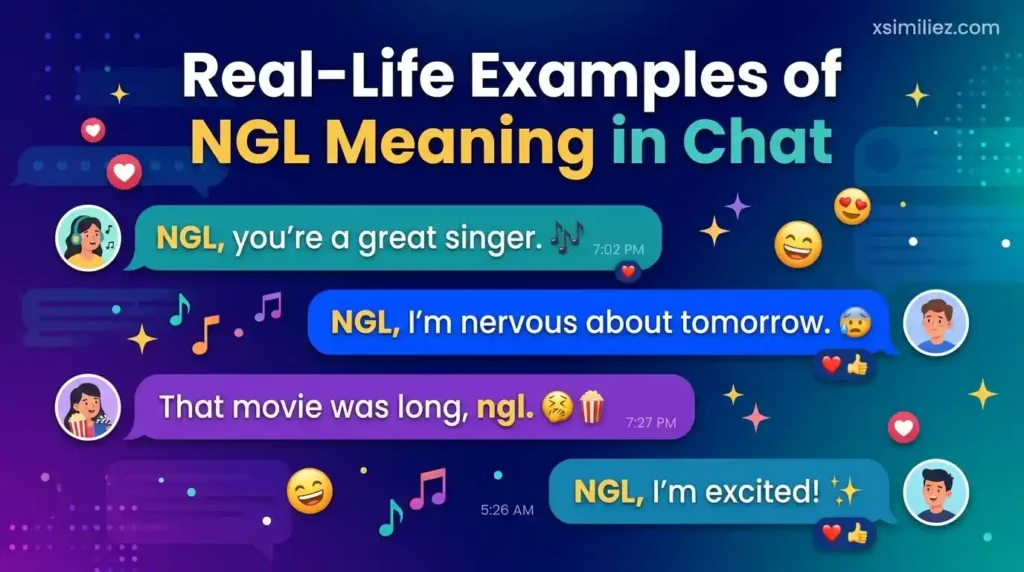
Seeing English in action is the best way to learn it. Here are some everyday messages and what they really mean.
A friend texts, “ngl, I’m nervous about tomorrow.” She is being open about her feelings. She trusts you enough to share them.
Someone commented on a video, “ngl, this recipe looks amazing.” That is a compliment, and the song makes it sound honest and warm.
Another person writes, “ngl, I didn’t finish the homework.” This is a confession. The ngl makes it sound less like an excuse and more like plain truth.
Here are a few more, laid out on a table.
| Message | What the Writer Means |
| “ngl, you’re a great singer.” | I really mean this compliment. |
| “That was a long movie, ngl.” | I want to be honest. It felt too long. |
| “ngl tho, I’d skip the party.” | However, my honest view is I would not go. |
| “ngl I’m lowkey excited.” | I am a little more excited than I expected. |
| “Not gonna lie, I forgot your birthday.” | A full-form version, used for a serious admission. |
Notice how the mood changes from one example to the next. Ngl can sit with good news, bad news, or just a casual thought. The tone of the rest of the message does the real work.
Current Usage and Trends of NGL Meaning in Chat
Ngl is still going strong. It is one of those slang terms that has settled into everyday online talk instead of fading away like some trendy words do. Most dictionaries that track internet slang now list it.
Younger people use it the most, especially teens and people in their twenties. But more adults are picking it up too. You will see it in group chats at work, in comment sections, and even in some brand posts on social media.
Social platforms keep it alive. Short videos, captions, and fast comments all reward quick, punchy language. Ngl fits that style perfectly. It is only three letters, and it adds personality.
One interesting trend is how ngl is shifting from “confession” to “casual filler.” More and more, people use it without any shocking truth behind it. That is a normal path for slang. Words start out strong and then become part of regular talk.
Because slang changes quickly, the exact way people use ngl may keep shifting. If you are unsure about a new twist, check how people in your own chats use it before copying them.
Tips and Best Practices for Using NGL in Chat
Using ngl well is mostly about reading the room. These tips will help.
First, know your audience. Ngl works great with friends, classmates, and teammates in casual chats. With teachers, clients, or older relatives who may not know slang, it is safer to write “honestly” or “to be honest.”
Second, use it with real feelings. Ngl hits best when it comes before a true thought. That keeps your messages sounding real instead of robotic.
Third, mix up your words. Try swapping ngl with “honestly,” “tbh,” or “to be real” now and then. Your chats will sound fresher.
Fourth, keep your kindness. Honesty and rudeness are not the same thing. If you need to say something hard, say it gently. “ngl, I think the second plan might work better” sounds much nicer than “ngl, your plan is bad.”
Fifth, match the tone. A serious message needs a serious ngl. A silly message can have a silly one. Adding a smile or emoji can help show your mood, since text can feel flat.
Last, keep it short. Ngl is already short, so let the rest of your message be clear and simple too.
FAQs About NGL Meaning in Chat
What does ngl mean in a text message?
It means “not gonna lie.” People use it to show they are being honest about something they think or feel.
Is ngl rude?
No, ngl is not rude by itself. It is just a way to be honest. But the message that comes after it can still be rude, so choose your words with care.
What is the difference between ngl and tbh?
They are very close. Ngl means “not gonna lie,” and tbh means “to be honest.” Most people use them the same way. Ngl often feels a bit more like a confession.
Can I use ngl in a work email or school paper?
It is best not to. Ngl is casual slang. For formal writing, use words like “honestly,” “frankly,” or “to be clear.”
Is ngl the same as the NGL app?
No. The slang word means “not gonna lie.” The NGL app is a separate anonymous messaging app that took its name from the phrase. Check the latest news and safety information before using it, especially for younger users.
Do I need capital letters when I write ngl?
No. You can write NGL, ngl, or Ngl. In chat, most people use lowercase. Capitals can make it feel louder, like you are stressing a point.
Conclusion:
The ngl meaning in chat is easy once you know it. It stands for “not gonna lie,” and people use it to share honest thoughts in a quick, friendly way. It can show up before a compliment, a confession, or a plain opinion.
Along the way, you learned how to place ngl in a sentence, how it differs from slang like tbh, and where it came from. You also saw the common mistakes, such as using it in formal writing or before a mean comment.
My best advice is to use ngl when you truly mean it, keep your tone kind, and save casual slang for casual chats. Do that, and your messages will sound natural, honest, and easy to read.

Hi, I’m Harper Blake, and I write for Xsimiliez.com. I enjoy sharing clear and friendly simile examples that students and beginners can understand easily. My goal is to make English learning simple and enjoyable.