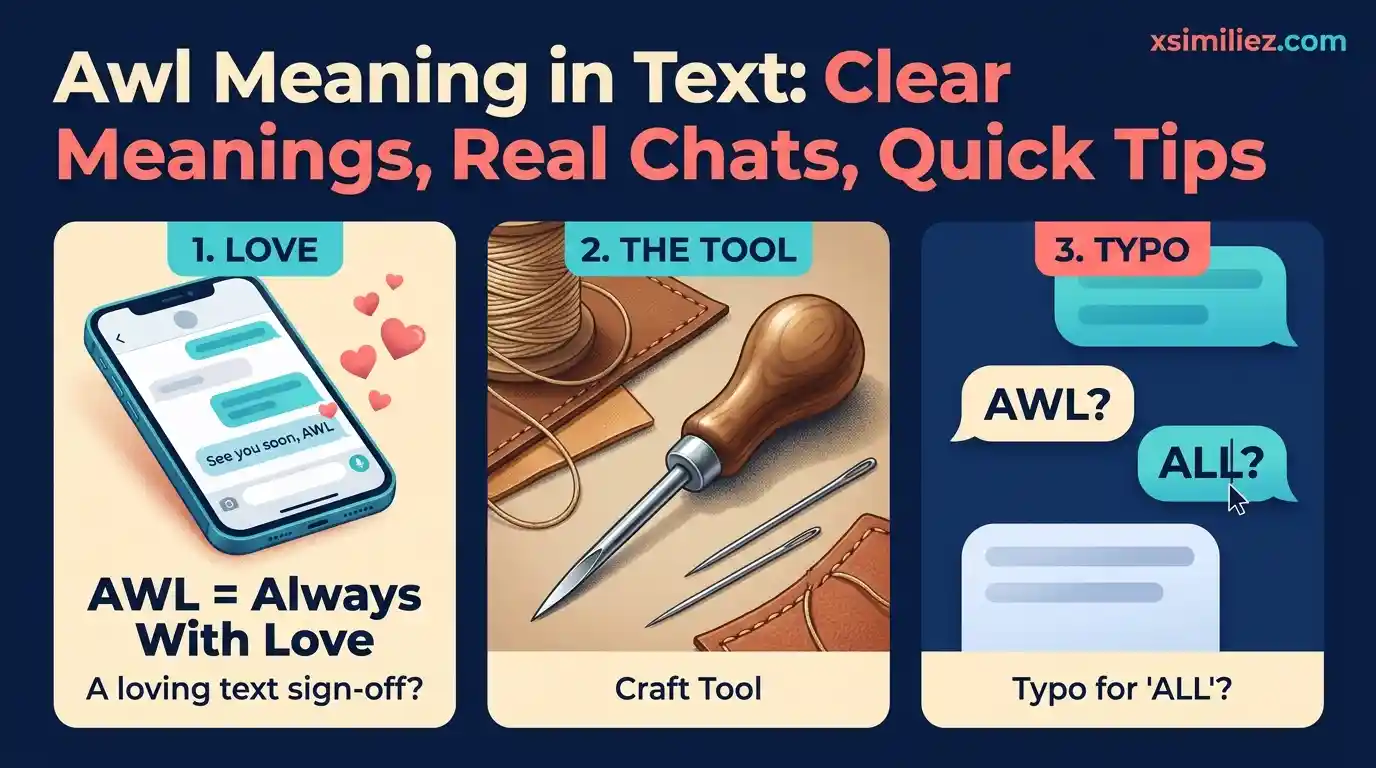
Awl meaning in text most often points to “Always With Love,” a sweet sign-off some people use in messages. But there is a catch. AWL is not a common texting short form, and it can mean other things. Context tells you which one is right.
Maybe a friend sent you “awl” and you froze. Was it a typo? Was it a tool? A secret code? You are not alone. Many people search for this word because it looks odd, and the web gives mixed answers.
In this guide, you will learn the main meaning, other meanings, how to use it, and mistakes to avoid. You will also get real examples, a few tables, and simple answers to common questions.
Quick Answer: Awl Meaning in Text
In a text message, AWL usually stands for “Always With Love.” People type it at the end of a kind message, much like “love always” or “with love.” It shows warmth and care.
Here is the honest part. AWL is rare. It does not show up on most popular lists of texting short forms. A few websites list other meanings, but they do not agree with each other. So treat AWL as a casual, informal term, not a firm rule.
If you see it, read the whole message. Look at who sent it and how they usually talk. A caring tone points to “Always With Love.” A silly tone might mean the person just mistyped “all.” When you are not sure, ask. A quick “What does AWL mean?” is polite and clear.
Awl Meaning in Text: Full Definition and Other Meanings
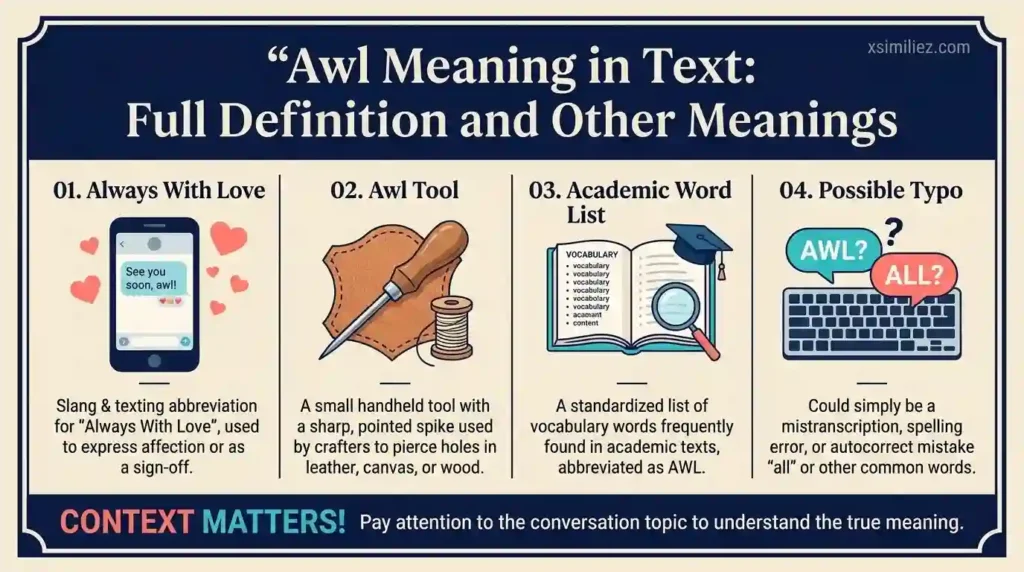
Let’s start with the meaning most often given online. “Always With Love” is a friendly closing. Think of it like signing a card. A mom might text it to her child. A friend might add it after a long, kind note. It is warm, soft, and personal.
Now for the other meanings. Some websites say AWL can mean “Away Laughing Loud,” which would be a way to show something is very funny. I could not find this in any trusted dictionary or language source, so it may be a rare or made-up use. It is best to treat it as unproven.
There is also a real word spelled A-W-L. An awl is a small tool with a sharp point and a handle. Workers use it to poke tiny holes in leather, wood, or paper. If someone texts about sewing or woodworking, they likely mean the tool.
One more real use comes from schools. AWL can stand for the Academic Word List, a list of 570 word families that show up often in school and college texts. Teachers who help students learn English often mention it.
The table below puts these meanings side by side.
| Meaning | Where You See It | How Sure Are We? |
| Always With Love | Friendly texts, captions, sign-offs | Most commonly listed, but informal |
| Away Laughing Loud | A few slang websites | Not confirmed by trusted sources |
| Awl (the tool) | Crafts, leatherwork, woodwork | Real dictionary word |
| Academic Word List | Schools and English classes | Real and well known in teaching |
| Typo for “all” | Fast, sloppy texting | Very common in real life |
How to Use Awl in Text the Right Way
Using awl in text is simple, but you should think about your reader first. It works best at the end of a message, as a warm goodbye. For example, “Proud of you, kiddo. AWL.” It also fits as a caption under a photo of family or close friends.
Capital letters are the usual style. Write AWL, not Awl, when you mean the short form. The capitals tell readers it is an acronym. Use lowercase “awl” only when you mean the tool, as in “I used an awl to make a hole in the belt.”
As for grammar, AWL is not a sentence by itself. It is a closing tag, like “xoxo.” You can place a period after it or leave it bare. Both are fine in a casual text.
Keep your reader in mind. If the person is new to texting slang, they may not know it. Older family members, coworkers, and teachers could be confused. In those cases, write the full words. “Always with love” is short enough, and it never confuses anyone.
Also, do not use AWL in school papers, job emails, or formal letters. Save it for casual chats with people who know you well.
Origin and History of Awl
The history of the texting meaning is hard to trace. No clear first user or date is known, and it is better to say that than to invent a story. What we can say is that people have shortened loving phrases for years. “Xoxo” and “ILY” are well-known examples. “AWL” may be one more in that long line.
The tool’s story is much clearer. The word “awl” is very old. It goes back to Old English, which people spoke over a thousand years ago. Early people used sharp points to make holes in animal skins for clothing and shoes. So the awl is one of the oldest hand tools we know.
The Academic Word List has a solid history too. A teacher and researcher named Averil Coxhead created it in 2000 at Victoria University of Wellington in New Zealand. She built it from a large set of school and college texts. Many English learners still use it today.
So the same three letters have three very different stories: a modern, loose texting habit, an ancient tool word, and a classroom list.
British vs American English: Awl Meaning in Text
Good news: there is no big split here. The word awl is spelled the same in both British and American English. The tool is also called an awl on both sides of the Atlantic.
The sound is close too. Most people say it like “all,” so awl and all sound alike in many accents. That is a big reason people mix them up in fast texts.
What can change is texting style. Americans may lean toward “xoxo” or “love always” in a note, while British texters often use kisses, such as “x,” at the end of messages. Neither group has one official rule, so it comes down to the person.
| Feature | American English | British English |
| Spelling of the tool | awl | awl |
| Sound | Close to “all” | Close to “all” |
| Common loving sign-off | xoxo, “love always” | x, xx, “love” |
| Use of AWL in texts | Rare, informal | Rare, informal |
Common Mistakes With Awl Meaning in Text
The first mistake is thinking AWL is a famous slang term. It is not. If you use it with a group of friends, do not be shocked when someone asks what it means.
The second mistake is mixing it up with AWOL. AWOL means “absent without leave.” It describes someone who is gone without permission, such as a soldier or a worker who does not show up. It has nothing to do with love. The table below shows how these look-alike words differ.
| Word | What It Means | Example |
| AWL | Always With Love (informal) | “Thinking of you. AWL.” |
| awl | A pointed hand tool | “She used an awl on the leather.” |
| AWOL | Absent without leave | “Dave went AWOL on Monday.” |
| all | Every one or everything | “I ate all the cookies.” |
| owl | A night bird | “An owl sat on the fence.” |
The third mistake is trusting every website. Some pages online repeat the same unproven meaning again and again. When many sites say the same thing, it can feel true even when it is not. Check for a trusted dictionary or a real person who uses the term.
The fourth mistake is forgetting the typo. People type fast. A text that says “awl good” probably means “all good.” Do not look for a deep secret code when a simple slip will do.
Last, do not use it in serious moments. Sending AWL after bad news can seem cold or confusing. Plain words are kinder.
Real-Life Examples of Awl in Text
Seeing awl in a real chat helps. Here are some simple cases. Each one shows how the meaning shifts with context.
Imagine a grandmother texts her grandson, “Good luck on your test today. AWL, Grandma.” Here, AWL most likely means “Always With Love.” The tone is soft and caring.
Now picture two friends planning a craft night. One writes, “Bring the leather and the awl. We will make wallets.” This is the tool. No slang is involved.
A third case comes from school. A teacher sends a note to students: “Study the AWL words before Friday’s quiz.” This points to the Academic Word List. The word “study” gives it away.
Last, a friend texts, “Awl set for tonight” This is almost certainly a typo for “All set for tonight” The meaning is clear from the rest of the sentence.
Social media works the same way. Under a photo of two sisters, a caption might read, “Best day ever. AWL.” Readers would most likely see that as warm affection. If the caption sits under a photo of a toolbox, it probably means the tool.
Notice how the words around awl do the work. When in doubt, check three things: the sender, the topic, and the mood. These clues solve most puzzles.
Current Usage and Trends of Awl in Text
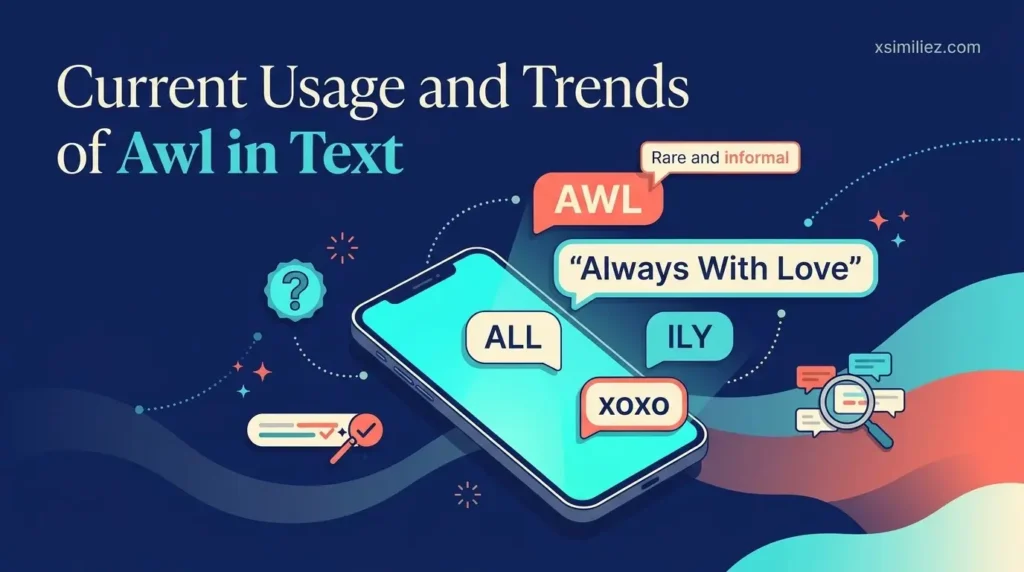
Right now, AWL is a small, niche term. It shows up mostly on slang-meaning websites and in the occasional caption or message. It is not trending the way short forms like “W” or “fr” have. Because it is rare, most readers need help to decode it.
Short forms spread when many people use them. Phones play a part too, since autocorrect often changes odd words. A typed “awl” might flip into “all” or “owl” without you noticing. That blurs the meaning even more.
Another trend is how people search. When they see an odd term in a message, they quickly look it up. That is why this question keeps coming up. The interest is real, even if the term is not common in everyday chats.
Also notice that online slang changes fast. A term can seem new one year and old the next. A meaning that is popular today could fade. Because of this, always check the person’s tone and ask when you are unsure.
For writers and brands, the lesson is simple. Do not build a message around a term few people know. Plain, clear words win every time.
Tips and Best Practices for Awl in Text
Here are practical ways to handle awl meaning in text without stress.
First, read the full message. The words near AWL almost always explain it. A warm message means “Always With Love.” A craft message means the tool.
Second, ask when you cannot tell. A short question saves time and avoids awkward guesses. You can say, “Quick question, what does AWL mean here?” Most people will gladly explain.
Third, know your audience. Use AWL only with people who will get it, like close friends or family you have talked to about it. With everyone else, spell out “always with love.”
Fourth, use trusted sources. Check a well-known dictionary for real words like awl. For slang, ask the sender, since few official lists cover rare terms.
Fifth, keep it casual. Skip AWL in work emails, school forms, and legal notes.
Sixth, proofread. A quick scan before you hit send can catch typos like “awl” for “all.” That small habit prevents lots of confusion.
Finally, if you want a sign-off that everyone understands, try “Warmly,” “Take care,” or “Love, [your name].” They are clear and kind.
FAQs
What does AWL mean in a text message?
Most often it means “Always With Love,” a friendly sign-off. It is rare, so check the message for clues. If the tone is not warm, it could be a typo for “all.”
Is AWL the same as AWOL?
No. AWOL means “absent without leave” and describes someone who is missing without permission. AWL is a different term, and it is usually a loving sign-off.
Can AWL mean “Away Laughing Loud”?
Some websites say so, but I could not confirm it in trusted sources. Treat it as unproven. If someone sends it to you, ask what they meant.
Is it okay to use AWL in work emails?
It is better not to. Most people do not know the term, and it can sound too casual. Write “Best regards” or “Warm wishes” instead.
How should I reply if someone sends me AWL?
If the message is kind, answer with “Thank you,” a heart, or “Same to you.” If you feel lost, just ask, “What does AWL mean?” Friends are usually happy to explain.
Why does awl look like a typo?
Because it sounds like “all” and looks like a mistyped word. Phone autocorrect can also swap letters and change the word you meant. That is why context matters so much.
Conclusion
So, what is the awl meaning in text? In most cases, it is a soft, informal way to say “Always With Love.” It can also be a tool, a school word list, or just a typo for “all.” The meaning depends on the message around it.
The big lesson is to stay calm and read the clues. Look at the sender, the topic, and the tone. If the clues do not help, ask. Nobody minds a friendly question, and it clears up confusion fast.
For your own messages, use AWL only with people who know it. For everyone else, write out the full words. Clear writing beats clever short forms every time. Now you can read the next “awl” you see with confidence.

Hi, I’m Harper Blake, and I write for Xsimiliez.com. I enjoy sharing clear and friendly simile examples that students and beginners can understand easily. My goal is to make English learning simple and enjoyable.