
HYU meaning in text is easy to learn. It stands for “hit you up,” which means “I will contact you.” Someone might use it to say they will text, call, or message you soon. If you just saw it in a chat and felt confused, you are not alone.
Short slang like this shows up everywhere now. People type fast, and short words save time. But a few letters can leave you guessing, and a wrong guess can make a chat feel awkward.
In this guide, you will learn what HYU means, how to use it, and where it came from. You will also see real examples, common mistakes, and simple tips. By the end, you will know exactly how to read and use it.
Quick Answer: HYU Meaning in Text
HYU is a slang acronym that means “hit you up,” and people use it in texting and on social media. It is the partner of HMU, which means “hit me up.”
So when someone writes “I’ll hyu later,” they mean “I’ll contact you later.” If you want the other person to reach out to you, you write HMU instead. If you plan to reach out to them, you write HYU. The “you” in HYU is the person getting the message.
Think of it like this. HYU is about what you will do. HMU is about what you want the other person to do. That small difference is the most important part to remember.
What Is the Meaning of HYU in Text

The full phrase is “hit you up.” It sounds strange if you take the words one by one. Nobody is hitting anybody. In everyday English, “hit someone up” is a casual way to say “contact someone.” It is a common, informal idiom that people often use when messaging a friend.
Contact can be many things. It might be a text, a phone call, a direct message, or a quick note on social media. The phrase does not say which one. That is part of why people like it. It is loose and easy.
HYU can carry a few different feelings, depending on the chat. The table below shows how the same three letters can do different jobs.
| How it is used | What it means | Example |
| A promise | I will contact you soon | “Got to run, will hyu tonight.” |
| A plan | I will reach out when I know more | “I’ll hyu once I get my schedule.” |
| A reminder | Do not forget I will message you | “Hyu after school, okay?” |
| A complaint | I always contact you first | “Why do I always have to hyu first?” |
Notice that the last row has a sad or annoyed feeling. People sometimes use HYU when they feel they are the only one trying. That is a real way people use it online, so tone matters. Always read the rest of the message before you decide how the writer feels.
HYU Meaning in Text: Grammar and Correct Usage
HYU works like a short verb phrase. It does not work like a noun. You would not say “I sent you a hyu.” Instead, you place it after a subject, like “I,” “we,” or “they.”
Here are a few simple patterns that work well. “I will hyu later” is the most common pattern. You can also shorten it to “I’ll hyu later.” Another pattern is “I’ll hyu tomorrow.” You can even use it in a question, like “Should I hyu after dinner?”
Capital letters do not matter much in texting. You can write HYU, hyu, or Hyu, and people will understand. Most people use lowercase because it feels more relaxed. All capitals can feel louder, like you are excited or stressed.
Punctuation is flexible too. A period at the end is fine. An exclamation mark makes it feel friendly. Many people skip punctuation completely.
One more tip about grammar. HYU does not change for past tense. If you already contacted someone, it is clearer to write the full words, such as “I hit you up yesterday.” Writing “I hyu’d you” looks odd, and many readers will not get it. Stick to the simple, forward-looking use. It is clean, and it keeps your message easy to read.
How HYU Compares to HMU

People mix up HYU and HMU all the time. They are close cousins, but they point in opposite directions. Seeing them next to each other makes it much easier to remember.
| Feature | HYU | HMU |
| Full phrase | Hit you up | Hit me up |
| Who acts | The writer | The reader |
| Typical meaning | “I will contact you” | “Contact me” |
| Common sentence | “I’ll hyu later” | “Hmu if you want to hang out” |
| How common it is | Less common | Much more common |
HMU is far more popular than HYU in everyday chats. That is simply what most slang lists and online chat habits suggest. Because of that, you might see HMU ten times before you see HYU once.
Here is an easy memory trick. Look at the middle letter. In HYU, the Y stands for “you,” so you are the target. In HMU, the M stands for “me,” so the writer is the target. If you keep that in mind, you will never swap them by mistake.
Origin and History of HYU
The roots of HYU come from the phrase “hit you up.” This idiom has been used in spoken English for a long time, mostly in casual talk. People said it out loud long before they typed it as an acronym.
As for the exact first use of HYU as a text shortcut, there is no clear record. No trusted source shows who typed it first or on what day. So it is best not to guess. What we can say is that the shortcut shows up in public posts online. Dictionary.com lists social media posts from around 2016 to 2018 that use HYU. That tells us people were already using it in the middle of the 2010s.
This path is common for slang. A phrase starts in speech. Then people type it. Then, to save time, they shrink it to a few letters. Acronyms like LOL, BRB, and HMU all followed this road.
It also helps to know that slang changes fast. A word can be hot one year and old the next. HYU never became as famous as HMU, but it stayed alive in friend chats, comments, and direct messages.
Real-Life Examples of HYU in Text
Examples make slang easier to learn. Here are some everyday chats where HYU fits well.
Imagine two friends planning a movie night. One writes, “I have homework first. Will hyu around 7.” The other replies, “Sounds good, text me when you’re done.” Here, HYU is a simple promise.
Now picture a busy parent. They get a message from a coworker and answer, “In a meeting right now. I’ll see you after lunch.” The meaning is clear and polite. It tells the other person they have not been forgotten.
Here is a sweeter example. A teen writes to a cousin, “Hyu this weekend, let’s play games.” That sounds friendly and exciting.
Sometimes HYU shows a little frustration. Someone might write, “I always hyu first, and I never hear back.” You can feel the hurt in that line. It is not rude, but it is honest.
A final example shows a funny use. A person tells a friend, “If I hyu at 2 a.m., ignore me.” This is a joke about late-night texts. People often use HYU in playful lines like this because it feels light.
You can see that the meaning stays the same each time. Only the feeling changes. That is why reading the full message matters more than the three letters alone.
Common Mistakes People Make with HYU
The biggest mistake is mixing up HYU and HMU. Writing “hyu if you need me” when you mean “hmu if you need me” tells the reader the opposite of what you want. Always check which person is supposed to reach out.
The second mistake is confusing HYU with look-alike slang. Many text terms share the same letters, and they mean very different things. The table below shows a few that cause trouble.
| Term | Common meaning | Notes |
| HYU | Hit you up | The writer will contact you |
| HMU | Hit me up | The reader should contact the writer |
| HYY | A casual “hi” | A friendly, informal way to say hello |
| HYI | “Yuck” or “ew” | An interjection that shows disgust, and it is not a greeting |
| YHU | Unclear | Online pages disagree, so ask the sender |
The row for YHU is worth a closer look. Some websites claim it means “yeah, you,” while others offer different ideas. Because the sources do not agree, it is safer to treat YHU as unclear and simply ask the person what they meant.
A third mistake is using HYU in the wrong place. It is slang. It fits a text to a friend, but it does not belong in a job email, a school paper, or a message to a boss. In those cases, write “I will contact you” instead.
The last mistake is assuming it always has one meaning. Some acronym sites list several meanings for HYU, including school, medical, and computer terms. For example, a university can use those letters as a short name. In a regular text chat, “hit you up” is nearly always the answer. But if the topic is school, health, or tech, think twice.
Current Usage and Trends
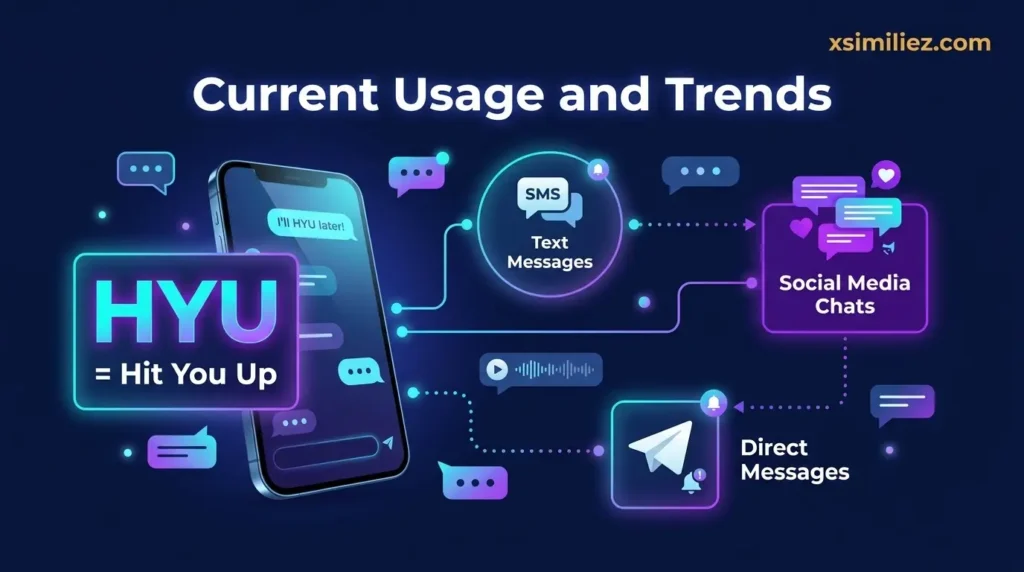
Today, HYU lives mostly in casual chats. You may spot it in text messages, comments, and direct messages on apps like Instagram, Snapchat, and WhatsApp. Acronym sites say HYU appears in messaging and chat forums, as well as in social apps.
Who uses it most? Younger people tend to use text slang more often, but plenty of adults use it too, especially with close friends. It feels relaxed, and it saves a few seconds.
Still, HYU is a quiet slang term. It does not blow up on trend lists the way new words do. Many people simply type “hit you up” in full, or they use HMU instead. That is fine. Slang does not need to be popular to be useful.
Another trend is that people now blend slang with emojis and short voice notes. A message like “hyu later 👍” feels warm and quick. Others skip the acronym and send a voice note instead. Both ways work.
One more point. Because language changes so fast, a term can slip in or out of style without warning. If you want to stay current, watch how your friends write. That is the best guide of all. And if you are unsure what something means, asking is perfectly okay. Nobody expects you to know every shortcut.
Tips and Best Practices for Using HYU
Here are a few friendly tips to help you use HYU well.
First, match your audience. Use HYU with friends, family, and people your age. Skip it with teachers, bosses, and clients. If you are not sure, write the full phrase.
Second, keep your promise. When you tell someone you will hyu, do it. A forgotten promise can hurt trust, even in a small chat. If your plans change, send a short update like “Running late, will message you tomorrow.”
Third, add a time when you can. “Will you tonight” is better than “will hyu.” A time gives the other person something to count on, and it avoids the sad feeling of waiting.
Fourth, check the tone before you hit send. A light “hyu later” feels friendly. A cold “hyu.” can feel short or upset. Small things like an exclamation mark or an emoji can change the mood.
Fifth, do not overuse slang. If every line is full of shortcuts, your message can be hard to read. Use one or two and keep the rest in plain words.
Last, if someone sends you HYU and you are unsure, just reply with a simple “Sounds good” You can also ask, “What do you mean?” Both answers are polite and natural.
FAQs About HYU Meaning in Text
What does HYU mean in text?
It means “hit you up.” The writer is saying they will contact you by text, call, or message. It is a casual and friendly shortcut that most people use with friends.
Is HYU the same as HMU?
No. They are partners, but they point in different directions. HYU means the writer will reach out to you. HMU means the writer wants you to reach out to them.
Is HYU rude or friendly?
Most of the time it is friendly. It simply shows a plan to get in touch. The tone only turns sour when it is used in a complaint, like “I always have to hyu first.” Read the whole message to know the mood.
Can I use HYU in a work email?
It is best to avoid it. HYU is slang, and work messages usually need clear, polite words. Try “I will contact you” or “I will follow up with you” instead.
How should I reply when someone texts HYU?
Keep it short and warm. You can say “Okay, talk soon” or “Sounds good.” If you want to set a time, add something like “Text me after 6.” That keeps the plan clear.
Does HYU ever mean something else?
Sometimes. Certain acronym websites list other meanings, like a school or group name. But in a normal text chat, “hit you up” is almost always correct. If the topic does not fit, ask the sender.
Conclusion
Now you know the HYU meaning in text. It stands for “hit you up,” and it tells someone you plan to contact them. It is the friendly partner of HMU, and the only difference is who does the reaching out.
Remember the main points. Use HYU for casual chats with people you know. Avoid it in work or school writing. Watch out for look-alike terms like HYY, HYI, and YHU. And always read the full message so you catch the tone.
If you ever feel stuck, here is the best advice. Ask. A quick “What does that mean?” is better than a wrong guess. Slang is just a tool for talking. Use it when it helps, skip it when it does not, and keep your messages clear and kind.

Hi, I’m Mason Avery, a content writer at Xsimiliez.com. I like writing about similes, figurative language, and creative expressions. I believe learning English becomes easier when examples feel natural and relatable.