Thepleading no contest meaning is simple: you tell the court you will not fight the charge. You do not say you are guilty, and you do not say you are innocent. The judge still finds you guilty and sets a sentence.
Many people search for this phrase after a ticket, an arrest, or a court scene on TV. The words sound strange, and the stakes feel high. One wrong guess can cost money, a job, or even your freedom. That is why a clear answer matters.
In this guide, you will learn what a no contest plea is, how it works, and how it differs from guilty and not guilty pleas. You will also see real examples, common mistakes, and smart tips. Let us start.
Quick Answer: Pleading No Contest Meaning in Plain Words
Pleading no contest means you choose not to argue against a criminal charge. The court then treats you as guilty and moves to sentencing. The plea is also called “nolo contendere,” which is Latin for “I do not wish to contend.”
Think of it like this.With a guilty plea, you say, ‘I did it.’ A not guilty plea sends the message, ‘Prove it.’ But when you plead no contest, you say, ‘I will not fight this You accept the punishment, but you do not say the words “I am guilty.”
That small difference can matter a lot. In many places, a no contest plea cannot be used as proof against you in a later civil lawsuit. A guilty plea often can. Still, the criminal result is almost always the same. You are convicted, and the conviction goes on your record.
Please remember that this article is for learning only. It is not legal advice. Court rules change from state to state, so talk to a licensed lawyer about your own case.
Pleading No Contest Meaning and Definition
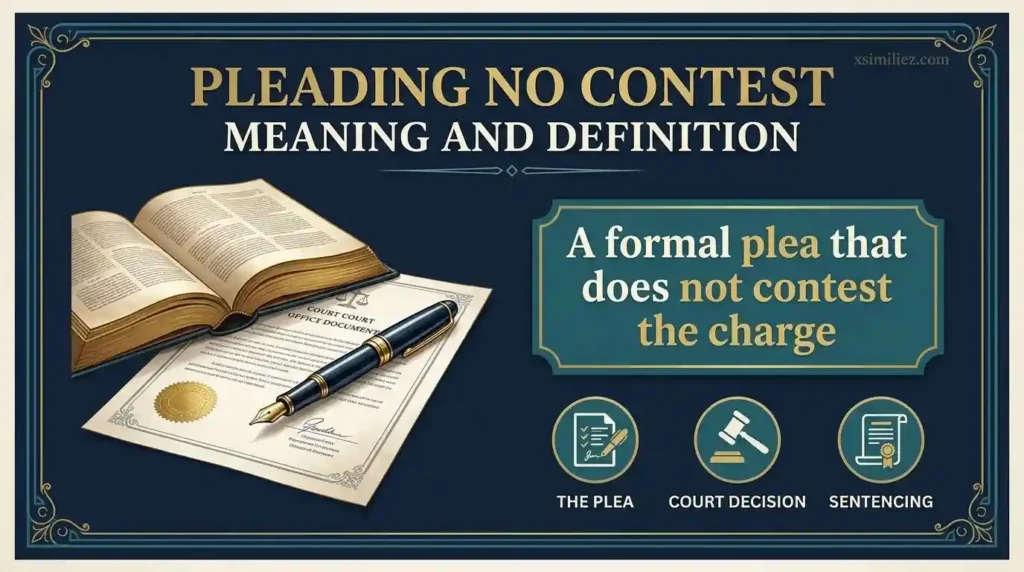
Let us go deeper into the definition. A “plea” is your formal answer to a criminal charge. The most common answers are guilty and not guilty. A no contest plea is a third choice that many courts allow.
When you plead no contest, you do three things. First, you give up your right to a trial. Second, you accept that the court may find you guilty based on the facts the prosecutor presents. Third, you agree to face the sentence, which might include fines, probation, classes, or jail time.
What you do not do is admit guilt out loud. The judge may read a short summary of the facts. You simply do not argue with it.
Here is a tip about the word “contest.” In this case, it means to fight or challenge. So “no contest” means “no challenge.” Some people think it means “no competition,” but that is not the legal meaning.
Another term you may see is “nolo plea.” It is just a short way to say the same thing. Lawyers, judges, and news writers use “no contest” and “nolo contendere” to mean the same plea. Both phrases appear in court papers, so it helps to know them.
How a No Contest Plea Works in Court
You cannot always just walk in and say “no contest.” In most courts, the judge must agree to accept the plea. In federal court, for example, the judge looks at what both sides want and what is best for justice. A few states limit or do not allow the plea at all.
Here is how it usually goes, step by step.
First, you meet with your lawyer. Together, you decide if this plea makes sense. Often, the prosecutor offers a deal, such as a lighter sentence or fewer charges, in return for your plea.
Next, you go before the judge. The judge asks questions to make sure you understand what you are doing. This talk is often called a “plea colloquy.” The judge wants to know that you are not being forced, that you know your rights, and that you understand the possible punishment.
Then the judge accepts the plea. The court enters a finding of guilt, and sentencing follows. Sometimes sentencing happens right away. In bigger cases, it happens weeks later.
Here is a quick look at correct usage in a sentence. You can say, “He is pleading no contest to the charge.” You can also say, “She entered a no contest plea.” People often write “pleaded no contest” for the past tense, though “pled no contest” is also common in the United States.
Origin of Nolo Contendere

The phrase “nolo contendere” comes from Latin, as noted. It means “I do not wish to contend.” The idea grew out of old English law, hundreds of years ago. Early on, a person might ask the Crown for mercy instead of fighting a charge.
Historians do not agree on every detail of how the plea first took shape. So it is safest to say that it grew slowly over time within English common law. American courts later adopted it, and it became part of many state and federal systems.
The plea is far more common in the United States than in other places. In England and Wales, the usual choices are guilty and not guilty, and nolo contendere is not a regular plea there. So if you read a British news story, you will rarely see this phrase.
Today, American courts use the plea for many reasons. It can save time, lower costs, and help settle cases faster. It also helps defendants who fear that a guilty plea could be used against them in a civil case. That last point is one big reason the plea survived for so long.
Pleading No Contest vs Guilty vs Not Guilty
Many readers want to see the choices side by side. The table below shows how the three pleas compare in everyday terms.
| Feature | Guilty | No Contest | Not Guilty |
| What you say | “I did it” | “I will not fight it” | “I did not do it” |
| Trial held? | No | No | Yes |
| Will the judge find you guilty? | Yes | Yes | Only if proven |
| Can it be used in a civil lawsuit? | Often yes | Often no | Not applicable |
| Should the judge approve? | Yes | Yes, and it may be refused | No |
| Criminal record? | Yes | Yes | Only if convicted |
You may also hear about an “Alford plea.” It is close to a no contest plea, but not the same. In an Alford plea, you say you are innocent, yet you admit the state has enough evidence to convict you. The name comes from a 1970 U.S. Supreme Court case, North Carolina v. Alford. A no contest plea does not need you to say anything about your innocence.
So which one is right? It depends on the facts, the evidence, and the deal on the table. That is a decision to make with a lawyer, not alone.
Common Mistakes About Pleading No Contest Meaning
Many people get the pleading no contest meaning wrong. Here are the most common mistakes, with the facts.
Mistake one: “No contest means no conviction.” This is false. A no contest plea leads to a conviction in nearly every case. It shows up on background checks, just like a guilty plea.
Mistake two: “It is the same as not guilty.” It is not. A not guilty plea sends you to trial. A no contest plea ends the fight.
Mistake three: “It keeps me safe from every lawsuit.” Not always. A no contest plea often cannot be used against you in a later civil case, but the facts of what happened can still be argued there. Rules vary, so ask your lawyer.
Mistake four: “It will not hurt my immigration status.” This one can be very risky. Under federal immigration law, a no contest plea is usually treated as a conviction. If you are not a U.S. citizen, speak with an immigration lawyer before you enter any plea.
Mistake five: “I can change my mind later.” Taking back a plea is hard. Courts usually allow it only before sentencing, and only for a good reason. After sentencing, the door is mostly closed.
Mistake six: “Traffic tickets do not count.” Some do. A no contest plea to a traffic charge can still add points to your license or raise your insurance rates.
Real-Life Examples of Pleading No Contest
Examples make the idea easier to see. Here are a few, some real and some simple made-up ones.
A famous real case comes from 1973. Spiro Agnew, then the Vice President of the United States, pleaded no contest to a tax charge. He also left office as part of the deal. The case showed how the plea can end a legal fight without a trial.
Now picture a simple, made-up case. A driver hits another car and gets charged with careless driving. The other driver plans to sue. The first driver pleads no contest to the traffic charge. The court still finds the driver guilty and sets a fine. But in many places, the plea cannot be used as an admission in the lawsuit.
Here is another everyday example. A person gets a minor charge for a small fight. The prosecutor offers probation if the person pleads no contest. The person agrees to avoid a long trial and high lawyer bills.
The table below shows how these cases look at a glance.
| Situation | Why Choose No Contest? | Main Result |
| Tax case with a public official | Ends the case without a trial | Conviction and sentence |
| Car crash with a possible lawsuit | May limit use of the plea in civil court | Fine and a record |
| Minor fight charge | Saves time and money | Probation and a record |
Tips Before Pleading No Contest
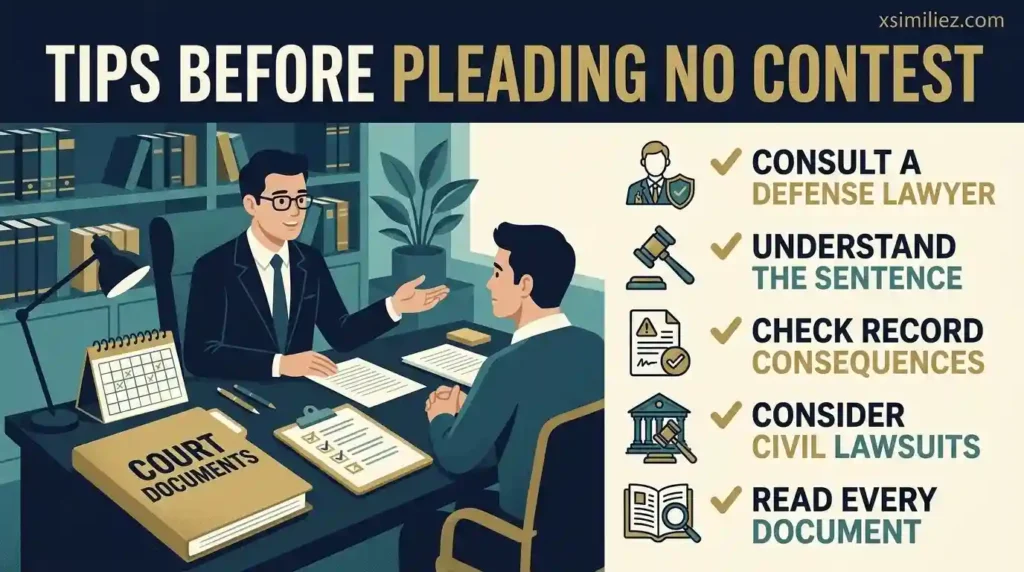
A plea is a big step. These tips can help you think it through.
Talk to a defense lawyer first. This is the most important step. A lawyer can tell you how your state treats the plea and what the deal really means.
Ask about the record. Find out if the conviction can be sealed or removed later. Some states allow this after a set time or after you finish probation.
Check for side effects. A conviction can affect your job, your housing, your gun rights, your professional license, and your right to vote in some places. If you are not a citizen, it can affect your immigration case too.
Ask about lawsuits. If someone may sue you over the same event, ask how the plea could play out in that case. This is often the main reason people choose no contest.
Read every paper before you sign. Do not rush. If you do not understand a word, ask the lawyer to explain it in plain English.
Think about the long run. A quick deal today can follow you for years. Weigh the pros and cons before you decide.
| Pros | Cons |
| Ends the case faster | Still leads to a conviction |
| Often cannot be used in a civil case | Judge may refuse the plea |
| Can come with a lighter deal | Hard to take back later |
| Avoids saying “I am guilty” | May hurt jobs and immigration |
FAQs
1. What does pleading no contest mean in simple words?
It means you will not fight the charge. You do not admit guilt, but the court still finds you guilty and gives a sentence.
2. Is pleading no contest the same as pleading guilty?
For the criminal case, the result is almost the same. You are convicted either way. The big difference is that a no contest plea often cannot be used against you in a civil lawsuit.
3. Does a no contest plea go on my record?
Yes. In most cases, it appears as a conviction on your criminal record and may show up on background checks.
4. Can a judge refuse a no contest plea?
Yes. You do not have a right to this plea. The judge must agree to accept it, and some courts only allow it in certain cases.
5. Can I take back a no contest plea?
Sometimes, but it is hard. Courts usually let you withdraw a plea only before sentencing and only for a strong reason. Ask your lawyer about your state’s rules.
6. Does pleading no contest affect immigration?
It can. Federal immigration law usually treats a no contest plea as a conviction. Non-citizens should speak with an immigration lawyer before making any plea.
Conclusion
The pleading no contest meaning comes down to this: you accept the charge without saying you are guilty. The court still convicts you and sets a sentence. The plea is also called nolo contendere, and many courts allow it with the judge’s approval.
The biggest benefit is that a no contest plea often cannot be used against you in a later civil case. The biggest risk is that it still creates a criminal record. It can also affect jobs, licenses, and immigration status.
Before you choose any plea, talk to a licensed lawyer. Ask clear questions, read every paper, and think about the long term. A smart, calm choice today can protect your future.

Hi, I’m Mason Avery, a content writer at Xsimiliez.com. I like writing about similes, figurative language, and creative expressions. I believe learning English becomes easier when examples feel natural and relatable.