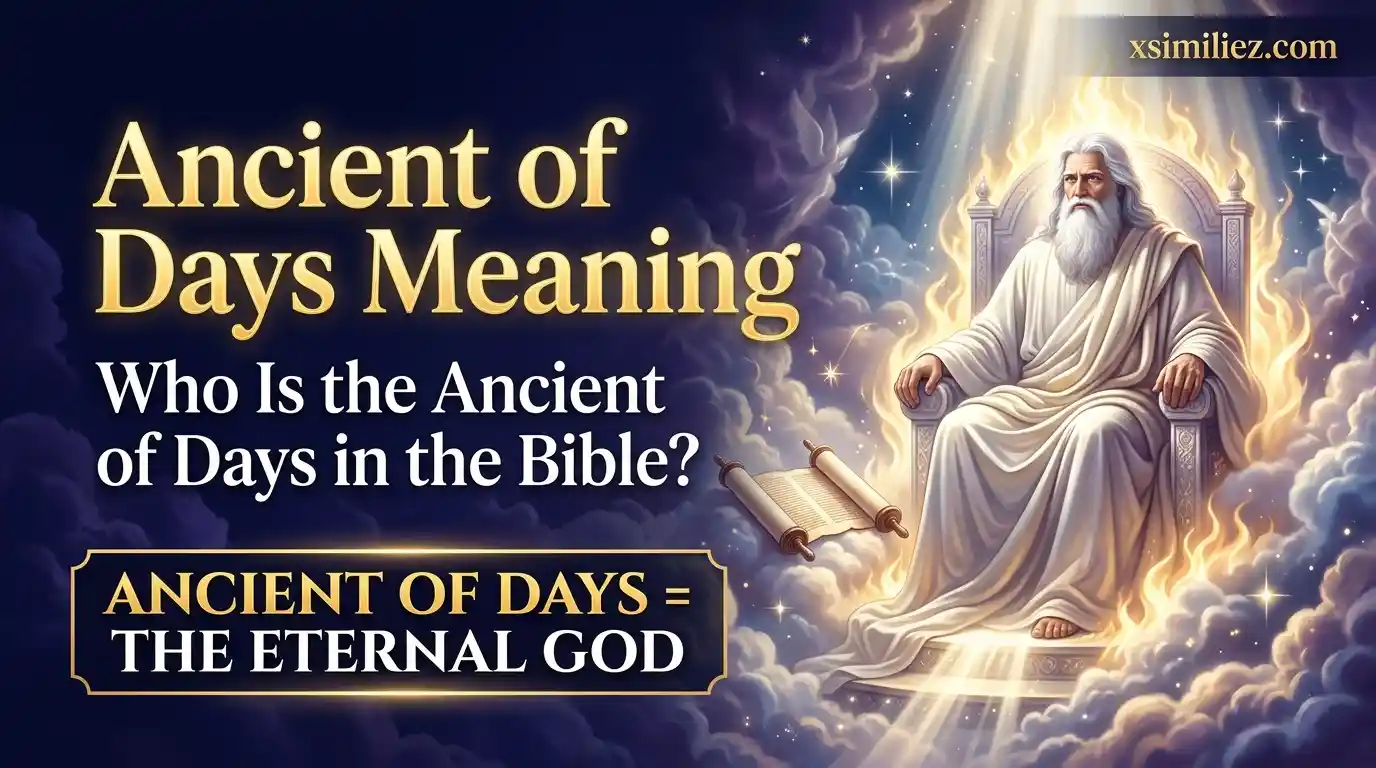
The Ancient of Days meaning is simple. It is a title for God in the Book of Daniel, and it shows Him as eternal, wise, and the final judge of all the earth. Many people see the phrase in the Bible, in songs, or in old paintings and want a clear answer.
People search for this phrase for many reasons. Some are reading Daniel for the first time. Others heard it in church and got curious.
In this guide, you will learn what the title means, where it appears, and what the original words say. You will also see how different groups explain it, which mistakes to avoid, and how to use the phrase correctly.
Quick Answer: What Is the Ancient of Days Meaning?
In short, the Ancient of Days means “the One who is very old and has lived forever.” It is a name for God. The phrase comes from the Book of Daniel, chapter 7. In that chapter, Daniel sees a vision of heaven. A powerful being takes a seat on a throne, and thousands of servants stand before Him. Books are opened, and judgment begins.
The title tells us three things about God. First, God is eternal. He was here before time began and he will be here when time ends. Second, God is wise, like a respected elder who has seen everything. Third, God is the final judge. No king or nation on earth is greater than He is.
Those three ideas sit at the heart of the Ancient of Days meaning. The rest of this article builds on them.
Ancient of Days Meaning and Definition
Let’s break the phrase into small parts. The word “ancient” means very old, from a long time ago. The word “days” stands for time. Put together, “Ancient of Days” means “one who is old in days.” That is an older way of saying “one who has lived for a very long time.”
Today we would say “advanced in years” or “very aged.” But in Daniel, the phrase does not describe someone weak or tired. It describes someone with great honor and power. In many ancient cultures, old people were seen as wise and worthy of respect. The title borrows that picture and applies it to God in the biggest way possible.
The table below shows how the English phrase matches the original Aramaic words.
| English Word | Aramaic Word | Simple Meaning |
| Ancient | attiq | Old, aged, advanced in age |
| Days | yomin | Days, time (plural of “yom”) |
| Ancient of Days | attiq yomin | The One who is old in days; the Eternal One |
Some Bible versions use a different wording. The New Living Translation says “the Ancient One.” The New Revised Standard Version says “an Ancient One.” The idea is the same in each case. The reader is meant to picture a being who is full of age, honor, and authority.
Where the Ancient of Days Appears in the Bible
The exact phrase shows up only in the Book of Daniel, chapter 7. It appears three times, in verses 9, 13, and 22. It is not used anywhere else in the Bible. That surprises many readers, because the title feels so well known.
Daniel 7 begins with a dream. Daniel sees four strange beasts rise out of a stormy sea. Each beast stands for a powerful kingdom. The last one is the most frightening. Then the scene changes. In verse 9, thrones are set in place, and the Ancient of Days takes His seat. His clothing is white as snow. The hair on His head is like pure wool. His throne is made of flames, and its wheels burn with fire.
In verse 13, Daniel sees “one like a son of man” coming with the clouds of heaven. This figure walks up to the Ancient of Days and is brought into His presence. He is given power, glory, and a kingdom that will never end.
In verse 22, the Ancient of Days comes and judges in favor of God’s holy people. Then the time arrives for them to receive the kingdom. So the title always shows up at the moment of judgment and justice.
Origin and History of the Ancient of Days Meaning
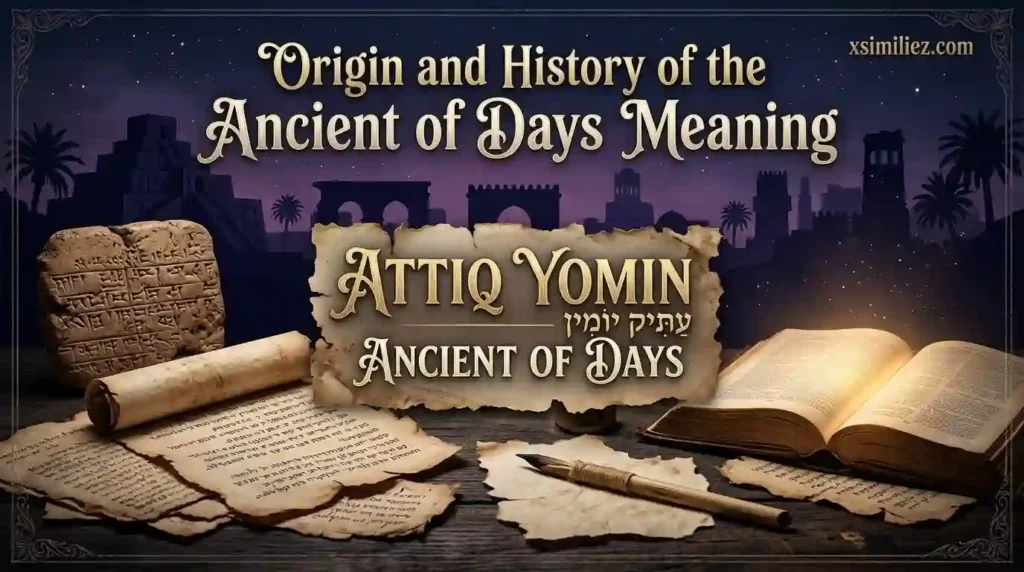
Part of the Book of Daniel was written in Aramaic, not Hebrew. Aramaic was a common language across the Near East in ancient times. Daniel 2:4 through 7:28 is in Aramaic, so the phrase “attiq yomin” comes from that language.
When was the book written? Traditional Jewish and Christian readers say Daniel lived in Babylon in the 500s BC. Many modern scholars think the book took its final form in the 160s BC, when a cruel ruler named Antiochus IV was hurting the Jewish people. Readers still disagree on this point. Either way, the message of the vision is the same. Earthly empires rise and fall, but God stays on the throne.
Some scholars see a link between this picture and very old writings from Canaan, where the chief god, El, was shown as an aged father. Experts debate that idea, so it should be treated with care.
Later Jewish writing kept the image alive. The Book of 1 Enoch uses the phrase “Head of Days” in a similar vision. In Jewish mystical writing, such as the Zohar, the Aramaic name “Atik Yomin” points to a very high and hidden side of God. Early Christian writers also studied the vision closely, and the title has stayed part of Christian worship ever since.
Who Is the Ancient of Days? Main Views Explained
Most readers agree that the Ancient of Days is God. The harder question is which part of God, and here traditions explain things a little differently.
In Judaism, the Ancient of Days is understood as God, the eternal King and Judge. Jewish mystical teaching adds deeper layers about the “Ancient Holy One.”
Many Christians believe the Ancient of Days is God the Father. They see “the son of man” in verse 13 as Jesus, since Jesus often called Himself the Son of Man. In Mark 14:62, He told the high priest that people would see the Son of Man coming on the clouds. That echoes Daniel 7 closely.
Another group of Christians, mainly in the Eastern Orthodox world, has painted icons that show Christ as the Ancient of Days. One reason is Revelation 1:14, where the risen Jesus is shown with hair “white like wool.” The picture sounds a lot like Daniel’s.
| Tradition | Common View | Main Reason |
| Judaism | God, the eternal King and Judge | The vision shows God ruling over all nations |
| Most Protestant and Catholic readers | God the Father | The Son of Man is a second figure in the same scene |
| Some Orthodox icons | Christ shown as the Ancient of Days | Revelation 1 uses similar images for Jesus |
Thoughtful people respectfully disagree here. It helps to read the text first and then compare what each tradition says.
Symbols in the Ancient of Days Vision
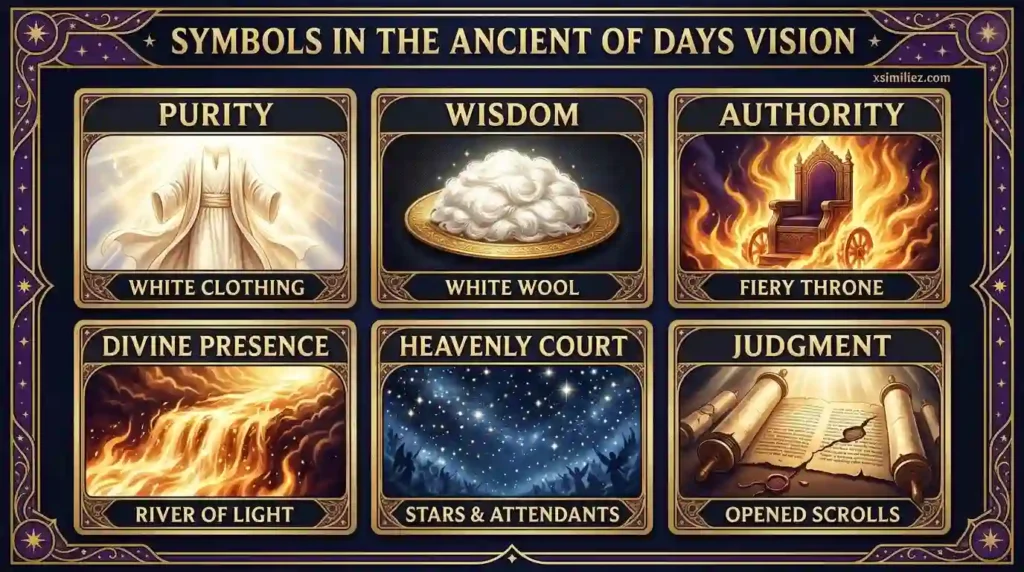
Daniel’s vision is full of pictures. Each one carries meaning, and knowing them makes the Ancient of Days meaning much richer.
White clothing is a sign of purity and holiness. God is perfectly good and has no stain at all. The hair “like pure wool” points to age and wisdom, and it also adds to the idea of cleanness. White hair was a mark of honor in the ancient world.
The fiery throne and burning wheels show power and judgment. Fire in the Bible often stands for God’s holy presence. A river of fire flowing from His throne, mentioned in verse 10, adds to that sense of awe. Thousands upon thousands serve Him, and ten thousand times ten thousand stand before Him. This tells us the heavenly court is huge and full of order. Finally, the books that are opened remind us that God’s judgment is fair and based on truth.
| Symbol in Daniel 7 | What It Likely Shows |
| Clothing white as snow | Purity and holiness |
| Hair like pure wool | Age, wisdom, and honor |
| Throne of flames | Power and judgment |
| River of fire | God’s holy presence |
| Countless servants | A vast, orderly heavenly court |
| Opened books | Fair and true judgment |
Notice that the vision does not give a full face or a detailed body. It focuses on a few strong signs, and those signs say more about who God is than about how He looks.
Grammar and Correct Usage of Ancient of Days
Using the phrase the right way is easy once you know a few rules. Start with the capital letters. Write both “Ancient” and “Days” with a capital letter, since the phrase works like a title or a name. Most writers also put “the” in front of it. So you would write “the Ancient of Days,” just like “the Almighty.”
The phrase is singular. It points to one being, so you pair it with a singular verb. For example, “The Ancient of Days sits on the throne.” Many writers use capital letters for pronouns that refer to God, such as “He” or “His.” Others prefer lowercase in modern style. Either choice is fine, as long as you stay consistent.
Here are a few correct examples:
“In Daniel 7, the Ancient of Days takes His seat on a throne.”
“Many hymns praise the Ancient of Days for His endless power.”
Avoid using the phrase for an ordinary older person. A playful joke might upset readers who treat the title as sacred. Also, avoid turning it into “an ancient of days” unless you are quoting a Bible version that uses a similar form, such as “an Ancient One.” The title is best left whole.
Common Mistakes About the Ancient of Days Meaning
Even careful readers slip on this topic. Here are the most common mistakes.
The first mistake is thinking the phrase only means God is old. Age is part of it, but the deeper point is that God is eternal, wise, and in charge. He is not old like a person who grows tired.
The second mistake is believing the phrase appears all over the Bible. It does not. It is found only in Daniel 7, in three verses. Other passages share similar ideas, but they do not use these exact words.
The third mistake is mixing up the Ancient of Days with the Son of Man. In Daniel’s vision, these are two figures in one scene. The Son of Man walks up to the Ancient of Days. Keeping them apart helps you read the passage clearly.
The fourth mistake is treating one view as the only possible one. As you saw earlier, Jewish and Christian readers explain the details in more than one way.
The fifth mistake is taking famous artwork as the Bible’s own picture. William Blake’s well-known 1794 image called “The Ancient of Days” shows a figure bending down with a compass. It is a strong work of art, but it comes from Blake’s imagination. Daniel’s text does not describe a compass or that pose.
Real-Life Examples, Current Usage, and Study Tips
You can find the Ancient of Days in many places today. Churches use the title in prayers, sermons, and worship songs. Bible studies often spend a full session on Daniel 7. Artists and writers keep returning to the image, and Blake’s painting is still one of the best-known examples. Some Orthodox churches display icons that show the Ancient of Days with white hair and a calm, strong face. Authors also borrow the phrase for book titles and chapter names because it sounds grand and timeless.
Here are two simple sentences showing how people use it in daily life:
“Our pastor said the Ancient of Days is not limited by time.”
“The class read Daniel 7 and talked about what the Ancient of Days teaches us about justice.”
If you want to study the topic yourself, a few habits will help. Read all of Daniel 7, not just verse 9, so you see the whole scene. Compare two or three Bible translations to notice small differences in wording. Read Revelation 1:12–16 next to Daniel 7:9 and see what the two passages share. Use a trusted Bible commentary, and ask a pastor, rabbi, or teacher when something feels unclear. Finally, take notes in your own words, since writing helps you remember.
FAQs
What does Ancient of Days mean in simple words?
It means “the One who has lived forever.” It is a title for God in Daniel 7. The title shows God as eternal, wise, and the final judge over all.
Where is the Ancient of Days found in the Bible?
The phrase appears only in the Book of Daniel, chapter 7. You will find it in verses 9, 13, and 22. No other book of the Bible uses these exact words.
Is the Ancient of Days God the Father or Jesus?
Most Christian readers say the Ancient of Days is God the Father and that the “son of man” is Jesus. Some Orthodox traditions show Christ as the Ancient of Days. Jewish readers understand the title as God. Respectful disagreement exists, so it is wise to read the text and compare views.
What is the original word for Ancient of Days?
The original words are Aramaic: “attiq yomin.” “Attiq” means old or aged, and “yomin” means days. Daniel 7 was written in Aramaic, not Hebrew.
Why does the Ancient of Days have white hair?
White hair like wool shows age, wisdom, and purity. In ancient cultures, white hair was a sign of honor. The picture tells readers that God is wise, holy, and worthy of deep respect.
Is Ancient of Days a personal name of God, like Yahweh?
No. It is a title or description, not the personal name of God. In the Hebrew Bible, the personal name is written with four letters and is often pronounced “Yahweh.” The Ancient of Days is a picture of who God is, not His name.
Conclusion
The Ancient of Days meaning comes down to this: God is eternal, wise, and fair. The title appears only in Daniel 7, yet it paints one of the most powerful pictures of God in the whole Bible.
Along the way, you saw the original Aramaic words, the symbols in the vision, and the main views about who the Ancient of Days is. You also saw that thoughtful people explain some details in different ways. That is normal and healthy.
If you want to go deeper, read Daniel 7 slowly, compare two or three Bible translations, and write down what each symbol teaches you. Take your time and keep an open mind. A calm, short study will teach you more than a quick search ever could.

Hi, I’m Harper Blake, and I write for Xsimiliez.com. I enjoy sharing clear and friendly simile examples that students and beginners can understand easily. My goal is to make English learning simple and enjoyable.