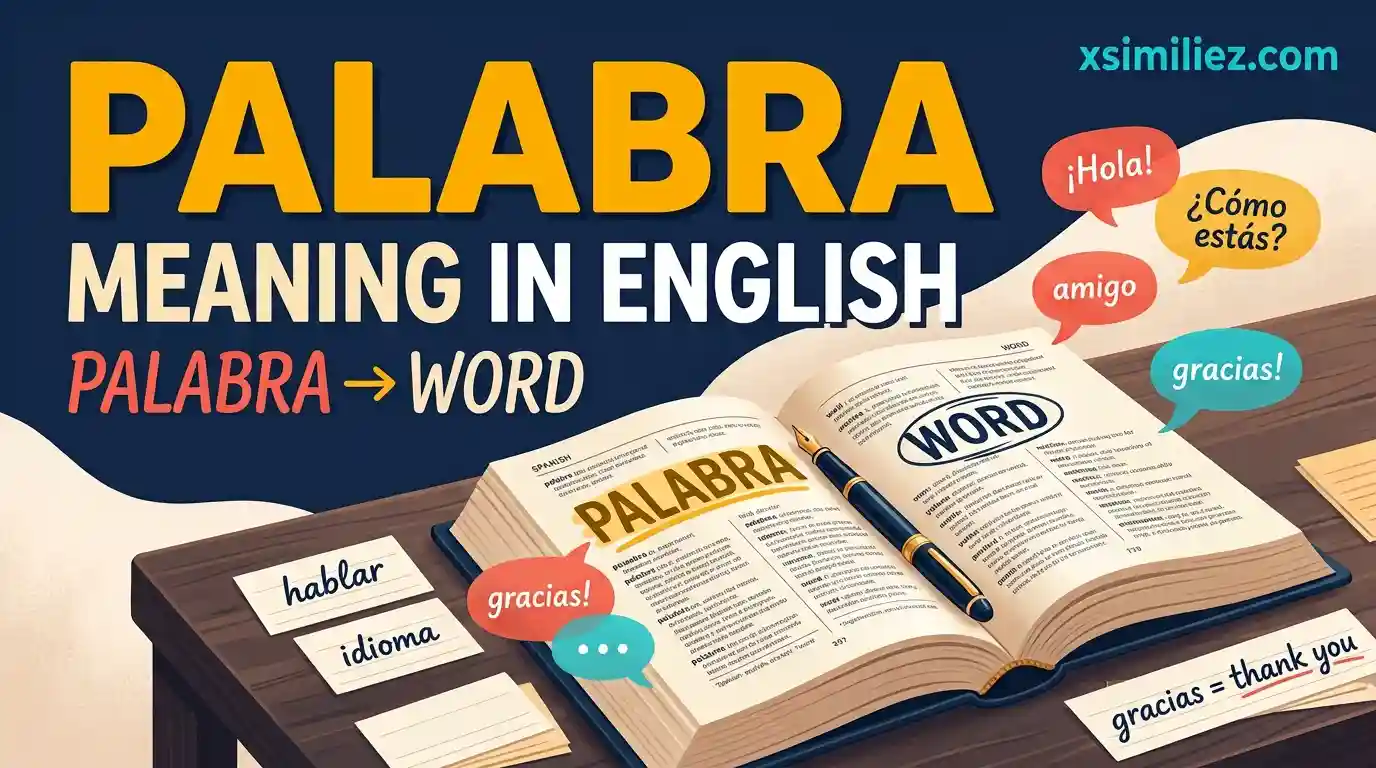
Palabra meaning in English is simple: it means “word.” In Spanish, palabra can name a single word, a promise, or the right to speak. You may have seen it in a song, a book, or a message from a friend, and now you want to know exactly what it says.
People search for this word for many reasons. Some are learning Spanish. Others hear it at home, at work, or in a neighborhood where Spanish is spoken. A few just love words and want to know where they come from.
In this guide, you will learn the meaning, the right way to say it, and how to use it in real sentences. You will also see common mistakes, popular phrases, and easy tips to remember it. Let’s get started.
Quick Answer: Palabra Meaning in English
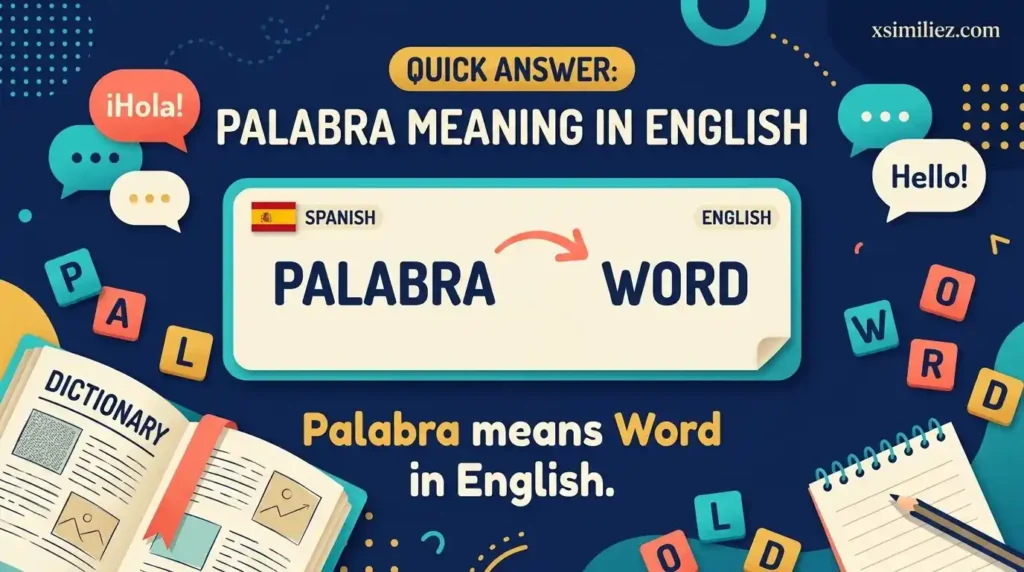
The quick answer is that palabra means “word” in English. It is a Spanish noun. You use it when you talk about a word in a sentence, such as “Esta palabra es nueva,” which means “This word is new.”
Palabra can also mean “promise.” If someone says “Tienes mi palabra,” they mean “You have my word.” It can also mean “speech” or “the right to speak.” For example, a teacher might give a student la palabra, which means the student gets a turn to talk.
That is the short version. Keep reading to see each meaning in detail, with plenty of easy examples.
Full Definition of Palabra and Its Main Meanings
Palabra is one of the most useful words in Spanish. You will hear it in classrooms, in movies, and in everyday talk. Most of the time, it means a single word, like “house,” “love,” or “run.” Spanish dictionaries, including the one from the Real Academia Española, list several other meanings too.
The second big meaning is “promise.” In English, we say “I give you my word.” Spanish speakers say “Te doy mi palabra.” In both languages, the word stands for trust. When you keep your palabra, people believe you.
The third meaning is the chance to speak. In a meeting or a class, someone may say “Tiene la palabra,” which means “You have the floor.” The fourth meaning is “what a person says.” When you read “Sus palabras me tocaron el corazón,” it means “Her words touched my heart.”
The table below puts these meanings side by side so you can see them at a glance.
| Meaning | English Word | Spanish Example | English Translation |
| A single word | word | Aprendí una palabra nueva. | I learned a new word. |
| A promise | word, promise | Te doy mi palabra. | I give you my word. |
| The right to speak | the floor | El maestro me dio la palabra. | The teacher gave me the floor. |
| What someone says | words, speech | Sus palabras fueron amables. | Her words were kind. |
Palabra Meaning in English: Grammar and Correct Usage
Palabra is a feminine noun. That means you use feminine helper words with it. You say “la palabra” for “the word” and “una palabra” for “a word.” Never say “el palabra.” It sounds wrong to Spanish speakers.
The plural is easy. Just add an s: “palabras.” So “the words” is “las palabras,” and “some words” is “unas palabras.”
Spanish adjectives must match the noun. If the noun is feminine, the adjective ends in a feminine form. So you say “una palabra bonita” for “a pretty word” and “palabras bonitas” for “pretty words.” You would say “una palabra difícil” for “a hard word,” because that adjective stays the same for both human beings.
Now for pronunciation. Say it like this: pah-LAH-brah. The stress falls on the middle part, “LAH.” The r is a soft tap of the tongue, like the “dd” in the English word “ladder” when you say it fast. Palabra has no written accent mark, so you spell it exactly as you see it: p-a-l-a-b-r-a.
Spanish also makes new words from palabra. Add “-ota” and you get “palabrota,” which means a swear word. Add “-ita” and you get “palabrita,” a “little word.” There is also “palabrería,” which means a lot of empty talk.
Origin and History of the Word Palabra
Palabra has an interesting past. It comes from the Late Latin word “parabola.” That Latin word came from a Greek word, “parabolē,” which meant “comparison” or “story used to teach a lesson.” You can still see the link in English. The word “parable” comes from the same root. A parable is a short story that teaches a lesson.
Here is the fun part. In Latin, the usual word for “word” was “verbum.” Over time, people in many places began to use “parabola” for “word” in everyday speech. Language experts think this happened because stories and sayings, like those told in churches, were a big part of daily life. That is why Spanish says palabra, Portuguese says palavra, and French says parole.
The sounds changed over the years. The Latin form “parabola” became “parabla” in early Spanish, and the letters r and l later swapped places to give us “palabra.” Language experts call this kind of switch a sound shift.
Palabra even has cousins in English. The word “palaver” came into English from the Portuguese “palavra,” and it means long, idle talk. The word “parley,” meaning a talk between two sides, is also a relative. So when you learn palabra, you are also learning a small piece of English history.
Common Phrases With Palabra and Their English Meaning
Spanish speakers use palabra in many fixed phrases. Learning them will help you sound more natural. The table below shows some of the most popular ones.
| Spanish Phrase | Literal Meaning | Real English Meaning |
| palabra de honor | word of honor | a serious promise |
| dar la palabra | to give the word | to promise, or to let someone speak |
| cumplir la palabra | to fulfill the word | to keep a promise |
| faltar a la palabra | to fail the word | to break a promise |
| juego de palabras | game of words | wordplay or a pun |
| palabra por palabra | word by word | word for word |
| palabra clave | key word | keyword |
| tener la última palabra | to have the last word | to make the final decision |
| mala palabra | bad word | a swear word |
| no tengo palabras | I have no words | I am speechless |
You can use these phrases in daily talk right away. For example, “Siempre cumple su palabra” means “He always keeps his word.” And “Fue un juego de palabras muy gracioso” means “It was a very funny pun.”
Spanish also has “palabras cruzadas,” which is the name for a crossword puzzle. And in computer talk, “palabra reservada” means “reserved word,” a special word that programmers cannot use for their own names.
Palabra vs Other Spanish Words for “Word”
Palabra is the most common way to say “word,” but Spanish has a few close cousins. Some are very similar, and some can trick learners. Here is how they compare.
| Spanish Word | English Meaning | How It Differs From Palabra |
| vocablo | word, term | More formal. You often see it in dictionaries and school books. |
| término | term | Used for special or technical words, like a science term. |
| frase | phrase | A group of words, not just one word. |
| oración | sentence | A full thought with a subject and a verb. |
| verbo | verb | A word that shows action. It can also mean “the Word” in religious writing. |
A good rule is this: if you are talking about one word in normal life, use palabra. If you are talking about a group of words, use “frase” or “oración.” If you are talking about a technical word, “término” often fits better.
Common Mistakes People Make With Palabra
Even smart learners slip up with this word. The good news is that the mistakes are easy to fix once you know them.
The first mistake is using the wrong gender. Many people say “el palabra” because English has no gender. Remember that palabra ends in -a and is feminine. So it is always “la palabra” or “una palabra.”
The second mistake is putting the stress on the wrong part. Some learners say “PA-la-bra.” The right way is “pa-LA-bra.” Say it slowly a few times, and it will feel natural.
The third mistake is using palabra for every meaning of the English word “word.” In English, we say “Any word from Sam?” when we mean “Any news?” In Spanish, you would say “¿Alguna noticia de Sam?” Palabra would sound strange there. In the same way, the English slang “Word!” does not always match palabra, even though it sometimes does in casual talk.
The fourth mistake is thinking palabra and “palaver” mean the same thing. They are related, but “palaver” in English means long, pointless talk. Palabra just means “word.” If you want the idea of empty talk in Spanish, the better word is “palabrería.”
The last mistake is forgetting that “palabra” and “palabras” can change the feeling of a sentence. “Dame tu palabra” asks for a promise. “Dame tus palabras” sounds odd. Always check which one fits your sentence.
Real-Life Examples of Palabra in Sentences
Seeing a word in real situations is the best way to learn it. Here are some examples from daily life, each with an English translation.
At school, a teacher might say, “¿Quién sabe cómo se escribe esta palabra?” That means, “Who knows how to spell this word?” A student might answer, “No conozco esa palabra,” which means, “I don’t know that word.”
At home, a parent might say, “Dame tu palabra de que vas a regresar temprano.” That means, “Give me your word that you will come home early.” The child might reply, “Tienes mi palabra,” which means, “You have my word.”
At work, a manager may open a meeting by saying, “Ana, tienes la palabra.” In English, that is, “Ana, you have the floor.” Later, someone might say, “Él siempre cumple su palabra,” which means, “He always keeps his word.”
With friends, you may hear, “Me quedé sin palabras cuando vi el regalo.” That means, “I was speechless when I saw the gift.” Or you might say, “No me gusta esa palabra,” meaning, “I don’t like that word.”
While traveling, a handy sentence is “No sé la palabra en español.” It means, “I don’t know the word in Spanish.” Locals will often smile and help you. It is a great sentence for beginners.
Current Usage and Trends of Palabra Today
Palabra is very much alive today. Millions of people speak Spanish, and this word shows up all day long. In the United States, many families mix Spanish and English in one sentence. This blend is often called Spanglish. A speaker might say, “What’s the palabra for that?” It is casual, friendly, and very common in bilingual homes.
In some parts of Latin America, especially in Mexico, people also use “¡Palabra!” in casual talk to mean “I swear!” or “I promise!” A friend might ask “¿Palabra?” to mean “Really? For real?” Slang changes from place to place and from age group to age group, so you may not hear it everywhere. If you want to try it, listen first to how local speakers use it.
Palabra is also big in language learning. Many apps and websites offer a “palabra del día,” which means “word of the day.” Spanish word games and crossword puzzles (“palabras cruzadas”) are popular too, and they help people grow their vocabulary in a fun way.
Finally, the phrase “palabra clave” is common online. It means “keyword,” and people use it when they talk about searching the internet. So even in the digital world, palabra has an important job.
Tips to Remember Palabra Meaning in English
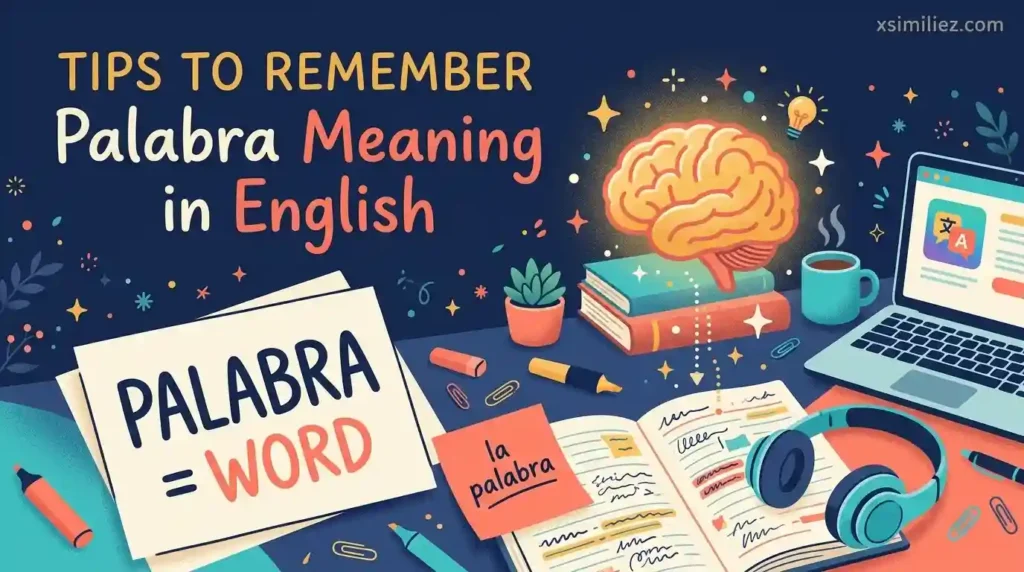
Learning one new word is easy. Keeping it in your memory takes a little practice. Here are some simple ideas that work well.
First, link it to a word you already know. Palabra sounds a bit like “palaver” and “parable,” and both of those are English words connected to talking and stories. When you think “palaver,” think “palabra equals word.” This small trick can make the meaning stick.
Second, say it out loud. Repeat “pah-LAH-brah” five times. Then use it in a short sentence, such as “Esta es mi palabra favorita,” which means “This is my favorite word.” Speaking helps your brain remember much better than reading alone.
Third, use sticky notes. Write “la palabra” on a note and stick it on a book or a dictionary. Seeing it each day will help you remember it, and you will also remember that it is feminine.
Fourth, learn one phrase a day. You do not have to learn all of them at once. Start with “palabra de honor,” then “juego de palabras,” and keep going. Small steps add up fast.
Fifth, listen for it in songs, shows, and videos. Once you know the word, you will start to hear it everywhere. That feeling is exciting, and it shows your Spanish is growing.
FAQs
What does palabra mean in English?
Palabra means “word.” It can also mean “promise,” “speech,” or “the right to speak,” depending on the sentence.
Is palabra masculine or feminine?
It is feminine. You say “la palabra” and “una palabra.” The plural is “las palabras.”
How do you pronounce palabra?
Say “pah-LAH-brah.” The stress is on the middle part. The r is a quick, soft tap of the tongue.
What does “palabra de honor” mean?
It means “word of honor.” It is a serious promise that a person plans to keep. People use it when they want to show they are telling the truth.
Is palabra an English word?
No, palabra is a Spanish word. Some bilingual speakers mix it into English sentences, but standard English dictionaries do not list it as an English word. Its relative “palaver” is an English word, though.
Is palabra the same as the Portuguese word palavra?
They are very close. Both come from the same Latin root and both mean “word.” They are spelled and pronounced a little differently in each language.
Conclusion
Now you know the full story of palabra meaning in English. At its core, palabra means “word.” It can also mean a promise, a short talk, or the chance to speak. One little Spanish word carries many ideas.
You also learned that palabra is a feminine noun, that it comes from Latin and Greek roots, and that it shows up in many everyday phrases. Words like palabra de honor and juego de palabras make Spanish feel warm and playful.
Here is a simple tip to finish. Use palabra in a few sentences today, out loud or on paper. Say “una palabra nueva” or “tienes mi palabra.” The more you use it, the faster it will stick, and soon it will feel like your own word.

Hi, I’m Mason Avery, a content writer at Xsimiliez.com. I like writing about similes, figurative language, and creative expressions. I believe learning English becomes easier when examples feel natural and relatable.