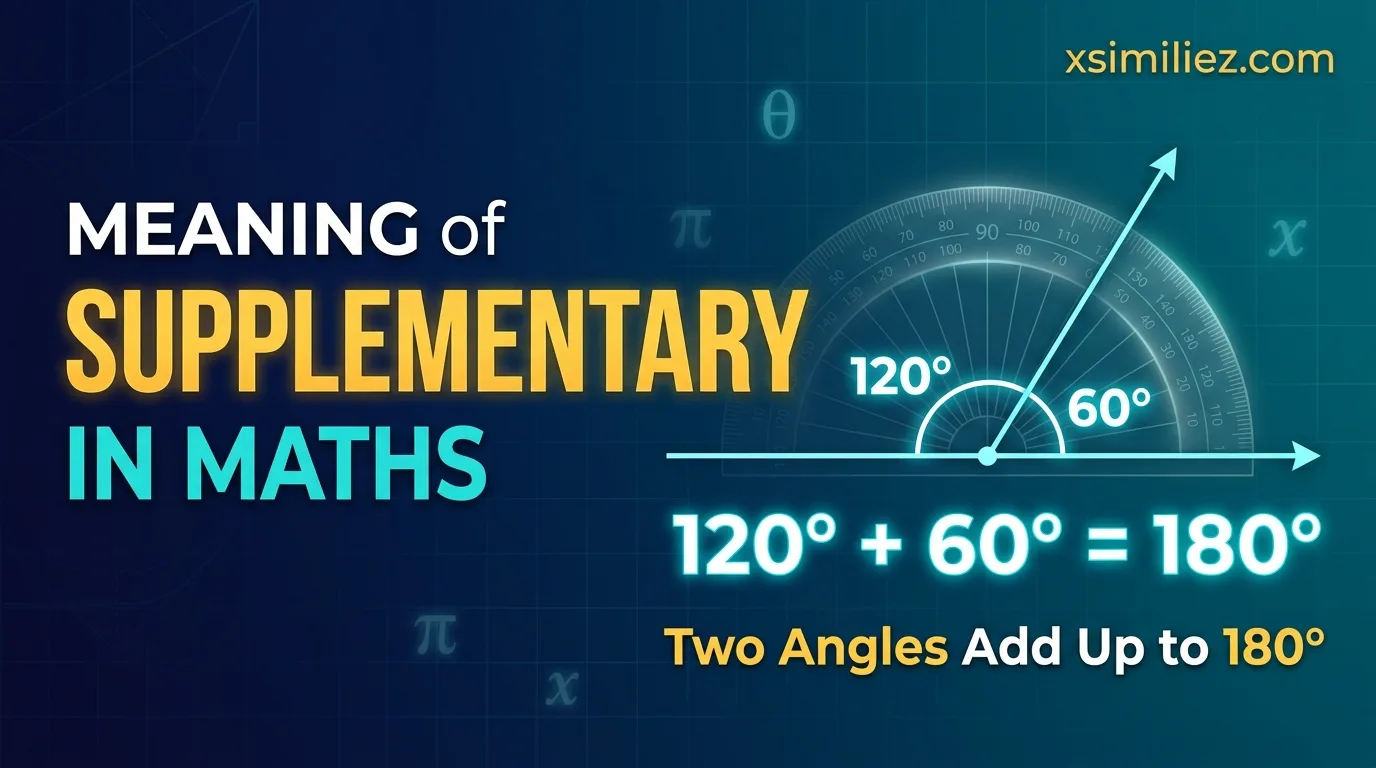
The meaning of supplementary in maths is simple: two angles are supplementary when their measures add up to exactly 180 degrees. For example, 120° and 60° are supplementary because 120 + 60 = 180.
Students often search for this phrase when a homework question, a test, or a geometry lesson uses the word and nobody explains it. It sounds fancy, yet the idea is easy once you see it. People in the USA usually say “math,” but many textbooks and websites use “maths,” so both spellings are common.
In this guide, you will learn the definition, the formula, easy steps, a comparison with complementary angles, real-life examples, common mistakes, and quick tricks. You will also get six FAQs to clear up any leftover questions.
Meaning of Supplementary in Maths, Explained Simply
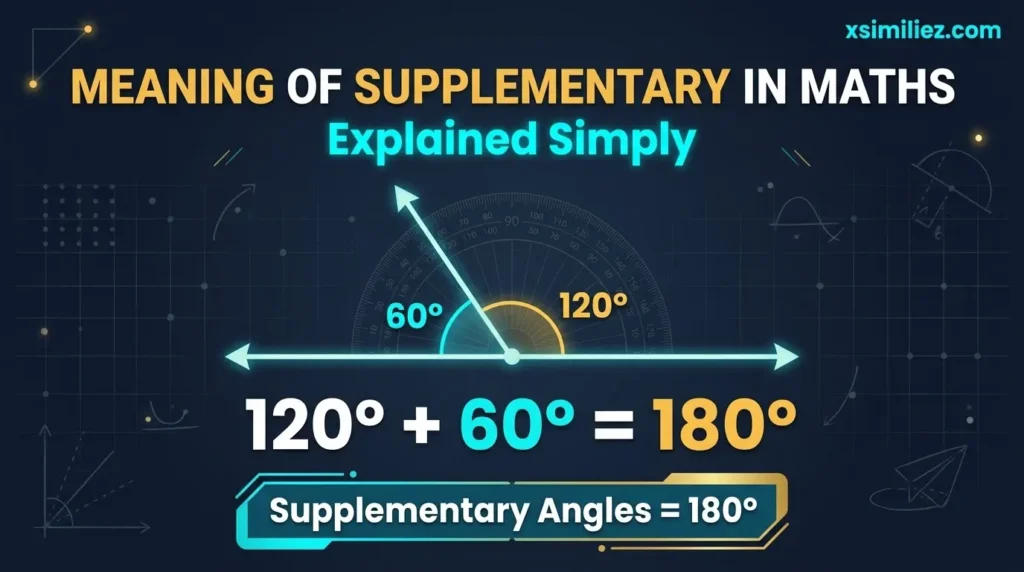
Think of a straight line. A straight line makes an angle of 180 degrees. Now imagine you draw a second line that starts from a point on that straight line and goes up into the air. That new line splits the 180 degrees into two smaller angles. Those two angles are supplementary.
So, supplementary angles are two angles that together “fill up” a straight line. One angle can be big and the other small. One can even be the same size as the other. The only rule is that the total must be 180°.
Here is a quick way to say it: if you add the two angles and get 180, they are supplementary. If you get anything else, they are not. That is the whole test.
Each angle in the pair is called the supplement of the other. So if one angle is 100°, its supplement is 80°. If one angle is 25°, its supplement is 155°. You never need to guess, because the number is always the same.
One more detail matters. Supplementary angles come in pairs. People sometimes say three angles are “supplementary,” but in standard school maths the word is used for exactly two angles.
Where the Word Supplementary Comes From
The word “supplementary” is connected to the word “supplement.” A supplement is something added to make a thing complete. Think of a vitamin supplement that fills in what your food is missing, or a bonus section added to the end of a magazine.
The English word traces back to Latin roots linked to the idea of filling up or completing. I can’t point to one exact date when mathematicians began using it for angles, so I won’t guess. What we can say safely is that the meaning fits perfectly. Each angle in the pair completes the other so that the pair reaches a straight line of 180 degrees.
This makes the word easier to remember. Supplement means “adds to complete.” Supplementary angles add to complete a straight angle.
How to Find a Supplementary Angle Step by Step
Finding a supplement takes one subtraction. The formula looks like this: supplement = 180° − the angle you know.
Let’s try an example. Suppose angle A is 65°. To find its supplement, take 180 and subtract 65. The answer is 115°. You can check your work by adding: 65 + 115 = 180. It works.
Here are the steps in plain words. First, write down the angle you know. Second, subtract it from 180. Third, add your answer to the original angle to double-check that you get 180.
Sometimes a problem uses algebra. Imagine two angles are supplementary, and one is x and the other is 2x. You write the equation x + 2x = 180. That gives 3x = 180, so x = 60. The two angles are 60° and 120°. Notice that 60 + 120 = 180, so the answer passes the test.
Here is another one. Angle P is (x + 20)° and angle Q is (x + 40)°. They are supplementary. So x + 20 + x + 40 = 180, which means 2x + 60 = 180. Subtract 60 and you get 2x = 120, so x = 60. Angle P is 80° and angle Q is 100°.
Supplementary vs Complementary Angles
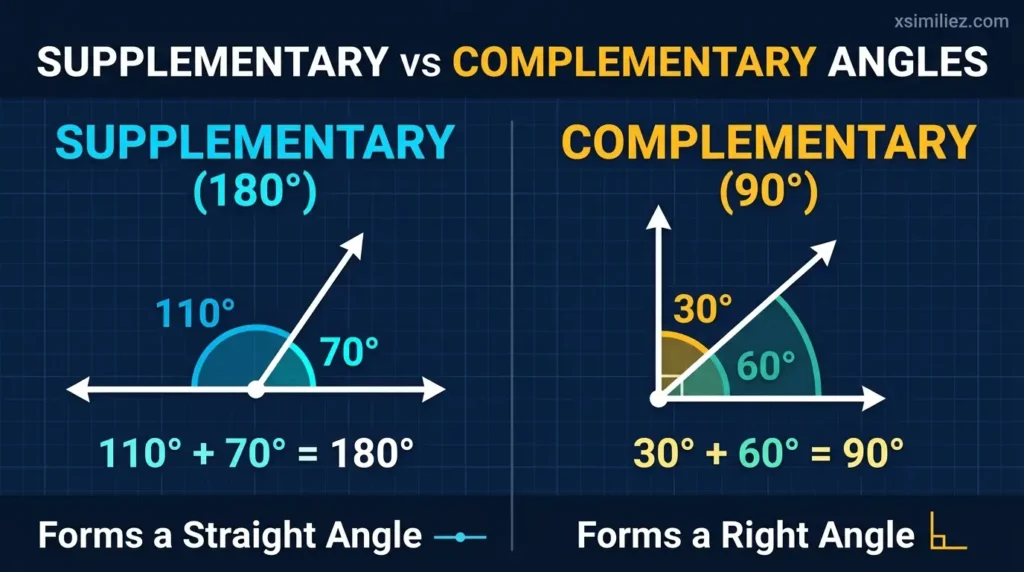
These two words sound alike, and that is why students mix them up. Both describe pairs of angles that add up to a special number. The difference is the number. Complementary angles add up to 90 degrees, which is a right angle. Supplementary angles add up to 180 degrees, which is a straight line.
| Feature | Supplementary Angles | Complementary Angles |
| Total of the two angles | 180° | 90° |
| Shape they make together | A straight line | A right angle (corner) |
| Can both be acute? | No | Yes |
| Can both be obtuse? | No | No |
| Formula for the missing angle | 180° − known angle | 90° − known angle |
| Example pair | 110° and 70° | 30° and 60° |
A neat memory trick uses the first letters. C comes before S in the alphabet, and 90 comes before 180 on a number line. So C goes with 90, and S goes with 180. Another trick: “C” is for “corner” (a right-angle corner) and “S” is for “straight” (a straight line).
Supplementary Angles and Linear Pairs
You may hear the term “linear pair” in the same lesson. A linear pair is two angles that sit side by side on a straight line, sharing one arm. Because they sit on a straight line, they always add up to 180°. That means every linear pair is supplementary.
However, the reverse is not always true. Two angles can be supplementary without touching each other at all. Picture one 70° angle on the left side of a page and a 110° angle on the right side. They are far apart, but 70 + 110 = 180, so they are still supplementary.
This is a very common test question. A good way to remember it: “All linear pairs are supplementary, but not all supplementary angles are linear pairs.” Touching is extra. The total is what counts.
Adjacent supplementary angles (the ones that touch) make it easy to spot a straight line. If you see two angles stacked on a straight line, you can instantly write that they sum to 180° and solve for the missing value.
Supplementary Angles in Parallel Lines and Shapes
Supplementary angles show up all over geometry, not just in simple pairs. One big place is parallel lines cut by a transversal. A transversal is a line that crosses two other lines. When the two lines are parallel, certain angle pairs follow strict rules.
Co-interior angles, also called same-side interior angles, sit between the two parallel lines on the same side of the transversal. They are always supplementary. If one is 75°, the other must be 105°.
Shapes use the idea too. In a parallelogram, any two angles that sit next to each other (consecutive angles) add up to 180°. So if one corner is 60°, the next corner is 120°. In a trapezoid with one pair of parallel sides, the two angles along each slanted side are supplementary as well.
There is also a rule for cyclic quadrilaterals, which are four-sided shapes whose corners all touch a circle. Opposite angles in these shapes are supplementary. This rule appears in many middle school and high school problems.
| Situation | What is supplementary? | Example |
| Linear pair | The two angles on a straight line | 40° and 140° |
| Parallel lines with a transversal | Co-interior (same-side interior) angles | 65° and 115° |
| Parallelogram | Angles next to each other | 50° and 130° |
| Cyclic quadrilateral | Opposite angles | 85° and 95° |
| Trapezoid | Angles on the same slanted side | 70° and 110° |
Real-Life Examples of Supplementary in Maths
Angles are everywhere, so supplementary pairs hide in everyday life. Open a laptop to a tilted position. The screen and the keyboard make an angle. The remaining space between the screen and the flat table surface on the other side forms its supplement, because together they make a straight line along the table.
A door is another good example. When a door opens part way, the angle between the door and the wall on one side and the angle on the other side add up to 180° along the wall line. Scissors work the same way. As the blades open wider, one angle grows and the other shrinks, but the total along the straight line stays at 180°.
Think about a seesaw or a ramp. A ramp leaning against a flat floor makes an angle with the ground. The angle on the other side of the ramp, measured back along the floor, is its supplement. Builders and carpenters use this idea to cut boards so that pieces fit tightly.
Even a clock gives you examples. At 6:00, the hands point in opposite directions, making a straight line of 180°. At 4:00, the angle between the hands is 120°, and its supplement is 60°. You can practice by choosing times and finding the pair.
Common Mistakes When Learning the Meaning of Supplementary in Maths
The first mistake is mixing up 90 and 180. Many students remember that the pair adds to a special number but forget which one. Use the “C for corner, S for straight” trick to fix this.
The second mistake is thinking supplementary angles must touch. As you read earlier, they do not. Only linear pairs have to be side by side. A test question may show two angles in different parts of a diagram and ask If they are supplementary. Always add them and check for 180.
The third mistake is a subtraction slip. When finding a supplement, some students subtract from 90 by accident or forget to subtract at all. Write “180 −” first and then fill in the angle. Then add your answer back to the original as a check.
The fourth mistake is believing two obtuse angles can be supplementary. They cannot. An obtuse angle is bigger than 90°, so two of them would total more than 180°. In the same way, two acute angles total less than 180°, so they cannot be supplementary either. The only way is one acute and one obtuse, or two right angles. For example, 90° and 90° are supplementary, and each is a right angle.
The fifth mistake is forgetting that the word applies to angles. In basic geometry, numbers by themselves are not called supplementary. Angles are.
Supplementary Angles in Higher Maths: Radians and Trigonometry
As you move to higher grades, you may measure angles in radians instead of degrees. A straight line equals π radians. So two angles are supplementary if they add up to π. The supplement of π/3 is 2π/3, because π/3 + 2π/3 = π.
Supplementary angles also matter in trigonometry. If an angle is θ, its supplement is 180° − θ. The sine of both angles is the same: sin(180° − θ) = sin θ. For example, sin 30° and sin 150° both equal 0.5.
Cosine and tangent behave a little differently. The cosine of the supplement is the negative of the original: cos(180° − θ) = −cos θ. The tangent follows the same pattern: tan(180° − θ) = −tan θ. So cos 60° is 0.5, while cos 120° is −0.5.
You don’t need these formulas for basic geometry. But if you plan to study trigonometry later, knowing the supplement idea now will make that step much easier.
Quick Tips to Remember Supplementary Angles
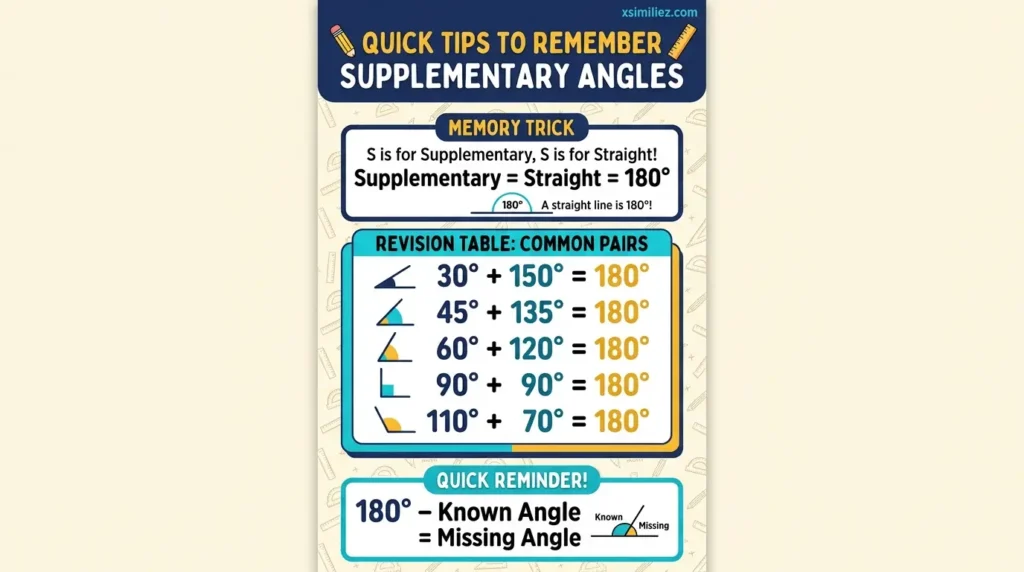
Practice makes the idea stick, and a few small habits help. Start by learning the common pairs. Once you know that 30° pairs with 150° and 45° pairs with 135°, many problems become quick.
| Angle | Its Supplement | Check (adds to 180°) |
| 30° | 150° | 30 + 150 = 180 |
| 45° | 135° | 45 + 135 = 180 |
| 60° | 120° | 60 + 120 = 180 |
| 90° | 90° | 90 + 90 = 180 |
| 110° | 70° | 110 + 70 = 180 |
| 125° | 55° | 125 + 55 = 180 |
| 170° | 10° | 170 + 10 = 180 |
Next, draw a picture. A quick sketch of a straight line with a second line coming off it shows you the two angles right away. Label what you know and what you need to find.
Then, say the rule out loud: “Supplementary means straight, straight means 180.” Saying it a few times helps your memory more than you might expect.
Finally, always check your answer by adding. It takes five seconds and catches most mistakes. If the two angles do not total 180, go back and look for the slip.
Maths vs Math: British and American Usage
The word “supplementary” means the same thing in every English-speaking country. The only difference is how people spell and say the subject name. In the USA and Canada, people say and write “math.” In the UK, Australia, India, and many other places, people say and write “maths.”
Both are short for “mathematics.” Neither one is wrong. If you are writing for a school in the United States, use “math.” If you are searching online and use “maths,” you will still find the same lessons, since search engines understand both spellings.
Some spelling around angles also changes slightly. For example, “centre” appears in British books where Americans write “center.” Yet the terms supplementary angles, complementary angles, and linear pairs look the same everywhere.
FAQs
1. What does supplementary mean in simple words?
It means two angles that add up to 180 degrees. When you put them together, they form a straight line.
2. How do you find a supplementary angle?
Subtract the angle you know from 180. For instance, if the angle is 80°, its supplement is 180 − 80 = 100°.
3. Can supplementary angles be equal?
Yes. Two right angles of 90° each are equal and supplementary. No other equal pair works, because each angle must be exactly half of 180.
4. Do supplementary angles have to be next to each other?
No. They can be far apart. If they sit side by side on a straight line, they are a linear pair, but the 180° total is what makes them supplementary.
5. What is the difference between supplementary and complementary?
Supplementary angles add up to 180°, while complementary angles add up to 90°. A helpful trick is “C for corner” and “S for straight.”
6. Can a supplementary angle be negative or zero?
In basic school geometry, no. Angles in these problems are positive. An angle of 180° would have a supplement of 0°, but most lessons skip that case and focus on angles between 0° and 180°.
Conclusion
The meaning of supplementary in maths comes down to one number: 180. Two angles are supplementary when they add up to a straight line. To find a missing angle, subtract the one you know from 180, then add them back to check.
Along the way, you saw how supplementary angles differ from complementary ones, how linear pairs fit in, and where these pairs appear in parallel lines, parallelograms, and real life. You also learned the most common mistakes, like mixing up 90 and 180 or thinking the angles must touch.
For practice, grab a pencil and try five or six pairs from the tables above. Draw each one, subtract from 180, and check your answer. After a few rounds, the idea will feel natural, and the next time you see the word supplementary, you will know exactly what to do.

Hi, I’m Harper Blake, and I write for Xsimiliez.com. I enjoy sharing clear and friendly simile examples that students and beginners can understand easily. My goal is to make English learning simple and enjoyable.