The ménage à trois meaning in English is simple.It is a French phrase for a relationship or living setup that involves three people. Most often today, it means a romantic or sexual relationship among three adults. Word for word, it means “household of three.”
You may have seen the phrase in a movie, a novel, or a news story and wondered what it really meant. Maybe you were not sure how to say it, or ifit was rude to use. Those are fair questions.
In this guide, you will learn the meaning, the right way to say and spell it, where it came from, and how people use it today. You will also see examples and clear answers to common questions.
Quick Answer: Ménage à Trois Meaning in English
A ménage à trois is a relationship or living arrangement that involves three people. In modern English, it usually means a romantic or sexual relationship among three adults who all know about it and agree to it. Some people use it for a one-time event, but the phrase was first meant for an ongoing arrangement.
The French words break down in a simple way. “Ménage” means household. “À” means “of” or “for” in this phrase. “Trois” means three. Put together, you get a “household of three.”
The Full Meaning of Ménage à Trois
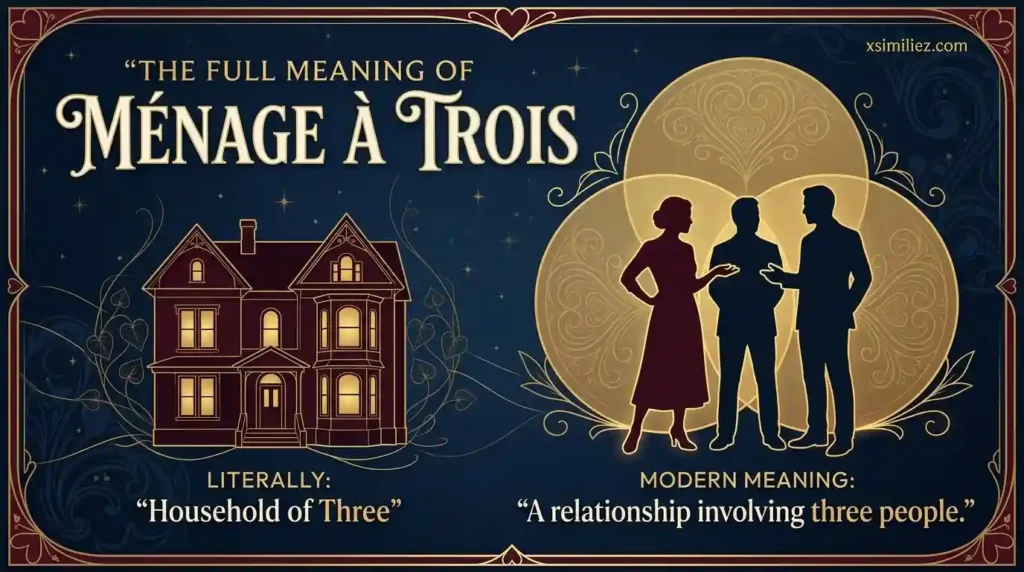
To understand this phrase, start with the word “ménage.” In French, it first meant a home and the people living in it. A “ménage” could be a family, a couple, or any group sharing one house. The word was about daily life, such as meals, rent, and chores.
When French speakers added “à trois,” the idea became a home shared by three people. In older French writing, this often described a married couple and a third person, usually a lover. The third person might live in the home or visit often. The phrase had a gossipy flavor because it hinted at a secret.
Over time, English speakers borrowed the phrase. Today, most English dictionaries define it as a close relationship among three people, often with a sexual side. Some dictionaries still mention the older idea of three people living together. So the phrase has two layers. One layer is about the home. The other is about love and intimacy.
The tone matters too. The phrase can sound fancy, playful, or a bit dramatic. People often choose it when they want to sound polite or humorous instead of using blunt words. That is one reason it shows up so much in books, films, and TV. It sounds softer than many other terms.
It is also worth saying that the phrase does not tell you if the people involved are happy, honest, or committed. It only tells you that three people are involved. You need the rest of the sentence to learn the details.
How to Say and Spell Ménage à Trois
Many people avoid this phrase because they are not sure how to say it. That is understandable, since it has French sounds. Here is a simple guide.
| Part | Simple Sound Guide | Meaning |
| Ménage | may-NAHZH | Household |
| À | ah | Of or for |
| Trois | TRWAH | Three |
| Full phrase | may-NAHZH ah TRWAH | Household of three |
The “zh” sound in the first word is like the middle sound in the word “measure.” The last word rhymes with “squa” in “squad,” but with a soft “w” in the middle. Say it slowly at first, then speed up.
For spelling, the correct form has two accent marks. The first “e” in ménage has an acute accent (é). The “a” has a grave accent (à). In English writing, many people drop the accents and write “menage a trois.” You will see both forms in print. Either one is widely understood, but the accented version looks more polished and is the better choice for formal writing.
If you type on a phone, you can usually hold down the “e” or “a” key to find the accented letters. On many computers, you can copy and paste the phrase if the accents are hard to type.
Grammar and Correct Usage
In English, ménage à trois works as a noun. You can say “a ménage à trois” or “the ménage à trois.” It usually appears in a sentence the same way any other noun would.
Here is a simple example: “The novel tells the story of a ménage à trois in Paris.” The phrase is the thing the story is about.
The plural form can feel tricky. Because the phrase is French, the “s” goes on the first word. The correct plural is “ménages à trois.” You do not add an “s” to “trois.” So you would write, “The film shows two ménages à trois over many years.” Some people say “ménage à trois” for both singular and plural in casual talk, but the form with “ménages” is the traditional one.
Should you put the phrase in italics? Many older style guides said yes, because it is a foreign phrase. Modern English has used it for so long that most writers now leave it plain. If you are writing for school or work, check the style guide you are following. When in doubt, plain text is fine.
Finally, think about the verb. You can “have” a ménage à trois, “be in” one, or “end” one. People also say a story “involves” or “features” one. It is not a verb on its own, so you would not say “they ménage à troised.” That would sound like a joke.
Origin and History of the Phrase
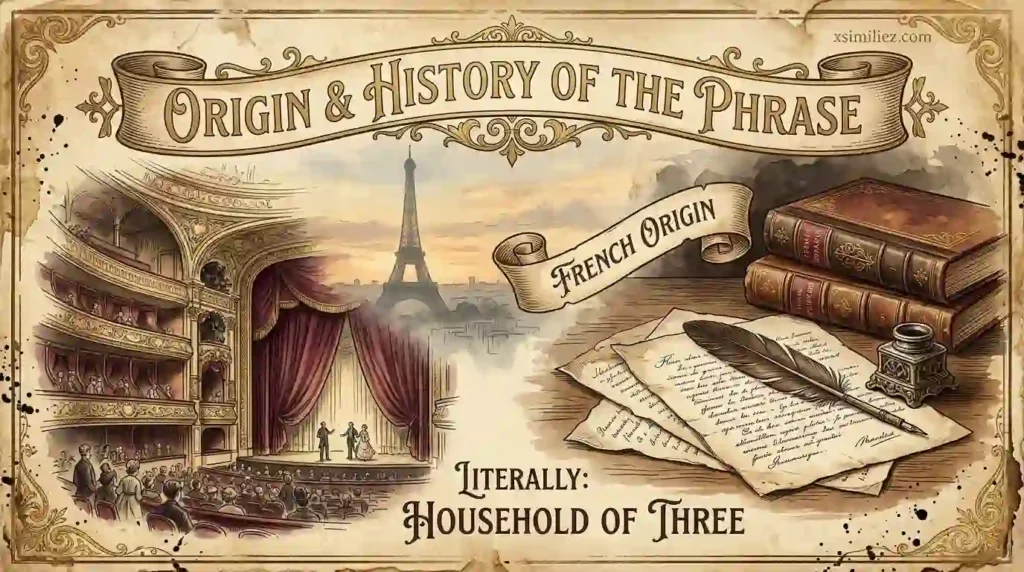
The word “ménage” comes from Old French. It traces back to Latin words about staying or living in a place. So, from the start, it was about home life. The French used it for centuries to talk about a household and how it was run.
The full phrase “ménage à trois” was used in France to describe a household that included a husband, a wife, and a lover. Writers in France liked this topic. Plays and novels often featured love triangles, and this phrase was a neat way to describe them.
English speakers borrowed the phrase around the late 1800s, according to major dictionaries. It spread through books, plays, and newspapers. At that time, it sounded daring and a little scandalous. Using a French phrase made the idea feel less blunt. It also gave writers a way to hint at a topic without describing it in detail.
During the 1900s, the phrase became more common in English. Films and magazines used it often. As talk about relationships became more open, the phrase lost some of its shock value. It also began to shift in meaning, moving from a hidden household arrangement to a broader term for three-way relationships.
It would be a mistake to claim we know every detail about who first said it in English or exactly when. Records of spoken language are limited. What we can say with confidence is that it is a French borrowing, it entered English long ago, and it has stayed in use ever since.
Ménage à Trois vs. Threesome, Throuple, and Love Triangle
People often mix up related terms. They overlap, but they are not always the same. This table gives a quick comparison.
| Term | Basic Meaning | Usually Ongoing? | Everyone Knows? |
| Ménage à trois | A relationship or household of three people | Often, but not always | Usually, in modern use |
| Threesome | A single event involving three people | No, often one time | Yes |
| Throuple | A romantic relationship of three, like a couple | Yes | Yes |
| Love triangle | Three people tangled in love, often with jealousy | Can be | Often not |
| Polyamory | Having more than one loving relationship, with consent | Yes | Yes |
A few details help here. “Threesome” is the most casual and direct word. It is usually about one event. “Throuple” is a modern slang word made from “three” and “couple.” It describes three people who see themselves as one committed unit.
A “love triangle” is different. It often means one person is caught between two others, and not everyone is happy about it. It may involve secrets, jealousy, or heartbreak. A ménage à trois can be a love triangle in older stories, but in modern use, it does not have to be.
“Polyamory” is a wider idea. It means a person can have more than one loving relationship, with the knowledge and agreement of everyone involved. A ménage à trois might be one form of it, but polyamory can involve many more people and many different setups.
So if you need to pick the clearest word, think about what you want to say. For an ongoing committed trio, “throuple” is closest. For a one-time event, “threesome” fits better. For a polite, old-fashioned, or literary tone, “ménage à trois” works well.
Common Mistakes to Avoid
Because the phrase is borrowed from French, people often slip up. Here are the mistakes that come up most.
The first mistake is the plural. Many writers add an “s” to the end and write “menage a troises” or “ménage à trois’s.” Neither is correct. The right plural is “ménages à trois.”
The second mistake is the pronunciation. Some people say “men-age” like the English word “message” with a different start. The first word should sound like “may-NAHZH,” not “men-ij.” Saying it wrong will not harm anyone, but getting it right makes you sound more confident.
A third mistake is treating it as a word for any group of three people. A group of three friends having lunch is not a ménage à trois. The phrase points to a close, usually romantic or sexual bond. Using it for a trio of coworkers would confuse readers or make them laugh.
Another mistake is mixing it up with “ménage” alone. In English, “ménage” by itself is rare. It can mean a household in older or French-style writing, but most readers will not know that. If you use it alone, add some context.
The last mistake is using the phrase in the wrong setting. It is not a word for a business email or a school report on a general topic. It also should not be used to tease or embarrass real people. Think about your audience before you use it.
Real-Life Examples of Ménage à Trois in Sentences

Seeing the phrase in use is the best way to learn it. The table below shows how it can fit different settings, along with notes on tone.
| Example Sentence | Setting | Tone |
| “The old French play is about a ménage à trois in a small village.” | Book or film review | Neutral |
| “Critics said the movie treated the ménage à trois with surprising care.” | Entertainment news | Neutral |
| “In the novel, the ménage à trois ends in heartbreak for everyone.” | Literature class | Serious |
| “She joked that her three cats and one dog were more of a zoo than a ménage à trois.” | Casual talk | Playful |
| “The historian explained that a ménage à trois was a hot topic in 1800s French theater.” | History lecture | Formal |
Notice how the phrase fits well in writing about stories, history, and the arts. It is less common in everyday speech, and when people do use it, it often has a light or joking tone.
Here are a few more short examples. “The TV show hints at a ménage à trois but never says it outright.” “The author based her book on a real ménage à trois from the 1920s.” “He used the phrase ménage à trois, and the room went quiet.” That last one shows how the phrase can still carry a bit of surprise.
When you write your own examples, keep the sentence clear. Give readers enough context so they know if you mean something real, fictional, or silly.
Current Usage and Trends
Today, ménage à trois is still alive in English, but it is not the most common choice for talking about three-person relationships. Many people now use plainer words such as “threesome,” “throuple,” or “polyamorous relationship.” Those words feel more modern and direct.
Even so, the French phrase has not disappeared. You will still find it in book reviews, film descriptions, history writing, and light humor. It often shows up when writers want a gentle or stylish tone. It also appears in crossword puzzles and word-of-the-day lists because it is a famous French loan phrase.
Another trend is how openly people talk about relationships. In the past, a phrase like this was whispered. Now people talk about different relationship styles in a more open way. Many people stress honesty, consent, and clear agreements among everyone involved. When the phrase appears in current writing, it is more likely to describe a relationship in which everyone is aware and agrees.
At the same time, the phrase can still be used in the older sense of a secret affair. Context decides which meaning is intended. If you read “a ménage à trois in the 1800s,” think of the older stories. If you read it in a modern lifestyle article, think of a more open arrangement.
It is also worth noting that the phrase is mostly about adults. Any story or article using it should be about grown-ups who are able to make their own choices.
Tips for Using the Phrase Wisely
Using a borrowed phrase well takes a little care. Here are some simple tips that can help.
First, know your audience. In a casual chat with friends, you may be able to use the phrase freely. In a classroom, workplace, or family setting, you might want to choose a different word or skip the topic. Respect is always a good guide.
Second, give context. If your reader might not know the phrase, add a short hint. For example, “a ménage à trois, which is a relationship among three people.” That small note keeps everyone on the same page.
Third, pick the right word for your meaning. If you are talking about a one-time event, “threesome” is clearer. If you are describing a committed trio, “throuple” or “polyamorous relationship” may be more accurate. Choose the mén84184eage à trois when you want a classic, literary, or lightly humorous tone.
Fourth, check your spelling and accents. Take a moment to add the accents or choose the plain version and stay consistent. Mixed styles in one article can look sloppy.
Fifth, avoid using it to judge or mock real people. Relationships are personal, and a word like this can hurt when used unkindly. When writing about real individuals, stick to facts and use respectful language.
Finally, when you are not sure, look it up. Good dictionaries and language sites can help you check meaning, spelling, and usage before you publish or speak.
FAQs
What does ménage à trois mean in English?
It is a French phrase that means “household of three.” In English, it usually describes a relationship among three people, often romantic or sexual. It can also refer to three people living together in the older sense.
What is a menage et trois meaning in english?
Ménage à trois is a French expression that literally means “household of three.”
What is a ménage à trois in english?
A romantic or sexual relationship involving three people.
How do you pronounce ménage à trois?
You say it as “may-NAHZH ah TRWAH.” The first word has a soft “zh” sound, like the middle of “measure.” The last word sounds like “TRWAH,” with the stress at the end.
Is ménage à trois the same as a threesome?
Not exactly. A threesome usually means a single event involving three people. A ménage à trois often suggests a longer arrangement or relationship. In casual use, many people treat them as close in meaning.
What is a menage trois meaning?
Ménage trois is often used as a shortened form of the French expression ménage à trois.
English meaning: A romantic or sexual relationship involving three people.
Literal meaning: Household of three.
What is the plural of ménage à trois?
The plural is “ménages à trois.” The “s” goes on the first word, because “ménage” is the noun. You do not add an “s” to “trois.”
Is it okay to use this phrase in formal writing?
It can be fine in literature, history, or arts writing, where the topic fits. For general business or school writing, it is usually better to avoid it unless it is needed. If you use it, make sure the meaning is clear.
Where does the phrase come from?
It comes from French. “Ménage” means household, and “à trois” means “of three.” English speakers borrowed it around the late 1800s, and it has stayed in use ever since.
Conclusion
The ménage à trois meaning in English comes down to one idea: three people in a close bond or shared household. The phrase came from French, where it literally means “household of three.” Over time, English speakers shifted it toward a romantic or sexual relationship among three people, while keeping a touch of the older, more dramatic feel.
Now you know how to say it, how to spell it, and how to form the plural. You also know how it differs from words like threesome, throuple, and love triangle. Watch out for common slips, such as the wrong plural or using it for any group of three.
When you use this phrase, keep your audience in mind and add context when needed. Choose clear, respectful words, and pick the term that best fits what you mean. A little care makes your writing stronger and your meaning easier to understand.

Hi, I’m Harper Blake, and I write for Xsimiliez.com. I enjoy sharing clear and friendly simile examples that students and beginners can understand easily. My goal is to make English learning simple and enjoyable.