Cat got your tongue meaning is simple: people say it when someone is quiet but should be talking. It is a playful way to ask, “Why aren’t you speaking?” You might hear it when a child goes silent after being caught with cookie crumbs on his face.
Maybe you heard the line in a movie, or a grandparent said it at the dinner table. You stopped and wondered, “What does a cat have to do with my tongue?” That is a fair question, and lots of people search for the answer.
In this guide, you will learn what the phrase means, how to use it, where it may have come from, and which mistakes to avoid. You will also see easy examples and clear answers to common questions.
Cat Got Your Tongue Meaning: The Quick Answer
The idiom “cat got your tongue?” is a question you ask when someone suddenly stops talking. It means, “Why are you so quiet?” The speaker pretends that a cat has stolen the person’s tongue, so the person cannot speak.
The phrase is almost always joking or teasing. Sometimes it is gentle. Sometimes it has a little edge, like when you are waiting for a guilty answer. The words are not meant to be taken as real. Nobody thinks a cat is running off with a tongue. It is just a fun picture that makes a point.
What Does “Cat Got Your Tongue” Mean in Everyday Life?

Let’s go a little deeper. The phrase is used when a person is silent at a moment when you expect them to talk. Maybe you asked a question and got no answer. Maybe a friend who is usually chatty has gone quiet at a party. That is when someone might say, “Cat got your tongue?“
The silence can come from many places. A person may be shy, nervous, or surprised. Maybe the person feels embarrassed. Maybe they are hiding something. Or maybe they just don’t know what to say. The phrase does not tell you which reason is true. It only points out that the quiet is noticeable.
The tone matters a lot. A warm voice and a smile make it sound kind and silly. A sharp voice and a stare make it sound like a challenge. Because of that, the same four words can feel friendly in one room and harsh in another.
Here is a simple way to remember it. If someone is speechless and you want to nudge them to speak, this phrase does the job. If you want to be gentle, you may want to pick softer words, which you will see later in this article.
How to Use “Cat Got Your Tongue” the Right Way
Most of the time, people use this phrase as a question. They say, “Cat got your tongue?” That short form skips the first word. The full question is, “Has the cat got your tongue?” In casual talk, almost everyone drops “has” and keeps it short.
You will also hear it as a statement. For example, “Looks like the cat got his tongue.” This is a way to describe someone else who has gone quiet. Here, the speaker is talking about a third person instead of asking the person directly.
Here are the main ways to say it:
| Form | Example | Who is it about? |
| Short question | “Cat got your tongue?” | The person you are talking to |
| Full question | “Has the cat got your tongue?” | The person you are talking to |
| Statement about someone | “The cat must have got his tongue.” | Another person |
| Past tense story | “I asked her twice, but the cat had her tongue.” | Someone from a past moment |
One small grammar note helps here. In American English, you may also hear “gotten” in other phrases, but this idiom is usually said with “got.” That is how most people say it, so it sounds natural and familiar.
Also, the phrase is informal. It works well with friends, family, and kids. It is less common in formal writing, like a business report or a school essay. If you do use it in writing, it fits best in dialogue, stories, or a casual blog post like this one.
The Origin of “Cat Got Your Tongue”: What Do We Really Know?
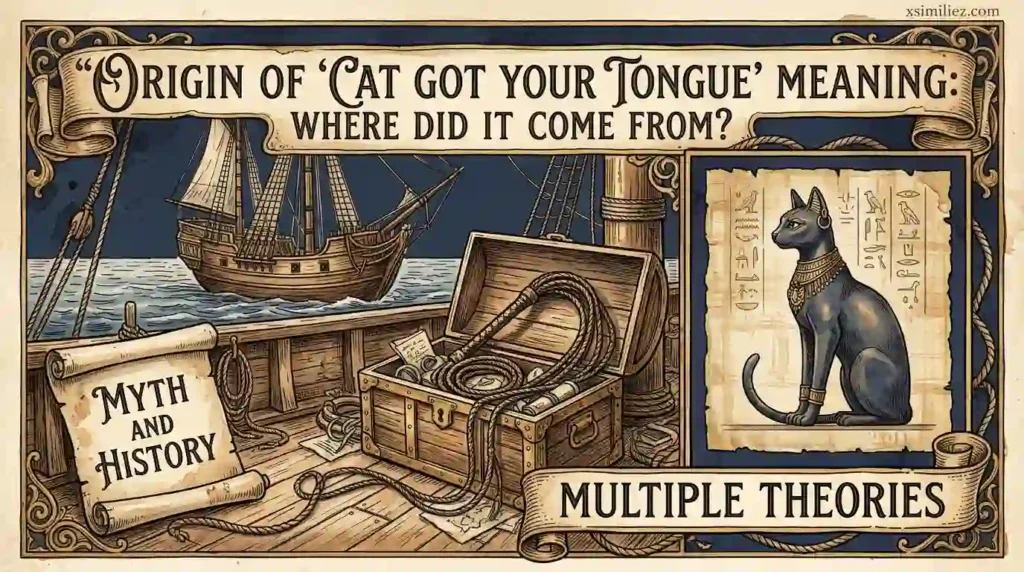
Here is where honesty matters. Nobody knows for sure where this phrase came from. Word experts have looked for a clear starting point, and they have not found one that everyone agrees on. What we have are several popular stories. Some are fun to read, but none has strong proof behind it.
Let’s look at the best-known ideas side by side.
| Popular Theory | The Story | How Reliable Is It? |
| The cat-o’-nine-tails | Sailors in the navy were whipped with a rope whip called a cat-o’-nine-tails. The pain left them too scared to speak. | Often repeated, but experts find little proof. |
| Ancient Egypt | Liars had their tongues cut out and fed to cats as punishment. | A dramatic legend with no solid evidence. |
| Witches and cats | People believed a witch’s cat could steal your voice. | Fits old folk beliefs, but not proven as the source. |
| Plain playful image | Cats are known for grabbing things. The phrase just pictures a cat running off with a tongue. | The simplest idea, and the most likely feel of the phrase. |
The navy story is probably the one you will hear most. It sounds believable because the whip had “cat” in its name. Still, many language experts doubt it. The idea that the phrase came from sailors is mostly a tale that people repeat, not a fact that is backed up.
The Egypt story has the same problem. It is exciting, but there is no strong record linking it to the saying. And the witch idea fits old tales about cats and magic, yet nobody has shown it started the phrase.
So what is the safest thing to say? The phrase seems to have grown out of everyday English. It has been common for a long time, and the exact beginning is unclear. If someone tells you they know the one true origin, you can smile and say the proof is missing.
Cat Got Your Tongue Meaning in British and American English
Good news: this idiom is used in both American and British English. The meaning is the same on both sides of the ocean. If you say it in New York or in London, people will know that you are asking why someone has gone silent.
There are small differences in feel, though. In the United States, the phrase is often linked to kids, family life, and movies. People may say it with a laugh when a child is caught doing something silly. In the United Kingdom, it may show up in casual chat, books, and old-fashioned humor.
Some people say the phrase feels a bit old now, no matter which country they live in. That is not a rule, just a common feeling. Younger speakers may choose other words, like “you’re quiet” or “nothing to say?“
The spelling stays the same everywhere. There is no “colour versus color” problem here. The only thing that might change is the small grammar choice, such as “has the cat got” in some British speech. Even then, the idea is exactly the same.
Common Mistakes With “Cat Got Your Tongue”
This phrase looks easy, but people still trip over it. Here are the mistakes that come up most.
The first mistake is taking it too literally. Some learners of English hear it and think a real cat is involved. It is an idiom, which means the words together mean something different from the words alone. A good habit is to learn idioms as whole pictures, not word by word.
The second mistake is using it at the wrong time. If someone is quiet because they are sad, grieving, or hurt, this phrase can sound rude. Teasing someone who is in pain is not kind. The phrase works best when the silence is small and light, like shyness or surprise.
The third mistake is mixing it up with other sayings. People sometimes say “cat got your tongue” when they mean “bite your tongue.” Those are different. “Bite your tongue” means to stop yourself from saying something. In the cat phrase, the person is silent without choosing to be.
The fourth mistake is changing the words too much. Saying “dog got your tongue” or “the cat took your voice” can confuse people, unless you are joking on purpose. The usual wording has the best chance of being understood right away.
Finally, some people use the phrase in serious writing. It can feel out of place in a formal report. If you want a professional tone, pick plain words like “You seem quiet” or “Do you have a response?”
Real-Life Examples of “Cat Got Your Tongue”
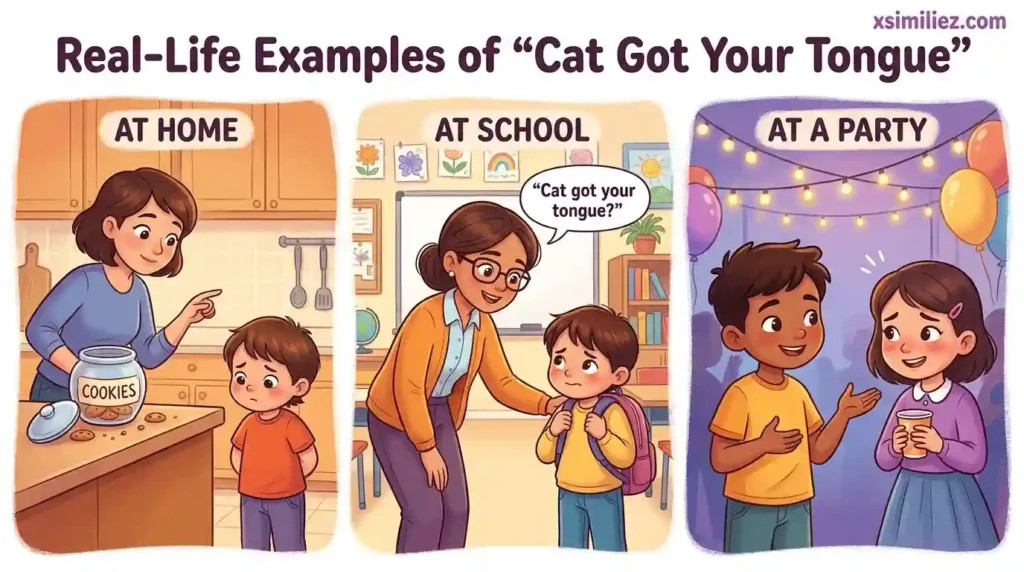
Examples make an idiom stick. Here are some everyday moments where the phrase fits well.
At home, a mom finds her son standing near an empty cookie jar. She asks him what happened. He stares at the floor and says nothing. She smiles and says, “What’s wrong? Cat got your tongue?” Here the phrase is playful, and she already has a good guess about the answer.
At school, a teacher calls on a student who always talks during class. Today, the student freezes. The teacher says gently, “You’re usually full of ideas. Cat got your tongue?” The tone is friendly, and it invites the student to relax and speak.
At a party, two people meet someone they find very interesting. One of them goes quiet from nerves. A friend nudges him and jokes, “Cat got your tongue?” The phrase teases him a little and helps him laugh at himself.
In a story or movie, a villain might lean in close and say it in a cold voice. The hero has been caught and cannot think of a reply. Here the phrase is not warm at all. It is sneaky, and it shows power.
In a past-tense sentence, you might say, “I wanted to say something, but the cat had my tongue.” That is a fun way to explain why you froze in a meeting or a talk.
Words and Phrases Similar to “Cat Got Your Tongue”
Sometimes you want another way to say the same thing. Some choices are softer, and some are more direct. The table below can help you pick the right one for the moment.
| Phrase | What It Means | Best Used When |
| Tongue-tied | Too nervous or confused to speak well | Describing yourself or a shy person |
| Speechless | So surprised that no words come out | Big news or a shock |
| Lost for words | Cannot find the right thing to say | A moving or hard moment |
| Not saying a word | Staying quiet on purpose or by habit | Describing a quiet person |
| Bite your tongue | Hold back what you want to say | Keeping calm in a tense moment |
| You’re quiet today | A gentle check-in | When you care about the person |
Notice that only the cat phrase is a teasing question. The others describe a state, or give calm advice. That is why the cat saying has a bit more spark. It adds a joke and a challenge to the question.
There is one more fun fact. French has a saying that uses a cat and a tongue, but it means something else: “to give your tongue to the cat” means to give up guessing an answer. It shows how different languages can use similar pictures in very different ways.
Cat Got Your Tongue Today: Current Usage and Trends
How common is the phrase now? You can still hear it in movies, TV shows, books, and everyday talk. It remains a classic, and many people know it from childhood. Parents and grandparents often say it, which keeps it alive for new kids.
That said, it is not the trendiest line. Many younger people may sound more natural using phrases like “you’re quiet” or “nothing to say?” Online, you may see the phrase in memes, jokes, and captions. People use it to poke fun at a friend who went silent in a group chat or left a message on read.
The phrase also shows up in song titles, book titles, and story dialogue. Writers like it because it is short and easy to picture. It tells the reader a lot about a character in only a few words: someone is watching, someone is stuck, and the room is tense.
A small warning for today’s world: the phrase can feel a bit pushy if someone is quiet for a real reason, such as anxiety. More people are aware that silence is not always rude or strange. Because of that, many speakers now use the phrase more carefully, mostly with friends and family who will take it as a joke.
Tips for Using “Cat Got Your Tongue” Well
A few simple habits can help you use this phrase like a pro.
First, read the room. Ask yourself if the silence is light or heavy. If the person looks nervous or silly, a joke may work. If they look hurt, skip it and offer kind words instead.
Second, watch your tone. A smile and a soft voice turn the phrase into a gentle tease. A hard stare and a flat voice turn it into a dare. The words stay the same, but the message changes.
Third, give the person a chance to answer. After you ask, stop and wait. The whole point is to invite them to talk, so do not rush in with your own answer.
Fourth, keep it for informal moments. It sounds great in a chat with friends, a family dinner, or a story. It sounds odd in a legal paper, a job email, or a school report.
Fifth, if you are teaching English, explain that it is an idiom. Show a picture of a cat running off with a tongue, then ask students to say what it really means. A silly image helps the meaning stay in memory for a long time.
FAQs
1. What does “cat got your tongue” mean?
It means someone has gone quiet when you expect them to talk. It is a playful question that asks, “Why aren’t you speaking?”
2. Is “cat got your tongue” rude?
Not always. With a smile, it is a light joke. With a sharp tone, it can feel like teasing or pressure. Use it with people who know you well, and avoid it when someone is upset.
3. Where does “cat got your tongue” come from?
Nobody knows for sure. Popular stories mention a navy whip, ancient Egypt, and witches’ cats, but none has strong proof. The phrase probably grew out of everyday English.
4. Is it a question or a statement?
It is usually a question: “Cat got your tongue?” You can also use it as a statement about someone else, like “The cat got his tongue.”
5. Can I use it at work or in school?
It is casual, so it is best with friends and family. In a formal setting, choose plainer words like “Do you have a response?” or “You seem quiet today.”
6. What can I say back if someone asks me?
You can answer with a laugh and say, “No, I’m just thinking,” or “I’m a little nervous.” You can also make a joke, like “The cat gave it back” and then say what you wanted to say.
Conclusion
Now you know the cat got your tongue meaning: it is a playful way to ask why someone is suddenly quiet. The phrase is old, friendly, and easy to picture. A cat runs away with a tongue, and the person cannot speak. That small picture explains a big feeling.
You also learned that the true origin is unclear. Stories about sailors, Egypt, and witches are fun, but they lack strong proof. It is okay to enjoy them as tales while remembering that the real start is a mystery.
The best advice is to use the phrase with care. Keep it light, watch your tone, and save it for people who will smile. If someone seems truly upset, choose kinder words. Used the right way, this classic idiom can add a little humor to any chat.

Hi, I’m Mason Avery, a content writer at Xsimiliez.com. I like writing about similes, figurative language, and creative expressions. I believe learning English becomes easier when examples feel natural and relatable.