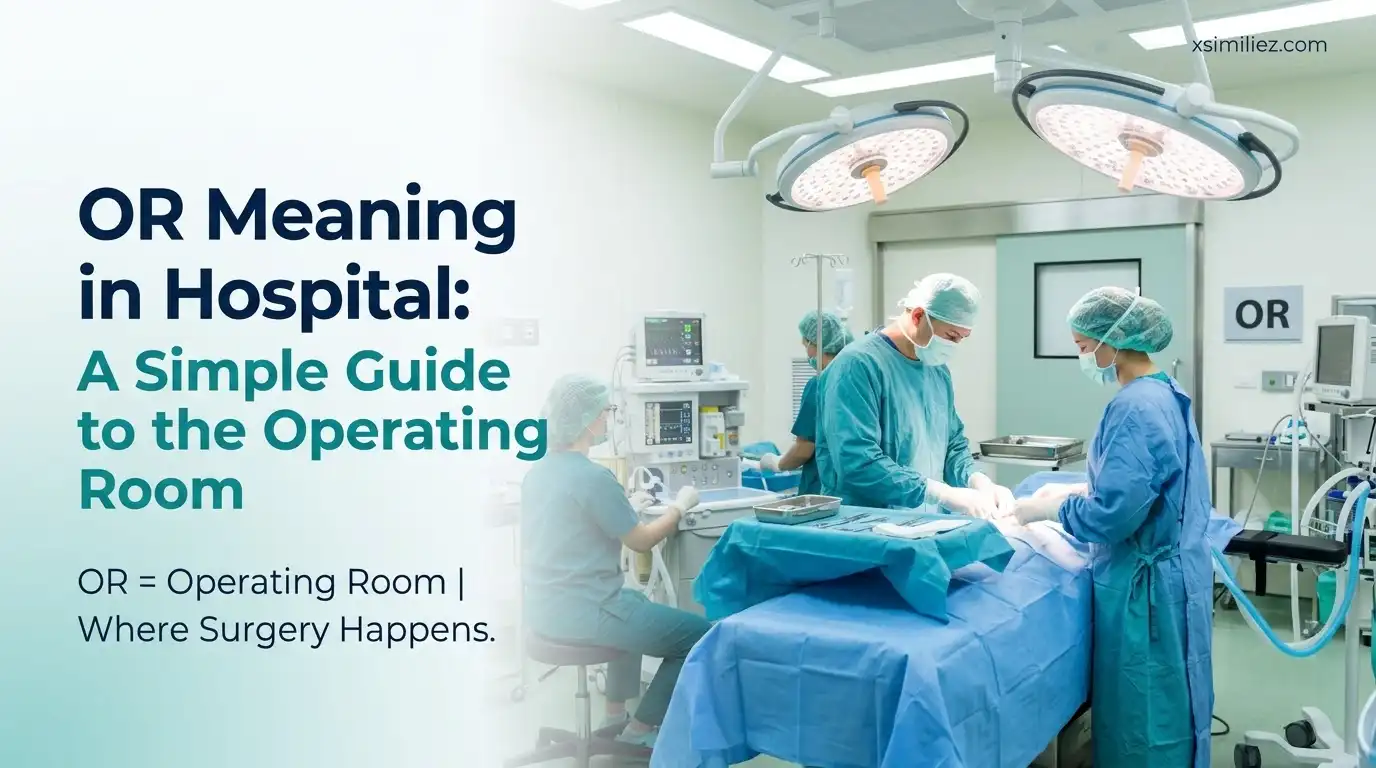
OR meaning in hospital is simple: OR stands for operating room. It is the special room where surgeons perform operations. Doctors, nurses, and other trained staff work there to keep patients safe.
You may have seen “OR” on a hospital sign, a schedule board, or a TV drama. Maybe a loved one is about to have surgery, and a nurse said, “We will take you to the OR soon.” That can sound scary when you do not know what the term means.
In this guide, you will learn what the OR is, who works there, and what happens inside. You will also see how it differs from the ER, why it looks the way it does, and how to prepare. Let’s start.
Quick Answer: OR Meaning in Hospital
In a hospital, OR means operating room. It is a clean, controlled space built for surgery. Some people write it as “O.R.” and some hospitals call it the “operating theatre.”
Here is the short version:
- Full form: Operating room
- Main purpose: To perform surgery safely
- Who uses it: Surgeons, anesthesia providers, nurses, and surgical technologists
- Common mix-up: People confuse it with the ER, which means emergency room
If you hear “OR” in a hospital, nearly every time it means the place where surgery happens.
OR Meaning in Hospital: A Full Definition

The meaning of or in hospital is simple. OR meaning hospital refers to the operating room, a specially equipped area in a hospital where surgeons perform operations and surgical procedures.
An operating room is a part of the hospital made for surgical procedures. Everything about it is planned to lower the risk of infection and help the surgical team work well.
Think of it like a kitchen in a fancy restaurant, but cleaner. A restaurant kitchen has tools in set places, strict cleaning rules, and a team where each person has a job. The OR works the same way, except the stakes are much higher.
An OR usually has a special surgical table, bright lights that hang from the ceiling, and machines that watch the patient’s heart rate and breathing. It also has an anesthesia machine, which helps the patient sleep and stay comfortable during surgery. Carts hold sterile tools that have been cleaned with heat or special methods to kill germs.
Most hospitals have several ORs. A large hospital might have dozens. Each room may be set up for different kinds of surgery, such as heart, bone, brain, or baby delivery by C-section.
Hospital staff often use “OR” as a shortcut in daily talk. You might hear “She’s in the OR,” “OR is running late,” or “We have an OR booked at 8.” They all point to the same idea: the surgery room, or the schedule that goes with it.
What Happens Inside the OR
Many people picture a quick scene from a TV show. Real surgery is slower and much more careful.
Before the patient arrives, staff clean the room and set up the tools. They check that every machine works. Each item that touches the surgical area must be sterile, which means free of living germs.
Then the patient is brought in, usually on a bed or stretcher. The team confirms who the patient is, what surgery is planned, and which part of the body is involved. This step is repeated on purpose. Safety checklists, including one promoted by the World Health Organization since 2008, help teams avoid mistakes. A common moment is called the “time-out.” Right before surgery starts, everyone stops and agrees on the plan.
Next, the anesthesia provider gives medicine so the patient does not feel pain. Depending on the surgery, the patient may be fully asleep or only numb in one area. The team watches heart rate, blood pressure, oxygen, and breathing the whole time.
Then the surgeon begins. The team passes tools, counts items, and tracks every step. Counting sponges and instruments is a key safety habit, so nothing is left behind.
OR meaning medical refers to the specialized surgical area where trained medical professionals perform operations using controlled conditions and advanced equipment.
When surgery ends, the patient is moved to a recovery area. This is not the OR itself. It is often called the PACU, short for post-anesthesia care unit.
Who Works in the OR
A surgery is not a one-person job. It takes a team, and each member has a clear role. Roles can vary by hospital and by type of surgery, but here are the most common ones.
| Team Member | What They Do |
| Surgeon | Leads the operation and performs the surgery |
| Anesthesiologist or nurse anesthetist | Gives anesthesia and monitors breathing, heart rate, and comfort |
| Scrub nurse or surgical technologist | Keeps the sterile field, hands tools to the surgeon, and tracks supplies |
| Circulating nurse | Moves around the room, gets supplies, and handles paperwork and safety checks |
| Surgical assistant | Helps the surgeon by holding tools or tissue and helping with the procedure |
Other people may help too. These can include cleaning staff, equipment technicians, and, for some surgeries, specialists such as heart machine operators.
The OR hospital meaning is the term used to describe the operating room where surgeons perform operations and patients receive surgical care.
Notice that the “scrub” team stays in the sterile area, while the circulating nurse works outside it. This keeps germs from spreading into the sterile zone. It is one small example of how much planning goes into each OR.
Why the OR Looks and Feels Different
If you ever see inside an operating room, you may notice a few things right away. The room is bright, tidy, and often cool. These details are on purpose.
The temperature is often kept in a cool range, around 68 to 75 degrees Fahrenheit, though each hospital sets its own rules. Cooler air can help staff stay comfortable in heavy gowns and lights. It can also make the patient feel cold, so nurses often provide warm blankets.
The air is cleaned too. Many ORs use filtered air systems that push air in a controlled way, which helps keep dust and germs away from the surgical area. Doors are kept closed as much as possible, because every opening can change the airflow.
Staff wear special clothing. This usually includes scrubs, a surgical cap, a face mask, and shoe covers. The surgical team also wears sterile gowns and gloves. People who do not need to be there do not enter. Some hospitals limit how many people can be in the room at once.
The goal behind every rule is the same: lower the chance of infection and keep the patient safe.
OR vs ER vs ICU vs PACU
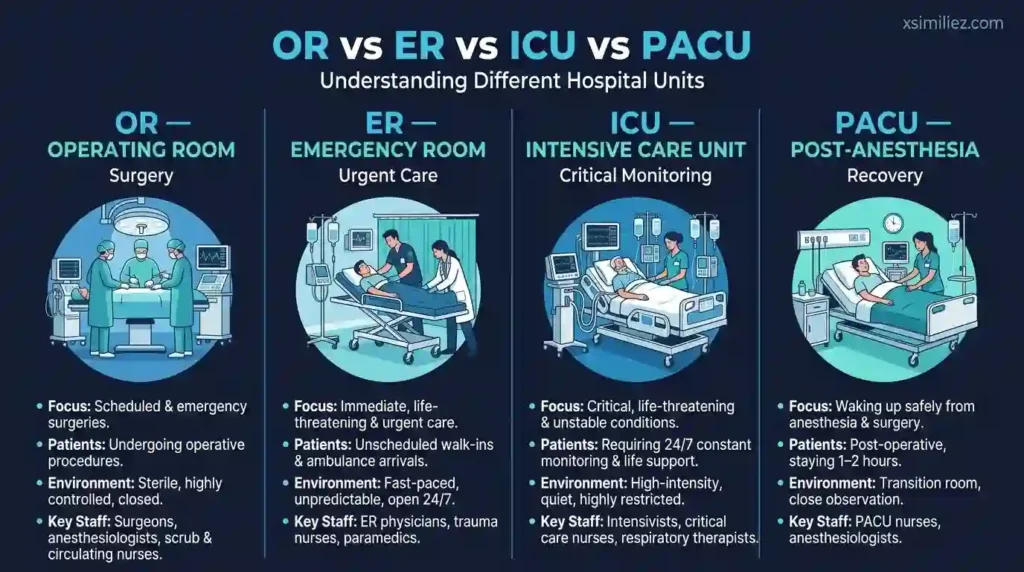
New patients and families often mix up hospital abbreviations. They look similar and show up in the same conversations. This table can help.
What’s the or
| Term | Full Name | What It Is |
| OR | Operating room | Where surgery is performed |
| ER | Emergency room | Where people go for urgent or life-threatening problems |
| ICU | Intensive care unit | Where very sick patients get close, constant monitoring |
| PACU | Post-anesthesia care unit | Where patients wake up and recover right after surgery |
| NICU | Neonatal intensive care unit | Where very sick or early newborn babies are cared for |
A patient’s path may go through several of these. For example, someone with a broken leg might arrive at the ER, be taken to the OR for surgery, wake up in the PACU, and then go to a regular hospital room.
The biggest mix-up is OR and ER. They sound alike, but they do very different jobs. The ER is a front door for emergencies. The OR is a surgery space, and not every ER patient needs it.
British vs American English
In the United States, most people say “operating room” and “OR.” In the United Kingdom, Canada, Australia, and several other countries, you will often hear “operating theatre.” Some people shorten it to “theatre” or “OT.”
So if you read a medical story from the UK and it mentions “theatre,” it does not mean a movie theater. It means the same place as the American OR.
Spelling also changes. Americans write “theater” when they use the word at all, while British English uses “theatre.” Either way, the meaning in a hospital stays the same.
The word “theatre” has a story behind it, which brings us to the next section.
Origin of the Term
The older word “operating theatre” comes from how early surgery was done. Long ago, surgeons often worked in rooms with rows of seats, like a small stadium. Medical students and doctors sat in the rows to watch and learn. That setup looked like a theater, so the name stuck.
Back then, surgery was very different. Anesthesia was only introduced in the 1840s, and understanding of germs was limited. Many patients faced serious infections after surgery. Over the following decades, doctors such as Joseph Lister helped promote cleaner methods, using antiseptics to cut infection rates.
As people learned more about germs, operating rooms changed. The open, crowded seating faded. Rooms became more private, more sterile, and more focused on patient safety. Today’s OR is built around cleanliness, teamwork, and technology.
The term “operating room” became common in American hospitals, while “theatre” stayed in many other countries. The exact timeline varies by place, so it is best to say these changes happened gradually over many years.
Common Mistakes with the Term OR
Because “OR” is so short, people sometimes use it the wrong way. Here are mistakes to watch for.
Mixing it up with ER. This is the most common mistake. If a person says, “He was rushed to the OR,” they mean he went to surgery. If they say, “He was rushed to the ER,” they mean the emergency room.
Thinking OR means “or” as a word. In writing, “OR” in capital letters on a hospital document often means operating room, not the simple word “or.” Context makes it clear. A schedule that says “OR 4, 9:00 AM” means operating room number four.
Using it for every medical room. Not every procedure takes place in an OR. A simple dental filling, a stitch for a small cut, or a basic blood test does not need one. Smaller procedures may happen in a clinic or procedure room.
Assuming OR always means major surgery. Some operations are short and low risk, such as certain eye or outpatient procedures. They still happen in an OR because it is a clean, controlled setting.
Confusing it with other medical meanings. In research papers, “OR” can mean “odds ratio,” which is a math term used in studies. That is a different meaning from the hospital room. If you see “OR” in a medical study with numbers next to it, it likely means odds ratio.
Real-Life Examples
Seeing the term in everyday sentences makes it easier to remember. Here are a few examples you might hear.
A nurse might say, “Your surgery is scheduled for the OR at 10 a.m.” This tells you where and when the operation will happen.
A doctor might tell a family, “She is in the OR now, and I will update you when we finish.” That means the patient is currently having surgery.
A hospital worker might say, “OR 3 is being cleaned between cases.” This means a specific room is getting ready for the next patient.
A scheduler might say, “We have a delay in the OR today.” This means surgeries are running behind.
A parent might hear, “He will go to the OR for his tonsil surgery, then to recovery.” In this case, the OR is just one stop in the day.
In each case, the meaning is the same. The OR is the room, or the schedule for the room, where surgery takes place.
Tips for Patients and Families
If you or someone you love is going to the OR, a little preparation can lower stress. These tips are general. Always follow the instructions from your own medical team.
Ask questions early. It is fine to ask what surgery will be done, how long it may take, and what recovery looks like.
Follow food and drink rules. Hospitals usually tell patients when to stop eating and drinking before surgery. This helps keep anesthesia safe. If you are unsure, call the hospital and ask.
Share your health information. Tell the team about your medicines, allergies, and past reactions to anesthesia. Do not leave anything out, even if it seems small.
Plan a ride and help at home. Many patients cannot drive after anesthesia. Arrange a trusted person to take you home and stay with you if needed.
Leave valuables at home. Jewelry, watches, and extra items are usually not allowed in the OR area. Bring only what the hospital asks for.
Know where family should wait. Ask where loved ones can wait and how the surgeon will share updates.
Take a breath. Feeling nervous is normal. The OR team does this work every day, and they are trained to guide you through each step.
FAQs
What does OR stand for in hospital?
OR stands for operating room. It is the room where surgeons perform operations.
Is the OR the same as the ER?
No. The OR is for surgery, while the ER is the emergency room for urgent problems. A person may go from the ER to the OR if surgery is needed.
What does or mean in hospital?
It refers to the operating room where surgical teams carry out medical operations.
Why is the OR so cold?
Hospitals often keep it cool for comfort, since staff wear heavy gowns and work under hot lights. Cool, controlled air can also support cleanliness. Nurses usually offer warm blankets to patients.
what does or mean hospital?
OR in a hospital means operating room, the dedicated space where surgical procedures are performed.
Who is allowed in the operating room?
Mainly the surgical team and the patient. This often includes the surgeon, anesthesia provider, nurses, and technologists. Visitors are not allowed in the OR during surgery.
What is an operating theatre?
It is another name for the operating room. People in the UK and some other countries use this term more often than Americans do.
Do all surgeries happen in the OR?
Not all. Major surgeries usually happen in an OR, but small procedures may be done in clinics or procedure rooms. Your care team can tell you where your procedure will take place.
Conclusion
To wrap it up, the OR meaning in hospital is operating room. It is the clean, carefully controlled space where surgeons and their teams perform operations. Every rule, from masks to cool air, exists to protect patients.
You also learned that the OR is different from the ER, ICU, and PACU. Each has its own job in a patient’s care. The term can show up in schedules, hospital talk, and even TV shows, and now you know what it means in each case.
If you are heading to the OR soon, ask questions, follow your care team’s instructions, and lean on the people around you. Feeling nervous is normal. The team in that room works hard to keep you safe, and knowing what to expect can make the day easier.

Hi, I’m Harper Blake, and I write for Xsimiliez.com. I enjoy sharing clear and friendly simile examples that students and beginners can understand easily. My goal is to make English learning simple and enjoyable.