Have you ever heard someone say, “Black don’t crack,” and then laugh as they point to a grandma who looks 40? You are not alone. This saying shows up in family chats, songs, memes, and social media posts every single day.
People searching for the black don’t crack the meaning because the words sound a little odd at first. Is it about skin, age, or pride? The answer is a mix of all three, and the story behind it is worth knowing.
In this guide, you will learn what the phrase means, how to use it the right way, and where it may have come from. You will also see what science says about aging skin and get simple tips for caring for your own.
Black Don’t Crack Meaning: Quick Answer
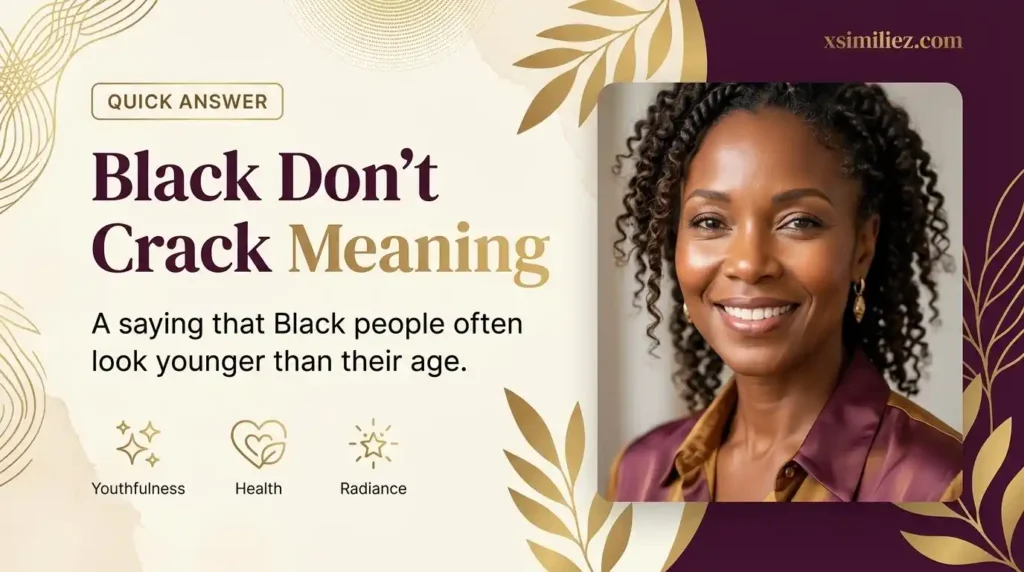
The black don’t crack meaning is simple. It is a saying that Black people often look younger than their real age. The word “crack” stands for deep lines, wrinkles, and other signs of aging. People say it as a compliment, usually with a smile and a little pride.
Think of it like saying, “Wow, you do not look your age” The saying adds a cultural touch, though. It ties that youthful look to Black identity and Black skin. It is warm, playful, and often shared among friends and family who understand the joke.
What the Phrase Means in Everyday Talk
Let’s break the phrase into three small parts. Each part carries its own piece of the meaning.
| Part of the Phrase | What It Means |
| Black | Black people, especially in the African American community |
| Don’t | A casual way of saying “does not” in everyday speech |
| Crack | To show deep wrinkles, lines, or visible aging |
Put together, the phrase says that Black skin does not show age as quickly. That is the plain meaning. But the feeling behind it matters just as much.
Most of the time, “Black don’t crack” is a happy phrase. Someone might say it when they see a 55-year-old with smooth, glowing skin. A mom might say it at a family cookout when an aunt arrives looking fresh. It is a way of celebrating beauty and good genes.
The phrase also carries pride. For many people, it is a small way to say, “Our skin is strong, and we are proud of it.” In a world that has not always praised Black beauty, a saying like this feels good. It lifts people up.
There is also a playful side. People often use it as a joke, a shout-out, or a reply to a surprising age. If someone says, “I’m 62,” and you gasp, “Black don’t crack” you are giving a friendly compliment. Most listeners will smile.
Still, the phrase is a general saying, not a rule. Not every person looks younger than their age, and that is perfectly fine. The saying is about a common pattern that people notice, not a promise about every face.
Grammar and Correct Usage of Black Don’t Crack
If you look at the grammar, you may notice that “don’t” is used where textbooks would say “doesn’t.” That is on purpose. The phrase comes from African American Vernacular English, often called AAVE. This is a real, rich way of speaking with its own patterns and rules. It is not “bad grammar.”
In AAVE, “don’t” can be used with “he,” “she,” “it,” or a noun, as in “She doesn’t know.” So “Black don’t crack” fits right into that style. If you changed it to “Black doesn’t crack,” the saying would lose its rhythm and its flavor. Most people who use it keep the original wording.
Here are a few simple tips for using the phrase well:
- Use it as a full sentence, such as “Girl, black don’t crack”
- Use it as a reply after hearing someone’s age.
- Keep the wording as it is, since changing it makes it sound stiff.
- Write “Black” with a capital B when you mean the people. This is common in modern style guides.
You can also add small words to make it fit your talk. People say, “Well, black don’t crack,” or “See, that’s why black don’t crack.” These small add-ons feel natural and keep the saying lively.
One more thing to know is that the phrase works best between people who know each other, or in a friendly setting. Tone is everything. The same words can feel kind from a friend and awkward from a stranger. We will come back to that in the mistakes section.
Origin and History of Black Don’t Crack

Here is where honesty matters. No one has found a clear first use of this phrase. There is no famous book, speech, or song that everyone agrees started it. It most likely began as spoken talk in Black families and neighborhoods in the United States, passed from one person to the next over many years.
Sayings like this often grow out of everyday life. People noticed that older relatives, neighbors, and church members looked younger than expected. They shared that thought out loud. Over time, a short and catchy line formed, and it stuck.
Because it started in spoken talk, it is hard to give a year or a place. Anyone who gives you an exact date is likely guessing. What we can say is that the saying has been part of Black American speech for a long time, and many people remember hearing it growing up.
The phrase has also spread far beyond its first circle. Radio, TV, comedy, music, and the internet carried it to new listeners. Today, people around the world know it, even if they use it in different ways.
It helps to see the phrase as part of a bigger tradition. Black communities have long used clever, short sayings to share wisdom, humor, and pride. “Black don’t crack” fits that tradition well. It is quick, memorable, and full of meaning.
Is There Science Behind Black Don’t Crack?
Many people wonder if the saying has any truth in it. The short answer is that science offers some support, but it is not the whole story.
The main player is melanin. This is the natural pigment that gives skin its color. People with darker skin have more melanin, and it helps protect skin from the sun’s harmful UV rays. Sun damage is one of the biggest causes of early wrinkles, dark spots, and rough skin. Doctors call this “photoaging.”
Because melanin takes in some UV light, darker skin may show sun-related aging later in life. Some older studies have estimated that dark skin has natural protection similar to a low-level sunscreen, around SPF 13. Experts still say that number is only a rough idea and that protection varies from person to person.
Genes, diet, sleep, stress, smoking, and daily habits all play a part too. Two people with the same skin tone can age very differently. That is why science cannot say that every Black person will look younger.
Here is a quick look at what is true and what is not.
| Common Belief | What Is More Accurate |
| Melanin gives some natural sun protection | True, but it is not full protection |
| Black skin never shows aging | Not true, since all skin ages over time |
| Black people do not need sunscreen | Not true, because skin cancer can happen in every skin tone |
| Lifestyle has no effect | Not true, as habits matter for every person |
One important point deserves extra attention. Some people hear “Black don’t crack” and think sunscreen is not needed. That is risky. Skin cancer is less common in people with darker skin, but it can still happen. Sadly, it is often found later, which can make it harder to treat. Doctors from groups like the American Academy of Dermatology encourage everyone to protect their skin.
Darker skin also has its own common concerns. Dark spots, uneven tone, and scars that stay dark can show up after acne or small injuries. So the saying may fit some part of aging, but skin care still matters.
Common Mistakes with Black Don’t Crack Meaning
Even a friendly phrase can be misused. Here are the most common mistakes people make.
Treating it as a scientific fact. The phrase is a saying, not a medical claim. It is fine to enjoy it, but it should not replace real skin care or doctor visits.
Using it to stereotype. Saying “all Black people look young” turns a fun phrase into a broad claim about a whole group. People are different. Some Black people show age early, and that is normal.
Using it the wrong way as an outsider. If you are not part of the community, think about your setting before using it. Between close friends, it may be fine and even funny. With strangers, or in a work meeting, it can come across as odd or as a stereotype. When in doubt, a simple “You look amazing” works well.
Changing the words. Some people try to “fix” the grammar and say, “Black doesn’t crack.” That removes the rhythm and the cultural feel of the original.
Forgetting the compliment. The phrase is supposed to lift people up. If it is used to joke at someone’s expense or to point out their age in a rude way, it misses the point.
Skipping sun care. As we saw, believing the saying too much can lead people to skip sunscreen. A good habit is better than a good saying.
If you remember one thing, make it this. Use the phrase with warmth, know your audience, and never use it to put anyone in a box.
Real-Life Examples of Black Don’t Crack
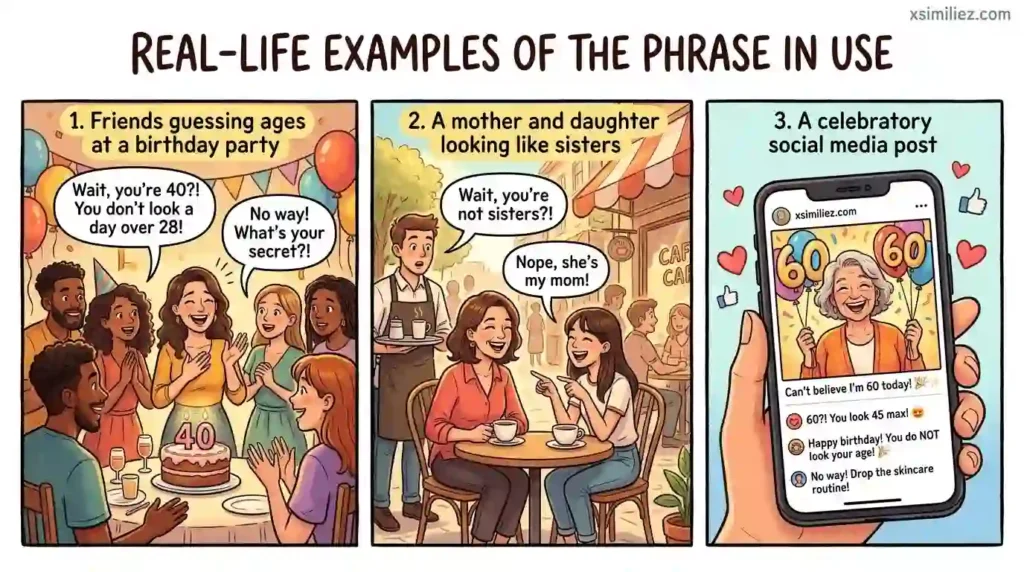
Seeing the phrase in action helps it click. Here are a few short, everyday scenes.
At a family reunion. A young man hugs his aunt and asks how old she is. She says, “Sixty-three.” He laughs and says, “No way. Black don’t crack” She smiles and does a little spin.
At a birthday party. Friends hold up photos of a coworker from ten years ago and today. The two photos look almost the same. Someone says, “See? Black don’t crack,” and everyone cheers.
On social media. A user posts a picture with the caption, “Turned 50 today. Black don’t crack.” The comments fill up with hearts, fire icons, and happy birthday wishes.
In a barbershop. Two men talk about a neighbor who still looks like he is in his thirties. One shakes his head and says, “That man is seventy. Black don’t crack, I’m telling you.”
In a school hallway. A teenager sees a photo of her grandmother at 45 and says, “Wait, that’s you? You look like my cousin” Her grandmother grins and replies, “That’s right, baby. Black don’t crack.”
Each example shows the same pattern. Someone is surprised by a person’s age, and the phrase is used to cheer them on. The mood is always light and kind.
Black Don’t Crack in Today’s Culture
These days, the phrase lives in many places. You will see it on TikTok, Instagram, X, and in comment sections. Fans use it when a famous actor, singer, or athlete seems to look the same for years. Hashtags and short videos keep it popular with younger people.
It has also shown up in comedy, music, and TV talk. Because it is short and catchy, writers and creators like to use it. That is part of why the black don’t crack meaning is searched so often. New listeners hear it and want to know what it says.
People from other communities use it too, sometimes in good fun and sometimes without knowing the background. Some Black people enjoy seeing the phrase spread. Others feel it should stay close to its roots. Both views are real, so it helps to be thoughtful.
The phrase has also joined a larger talk about beauty and skin care. More brands now make products for deeper skin tones, and more people share tips for dark spots, glow, and sun care. The saying sits right in the middle of that talk. It reminds people that Black beauty deserves praise, and that good skin care is for everyone.
Another trend is that people now pair the phrase with real advice. A video might start with “Black don’t crack,” then explain a daily routine with cleanser, moisturizer, and sunscreen. That mix of pride and practical help is a healthy way to use the saying.
Tips for Healthy, Glowing Skin at Any Age
Good genes help, but daily habits do a lot of the work. These simple steps work for every skin tone.
Wear sunscreen every day. Choose a broad-spectrum sunscreen with SPF 30 or higher. Some sunscreens leave a pale cast on deeper skin, so look for ones made to blend in well. Apply it even on cloudy days.
Wash gently. Use a mild cleanser once or twice a day. Scrubbing hard can hurt your skin and cause dark spots.
Moisturize. Dry skin can look dull and ashy. A good moisturizer keeps skin soft and helps it hold water.
Drink water and eat well. Fruits, vegetables, nuts, and healthy fats feed your skin from the inside. You do not need a perfect diet, just a good pattern.
Sleep enough. Rest gives your skin time to repair. Most adults do best with seven to nine hours.
Avoid smoking. Smoking speeds up wrinkles on every skin tone.
Treat dark spots with care. If acne or small cuts leave dark marks, ask a dermatologist for safe options. Do not pick at your skin, because that can make marks last longer.
Get regular skin checks. See a doctor if you spot a new mole, a spot that changes, or a dark line under a nail. Early care saves lives.
Manage stress. Walks, music, prayer, time with loved ones, and rest all help your body and your face.
None of these steps are fancy. They are small habits that add up. Over the years, they can help any person’s skin look and feel its best.
FAQs
What does “black don’t crack” mean?
It means Black people often look younger than their age. “Crack” refers to wrinkles and lines. People say it as a friendly compliment about youthful-looking skin.
Is “black don’t crack” offensive?
Usually, no. Within the Black community, it is a proud and playful saying. It can feel awkward if an outsider uses it carelessly or in a stereotyping way, so tone and setting matter.
Is it true that Black skin ages slower?
Partly. Melanin gives some protection from the sun, which can delay certain signs of aging. But all skin ages, and habits, genes, and sun care make a big difference.
Where did the phrase come from?
No one knows the exact start. It most likely grew from everyday speech in Black communities in the United States. There is no single proven source or date.
Why does the phrase say “don’t” instead of “doesn’t”? It follows African American Vernacular English, where “don’t” is often used with words like “he,” “she,” or a noun. It is a real style of speech, not a mistake.
Do Black people still need sunscreen?
Yes. Melanin helps, but it does not block all UV rays. Skin cancer can happen in any skin tone, so daily sunscreen is a smart habit for everyone.
Conclusion
The black don’t crack meaning comes down to one warm idea: Black people often look younger than their age, and many are proud of that. It is a compliment, a joke, and a point of pride rolled into four short words.
Science gives the saying some support, since melanin offers natural sun protection. But it does not tell the whole story. Genes, habits, and care all shape how skin ages, and no one is exempt from needing a little help.
So enjoy the phrase, use it kindly, and know your audience. Most of all, take care of your skin with sunscreen, water, rest, and regular checkups. The best way to honor “black don’t crack” is to keep your skin healthy for years to come.

Hi, I’m Mason Avery, a content writer at Xsimiliez.com. I like writing about similes, figurative language, and creative expressions. I believe learning English becomes easier when examples feel natural and relatable.