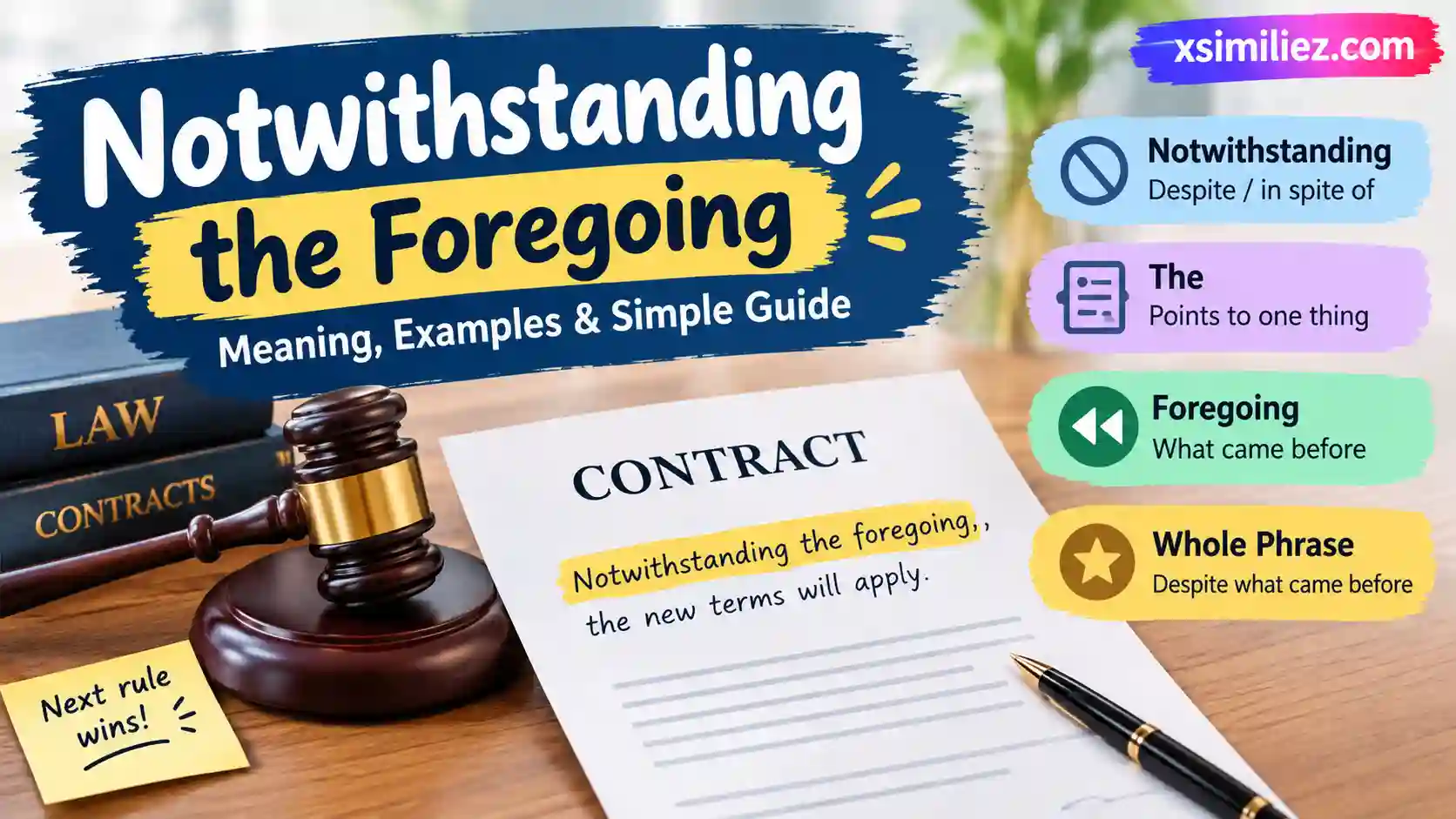
Notwithstanding the foregoing meaning is easy to state: the phrase tells you the next rule wins, even if earlier words say something different. It means “in spite of what was just said.” Lawyers use it in contracts to put one rule above another.
You may have seen it in a lease, a job offer, or an app’s terms of service. It sounds stiff and a little scary, so most people skip it and keep scrolling. But this small phrase can change who pays, who gets paid, and who can walk away. That is why so many readers stop and search for it.
In this guide, you will learn what the phrase means, how it works, and where it came from. You will also see real examples, helpful tables, common mistakes, and tips for reading or writing it.
Quick Answer: Notwithstanding the Foregoing Meaning in Plain English
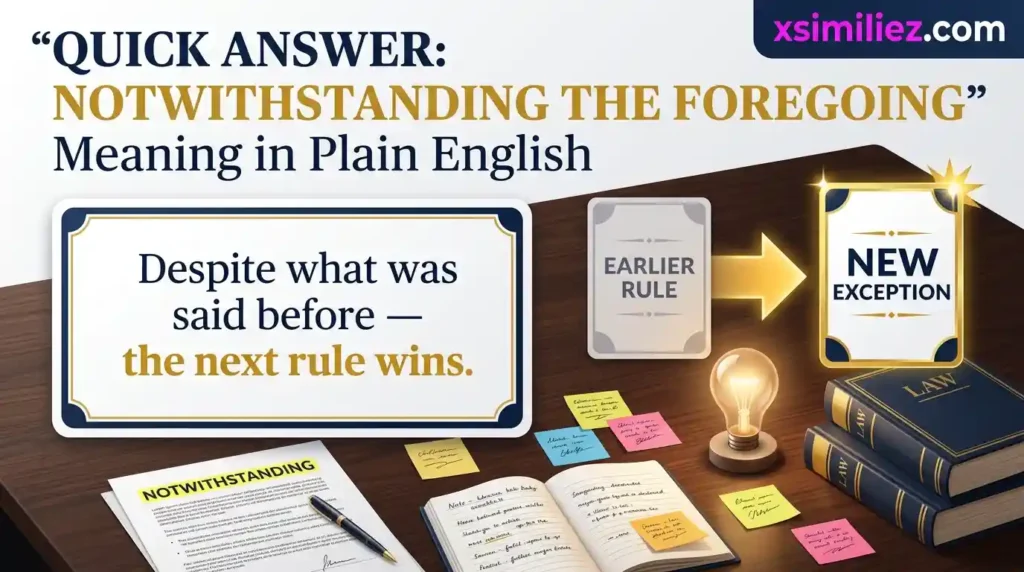
When a writer says “notwithstanding the foregoing,” they mean “even though I said that above, this next part is the one that counts.” It works like a trump card in a card game. The words after the comma beat the words before it.
Think about a house rule. Mom says, “No snacks in the living room.” Then she adds, “Notwithstanding the foregoing, you may eat popcorn on Friday movie night.” Now you know the rule has an exception. Popcorn is allowed on Friday, even though snacks are not allowed the rest of the time.
That is all the phrase does. It does not erase the first rule. It says that in one special case, the second rule takes over.
Contracts use it because contracts are long. An early part may say one thing, and a later part may need to say something that seems to clash. This phrase tells the reader which part to follow when two parts seem to disagree.
One quick note before we go on. This article explains words in plain English. It is not legal advice. If a contract matters to your money, home, or job, a licensed lawyer can read it with you.
What the Words Mean One by One
Big phrases get easier when you split them into small pieces. This one has only a few parts, and each part is simple on its own.
| Word or Part | Plain Meaning | Easy Example |
| Notwithstanding | In spite of; even with | “Notwithstanding the rain, we played ball.” |
| The | Points to one specific thing | “The rule” means one exact rule |
| Foregoing | What came before; what was said above | “The foregoing paragraph” means the paragraph above |
| Notwithstanding the foregoing | Despite what was just said | “Despite the rule above, this exception applies.” |
Now put the pieces together. “Notwithstanding” means “despite.” “The foregoing” means “what came before.” So the whole phrase means “despite what came before.”
Notice something about the word “foregoing.” It is not a fixed target. It can point to one sentence, a whole paragraph, or even several pages. The reader has to figure out how far back it reaches. This is one reason lawyers argue about the phrase. A good writer makes the target clear. A rushed writer leaves it fuzzy.
Also notice that the phrase does not mean “forget everything above.” It only gives the next rule more power in the situation it describes. The earlier rules still count everywhere else.
How Notwithstanding the Foregoing Works in a Sentence
The phrase is a transition. It connects what came before to what comes next. In most writing, it sits at the start of a sentence and is followed by a comma. After the comma comes the new rule that wins.
Here is a simple pattern. First, you state a general rule. Second, you write “Notwithstanding the foregoing,” and a comma. Third, you state the exception. Look at this example: “Tenants may not keep pets. Notwithstanding the foregoing, tenants may keep one service animal.” The first sentence sets the rule. The second sentence carves out the exception.
The phrase can also sit in the middle of a sentence, though that is less common. For example: “The seller may cancel, but, notwithstanding the foregoing, must give ten days of notice.” It works, but it is harder to read. Starting a sentence with it is usually clearer.
Writers also use close cousins of the phrase. “Notwithstanding the above” and “notwithstanding the preceding sentence” do the same job. Some drafters name the exact section, like “Notwithstanding Section 4.” That is often the best choice, because it removes guesswork. When the target is named, nobody has to wonder how far back “the foregoing” reaches.
One grammar tip is worth remembering. “Foregoing” acts as a noun here. That is why you see “the foregoing” and not just “foregoing.” If you drop “the,” the sentence sounds wrong to most readers.
Where the Phrase Comes From
“Notwithstanding” is built from two old parts. The first is “not.” The second is “withstanding,” from the verb “withstand,” which means to stand against or resist. So the word means “not standing in the way.” Whatever came before does not stand in the way of what comes next.
This idea is not new to English. Old legal writing in Latin used a similar phrase, “non obstante,” which also carries the sense of “not standing in the way.” English lawyers took the same idea and put it in their own words. Many scholars of legal language link the two.
“Foregoing” also has a plain history. It comes from “forego,” the old word meaning “to go before.” That is why “the foregoing” means “the thing that went before.”
I will stop there on purpose. People sometimes claim exact dates and names for when this phrase first appeared in contracts. Those claims are hard to check, and guessing would not help you. What we can say with confidence is that the phrase is old, formal, and part of traditional legal English. That history explains why it sounds so stiff today.
Real-Life Examples of Notwithstanding the Foregoing
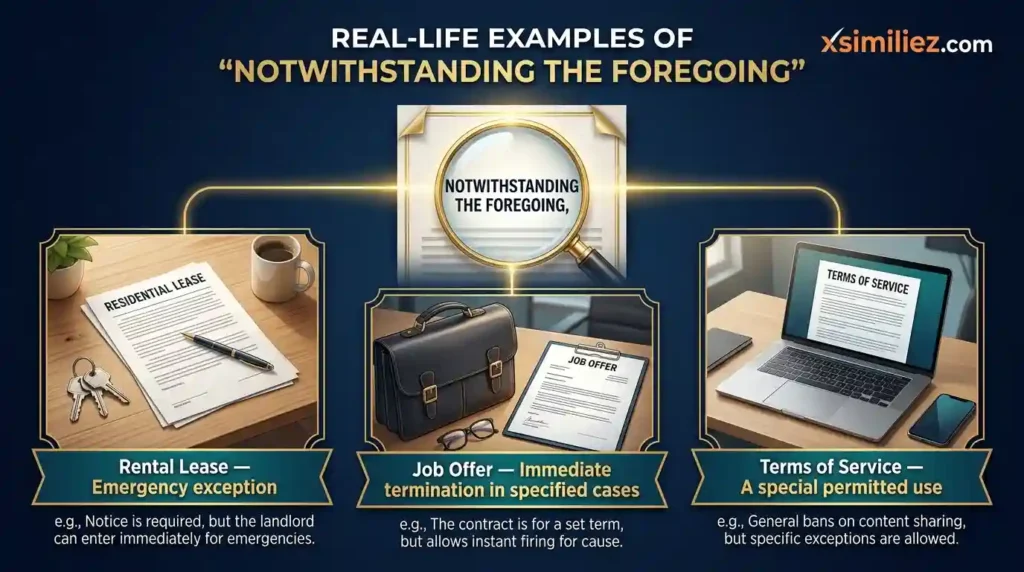
Seeing the phrase in action makes it click. Here are three common places you might meet it.
First, a rental lease. Imagine one section says, “The landlord may enter the home with 24 hours of notice.” A later sentence says, “Notwithstanding the foregoing, the landlord may enter at any time in an emergency.” What does this mean for you? Normally, the landlord must give notice. In a real emergency, like a burst pipe, the landlord can come in right away.
Second, a job offer. One part might say, “Either side may end this job with 30 days of notice.” Then another part says, “Notwithstanding the foregoing, the company may end this job at once for serious misconduct.” The first rule gives a long warning period. The second rule says that for serious wrongdoing, the company does not have to wait.
Third, an app’s terms of service. A company might write, “You may use our service for personal use only. Notwithstanding the foregoing, schools may use the service in classrooms.” The general rule limits use to personal reasons. The exception opens the door for teachers and students.
In each case, you can use the same two-step method. First, find the general rule. Second, find what comes after “notwithstanding the foregoing.” The second part is the one that controls in that special case.
Notwithstanding the Foregoing vs. Similar Legal Phrases
Contracts are full of small phrases that sound alike. Some of them do very different jobs. This table shows how they compare.
| Phrase | What It Does | Simple Example |
| Notwithstanding the foregoing | The next rule wins over what came before | “Notwithstanding the foregoing, pets are allowed with approval.” |
| Notwithstanding anything to the contrary | The next rule wins over anything else in the whole document | “Notwithstanding anything to the contrary, this promise cannot be changed.” |
| Subject to | The current rule gives way to another rule | “This right is subject to Section 5.” |
| Except as provided in | Names a specific exception | “No fees apply, except as provided in Section 8.” |
| However | A casual way to add a contrast | “Pets are not allowed. However, fish are fine.” |
Here is the big difference. “Notwithstanding” puts the new rule on top. “Subject to” does the opposite. It puts the current rule underneath another rule. If you mix them up, you can flip the meaning of a sentence without noticing.
The phrase “notwithstanding anything to the contrary“ is stronger and wider. It reaches across the whole contract, not just the text right before it. “Notwithstanding the foregoing” is narrower. It mainly speaks to what came just before.
“However” is the friendly, everyday cousin. It shows contrast, but it does not tell you which rule wins. That is why lawyers prefer stronger phrases when the winner matters.
Common Mistakes With Notwithstanding the Foregoing
Even careful writers slip up with this phrase. Here are the mistakes that show up most.
The first mistake is using it when nothing actually conflicts. If two rules already fit together, you do not need a “notwithstanding.” Adding it only makes the sentence heavier and the contract harder to read.
The second mistake is leaving “the foregoing” unclear. If three paragraphs came before, which one is the writer talking about? When the target is vague, two readers can reach two different answers. Naming the exact section fixes this problem.
The third mistake is using it too often. A contract with “notwithstanding” in every other sentence becomes a maze. Each one tries to beat the others, and soon nobody knows which rule is on top. Lawyers sometimes call this a tangle of overrides.
The fourth mistake is thinking the phrase cancels everything above it. It does not. It wins only for the situation the new sentence covers. The rest of the earlier rules stay in force.
The fifth mistake is mixing up two look-alike words. “Forego” means to go before. “Forgo” means to do without. “The foregoing” uses the first one. If you write “the forgoing,” a sharp-eyed reader will notice.
The last mistake is treating the phrase as filler. Readers who skim past it can miss the one sentence that changes everything. If you see it, slow down and read that part twice.
Current Usage and Trends
Legal English is changing. For years, a plain-language movement has urged lawyers to write in ways that regular people can follow. Government agencies, banks, and software companies have all put effort into simpler contracts and clearer notices.
Because of this shift, you will sometimes see “notwithstanding the foregoing” replaced by friendlier words. A modern contract might say “even so,” “despite this,” or “but in this case.” These versions do the same job in fewer syllables.
Even so, the old phrase has not disappeared. It is still common in business contracts, loan papers, leases, and software agreements. Lawyers like it because it is familiar and because courts have seen it many times. Familiar words feel safe in a field where small changes can cause big fights.
I will not give you numbers here, because I do not have a reliable count of how often the phrase appears. What you can count on is this: you are likely to meet it in formal documents, and you are less likely to meet it in everyday emails or ads.
One more point is worth knowing. In a dispute, a judge usually reads the whole contract, not just one phrase. Rules for how courts read contracts differ from place to place. So the phrase helps show what the writers meant, but it works together with every other word on the page.
Tips for Reading and Writing Notwithstanding the Foregoing
If you are reading a contract and spot the phrase, try this method. Start by finding the sentence that comes right before it. Then ask, “What general rule is being set?” Next, read the sentence after the comma. Ask, “How does this change the rule?” Finally, write the answer in one plain sentence of your own. If you can do that, you understand the clause.
It also helps to look for the target. Check if “the foregoing” means one sentence, one paragraph, or a whole section. If you cannot tell, that is a good question to ask the person who wrote it. Asking early is better than arguing later.
If you are writing a contract, keep the phrase short and sharp. Name the exact section when you can. For example, “Notwithstanding Section 3, the buyer may cancel within five days” is clearer than a vague reference. Use the phrase only when two parts really do clash.
Try a plain version, too. Many writers find that “Even if Section 3 says otherwise” is easier for readers. If your audience is regular people, the simple version may serve them better.
Finally, test your work. Hand your sentence to someone who has never seen the contract. Ask them what it means. If they get it right, your writing works. If not, rewrite it before anyone signs.
FAQs
What does notwithstanding the foregoing mean?
It means “despite what was just said.” The rule that follows the phrase wins over the rule before it, at least in the situation the new rule covers.
Is “notwithstanding the foregoing” the same as “despite the above”?
They are very close. Both tell the reader that a new rule beats an earlier one. “Notwithstanding the foregoing” is the older, more formal version, and “despite the above” is the plainer one.
Does the phrase cancel the earlier part of a contract?
No. It only gives the new rule priority in the case it describes. The earlier rule still applies everywhere else.
Where does the phrase go in a sentence?
Most often it starts a sentence and is followed by a comma. You may also see it in the middle of a sentence. Starting a sentence with it is usually easier to read.
How is it different from “subject to”?
They work in opposite directions. “Notwithstanding” puts the new rule on top. “Subject to” puts the current rule underneath another rule. Mixing them up can flip a sentence’s meaning.
Can I use plain words instead of this phrase?
Often, yes. Words like “even so,” “despite this,” or “even if Section 3 says otherwise” can do the same job. For important contracts, ask a lawyer before you swap the wording.
Conclusion
Here is the main idea. Notwithstanding the foregoing meaning comes down to “despite what I just said, this next rule wins.” It does not erase earlier rules. It makes one exception stronger than the general rule in one specific case.
Once you know that, long contracts feel less scary. Find the general rule, find the sentence that follows the phrase, and say the difference out loud in plain words. That small habit catches many surprises before they cost you.
Practical advice comes next. When you read a contract, slow down at this phrase. Check what “the foregoing” points to. When you write one, use it only when two parts truly clash, and name the section if you can. If the stakes are high, have a licensed lawyer look it over. A few minutes of care today can save you a lot of trouble later.

Hi, I’m Mason Avery, a content writer at Xsimiliez.com. I like writing about similes, figurative language, and creative expressions. I believe learning English becomes easier when examples feel natural and relatable.