Whoa is me meaning comes from a common spelling mix-up. The real phrase is “woe is me,” and it means “I am very sad” or “poor me.” People say it when they feel unlucky, upset, or a little dramatic. Sometimes they mean it seriously. Often they are just joking.
You may have seen it in a text, a movie, or a funny post online. It sounds old-fashioned, so it can leave you scratching your head. If you saw it spelled “whoa is me,” you may be even more confused. You are not alone, because the two words sound exactly the same.
In this guide, you will learn what the phrase means, why the spelling matters, and where it came from. You will also see easy examples, common mistakes, and tips for using it with confidence.
Quick Answer: What Does Whoa Is Me Meaning?
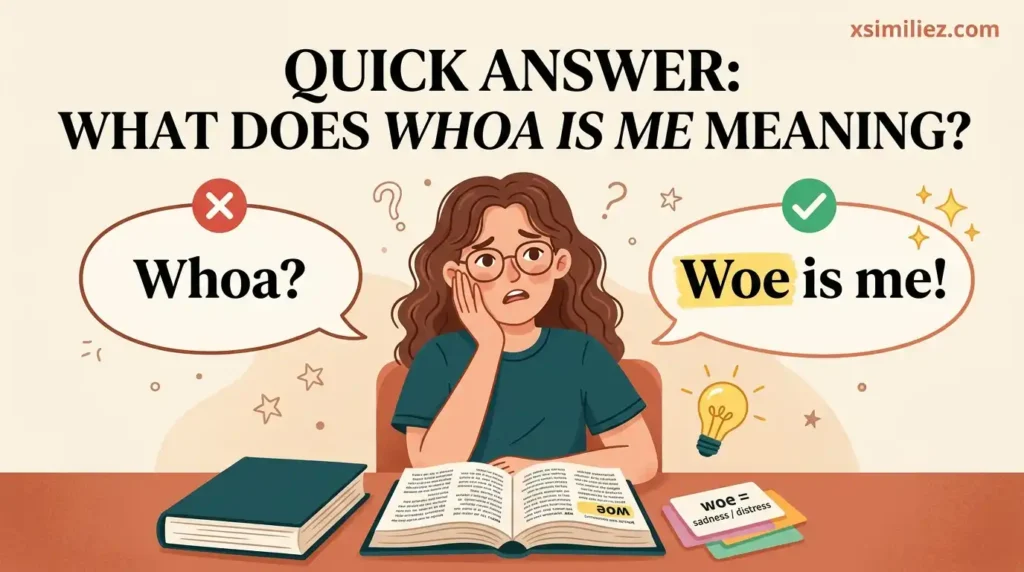
The whoa is me” is simple. It is a way to say, “Oh, how sad things are for me.” The correct spelling is “woe is me.” The word “woe” means deep sadness, trouble, or pain. So the whole phrase tells others that you feel sorry for yourself or that something bad has happened.
Here is the short version you can remember. “Woe is me” equals “Poor me.” It is a cry of sadness, and it can be serious, silly, or sarcastic depending on who says it.
Most of the time today, people use it with a wink. Say you spill coffee on your shirt before a big meeting. You might sigh and say, “Woe is me.” It is not a real emergency, though. You are simply being a bit theatrical about a small problem.
That playful style is the most common use in everyday American English.
In older books, though, the phrase was often very serious. Writers used it for real grief and fear. So the meaning depends on the situation, the tone of voice, and the person speaking. Context is the key to understanding it.
Whoa vs. Woe: Why People Mix Them Up
The big reason for the confusion is sound. “Whoa” and “woe” are homophones. That means they sound the same but have different meanings and spellings. When you hear someone say the phrase, you cannot tell which spelling they mean. You have to know the word from reading it.
“Whoa” is a word we say to stop something. A rider says it to a horse. It is also a word of surprise, like “Whoa, that was fast!” It is a cry, not a feeling of sadness.
“Woe” is a noun. It names a heavy kind of sadness or trouble. You can have woes, like money woes or travel woes. That is why “woe is me” makes sense. It talks about sadness, not surprise.
The table below shows the difference at a glance.
| Word | What It Means | Part of Speech | Example Sentence |
| Whoa | Stop, or a cry of surprise | Interjection | “Whoa, slow down!” |
| Woe | Deep sadness or trouble | Noun | “The farmer shared his woes about the bad weather.” |
| Woe is me | Poor me, I am so sad | Phrase | “I lost my keys again. Woe is me.” |
| Whoa is me | A spelling mistake | Not correct | Use “woe is me” instead |
Here is a simple trick. Think of the “e” at the end of “woe” as standing for “emotion.” If you mean a sad feeling, you want the shorter word with the “e.” If you mean “stop” or “wow,” you want the one with the “h.”
Since many people type fast and go by sound, this error is very common. It is nothing to feel bad about. Even strong writers slip on homophones now and then. The good news is that once you know the trick, it is easy to fix.
How to Use “Woe Is Me” Correctly
Let’s look at the grammar, because the phrase looks strange at first. “Woe is me” does not follow the way we normally speak today. In modern English, we would say “I am sad.” But “woe is me” comes from an older style of English.
In this older style, “me” works like “to me.” So the phrase can be read as “Woe is to me,” or “Sadness comes to me.” That helps it make more sense. The word “woe” is the thing that exists, and “me” is the person it is happening to.
Because it is a fixed phrase, you should not change the order. People sometimes write “me is woe” or “I am woe.” Those do not work. Keep it as “woe is me” and it will always be right.
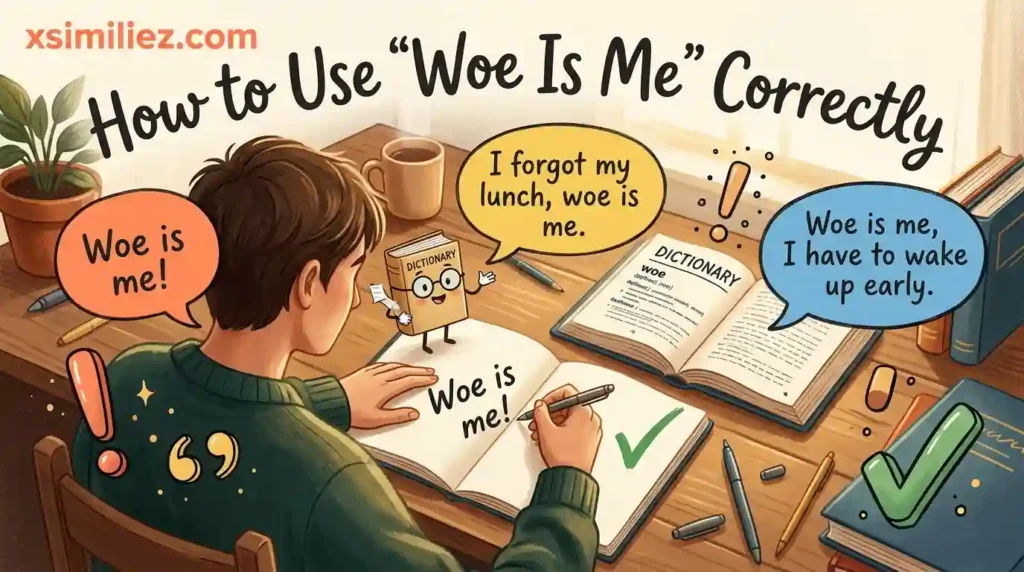
You can use it in a few ways. It can stand alone as a short cry, such as “Woe is me!” It can come at the end of a sentence, like “I forgot my lunch, woe is me.” It can also come at the start, as in “Woe is me, I have to wake up early again.”
Punctuation is easy too. If you want to show a strong feeling, add an exclamation mark. If you want a dry, joking tone, use a period or a comma. Using a comma helps the phrase flow when it sits next to other words.
One more tip is about tone. This phrase works best in casual writing, humor, stories, and speeches that sound dramatic. In a business email or a school report, it may feel too playful. Use it where a little color fits.
Where Does “Woe Is Me” Come From?
The phrase has a long history. The word “woe” comes from Old English, where it was an exclamation of grief. English speakers have used it for over a thousand years, which is why it feels so old.
One of the best-known places it appears is the Bible. In the King James Version, the prophet Isaiah cries “woe is me” when he feels unworthy in a holy vision. The Psalms also use the phrase to speak of sorrow and distance from home. In these places, the words are serious and deeply emotional.
William Shakespeare also used it. In Hamlet, the character Ophelia says it when she is overcome with grief and confusion. That scene helped keep the phrase alive in schools and theaters for hundreds of years.
Over time, the phrase moved from serious writing into daily speech. People began to use it with humor because it sounded so grand. Saying something big for a small problem is funny, and that is how the playful use grew.
It is worth saying that language experts explain the exact grammar of “is me” in slightly different ways. The “to me” idea is the most common explanation, but older English changed a lot over the years. So it is best to say the phrase is old, well used, and rooted in religious and literary writing, without claiming one exact date for its start.
Real-Life Examples of Whoa Is Me Meaning in Action
Seeing the phrase in real situations makes the meaning stick. Notice how the tone changes from one example to the next. Sometimes it is funny, and sometimes it is serious.
| Situation | Example | Tone |
| Small daily problem | “My phone is at two percent. Woe is me.” | Playful |
| Homework or work stress | “Three tests in one week, woe is me!” | Dramatic joke |
| Sports fans | “Our team lost again. Woe is me.” | Light and silly |
| Story or play | “Woe is me, for all my friends have gone.” | Serious |
| Teasing a friend | “Oh, woe is you, you have to eat pizza again.” | Sarcastic |
Now let’s think about a few short scenes. A mom is cleaning up after a busy weekend and sees laundry piled high. She laughs and says, “Woe is me, the mountain of socks has returned.” Nobody thinks she is truly in despair. She is making a small joke.
A student gets a surprise quiz and groans, “Woe is me.” Classmates smile because they understand. The phrase works like a friendly shared sigh.
Compare that with a novel where a character has lost her home in a storm. When she cries, “Woe is me,” the reader feels real pain. The same words carry a very different weight.
You may also hear someone use it to tease another person. If a friend complains about a tiny problem, you might say, “Oh, woe is you.” This changes “me” to “you,” and it makes the joke gentle and fun.
Common Mistakes With the Whoa Is Me Meaning
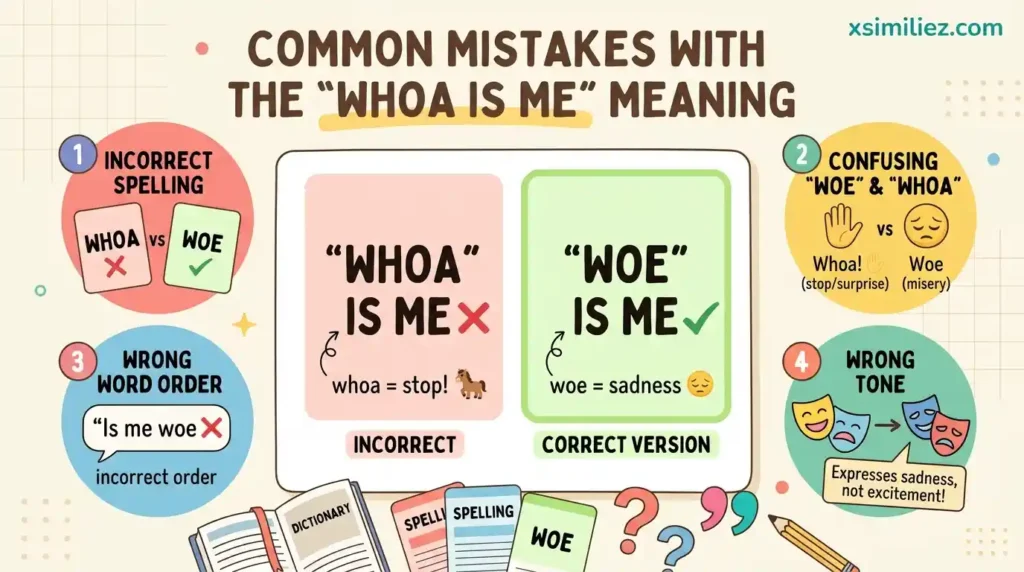
A few errors come up again and again. Knowing them will help you avoid them.
The first mistake is the spelling. Writing “whoa is me” is the number one slip. It makes sense because the sounds match, but it is not the standard spelling. Always use “woe.”
The second mistake is changing the word order. Some people write “is woe me” or “woe me is.” The phrase only works in the form “woe is me.” Treat it as a fixed block of words.
The third mistake is using it in the wrong tone. If a friend shares real bad news and you answer with a joking “woe is me,” it may come across as unkind. Save the playful use for light moments.
The fourth mistake is thinking it always means real despair. Many people believe the phrase is only for deep sadness. In modern speech, it is often a playful sigh. Reading the situation helps you tell which one is meant.
The fifth mistake is mixing it up with other phrases. For example, “woe betide you” is a different expression. It is a warning that bad things will happen to someone. It does not mean the same thing as “woe is me.”
Finally, be careful about overusing it. If you say it all the time, it loses its charm. A little goes a long way, like salt on food.
Current Usage and Trends
Today, “woe is me” is alive and well, especially online. You will see it in jokes, captions, and short posts. People use it to turn small annoyances into funny, over-the-top moments. It fits well with the dramatic humor that is popular on social media.
It also shows up in the names of things. For example, there is a metalcore band called Woe, Is Me. This shows how the phrase has moved into pop culture and art. Writers and creators like it because it is short, vivid, and easy to remember.
Another trend is the spelling mistake itself. Because so many people type “whoa is me,” the wrong version appears often in search results. That is likely why you landed here. Search tools see the confusion, and readers want a clear answer.
In everyday American English, the phrase is mostly lighthearted. Teachers, parents, and friends say it with a grin. You may hear it in a sitcom, a family chat, or a funny speech.
At the same time, it still appears in serious writing, like religious texts, poems, and old stories. So the phrase lives in two worlds at once. It is both ancient and trendy, which is part of why people find it interesting.
Phrases Similar to “Woe Is Me”
Sometimes you want another way to say the same thing. English has many options, and each one has its own flavor. Here are a few that are close in meaning.
| Phrase | Meaning | Best Used When |
| Poor me | I feel sorry for myself | Casual, simple talk |
| Alas | A word of sadness or regret | Old-style or poetic writing |
| Oh dear | Mild worry or sadness | Gentle, polite moments |
| Why me? | Asking why bad luck came to me | Frustrated or upset moments |
| Pity party | Feeling sorry for oneself, often with a negative tone | Describing someone else, or joking about yourself |
Each of these shares the idea of feeling sad or unlucky. But “woe is me” has a special, grand feeling that the others lack. It sounds like something from a play, which is why it is so fun to say.
Notice that “pity party” can sound a bit unkind when aimed at another person. “Poor me” is more direct and simple. “Alas” is the most old-fashioned. Picking the right one depends on the mood you want.
Tips for Using “Woe Is Me” Well
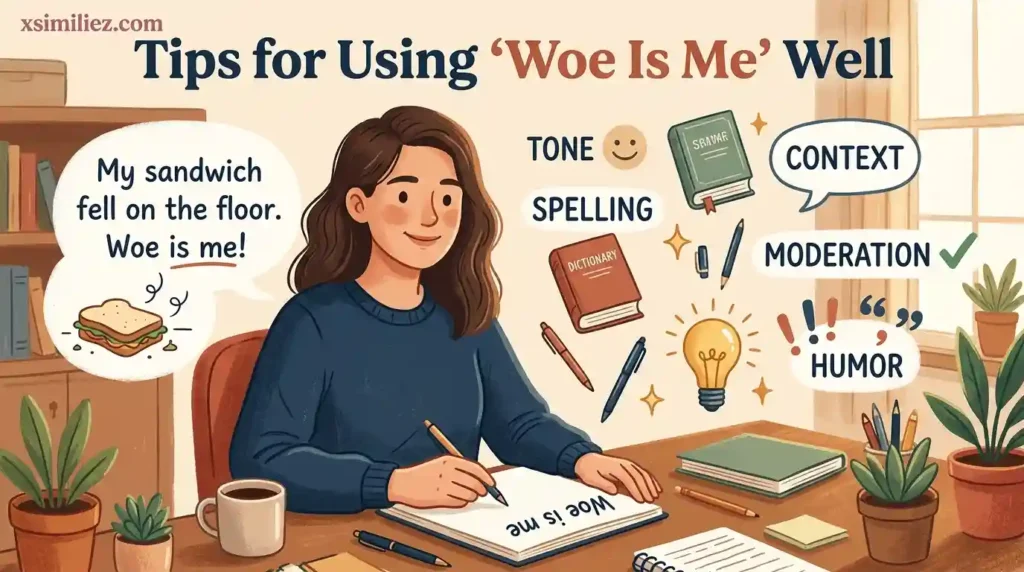
Using this phrase with skill is easy if you keep a few ideas in mind.
First, match the tone to the moment. A light problem calls for a light, funny delivery. A serious problem may call for a different phrase, or none at all. Reading the room is always smart.
Second, use it sparingly. Because the phrase is dramatic, it works best when it is a surprise. If it appears in every message, it will feel stale.
Third, pair it with a clear, small problem for humor. The bigger the gap between the words and the problem, the funnier it is. “My sandwich fell on the floor. Woe is me” works nicely because the problem is so tiny.
Fourth, double-check your spelling before you hit send. Remember, “woe” with an “e” is the sad one. A quick look can save you from a simple error.
Fifth, if someone else says it to you, answer kindly. If they are joking, you can joke back. If they sound truly upset, ask what is wrong. A good listener can tell the difference.
Sixth, use it in writing to add voice. Stories, blogs, and speeches can feel more alive with a well-placed “woe is me.” Just make sure it fits the style of the whole piece.
FAQs
What does “whoa is me” mean?
It is a common misspelling of “woe is me.” The phrase means “I am so sad” or “poor me.” People use it to show sadness, bad luck, or playful drama.
Is “whoa is me” ever correct?
No, the standard spelling is “woe is me.” “Whoa” is a word for “stop” or surprise. Even though the two sound alike, they have different meanings, so “woe” is the right choice for this phrase.
Is “woe is me” a serious phrase or a joke?
It can be either. In old books and religious texts, it is usually serious. In modern daily talk, it is often used as a funny, dramatic sigh. The tone of voice and the situation tell you which one it is.
Where did the phrase come from?
It comes from older English and appears in the Bible and in Shakespeare’s Hamlet. The word “woe” itself goes back to Old English. The exact grammar is explained in a few ways, but the phrase has been used for many centuries.
What is the difference between “woe” and “whoa”?
“Woe” is a noun that means deep sadness or trouble. “Whoa” is an interjection used to stop something or show surprise. They sound the same, but they are spelled and used differently.
Can I use “woe is me” in formal writing?
You can, but only when it fits. It works well in stories, speeches, and creative writing. In business emails or school reports, it may sound too dramatic, so a simpler phrase is usually better.
Conclusion
The whoa is me meaning is easy once you see the full picture. It is a spelling slip for “woe is me,” an old phrase that means “poor me” or “I am so sad.” The word “woe” is the heart of it, and it points to sadness or trouble.
You also learned that the phrase has deep roots. It shows up in the Bible and in Shakespeare, yet it still lives in jokes and posts today. Its tone can be serious or silly, so context matters a great deal.
For practical advice, remember the “e” trick and keep the words in order. Use the phrase with a light touch, match it to the mood, and check your spelling. Do that, and you will use “woe is me” like a true word lover.
Explore Related Wishes

Hi, I’m Mason Avery, a content writer at Xsimiliez.com. I like writing about similes, figurative language, and creative expressions. I believe learning English becomes easier when examples feel natural and relatable.