The meaning of “like a moth to a flame” is simple. It describes someone who feels a strong pull toward a person, thing, or idea, even when it could hurt them. Picture a moth that keeps flying at a hot light bulb.
Many people search for this phrase because they hear it in books, songs, movies, and everyday talk. It sounds poetic, but the meaning can feel tricky at first. Is it a sweet thing to say, or a warning?
In this guide, you will learn the clear meaning, how to use the phrase in a sentence, and where it likely came from. You will also learn why moths really act this way, plus common mistakes and easy tips to remember it.
Quick Answer: Like a Moth to a Flame Meaning
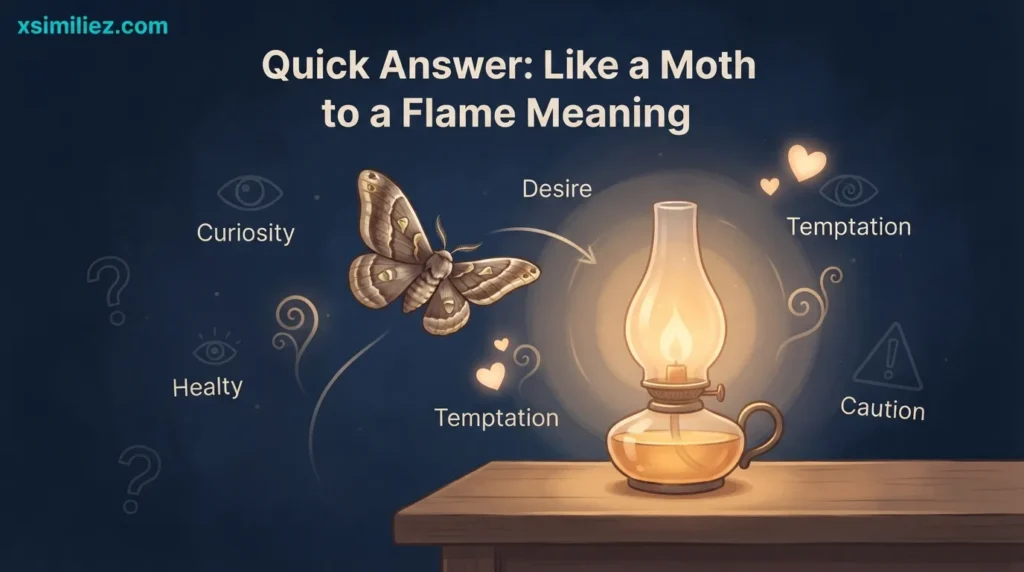
“Like a moth to a flame” means being drawn to something that is exciting or tempting, but risky. The person cannot easily stop. They move closer even when danger is easy to see.
Here is the short version:
- Simple meaning: Strongly attracted to something harmful.
- Feeling behind it: Curiosity, desire, or temptation.
- Usual result: Trouble, pain, or a hard lesson.
- Tone: Often a warning, but sometimes a dramatic way to describe love.
If you remember only one thing, remember this. The phrase is not just about liking something. It is about being pulled toward something that can cause harm.
Like a Moth to a Flame Meaning and Definition Explained
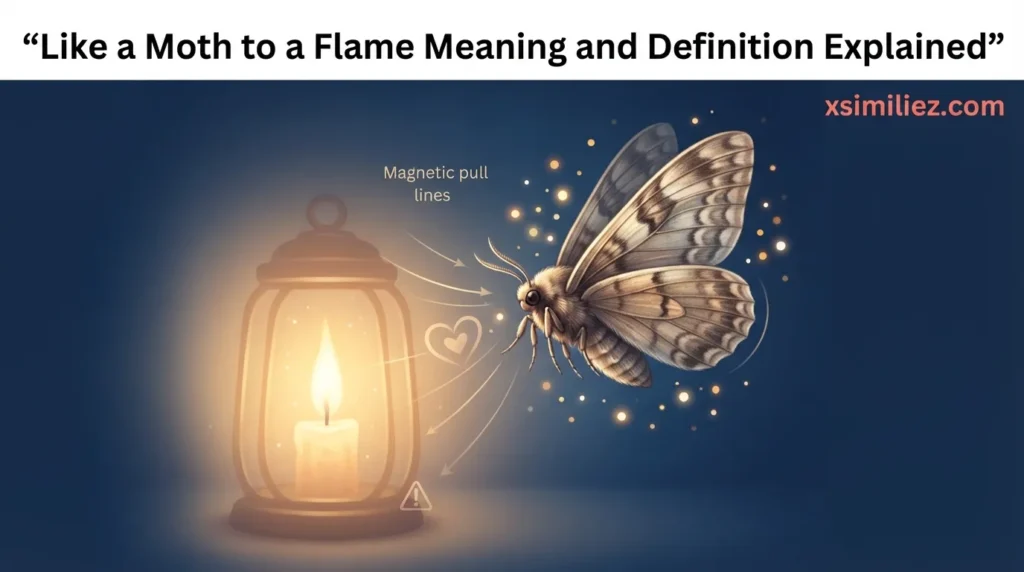
The flame is bright and warm, and it looks beautiful. A moth sees it and flies straight toward it. But fire can burn the moth’s wings. The moth does not understand the danger, so it keeps going.
People use this picture to describe human behavior. Someone sees something shiny, thrilling, or tempting. They move toward it without thinking about the cost. The pull feels stronger than good sense.
This idiom can describe many kinds of attraction. Here are the most common ones.
| Type of Pull | What It Looks Like | Example |
| Romantic attraction | Falling for someone who is bad for you | She kept going back to him, like a moth to a flame. |
| Money and fame | Chasing wealth or attention at any cost | Young actors rush to the big city like moths to a flame. |
| Risky habits | Returning to something unhealthy | He was drawn to the casino like a moth to a flame. |
| Curiosity | Wanting to see or touch something forbidden | The kids walked toward the strange noise like moths to a flame. |
Notice that the pull often feels exciting at the moment. That is why the phrase fits so well. The danger is real, but the attraction feels stronger.
Is It Positive or Negative? The Tone of the Phrase
Most of the time, the tone is negative or warning. It suggests that the person is not thinking clearly. A friend might say it with worry. A writer might use it to show that a character is about to make a mistake.
But the tone can change with the situation. Sometimes people use it in a lighter way. For example, a person might say, “Kids flock to the ice cream truck like moths to a flame.” Here, nobody is in danger. The phrase just shows a strong, quick pull.
So the tone depends on the danger. If harm is possible, the phrase sounds serious. If it is just excitement, the phrase sounds playful.
Grammar and Correct Usage of “Like a Moth to a Flame”
This phrase is a simile. A simile compares two things using the word “like” or “as.” Here, a person is compared to a moth, and the thing they want is compared to a flame.
You can use it in a few simple ways. It usually comes after a verb that shows movement or attraction, such as “drawn,” “pulled,” “attracted,” “rushed,” or “went.”
| Sentence Pattern | Example |
| Person + verb + like a moth to a flame | He was drawn to danger like a moth to a flame. |
| Person + verb + to + thing + like a moth to a flame | Shoppers rushed to the sale like moths to a flame. |
| Like a moth to a flame, + person + verb | Like a moth to a flame, she walked toward the bright stage. |
A few small grammar tips will help you sound natural.
First, use “a moth” and “a flame” for one person. Use “moths to a flame” when you talk about a group. Both are correct. For example: “The fans moved toward the stage like moths to a flame.”
Second, keep the order of the words. Saying “like a flame to a moth” is wrong. The moth moves toward the flame, not the other way around.
Third, the phrase works best when the attraction is strong or unwise. If someone simply enjoys a hobby, this idiom is too dramatic.
Origin and History of the Moth to a Flame Idiom
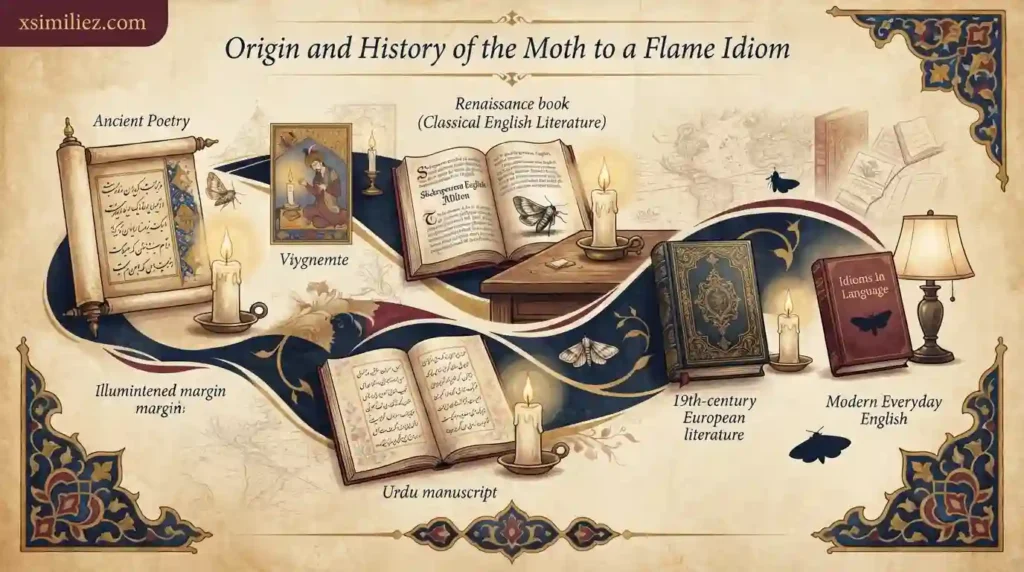
People have watched moths circle lights and fires for thousands of years. It makes sense that writers noticed it too. Still, the exact first person to say “like a moth to a flame” is not clear. No single reliable source proves who first used it.
What we do know is that the image of an insect drawn to fire is very old in poetry. Writers across many cultures used it to talk about love, desire, and risk.
In Persian and Urdu poetry, the moth and the candle are a famous pair. The moth is called the parwanaand the candle is the shama. In these poems, the moth loves the candle so much that it gives up its life. The image often stands for deep love or devotion, sometimes with a sad ending. This is a good example of how the same picture can carry a different feeling in different cultures.
In English writing, similar images appeared long ago as well. The English playwright William Shakespeare used the picture of a candle that burns a moth in The Merchant of Venice. Writers kept using the idea in poems, stories, and speeches over the years.
The modern wording, “like a moth to a flame,” became a common saying in English. Today it is a well-known idiom in everyday speech. Because its early history is not fully documented, it is best to say that the idea is very old and the exact first use is unknown.
Why Do Moths Really Fly Toward Light?
Here is a surprise. The idiom says moths are drawn to flames, but science shows the story is a bit more complicated. Scientists have studied this for a long time, and they still talk about it.
For many years, a popular idea was that moths use the moon to find their way. The moon is very far away. So if a moth keeps the moon at the same angle, it flies in a nice straight line. Then a close light, such as a bulb, confuses the moth. It tries to keep the same angle to the light, but the light is close. So the moth ends up flying in circles that get tighter and tighter.
A newer study in 2024 offered another idea. Researchers filmed insects with high-speed cameras. They found that many insects tilt their backs toward the brightest light. In nature, the sky is brighter than the ground, so this helps them stay level. Near a lamp, though, this habit makes them turn and circle the light instead.
So moths may not be “in love” with the flame at all. They may simply be confused. That makes the idiom even more fitting. A person who acts “like a moth to a flame” is also pulled in by something that tricks their normal sense of direction.
It is also worth saying that not every month does this. Many moths and insects do not gather around lights at all.
Common Mistakes with Like a Moth to a Flame Meaning
Even a simple idiom can be misused. Here are the mistakes people make most often.
| Mistake | Why It Is Wrong | Better Version |
| Using it for a mild interest | The phrase is too strong for small likes | She enjoys tea. (No idiom needed) |
| Saying “like a flame to a moth” | The words are in the wrong order | Like a moth to a flame |
| Using it when there is no risk | The idiom suggests danger or temptation | Use “flocked to” instead |
| Thinking it always means love | It can also mean greed, curiosity, or habit | Check the context before using it |
| Mixing it with “playing with fire” | Both are about danger, but they are different | See the next section |
One more point is worth knowing. Some people think the phrase means the moth is smart and brave. It does not. The idiom suggests the opposite. The moth is not thinking clearly, and that is the point.
Real-Life Examples You Can Relate To

Examples make an idiom easier to learn. Here are some ordinary situations where the phrase fits well.
Friendship and love. A teenager keeps texting a person who treats them badly. Friends say, “You keep going back like a moth to a flame.” The pull is strong, but it is not healthy.
Money and tricks. A man hears about a “get rich quick” plan. He knows it sounds fake, but he joins anyway. He walked toward it like a moth to a flame, and he lost his savings.
Shopping and sales. On the first day of a big sale, crowds rush into the store. No one is in danger, so the phrase is playful here. It shows how strong the pull of a deal can be.
Social media. Many people open their phones “like moths to a flame” when a notification lights up the screen. The bright light and the sound pulled them in, even when they wanted to rest.
Stories and movies. In a scary story, a character hears a strange sound in a dark basement. He knows he should run, but he goes down the stairs anyway. Writers use the idiom to show that the character cannot resist.
Each example has the same pattern. Something bright or tempting appears. The person moves toward it. The risk is clear, but the pull is stronger.
Current Usage in Books, News, and Daily Talk
Today, this idiom shows up in many places. Authors use it in novels to describe characters who make risky choices. Journalists use it in news stories, for example when they write about crowds, investors, or fans gathering around a big event. People also use it in casual speech and in captions online.
Since it is a vivid picture, the phrase is also popular in song and movie titles and in creative writing. Because it is so well known, writers can use it without a long explanation. Readers instantly get the idea.
One trend is that people now use it in a more playful way. You may see it in posts about food, sales, or celebrity news. In those cases, it just means “very quickly drawn to.” Even so, the older and more serious meaning is still alive.
Similar Idioms and Phrases to Know
Several other sayings are close to this one. They are not exactly the same, but they share the idea of risk and attraction.
| Phrase | Meaning | How It Differs |
| Playing with fire | Doing something dangerous on purpose | The person knows the risk and chooses it |
| Drawn like a magnet | Strongly pulled toward something | Does not always include danger |
| Walking into the lion’s den | Entering a dangerous place | Focuses on the place, not the pull |
| Curiosity killed the cat | Too much curiosity can cause harm | Focuses on curiosity only |
| Sitting duck | An easy target | About being helpless, not attracted |
The main difference is this. “Like a moth to a flame” stresses the pull. The person feels drawn in, almost like they have no choice.
Tips to Remember and Use the Idiom Well
If you want to use this phrase with confidence, these tips can help.
Start with the picture in your mind. Imagine a moth circling a bright lamp. That image holds the whole meaning.
Next, ask yourself two questions before you use it. Is there a strong pull? Is there some risk or temptation? If both answers are yes, the idiom fits.
Then match the tone. For serious situations, use it with care. For light, funny situations, add a playful word or two, so readers know you are joking.
Also, do not overuse it. Idioms are like spices. A little makes writing tastier, but too much spoils it. One good use in an article or story is plenty.
Finally, try writing your own sentences. Practice makes the phrase feel natural. For example: “The kids ran toward the fireworks like moths to a flame.”
FAQs
What is the meaning of “like a moth to a flame meaning in one sentence?
It means being strongly attracted to something even though it may cause harm.
Is “like a moth to a flame” a metaphor or a simile?
It is a simile because it uses the word “like” to compare two things.
Can the phrase be used in a positive way?
Yes, but not often. Some people use it playfully for things like sales or treats. Still, the usual meaning has a warning in it.
Where did the phrase come from?
It comes from the old habit of moths circling lights and fires. The exact first use is not clearly known, but the image appears in poetry from many cultures.
Do moths really get drawn to flames?
Moths are often drawn to lights, but scientists think they may be confused rather than truly attracted. Not all moths do this.
What is a good example sentence?
“He was drawn to the bright city lights like a moth to a flame.”
Conclusion
The like a moth to a flame meaning is about a pull that is hard to resist. A person sees something exciting or tempting and moves toward it, even though it could hurt. That is why the phrase often works as a gentle warning.
You now know how to use it in a sentence, how to avoid common mistakes, and where the idea may have started. You also learned that the science behind moths is more interesting than the old saying suggests.
Next time you want to describe a strong and risky attraction, try this idiom. Keep the picture of the moth in mind, match your tone to the situation, and use it sparingly. A single well-placed phrase can make your writing clear and memorable.
Explore Related Wishes
KMG Meaning in Text: What Does KMG Really Mean?

Hi, I’m Mason Avery, a content writer at Xsimiliez.com. I like writing about similes, figurative language, and creative expressions. I believe learning English becomes easier when examples feel natural and relatable.