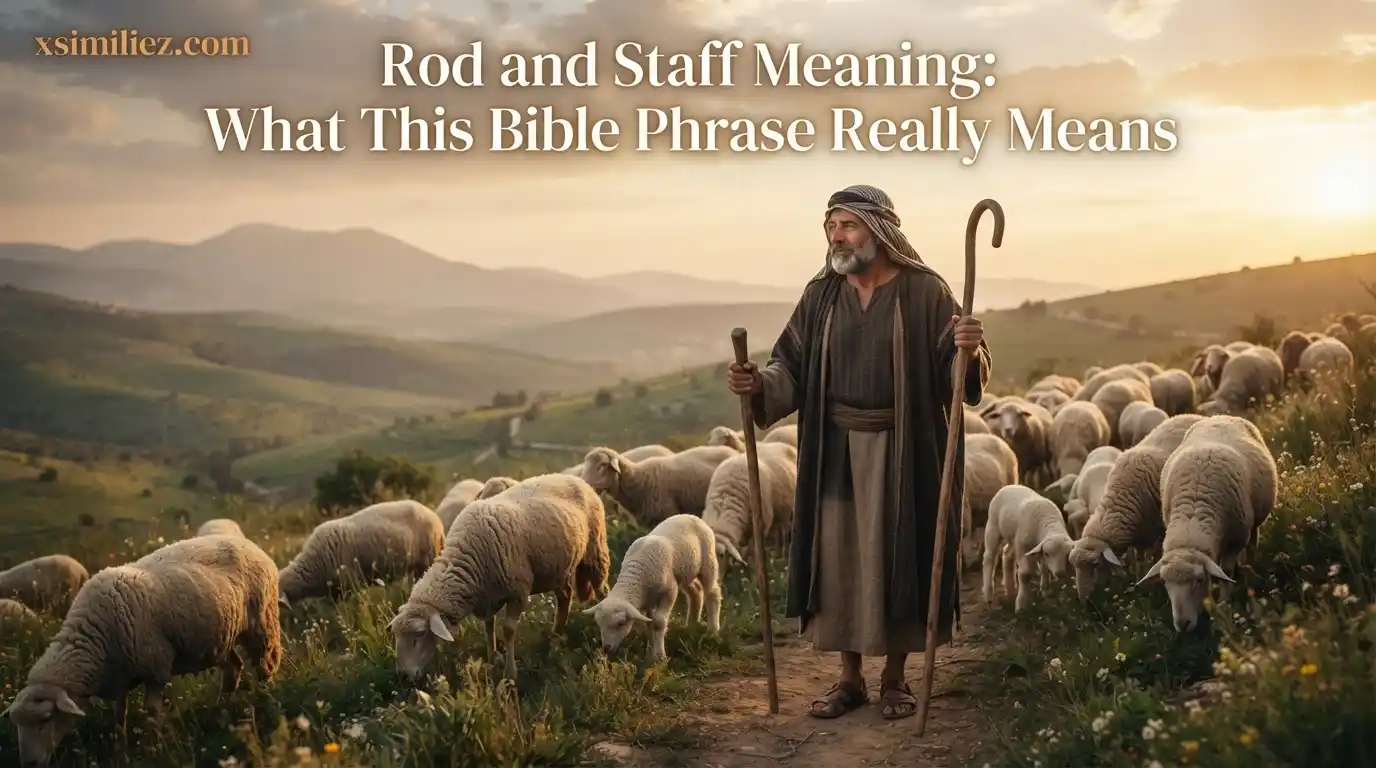
The phrase “rod and staff” comes from Psalm 23:4, one of the most quoted verses in the Bible. In simple terms, rod and staff meaning points to two tools a shepherd used to protect and guide sheep and by extension, it symbolizes God’s protection and gentle guidance in a person’s life. The rod defended the sheep from danger. The staff helped guide them and pull them back when they wandered.
People search for this phrase because it shows up often in church readings, funerals, worship songs, and even tattoos. It sounds poetic, but many readers want to know exactly what it means in plain language. Is the rod a weapon? Is the staff just a walking stick? Why does the verse pair them together?
This article breaks down the meaning, the history, and how the phrase is used today. You’ll also learn common mistakes people make when explaining it, along with real examples from everyday language and scripture. By the end, you’ll be able to explain “rod and staff” clearly to anyone who asks.
Quick Answer: Rod and Staff Meaning
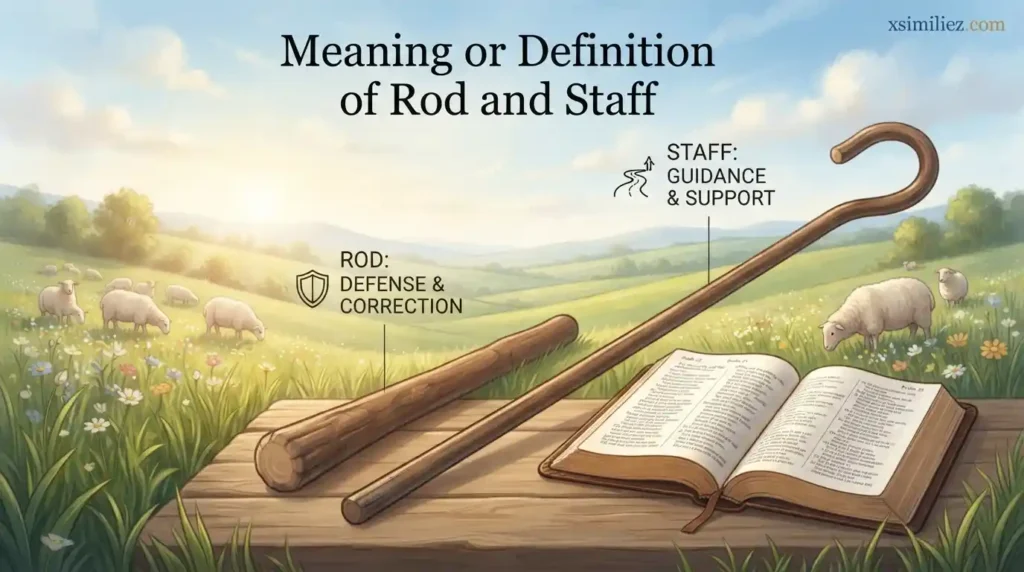
In short, the rod and staff were two shepherding tools. The rod was a short, sturdy stick used for protection and discipline, often to fight off wild animals. The staff was a longer stick, usually with a curved end, used to guide sheep and gently pull them back if they strayed. Together, in Psalm 23:4, they represent comfort, safety, and steady guidance, especially during hard or scary times.
Meaning or Definition of Rod and Staff
Psalm 23 is written from the point of view of someone comparing God to a shepherd. The full verse reads: “Even though I walk through the valley of the shadow of death, I will fear no evil, for you are with me; your rod and your staff, they comfort me.”
At first glance, this might sound confusing. Why would a rod, which sounds like a weapon, bring comfort? The answer lies in how shepherds actually used these tools in daily life.
A shepherd’s rod was a short club, often carved from a single piece of wood with a heavy end. Shepherds used it to defend the flock from wolves, lions, or thieves. It was a tool of protection, not punishment in a cruel sense. When a sheep saw the rod in the shepherd’s hand, it knew danger would be handled.
The staff was different. It was longer, often shoulder height, with a hook or crook at the top. Shepherds used the staff to guide sheep along the right path, to reach out and catch a sheep that had wandered too close to a cliff, or to gently nudge a stubborn animal in the right direction.
So the meaning becomes clearer. The rod stood for protection from outside threats. The staff stood for gentle correction and guidance. Together, they gave the sheep a reason to feel safe, even in dark or dangerous places, because the shepherd was fully equipped to protect and guide them.
Here’s a simple table that breaks down the two tools side by side.
| Feature | Rod | Staff |
| Length | Short, club-like | Long, often shoulder height |
| Shape | Straight, heavy end | Curved hook at the top |
| Main Purpose | Protection and defense | Guidance and rescue |
| Used Against | Predators, danger | Straying or stuck sheep |
| Symbolic Meaning | God’s protection | God’s gentle guidance |
Origin or History of the Rod and Staff
The phrase comes from ancient shepherding culture in the Middle East, where Psalm 23 was written thousands of years ago. Shepherding was a common job, and readers of that time would have instantly understood the imagery. Nobody needed it explained, because most people had seen shepherds working in the fields with these exact tools.
The Psalm is traditionally credited to King David, who worked as a shepherd himself before becoming king of Israel. This detail matters because David wasn’t writing about something abstract. He had personally carried a rod and staff, defended sheep from lions and bears, and guided flocks through rocky, dangerous terrain. His words came from lived experience, not just religious theory.
Historians and biblical scholars generally agree on the practical use of these tools, even though exact designs likely varied by region and era. The rod was sometimes weighted or studded to make it more effective as a defensive weapon. The staff, meanwhile, was a multi-purpose tool. Shepherds leaned on it while walking long distances, used it to count sheep as they passed through a gate, and used the hook to catch animals safely by the leg or neck without hurting them.
Over time, the imagery expanded beyond literal shepherding. It became a broader symbol used in religious teaching, art, and hymns to represent divine care. Many older paintings and stained-glass windows show a shepherd holding both tools, reinforcing the message found in the psalm.
Grammar or Correct Usage of Rod and Staff
In modern writing and speech, “rod and staff” is almost always used as a set phrase, not as two separate words. People rarely say “the rod” or “the staff” alone when referencing this idea. The pairing itself carries the meaning.
Grammatically, the phrase functions as a compound subject or object, depending on the sentence. For example: “Your rod and staff comfort me” uses it as the subject of the sentence. In “I trust in your rod and staff,” it functions as the object.
Capitalization only applies when quoting the Bible verse directly, since it’s part of a proper noun-like reference to scripture. In casual writing, lowercase is standard unless you’re quoting Psalm 23 directly.
One common structural pattern is pairing the phrase with comfort-related words: “comfort,” “protect,” “guide,” or “safe.” This mirrors the original verse and helps the phrase keep its intended emotional tone.
Common Mistakes with Rod and Staff Meaning
A few misunderstandings come up again and again when people talk about this phrase.
The first mistake is assuming the rod was purely a punishment tool, similar to how the phrase “spare the rod, spoil the child” is used elsewhere in the Bible. That’s a different phrase from a different book (Proverbs), and it carries a different meaning. In Psalm 23, the rod is about protection, not discipline of the sheep.
The second mistake is thinking the staff and rod are the same object with two names. They were separate tools with separate jobs, even though both were made of wood and carried by the same shepherd.
The third mistake is treating the phrase as purely symbolic with no real-world basis. While the spiritual meaning is important, the phrase only works because it’s rooted in something literal and practical. Losing that context makes the phrase harder to explain and easier to misquote.
Finally, some people misquote the verse itself, saying “thy rod and thy staff comfort me” without including “they,” which changes the sentence structure slightly from the traditional King James Version wording.
Real-Life Examples of Rod and Staff
The phrase shows up in many places beyond church services. Here are a few common examples people encounter:
Funeral services often include Psalm 23 as a reading, with the rod and staff line highlighting comfort during grief. Country and gospel songs frequently borrow the imagery, using “rod and staff” to represent steady support during hard times. Tattoos featuring a shepherd’s crook or the phrase itself are popular among people who want a symbol of guidance and protection. Greeting cards, sympathy notes, and devotional books also use the phrase to reassure someone going through a difficult season.
In everyday conversation, someone might say, “She’s been my rod and staff through this whole ordeal,” meaning a person who protected and guided them emotionally, even outside a religious context.
Current Usage or Trends
Today, the phrase still holds strong ties to its religious roots, but it has also drifted into general language use. People sometimes apply it to describe any steady, protective presence in their life, if that’s a mentor, a parent, a close friend, or even a routine that keeps them grounded.
Search interest in “rod and staff meaning” tends to spike around funerals, weddings, graduations, and other emotional milestones, since Psalm 23 is commonly read at these events. It’s also popular among people studying the Bible for the first time, since the shepherd imagery isn’t always obvious to modern readers who have never seen a real shepherd at work.
Social media has also played a role. Short devotional clips and scripture explainer videos often break down this phrase specifically, since it’s short, memorable, and visually easy to illustrate with shepherd imagery.
Tips for Understanding and Using Rod and Staff Correctly
If you want to explain or use this phrase accurately, a few practices help.
Always keep the rod and staff as a pair rather than separating their meanings entirely, since the verse presents them together for a reason. When writing about the phrase, briefly explain the shepherd context so readers unfamiliar with farming or ancient culture aren’t left confused. If quoting scripture directly, match the translation you’re using rather than mixing wording from different Bible versions.
When using the phrase outside a religious context, make sure the comparison still fits the original meaning: protection paired with guidance. Calling something a “rod and staff” moment only makes sense if both elements safety and direction are present.
Here is a table summarizing quick usage tips.
| Situation | Best Practice |
| Quoting scripture | Match the exact Bible translation |
| Explaining to beginners | Include shepherd background |
| Everyday use | Keep both protection and guidance meanings intact |
| Writing or speeches | Pair with words like comfort, safety, guide |
| Avoiding confusion | Don’t confuse with the “spare the rod” proverb |
FAQs
What does “rod and staff” mean in Psalm 23?
It refers to two shepherding tools. The rod protected sheep from danger, and the staff guided them, together symbolizing God’s protection and guidance.
Is the rod in Psalm 23 a weapon?
It functioned as a defensive tool against predators, so in that sense, yes, but its purpose was protection, not punishment of the sheep.
What is the difference between a rod and a staff?
The rod is short and used for defense, while the staff is longer with a curved end, used for guiding and rescuing sheep.
Who wrote Psalm 23?
It’s traditionally attributed to King David, who worked as a shepherd before becoming king of Israel.
Why do people read Psalm 23 at funerals?
The verse offers comfort and reassurance during grief, and the rod and staff line specifically speaks to feeling protected even in dark times.
Does “rod and staff” have meaning outside the Bible?
Yes, people sometimes use it to describe anyone or anything that provides steady protection and guidance in their life, even in non-religious settings.
Conclusion
The rod and staff meaning goes back to simple, practical tools used by ancient shepherds, but its message has lasted for thousands of years because it speaks to something universal: the comfort of being protected and guided, especially during hard times. The rod represents safety from danger, and the staff represents steady, gentle direction.
Understanding this phrase helps readers appreciate Psalm 23 on a deeper level, If they’re studying scripture, preparing a eulogy, or simply curious about a familiar verse. It also shows how ancient imagery can still carry meaning in modern life, long after most people stopped working as shepherds.
If you take one thing from this article, let it be this: comfort often comes not from the absence of danger, but from knowing someone capable is walking beside you, ready to protect and guide. That’s the heart of what “rod and staff” has always meant.

Hi, I’m Mason Avery, a content writer at Xsimiliez.com. I like writing about similes, figurative language, and creative expressions. I believe learning English becomes easier when examples feel natural and relatable.