
“Kudos to you” means “well done” or “great job.” It is a simple way to praise someone for something they did well. People say it when they want to give credit or show respect for hard work, a smart choice, or a kind act.
You may have seen this phrase in emails, text messages, or on social media. Maybe a coworker sent it after you finished a big project. Maybe a friend wrote it under your post about running a marathon. It shows up a lot, and it can feel a little formal or old-fashioned if you have never used it before. That is why so many people search for its exact meaning before they use it themselves.
In this article, you will learn what “kudos to you” means, where the word “kudos” came from, how to use it the right way, and some common mistakes people make with it. You will also see real examples so you can use this phrase with confidence in your own writing.
Quick Answer: Kudos to You Meaning

“Kudos to you” simply means “congratulations to you” or “good job.” It is a short phrase used to praise or thank someone for doing something well. People often use it in place of saying “great work” or “nice job” when they want to sound a bit more polished or sincere.
You will usually see this phrase used after someone finishes a task, wins an award, makes a smart decision, or shows kindness. It works in both spoken and written English, though it shows up more often in writing, like emails, cards, and online comments.
Meaning and Definition of Kudos to You
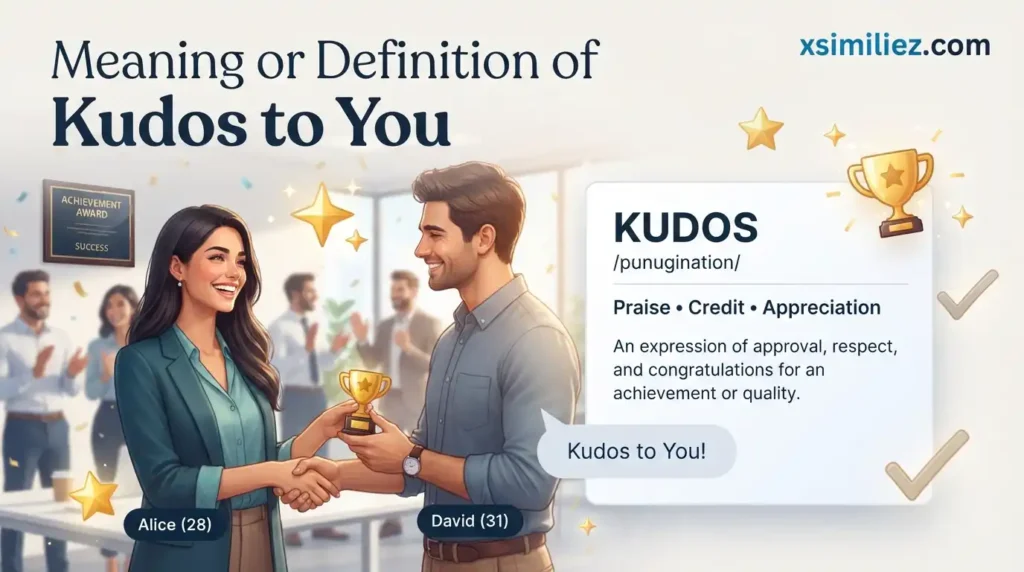
The word “kudos” comes from a single root, but it acts a bit differently than most English nouns. “Kudos” means praise, honor, or glory that someone earns from an achievement. When you add “to you,” you are pointing that praise directly at a person.
So “kudos to you” means: “I am giving you praise” or “you deserve credit for this.” It is similar to saying:
- “Good job “
- “Well done “
- “Congratulations “
- “I’m proud of you “
Here is a simple breakdown to help make the meaning clear:
| Phrase | Simple Meaning | When to Use It |
| Kudos to you | Great job, well done | After an achievement or good decision |
| Kudos to the team | Praise for a group | After teamwork or a group win |
| Kudos on your promotion | Congrats on a specific event | After a milestone or announcement |
| Big kudos | Extra strong praise | When the achievement feels impressive |
One important thing to know: “kudos” is a singular, uncountable noun in English, even though it ends in an “s.” That means you should never say “a kudo” or “two kudos.” You always use “kudos” as one whole word, no matter how much praise you are giving.
Grammar and Correct Usage of Kudos to You
Many people get confused about “kudos” because it looks like a plural word. It is not. In English, we treat “kudos” the same way for one person or ten people. You do not add or remove an “s” depending on the amount of praise.
Here are some correct and incorrect examples to make this clear:
Correct:
“Kudos to you for finishing the marathon.”
“Kudos to the whole team for their hard work.”
“That was a great presentation. Kudos “
Incorrect:
“You deserve a kudo.” (Wrong “kudos” is not countable)
“Two kudos to you.” (Wrong you cannot count kudos like objects)
“Kudos to you” can stand alone as a short sentence, or it can be part of a longer sentence. Both are fine:
- Short form: “Kudos to you “
- Longer form: “Kudos to you for handling that difficult client so calmly.”
You can also swap “you” for other words, depending on who you are praising:
- Kudos to her
- Kudos to the design team
- Kudos to everyone who helped
This flexibility is part of why the phrase is so popular. It fits almost any situation where praise is needed.
Origin and History of Kudos
The word “kudos” comes from the Greek word “kydos,” which meant glory, fame, or renown, especially the kind of glory earned through a great achievement. Ancient Greek writers used it to describe honor won in battle or through heroic deeds.
The word made its way into English in the 1800s, first appearing in British university slang. Students used “kudos” to talk about praise or recognition earned through academic success. Over time, the word spread beyond universities and into everyday English, both in Britain and later in the United States.
Because “kudos” ends in an “s,” many English speakers wrongly assumed it was a plural noun, similar to words like “photos” or “videos.” This mistaken belief even led to a rare, informal singular form, “kudo,” appearing in some casual writing. However, “kudo” is still considered nonstandard and is best avoided in careful or professional writing.
Today, “kudos to you” is a normal part of modern English. You will find it in workplace emails, social media captions, birthday cards, and everyday conversations. It kept its original meaning of praise and honor, even though its use has become much more casual than it was in ancient Greece.
Real-Life Examples of Kudos to You
Seeing the phrase in action can help you understand exactly how and when to use it. Here are some everyday situations where “kudos to you” fits naturally.
At work:
“Kudos to you for meeting the deadline despite the tight schedule.”
“Kudos to you for staying calm during that stressful meeting.”
In school:
“Kudos to you for improving your grade this semester.”
“Kudos to you for helping your classmate study.”
On social media:
“Kudos to you for running your first 5K. So proud of you.”
“Kudos to you for starting your own small business this year.”
In personal life:
“Kudos to you for finally finishing that home renovation project.”
“Kudos to you for being patient with your kids today.”
Notice that the phrase almost always follows an action or achievement. It rarely stands completely alone without context, because the point of the phrase is to praise a specific effort or result.
Common Mistakes People Make With Kudos to You
Even though “kudos to you” is a simple phrase, people often misuse it in small ways. Here are the most common mistakes, along with corrections.
| Mistake | Why It’s Wrong | Correct Version |
| “You deserve a kudo” | “Kudos” is not countable | “You deserve kudos” |
| “Two kudos for that” | Cannot count kudos like objects | “Kudos for that” |
| “Kudos are appreciated” | Treats kudos as plural verb subject | “Kudos is appreciated” |
| Using it in very casual chat with strangers | Can sound stiff or overly formal | Use “great job” or “nice work” instead |
| Overusing it for small tasks | Loses its impact if used constantly | Save it for real achievements |
Another common issue is tone. Because “kudos to you” sounds a little more formal than “good job,” it can feel odd if you use it constantly in casual texting with close friends. It fits better in emails, professional messages, or slightly more special occasions.
Current Usage and Trends of Kudos to You
“Kudos to you” remains popular today, especially in workplace communication and online spaces. Many managers and coworkers use it in emails to recognize good performance without sounding overly emotional or too casual. It strikes a balance between professional and warm.
On social media, the phrase often appears in comment sections under posts about personal achievements, such as weight loss goals, new jobs, graduations, or creative projects. It gives people an easy way to celebrate someone publicly without writing a long comment.
You will also notice “kudos” being used without “to you” in short exclamations, like:
- “Kudos “
- “Big kudos on that ! “
- “Kudos, seriously.”
This shows how flexible the phrase has become in modern English. If in a formal email or a quick comment, “kudos to you” continues to be a trusted way to express genuine praise.
Tips for Using Kudos to You Correctly

If you want to use this phrase naturally and correctly, keep these simple tips in mind.
- Always treat “kudos” as a single, uncountable noun.
- Never say “kudo” or “two kudos.”
- Use it after a real achievement, not for minor daily tasks.
- Pair it with a specific detail for a stronger, more sincere message.
- Save it for slightly more formal or heartfelt moments, rather than constant casual texting.
- Feel free to add “big” or “huge” before “kudos” for extra emphasis, such as “Huge kudos to you.”
Following these tips will help your praise feel genuine and well-placed, rather than repetitive or robotic.
FAQs About Kudos to You
What does “kudos to you” mean in simple words?
It means “good job” or “well done.” It is a short way to praise someone for something they did well.
Is “kudos” singular or plural?
“Kudos” is always singular, even though it ends in “s.” You never say “kudo” for one piece of praise.
Can I say “kudos to you” in a professional email?
Yes. It is a great phrase for workplace emails because it sounds respectful, warm, and slightly more polished than “good job.”
Is “kudos to you” the same as “congratulations”?
They are very similar. “Kudos to you” focuses more on praising effort or skill, while “congratulations” often marks a specific event, like a graduation or promotion. Both work well in many of the same situations.
Where did the word “kudos” come from?
“Kudos” comes from the ancient Greek word “kydos,” meaning glory or honor earned through achievement. It entered English through British university slang in the 1800s.
Can I use “kudos to you” with a group of people?
Yes, but you should adjust the wording slightly, such as “kudos to you all” or “kudos to the team,” to make it clear you are praising more than one person.
Conclusion
“Kudos to you” is a simple, friendly way to praise someone for doing something well. It works in emails, social media comments, and everyday conversations, and it carries a slightly more polished tone than casual phrases like “nice job.” Understanding its Greek roots and its uncountable noun status can help you use it correctly and confidently.
The most important thing to remember is that “kudos” never changes form, no matter how much praise you are giving. If you are congratulating a friend, praising a coworker, or celebrating a personal win, “kudos to you” fits naturally into many situations.
Next time someone in your life accomplishes something great, try using this phrase yourself. A simple “kudos to you” can brighten someone’s day and show that their hard work truly did not go unnoticed.

Hi, I’m Harper Blake, and I write for Xsimiliez.com. I enjoy sharing clear and friendly simile examples that students and beginners can understand easily. My goal is to make English learning simple and enjoyable.