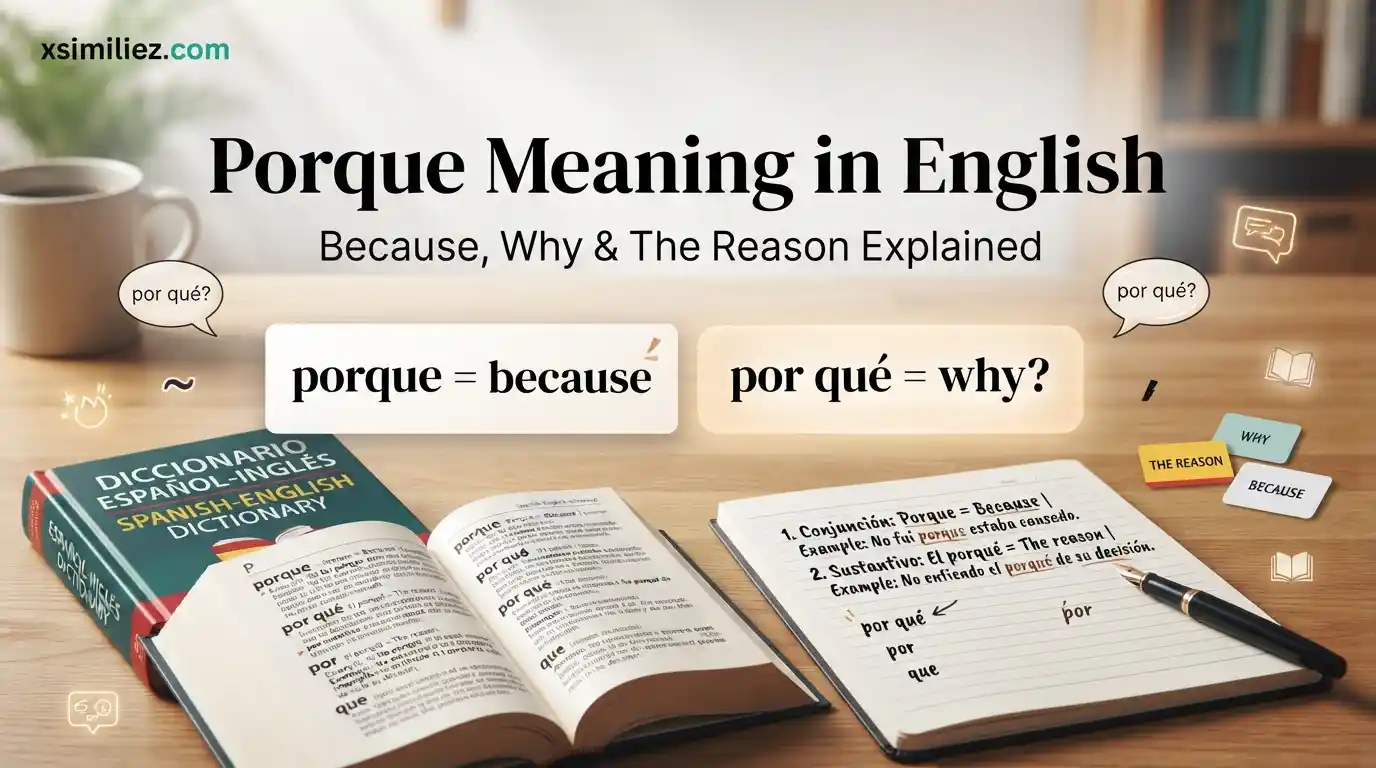
Have you ever seen the word “porque” in a Spanish sentence and wondered what it means in English? You are not alone. The porque meaning in English is simply “because.” It is one of the most common words in the Spanish language, and people use it every single day to explain reasons for things.
Many English speakers run into this word while learning Spanish, watching a Spanish TV show, reading a text message, or chatting with a Spanish-speaking friend. Sometimes they see “porque” written as one word, and other times they see “por qué” written as two words with an accent mark. This small difference can be confusing, even for people who have studied Spanish for years.
In this article, we will break down exactly what “porque” means, how to use it correctly, and how it compares to its tricky look-alike words. We will also share real examples, common mistakes, and helpful tips so you never feel confused about this word again.
Quick Answer: Porque Meaning in English
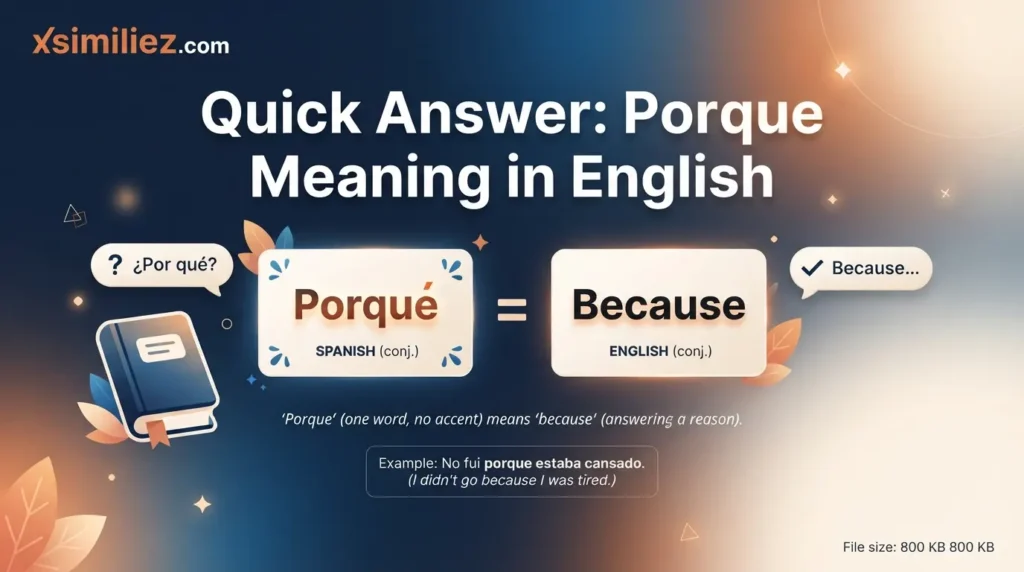
The short answer is easy. “Porque” means “because” in English. It is a conjunction, which is just a fancy word for a connector. It connects two parts of a sentence, where the second part explains the reason for the first part.
For example, in Spanish you might say, “No fui a la fiesta porque estaba enfermo.” In English, this means, “I did not go to the party because I was sick.” See how “porque” connects the two ideas together, just like “because” does in English?
This word shows up constantly in daily conversations, books, songs, and movies. Once you learn it, you will start noticing it everywhere.
Meaning and Definition of Porque
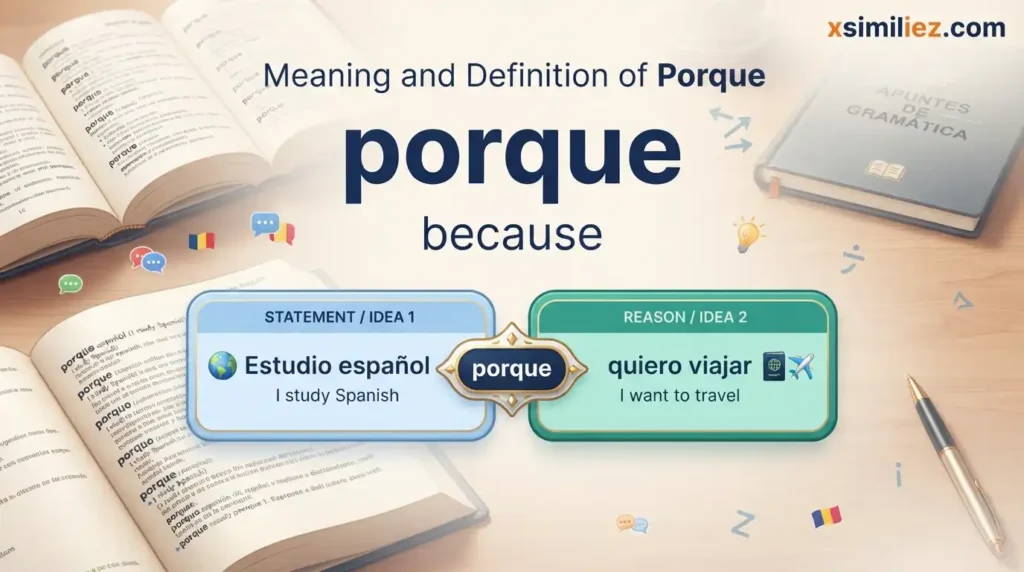
Let’s dig a little deeper into the meaning. “Porque” is a subordinating conjunction. That means it joins a main idea with a supporting idea that gives a reason. In English grammar, the word “because” does the exact same job.
Here is a simple way to picture it. Imagine two puzzle pieces. One piece is the main fact, and the other piece is the reason behind that fact. The word “porque” is the connector piece that snaps them together.
Take this sentence: “Ella está feliz porque ganó el partido.” This translates to “She is happy because she won the game.” The first part tells us how she feels. The second part, after “porque,” tells us why she feels that way.
This word never changes its spelling based on gender or number, which makes it easier than many other Spanish words. If you are talking about a man, a woman, one person, or many people, “porque” always stays the same. That is one less thing to memorize.
| Spanish Sentence | English Translation |
| Como porque tengo hambre. | I eat because I am hungry. |
| Estudio porque quiero aprender. | I study because I want to learn. |
| Lloró porque estaba triste. | She cried because she was sad. |
| No salimos porque llovía. | We did not go out because it was raining. |
Grammar and Correct Usage of Porque
Now let’s talk about grammar, since this is where most learners get stuck. Spanish actually has four different versions of this word, and they all sound almost the same when spoken out loud. But they mean different things and are used in different situations.
Here is a breakdown to make things crystal clear:
| Spanish Word | Meaning | How It Is Used |
| porque | because | Joins a reason to a statement (one word, no accent) |
| por qué | why | Used to ask questions (two words, with accent) |
| porqué | the reason | Used as a noun (one word, with accent) |
| por que | for which / that | Used in specific formal or literary phrases |
The most important pair to remember is “porque” and “por qué.” “Porque” answers a question. “Por qué” asks a question. Think of it this way: if you are asking “why,” you always need two words and an accent mark. If you are answering “because,” you use one word with no accent.
For example: “Por qué estás triste?” means “Why are you sad?” The answer might be, “Estoy triste porque perdí mi trabajo,” which means “I am sad because I lost my job.” Notice how the question uses “por qué” and the answer uses “porque.” This pattern repeats constantly in Spanish conversations.
The third version, “porqué,” written as one word with an accent, works like a noun. It means “the reason” or “the motive.” For example, “No entiendo el porqué de su decisión” means “I do not understand the reason for his decision.” This version is much less common, but you will still see it in newspapers, books, and formal writing.
Common Mistakes with Porque
Many English speakers, and even some native Spanish speakers, mix up these four words. This happens because they all sound identical when spoken. The only way to tell them apart is by looking at the spelling and the context of the sentence.
Here are the most common mistakes people make:
Mistake one: Using “porque” instead of “por qué” in a question. For example, writing “Porque estás aquí?” instead of ” Por qué estás aquí?” This mistake is very common because the words sound the same, but a question always needs the two-word version with the accent.
Mistake two: Using “por qué” in a statement. For example, writing “Estoy cansado porque trabajé mucho” instead of “Estoy cansado porque trabajé mucho.” Since this sentence is giving a reason, not asking a question, it needs the one-word “porque.”
Mistake three: Forgetting the accent mark on “por qué” and “porqué.” Accent marks matter in Spanish. Leaving them out can change the meaning of a sentence or confuse the reader.
Mistake four: Confusing “porque” with “para que.” These look similar but mean different things. “Porque” means “because,” while “para que” means “so that” or “in order that.” For example, “Trabajo porque necesito dinero” means “I work because I need money,” but “Trabajo para que mis hijos tengan una buena vida” means “I work so that my children have a good life.”
A helpful trick to remember the difference is this: if you can replace the word with “why” in English, use two words with an accent. If you can replace it with “because,” use one word without the accent.
Real-Life Examples of Porque in Sentences
Seeing real examples can help the meaning stick in your memory. Below are everyday sentences that show how “porque” is used in normal conversations.
“Me quedé en casa porque llovía mucho.” This means, “I stayed home because it was raining a lot.” You might hear a friend say this when explaining why they skipped a walk or a trip outside.
“Compré este libro porque me lo recomendaron.” This means, “I bought this book because someone recommended it to me.” This kind of sentence pops up often when people talk about shopping or gift-giving.
“No pude llamarte porque mi teléfono se apagó.” This means, “I could not call you because my phone died.” This is a very common excuse people use when they miss a call or a message.
“Aprendo español porque quiero viajar a México.” This means, “I am learning Spanish because I want to travel to Mexico.” Sentences like this show up constantly in language classes and travel conversations.
“Él llegó tarde porque había mucho tráfico.” This means, “He arrived late because there was a lot of traffic.” This is one of the most common excuses used around the world, in any language.
Notice that in every single example, “porque” connects two thoughts. The first part is a fact or an event, and the second part explains why it happened. This pattern is the heart of how the word works.
British vs American English Usage
There is some good news here. The word “because,” which is the English translation of “porque,” is used the exact same way in both British English and American English. There is no difference in spelling, pronunciation, or grammar rules between the two versions of English.
Some people also use the shortened form “’cause” in casual speech, especially in the United States. For example, “I stayed home ’cause it was raining.” This informal version is common in spoken conversation and text messages, but it is not used in formal writing like school essays or business emails, in either British or American English.
So If you are learning English in London or in Los Angeles, “porque” will always translate to “because,” and the usage rules stay the same.
Tips for Remembering Porque Correctly
Learning a new language often comes down to small tricks that help ideas stick in your brain. Here are some simple tips to help you remember how “porque” works.
First, remember the letter count trick. Questions use two words (“por qué”), and answers use one word (“porque”). Two words for a question mark, one word for a period.
Second, practice with flashcards. Write a question on one side using “por qué” and the answer on the other side using “porque.” This helps your brain connect the two words as a natural pair.
Third, listen to native speakers. Watching Spanish shows, listening to Spanish music, or following Spanish social media accounts will expose you to this word constantly. The more you hear it, the more natural it will feel.
Fourth, read sentences out loud. Since all four versions of this word sound almost the same, reading them aloud while looking at the spelling helps train your eyes and ears together.
Fifth, do not worry about mistakes. Even native Spanish speakers sometimes mix up “porque” and “por qué” in fast texting or casual writing. Making mistakes is a normal part of learning any language.
Current Usage and Trends
Today, “porque” remains one of the most frequently used words in the Spanish language, both in spoken conversation and written text. It appears in songs, social media posts, text messages, news articles, and everyday chats between friends and family.
With more people around the world learning Spanish as a second language, many language apps and online courses now include specific lessons focused on the difference between “porque,” “por qué,” “porqué,” and “por que.” This shows how important and commonly confused this word truly is.
Spanish is currently one of the most studied languages in schools across the United States, and understanding small but important words like “porque” helps learners build a strong foundation for real conversations.
FAQs About Porque Meaning in English
What does “porque” mean in English?
“Porque” means “because” in English. It is used to give a reason for something in a sentence.
Is “porque” the same as “por qué”?
No, they are different. “Porque” is one word and means “because.” “Por qué” is two words with an accent mark and means “why.” One asks a question, and the other answers it.
How do you use “porque” in a sentence?
You use “porque” to connect a statement with its reason. For example, “Estoy cansado porque trabajé todo el día” means “I am tired because I worked all day.”
What is the difference between “porque” and “porqué”?
“Porque” is a connector word meaning “because.” “Porqué,” written as one word with an accent, is a noun meaning “the reason.” For example, “el porqué de su decisión” means “the reason for his decision.”
Can “porque” be used to start a question?
No. To ask a question, you need “por qué,” written as two words with an accent mark, such as ” Por qué lloras?” which means “Why are you crying?”
Is “because” used the same way in British and American English?
Yes. “Because,” the English translation of “porque,” follows the same grammar and spelling rules in both British and American English.
Conclusion
Understanding the porque meaning in English opens up a much clearer path to reading and speaking Spanish with confidence. At its core, “porque” simply means “because,” and it works as a connector that links a statement to its reason. Once this basic idea clicks, the rest becomes much easier to follow.
The real challenge lies in telling “porque” apart from its close cousins: “por qué,” “porqué,” and “por que.” Each one plays a different grammatical role, and mixing them up is one of the most common errors Spanish learners make. Remembering the simple rule of “two words for questions, one word for answers” can save you from a lot of confusion.
With practice, real examples, and a little patience, this word will soon feel as natural as saying “because” in your own native language. Keep listening, keep reading, and keep practicing, and this small word will no longer trip you up.

Hi, I’m Mason Avery, a content writer at Xsimiliez.com. I like writing about similes, figurative language, and creative expressions. I believe learning English becomes easier when examples feel natural and relatable.