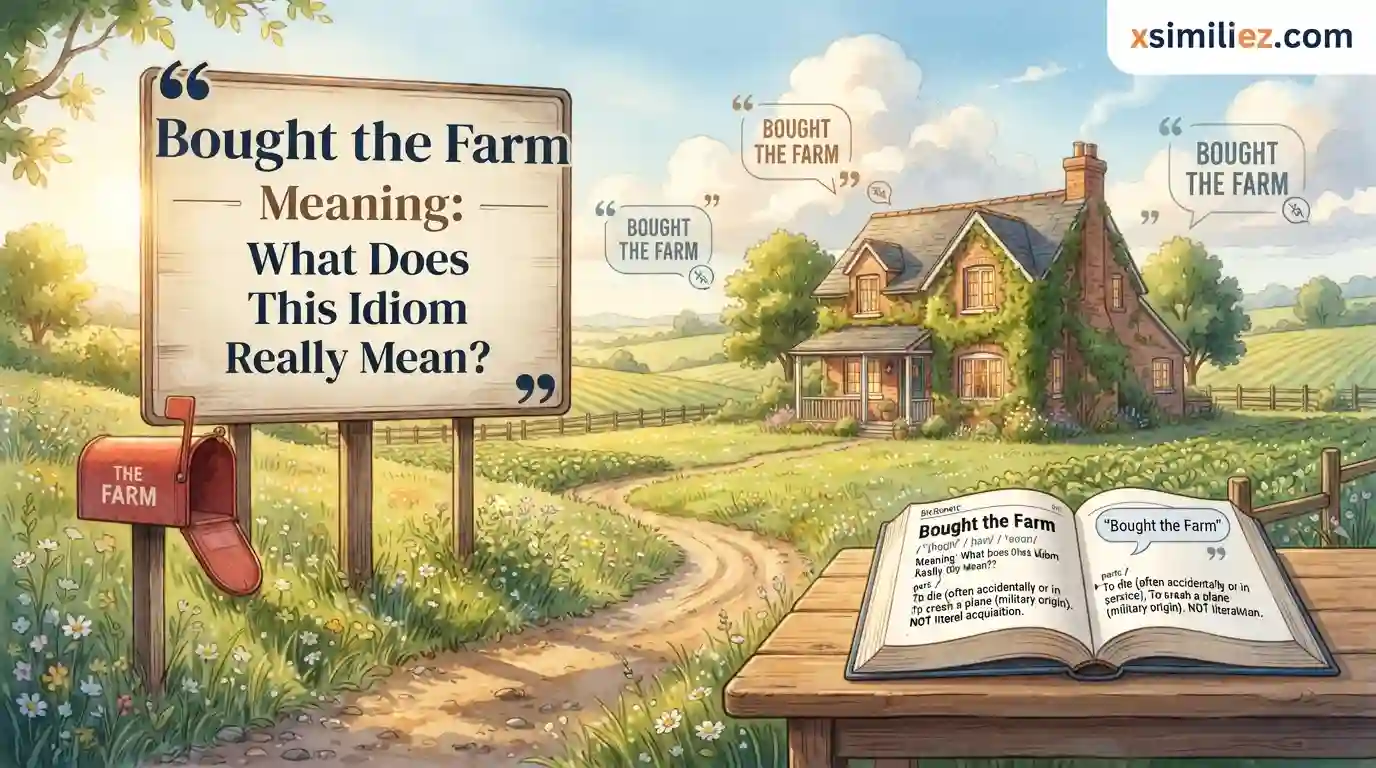
Have you ever heard someone say a person “bought the farm” and wondered what farms have to do with anything? You’re not alone. This strange saying confuses a lot of people the first time they hear it, especially if English is not their first language.
The short answer is simple: “bought the farm” means someone died. It’s an old slang phrase, and people still use it today in books, movies, and everyday conversation. It sounds odd because it has nothing to do with real farms or buying property.
In this article, we’ll break down exactly what “bought the farm” means, where it may have come from, how to use it correctly, and when you should avoid it. By the end, you’ll understand this idiom well enough to use it yourself or explain it to someone else.
Quick Answer: What “Bought the Farm” Means
“Bought the farm” is an idiom that means a person died, usually suddenly or in an accident. It’s most often used in a casual or joking way, even though death is a serious topic. For example, someone might say, “He bought the farm in a car crash last year,” meaning he died in that crash.
This phrase is not something you’d hear at a funeral or in a formal setting. It’s more common in casual talk, military stories, action movies, and older slang from the 20th century. People also use it sometimes to talk about something failing completely, like a business or a machine, though the “death” meaning is far more common.
Meaning and Definition of “Bought the Farm”
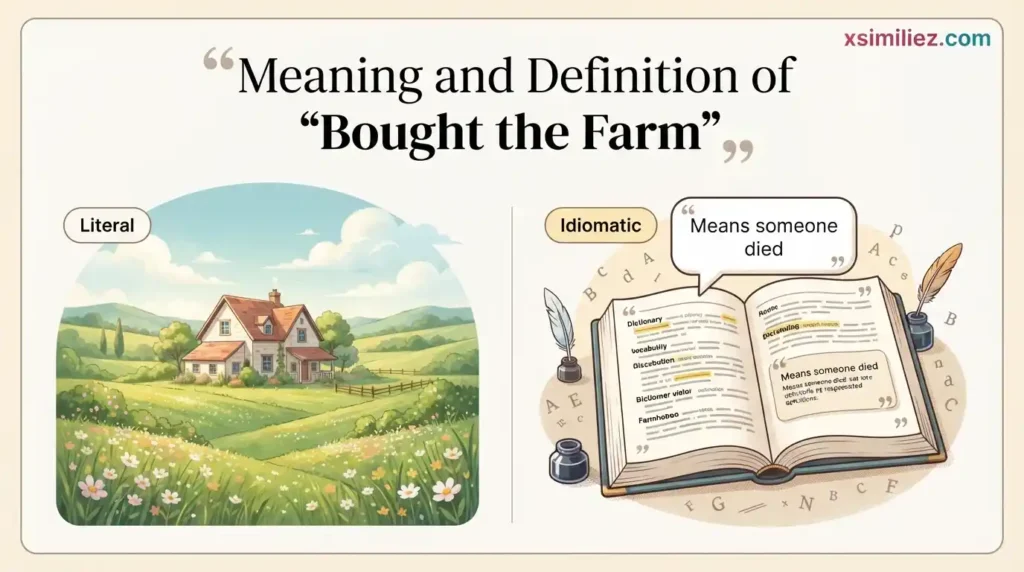
At its core, “bought the farm” is a euphemism. A euphemism is a soft or indirect way of saying something harsh or uncomfortable. Instead of saying “he died,” people say “he bought the farm” to soften the blow or add a bit of dark humor to the sentence.
The phrase works as a complete idea on its own. You don’t need extra words to explain it once someone understands the idiom. Here’s a simple breakdown:
| Part of Phrase | Literal Meaning | Idiomatic Meaning |
| Bought | Purchased something | Nothing purchased; just part of the fixed phrase |
| The farm | A piece of land used for farming | Nothing to do with land; part of the idiom only |
| Full phrase | Purchasing farmland | The person died |
It’s important to know that this phrase is almost always used about death, not injury. If someone is hurt but alive, you wouldn’t say they “bought the farm.” The phrase implies the end, not a setback.
Sometimes, though rarely, people stretch the phrase to mean something was destroyed completely, like a car engine that “bought the farm” after years of hard use. Even here, the core idea stays the same: something reached its final end.
Origin and History of “Bought the Farm”
The exact origin of “bought the farm” is debated, and word historians don’t fully agree on one clear story. However, most experts believe the phrase became popular among American military pilots in the 1950s and 1960s.
One common theory says that when a military plane crashed on a farmer’s land, the government sometimes had to pay the farmer for the damage. Pilots joked darkly that a crash was so costly, it was like the pilot “bought” the farm with his life and the government’s money.
Another theory suggests the phrase relates to an old idea that a dead soldier’s life insurance money could be enough for his family to pay off their farm’s mortgage. In other words, his death “bought” the farm for his surviving family.
Word experts at trusted language sources note that while both theories are widely repeated, there is no single confirmed origin. What we do know for certain is that the phrase spread quickly through military slang before moving into general American English by the mid-20th century.
By the 1970s and 1980s, “bought the farm” had become common in movies, books, and everyday speech, especially in stories involving danger, war, or risky jobs like flying and racing.
Grammar and Correct Usage of “Bought the Farm”
Getting the grammar right matters if you want to use this idiom smoothly. “Bought” is the past tense of “buy,” so this phrase is almost always used in the past tense, since it describes something that already happened.
Here are the basic grammar rules to remember:
- Use “bought the farm” only in the past tense (he bought the farm, she bought the farm, they bought the farm).
- Do not use it in the present tense (“he buys the farm” sounds incorrect and confusing).
- You can use “buy the farm” in future tense if you’re making a prediction, like “If he keeps driving like that, he’s going to buy the farm.”
- The phrase works as a verb phrase, meaning it needs a subject before it, such as a person’s name or a pronoun.
Let’s look at a simple table showing correct and incorrect usage:
| Sentence | Correct or Incorrect | Why |
| “He bought the farm last year.” | Correct | Past tense matches the idiom’s normal use |
| “She buys the farm every Monday.” | Incorrect | Present tense doesn’t fit the idiom’s meaning |
| “If he’s not careful, he’ll buy the farm.” | Correct | Future tense works for predictions |
| “They are buying the farm right now.” | Incorrect | Present continuous tense sounds confusing here |
Notice that the idiom always keeps its exact wording. You can’t swap “farm” for another word or add extra words in the middle, or it stops sounding like the idiom people recognize.
Common Mistakes People Make With “Bought the Farm”
Even native English speakers sometimes misuse this phrase, especially if they’ve only heard it once or twice. Here are the most common mistakes.
First, some people think it literally means someone bought a farm, like a piece of land for growing crops. This confusion usually happens the first time someone hears the phrase, since there’s no obvious hint that it means death.
Second, people sometimes use the phrase for injuries instead of death. Saying “he bought the farm but he’s recovering in the hospital” doesn’t make sense, because the idiom only applies to death, not survival.
Third, some learners try to change the wording, saying things like “bought the ranch” or “purchased the farm.” These versions aren’t recognized idioms, and native speakers won’t understand what you mean.
Fourth, people occasionally use this phrase in serious or formal writing, like a news report or a sympathy card. Since the idiom carries a joking or blunt tone, it can come across as disrespectful in serious situations.
Finally, some non-native speakers translate the idiom word for word into other conversations, which leads to confusion since the humor and history behind the phrase don’t carry over directly.
Real-Life Examples of “Bought the Farm”
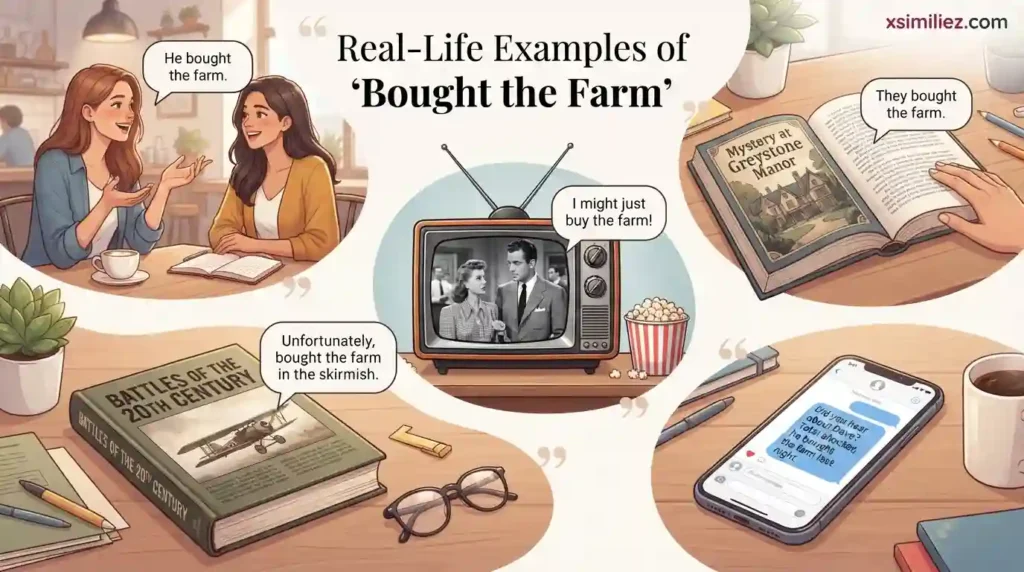
Seeing the phrase used in real sentences can help you understand it faster than definitions alone. Here are several examples showing different situations where this idiom fits naturally.
In casual conversation: “Did you hear about Tom’s grandfather? He bought the farm peacefully in his sleep at 90 years old.”
In storytelling or fiction: “The old cowboy knew his luck had run out the moment he saw the outlaw’s gun. Within seconds, he’d bought the farm.”
In military or war stories: “Half the squad bought the farm during that mission, and the survivors never talked about it much.”
In movies or pop culture: Action films often use this phrase when a character dies suddenly, especially in a dramatic or ironic way, such as a villain dying by their own trap.
In dark humor among friends: “If I eat one more slice of this cake, I might just buy the farm from a sugar rush.”
These examples show that while the phrase almost always means death, the tone can range from serious to lighthearted, depending on the situation and the people using it.
Current Usage and Trends of “Bought the Farm”
Today, “bought the farm” is considered slightly old-fashioned slang, but it hasn’t disappeared. You’ll still hear it in movies, especially those set in military settings, racing culture, or crime dramas. Writers use it to add a rougher, more casual voice to characters.
Younger generations may not use this phrase as often in daily speech, but they still recognize it from movies, video games, and older relatives. It remains a useful phrase to understand, even if you don’t use it yourself every day.
Online, you’ll often see the phrase used in forums, gaming communities, and social media posts, usually in a joking tone about a character dying in a video game or show, rather than talking about a real person’s death.
Tips for Using “Bought the Farm” Correctly
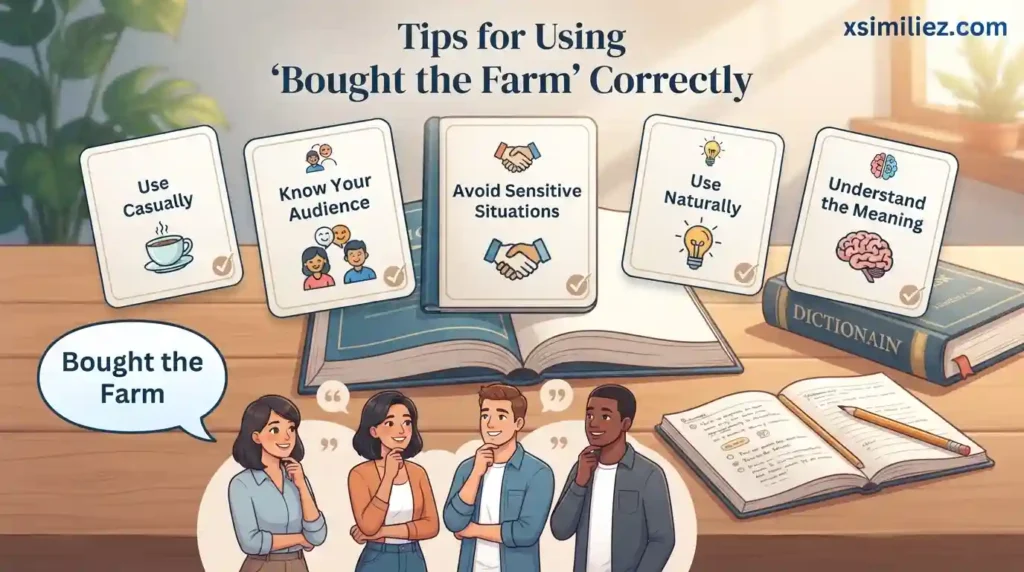
If you want to use this idiom naturally, keep these simple tips in mind.
Always use it in casual conversations, not formal writing. Save formal words like “passed away” for serious situations, like speaking with a grieving family member.
Make sure your audience already understands American slang, since this phrase might confuse people unfamiliar with English idioms.
Avoid using it right after hearing about someone’s recent death, since the joking tone can feel insensitive if emotions are still raw.
Use it in storytelling, humor, or casual chats among friends where a lighter tone about death fits naturally.
Remember that this phrase always refers to death, not injuries, failure, or minor setbacks, unless you’re using it loosely about something being completely broken, like an old car.
FAQs About “Bought the Farm”
What does “bought the farm” mean in simple words?
It means someone died, usually suddenly or in an accident. It doesn’t have anything to do with actually buying land.
Is “bought the farm” rude to say?
It can sound rude or insensitive if used right after a real person’s death, especially around grieving family or friends. It’s better for casual talk or storytelling.
Where did “bought the farm” come from?
Most experts believe it started as military slang, possibly linked to pilots or soldiers dying and their families receiving money that could pay off a farm’s mortgage.
Can I use “bought the farm” for injuries?
No. This phrase only refers to death, not injuries or near-misses. If someone survives an accident, this idiom doesn’t apply.
Is “bought the farm” still used today?
Yes, though it’s considered older slang. You’ll still hear it in movies, books, and casual conversations, especially among older generations.
Is “bought the farm” the same as “kicked the bucket”?
Both phrases mean someone died, and both are casual or slightly humorous. However, “bought the farm” has military roots, while “kicked the bucket” has a different, older history.
Conclusion
Understanding idioms like “bought the farm” helps you sound more natural in English and understand books, movies, and conversations that use casual slang. While the phrase might sound strange at first, it simply means someone died, often suddenly or unexpectedly.
We’ve covered where the phrase likely came from, how to use it correctly, common mistakes to avoid, and real examples showing it in action. If you’re a language learner or just curious about English slang, knowing this idiom adds a useful phrase to your vocabulary.
Remember to use “bought the farm” in casual settings, keep it in the past tense, and avoid it in serious or emotional situations. With this guide, you now know exactly what the phrase means and how to use it the right way.

Hi, I’m Harper Blake, and I write for Xsimiliez.com. I enjoy sharing clear and friendly simile examples that students and beginners can understand easily. My goal is to make English learning simple and enjoyable.