Jumping the gun meaning is simple: it means doing something too soon, before the right time. Think of a runner who starts before the race signal. In daily life, people jump the gun when they act, speak, or decide too early.
Have you ever spoiled a surprise party by telling the guest of honor? Or bought a gift before you knew what the person wanted? Someone may have told you, “Don’t jump the gun.” Many people hear this phrase and want to be sure they understand it. That is why this topic is searched so often.
In this guide, you will learn what the phrase means, where it came from, and how to use it in a sentence. You will also see common mistakes, real-life examples, and simple tips to help you slow down and act at the right time.
Quick Answer: Jumping the Gun Meaning
To jump the gun means to start something before it is time. It can be an action, a choice, or an announcement. The person moves too fast and does not wait for the right moment, the full facts, or a clear signal.
Here is a short example. Your teacher says the test will start at 9:00. A student starts writing at 8:55. That student jumped the gun.
The phrase is an idiom. That means the words together have a special meaning that is different from the words alone. Nobody is holding a gun in this saying. The “gun” is the starting signal, and “jumping” means moving too early.
Jumping the Gun Meaning and Definition
Most dictionaries explain the phrase in a very similar way. It means to start too soon, act too early, or do something before you should. Some writers add that the person often acts before they have enough information.
The phrase is usually a mild criticism. It says, “You moved too fast.” But it is not a harsh or rude phrase. People often use it in a kind and friendly way, like a gentle warning. When a friend says, “Don’t jump the gun,” they are usually trying to help.
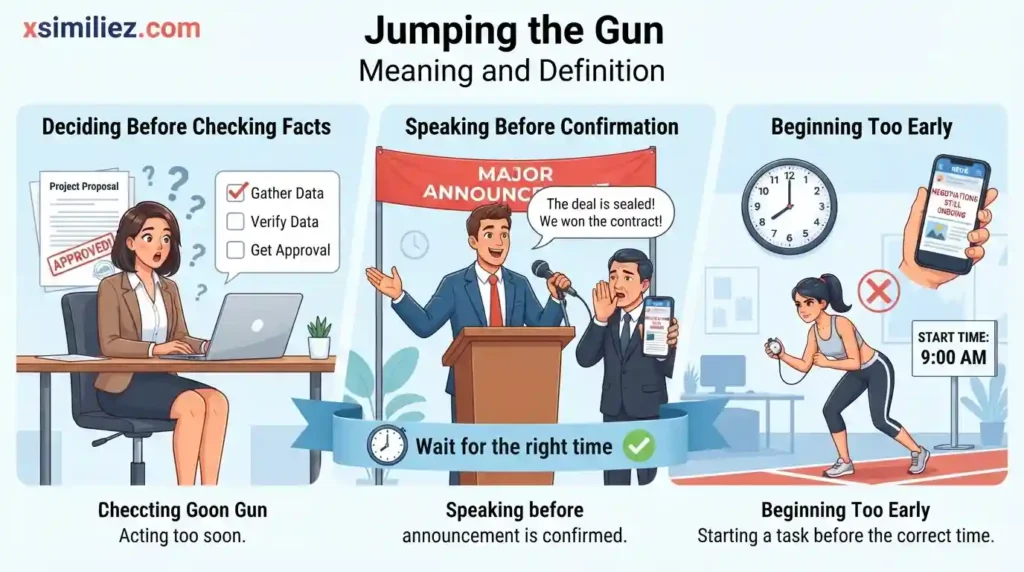
The phrase can describe three main things:
- Acting too early: Starting a task before the plan is ready.
- Speaking too early: Sharing news before it is confirmed.
- Deciding too early: Making up your mind before you have all the facts.
Sometimes the phrase has a lighter feeling. If a child opens a birthday gift a day early, you might laugh and say, “Someone jumped the gun” No one is upset. The phrase just points out the early timing.
One more thing is worth noting. The phrase says nothing about If the action itself is good or bad. Starting a project is fine. Starting it too early is the problem. The timing is what matters, not the action.
Where the Phrase Comes From
The phrase comes from foot races. In track and field, a starter holds a pistol that makes a loud bang. The bang tells the runners to go. A runner who leaves before the bang has “jumped the gun.”
That picture is easy to see, and it is why the saying works so well. Everyone knows a runner should wait for the signal. Leaving early is unfair to the other runners, and it breaks the rules.
Language experts link the phrase to this kind of race, and it has been used in English for about a century. However, no one can point to the very first person who said it. Because of that, it is best not to trust any story that names one exact inventor or one exact day.
Racing still uses this idea today. Modern races often use sensors in the starting blocks that detect very early movement. If a runner moves too soon, the race official calls a false start. In top-level races, a false start can mean the runner is out of the race. So the saying comes from a rule that still matters.
Over time, people began using the phrase outside of sports. Today, most people who say it have never thought about racing at all. They just know it means “too early.”
How to Use Jump the Gun in a Sentence
The phrase works as a verb. That means it changes form based on when the action happens. The words “the gun” always stay the same. Only the first word changes.
| Form | Example Sentence |
| jump the gun | Please don’t jump the gun on this. |
| jumps the gun | My brother always jumps the gun. |
| jumped the gun | The store jumped the gun and put up holiday lights in August. |
| jumping the gun | I think you are jumping the gun. |
| has/have jumped the gun | She has jumped the gun again. |
| will jump the gun | If we tell them now, we will jump the gun. |
A few simple rules can help you use it well.
First, use the phrase with a person, a group, or a company. You can say, “The team jumped the gun.” You would not usually say, “The rain jumped the gun,” unless you are being playful.
Second, you can add an object with “on.” For example, “He jumped the gun on the announcement.” This tells the reader what was done too early.
Third, the phrase often follows words like “don’t,” “let’s not,” and “I think.” These make it sound polite. “Let’s not jump the gun” is a friendly way to say “Let’s wait.”
Fourth, keep your sentences short and clear. The phrase already carries a lot of meaning. You do not need to add extra words like “too early” because the idiom already says that. Saying “jumped the gun too early” is a bit repetitive.
Jumping the Gun Meaning in Everyday Life
The best way to understand an idiom is to see it in real life. Here are some common places where people jump the gun.
At school. A student sees one low grade and decides the whole class is lost. The report card has not come yet. Or a parent hears a rumor about a new rule and complains before the school shares the facts. Both people jumped the gun.
At work. A manager tells the team about a new project before the boss approves it. Then the plan changes, and everyone feels confused. Or a worker sends a long email before reading the whole message they got. Waiting five more minutes would have solved the problem.
With money. Someone spends a bonus before it arrives in the bank. Then the bonus is smaller than expected. This is a classic example of jumping the gun, and it can cause real stress.
In health. A person reads a few things online and decides they know what is wrong. They panic before seeing a doctor. It is wise to get real advice first, because worry often grows faster than facts.
In relationships. Someone reads a short text message and assumes their friend is angry. They send an upset reply. Later, they learn the friend was just busy. A little patience would have saved a lot of hurt feelings.
In sports. This is where the phrase began. A swimmer leaves the block early. A sprinter twitches before the sound. A football player moves before the snap. Each of these is a real case of jumping the gun.
With technology. A company shows off a new product before it works well. Buyers get excited, then disappointed. This happens often, and it shows that even big groups can act too soon.
Jumping the Gun vs. Similar Phrases
English has many sayings about acting too early. They are close in meaning, but not exactly the same. This table can help you choose the right one.
| Phrase | Meaning | Best Used When |
| Jump the gun | Start before the right time | Someone acts or speaks too early |
| Put the cart before the horse | Do things in the wrong order | Steps are mixed up |
| Count your chickens before they hatch | Expect a result that is not certain yet | Someone celebrates too soon |
| Get ahead of yourself | Plan or think too far into the future | Someone assumes too much |
| Rush into something | Act fast without thinking | Someone skips careful thought |
| Go off half-cocked | Act without being ready | Someone acts in a careless way |
Notice the small differences. “Jump the gun” is mostly about timing. “Put the cart before the horse” is about order. “Count your chickens” is about expecting a good result too soon. Picking the right phrase makes your writing sound sharper.
There is also an opposite idea. When someone waits for the right moment, you might say they “bide their time” or “wait for the green light.” These phrases show patience, which is the opposite of jumping the gun.
British vs. American English
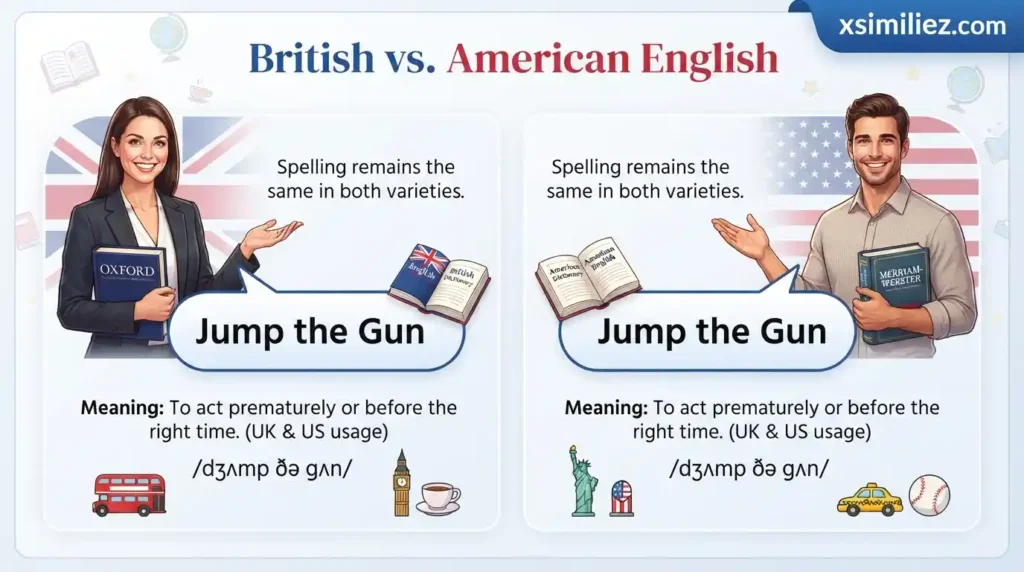
The phrase is used in both American and British English. The meaning is the same, and the spelling does not change. You can use it in the USA, the UK, Canada, or Australia, and people will understand.
Small differences show up in nearby phrases. You may hear “go off at half cock” in British speech and “go off half-cocked” in American speech. Both are close to jumping the gun, but they are not identical. For the phrase in this article, you do not need to worry about any change.
Common Mistakes with Jumping the Gun
Even a simple phrase can be misused. Here are the most common mistakes.
Mixing it up with “jump the shark.” These two phrases sound alike, but they are very different. “Jump the shark” is a TV term. It means a show has gotten so silly or desperate that its best days are over. “Jump the gun” is only about acting too early. Do not swap them.
Changing the words. Some people write “jumping the guns” or “jump on the gun.” These are not the standard forms. The correct phrase is “jump the gun,” with one gun and no extra words.
Thinking it means being brave. Because the word “jump” sounds bold, some readers think it means taking a big risk. It does not. It only means acting too soon.
Using it for being late. The phrase is about being early, not late. If someone shows up after the start, they did not jump the gun.
Using it when the early action was planned. If a store runs a sale early on purpose and tells everyone, that is not jumping the gun. The phrase works best when the early action was a mistake or a bit too hasty.
Taking it as a rude phrase. Some people worry it is an insult. It is not usually meant that way. The tone depends on how you say it. A calm “Let’s not jump the gun” sounds kind and helpful.
Current Usage in News, Business, and Daily Talk

This phrase is still very common today. You will hear it in many places.
In the news, reporters and writers use it when a story comes out before the facts are confirmed. Someone may say a news outlet “jumped the gun” by sharing a result too soon. Because news moves fast, the phrase fits well.
In business, leaders use it about products, prices, and plans. A company that tells the public about a new item before it is ready may be called out for jumping the gun. Teams also use it in meetings as a polite reminder to slow down.
On social media, people share posts before checking the facts. This can spread false information fast. Saying “Let’s not jump the gun” is a common way to ask others to wait for proof.
In sports, the phrase is still used in its original sense and in many playful ways. A fan may say a team jumped the gun by celebrating before the game ended.
In everyday talk, families, friends, and coworkers say it all the time. It is short, easy, and friendly, which is why it has lasted so long.
Tips to Avoid Jumping the Gun
Nobody is perfect, and everyone acts too early sometimes. The good news is that you can build better habits. Here are some simple ways to slow down.
Pause before you act. Take one deep breath. Even a few seconds can help you think more clearly.
Ask yourself two questions. Do I have all the facts? Is it the right time? If either answer is no, wait.
Sleep on big choices. If a decision is large, such as spending a lot of money or sending an angry message, wait until tomorrow. Things often look different after a night of rest.
Check the source. Before you share news, make sure it comes from a trusted place. If you cannot tell, do not share it yet.
Wait for the official word. If a boss, teacher, or doctor is going to give an answer soon, wait for it. Guessing early rarely helps.
Write it down first. If you are upset, write your message but do not send it. Read it again later. You may want to change it.
Make a simple plan. A short list of steps with clear start times can stop you from rushing ahead.
Remember, patience is a skill. The more you practice it, the easier it gets. Also remember that waiting is not the same as doing nothing. You are simply choosing the best moment.
FAQs
1. What does “jumping the gun” mean in simple words?
It means doing something too early. You start before the right time, before the signal, or before you have the facts.
2. Where does the phrase “jump the gun” come from?
It comes from racing. A starter fires a gun to begin the race. A runner who leaves before the sound has jumped the gun. No one knows who first said it in everyday speech.
3. Is “jumping the gun” a negative phrase?
It is usually a mild criticism, since it points out that someone acted too soon. But it is often said in a friendly, gentle way, so it is not usually rude.
4. What is the difference between “jump the gun” and “jump the shark”?
“Jump the gun” means to act too early. “Jump the shark” is a TV phrase that means a show has become silly or has passed its best days. They are not related.
5. Can I use “jump the gun” in formal writing?
Yes, in most cases. It is common in news, business, and school writing. If you need a very formal tone, you can use “act prematurely” instead.
6. What can I say instead of “jumping the gun”?
You can say “acting too soon,” “rushing ahead,” “getting ahead of yourself,” or “acting prematurely.” Each one is close in meaning.
Conclusion
Now you know the jumping the gun meaning. It is a short way to say someone did something too early. The phrase comes from racing, where a runner starts before the starting gun fires. Today, people use it for many things, from work plans to party news.
The key idea is timing. Being fast is not always good. Acting too soon can cost money, hurt feelings, or spoil a good plan. Waiting for the facts often gives you a better result, and people trust you more when you do.
Here is a simple tip to remember. Before you act, ask yourself if you have all the facts and if the time is right. If the answer is no, pause. A short wait can save you from a big mistake.

Hi, I’m Mason Avery, a content writer at Xsimiliez.com. I like writing about similes, figurative language, and creative expressions. I believe learning English becomes easier when examples feel natural and relatable.