
RBI meaning in baseball is simple: RBI stands for “run batted in.” A batter earns one when his turn at the plate makes a teammate score a run, or when he hits a home run and scores himself. Think of it as credit for driving runs across home plate.
Fans search for this term for good reasons. Maybe you are watching your first game and heard the announcer say a player has 80 RBIs. Maybe your child just joined Little League, or you are building a fantasy team and the stat line looks like a secret code.
In this guide, you will learn what an RBI is, how players earn one, and when they do not. You will also see real examples, famous records, and common mistakes. By the end, you can read any box score with confidence.
Quick Answer: What Is the RBI Meaning in Baseball?
RBI stands for “run batted in.” A batter gets one RBI for each run that scores because of his at-bat. If he hits a single and a runner scores from third base, that is one RBI.
If he hits a home run with nobody on base, he also gets one RBI, because he drove himself home. The stat shows how often a hitter turns chances into runs for his team.
Full Definition: What RBI Means in Baseball
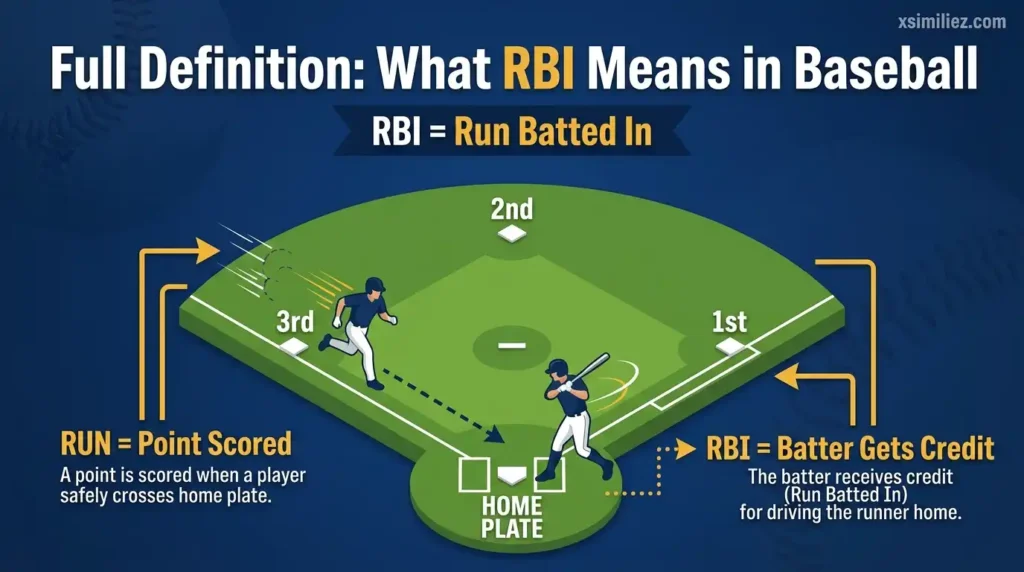
Let’s break the three words apart. A “run” is one point in baseball. A player scores a run when he touches all four bases and crosses home plate. “Batted in” means the batter’s swing, walk, or smart bunt helped make that run happen. Put them together, and an RBI is credit given to the batter for a run he helped bring home.
You will hear fans say the plural in two ways. Some say “RBIs,” and others say “RBI” for both one and many. Both are fine. Announcers also love the nickname “ribbies,” as in, “He drove in three ribbies tonight.” You may also hear phrases like “he knocked in two” or “he drove in the winning run.” They all mean the same thing.
One important detail: the official scorer makes the final call. This person works at every professional game and follows a rulebook. Most plays are easy to score. A few tricky ones, like errors, take some judgment. We will cover those soon.
The stat is written in box scores as RBI, and you will see it right next to hits and runs. A hitter’s line might read, “3 for 5, 1 home run, 4 RBI.” That tells you he got three hits in five tries and pushed four runs across the plate.
How a Batter Earns an RBI
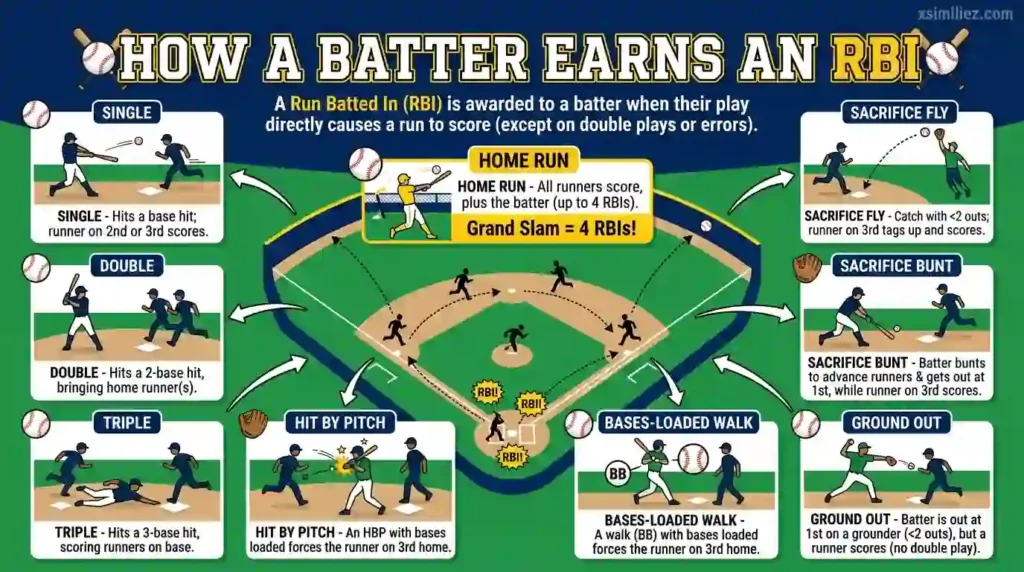
There are several ways to earn an RBI, and not all of them involve a big hit. The rule of thumb is this: if the batter’s action causes a run to score, he usually gets credit. The table below shows the most common ways.
| Type of Play | Does the Batter Get an RBI? | Simple Explanation |
| Single, double, or triple | Yes | A runner scores because of the hit |
| Home run | Yes | Credit for every runner plus the batter |
| Sacrifice fly | Yes | A fly ball is caught, and a runner scores after the catch |
| Sacrifice bunt or squeeze play | Yes | A bunt moves the runner home |
| Ground out (fewer than two outs) | Yes | The batter is out, but a runner scores |
| Fielder’s choice | Yes | The defense picks another out, but a run still scores |
| Walk with bases loaded | Yes | Everyone is forced to move, so one run scores |
| Hit by pitch with bases loaded | Yes | The same forced move as a walk |
The home run deserves a closer look. If a batter hits a solo home run, he gets one RBI. With a runner on first, it is two RBIs. With the bases loaded, it is a grand slam, and the batter earns four RBIs. That is the most a hitter can get in a single at-bat.
The sacrifice fly surprises many new fans. The batter hits a ball high in the air, and an outfielder catches it. That is an out, yet a runner on third tags up and scores. The batter does not get a hit, but he still gets an RBI. It is a small way to help the team, and coaches love it.
The bases-loaded walk is another odd one. The batter never swings, yet he gets an RBI. The reason is that the runners are forced to move, so the run is a direct result of his plate appearance.
When a Batter Does Not Get an RBI
Just as important is knowing when no RBI is given. Some plays look like the batter helped, but the rules say otherwise. Here is a quick look at the most common cases.
| Type of Play | RBI? | Why Not |
| Ground into a double play | No | The rules do not credit an RBI on a double play ground ball |
| Wild pitch or passed ball | No | The pitcher or catcher caused the run, not the batter |
| Balk | No | The pitcher made an illegal move |
| Stolen base home | No | The runner did it alone |
| Run scores on a defensive error | Usually no | The scorer decides if the run would have scored anyway |
The double play rule is the one people forget most. Imagine a runner on third and one out. The batter hits a ground ball, and the defense turns two outs. Even if the runner crosses home plate, the batter does not get an RBI. The rulebook simply does not credit it on that kind of double play.
Errors are the trickiest. If a fielder makes a mistake and a run scores because of it, the batter normally gets no RBI. There is one exception. If there are fewer than two outs, and the scorer believes the run would have scored anyway, the batter can still get credit. That is why you may see two fans argue about one play. The scorer’s judgment settles it.
Real-Life Examples of RBI Plays
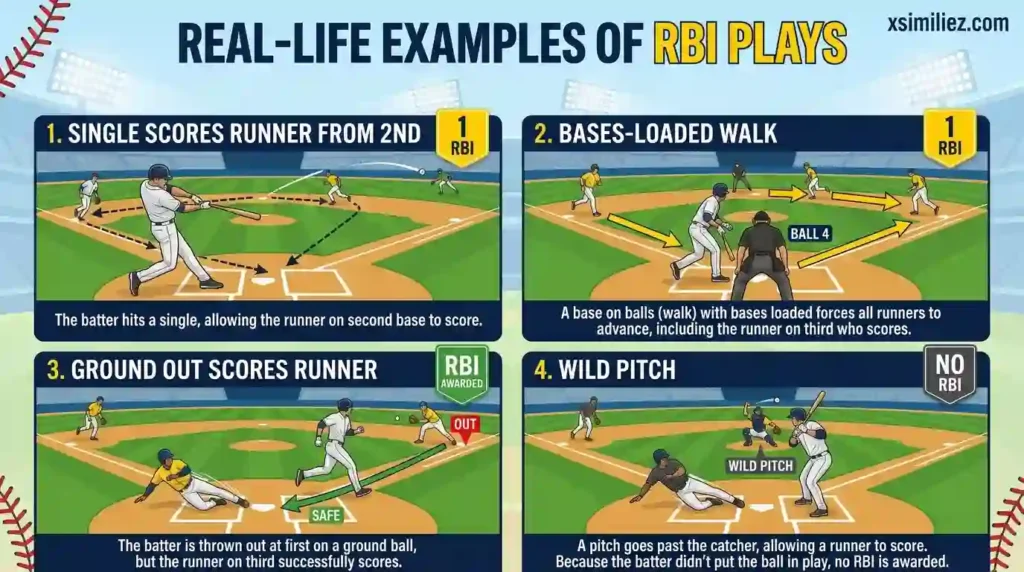
Examples make the rules much easier to remember. Here are a few simple game situations, and what the scorer would do in each.
Say it is the fifth inning. A runner is on second, and your favorite player lines a single into right field. The runner races home. That is one RBI for your player. Easy.
Now picture the bases loaded with two outs in the ninth inning. The pitcher cannot find the plate and throws four balls. The runner on third trots home, and the game is tied. The batter gets an RBI without ever swinging the bat. Fans may call it boring, but the stat is real.
Here is a different one. A runner is on third with one out. The batter taps a slow ground ball to the shortstop, who throws him out at first. Meanwhile, the runner scores. The batter gets an RBI, even though he made an out. Managers often ask hitters to do exactly this.
Finally, picture a runner on third who scores on a wild pitch while the batter is up. No RBI is given. The batter did nothing to cause the run, so he gets no credit.
These quick stories show the main idea. The question the scorer asks is, “Did the batter’s action cause this run?” If the answer is yes, and no special rule blocks it, the batter earns an RBI.
Origin and History of the RBI Stat
Baseball fans have counted runs driven in for well over a century. Early scorekeepers and newspaper writers tracked the number on their own, but it was not a standard statistic at first. Major League Baseball began counting RBIs as an official stat in 1920. Since then, it has become one of the best-known numbers in the sport.
The rules for scoring RBIs have changed a bit over the years, especially around sacrifice flies and errors. Even so, the core idea has stayed the same. Players who drive in runs are valued, and the stat has helped tell their stories for more than a hundred years.
The RBI is also one part of the famous “Triple Crown.” A hitter wins the batting Triple Crown by leading his league in batting average, home runs, and RBIs in the same season. It is rare. Miguel Cabrera did it in 2012 with 139 RBIs, and no one has done it in the major leagues since. If more recent news has changed that, check a trusted source such as MLB.com.
Famous RBI Records Every Fan Should Know
Big numbers make baseball fun. Here are some of the most famous RBI marks. The details come from widely used record books, and small differences can show up across sources for very old seasons.
| Record | Player | Number |
| Most RBIs in a season | Hack Wilson (1930) | 191 |
| Most career RBIs | Hank Aaron | 2,297 |
| Most RBIs in one game | Jim Bottomley (1924) and Mark Whiten (1993) | 12 |
| Most RBIs in one inning | Fernando Tatis (1999) | 8 |
Hack Wilson’s 191 RBIs in 1930 has stood for nearly a century. Many fans think it may never be broken, because modern teams use more pitchers and play differently than they did back then.
Hank Aaron, famous for his home run total, is also the career RBI leader. He drove in runs for more than twenty years, which shows how steady he was.
Fernando Tatis has the most unusual record. In one inning, he hit two grand slams, and he finished with eight RBIs in that one frame. No one else has ever done that in a major league game.
Why RBIs Matter, and Why Some Experts Question Them
RBIs matter because baseball is a game of runs. The team that scores more wins. A player who often drives in runs is helping his team win. That is why coaches, scouts, and fantasy players look at the stat.
Still, the number has limits. A hitter cannot get an RBI if no one is on base. If a player bats behind teammates who get on base often, he will have more chances. A great hitter on a weak team may finish with fewer RBIs than a good hitter on a strong team. In other words, luck and lineup matter.
That is why many analysts also use other stats, such as on-base plus slugging, often called OPS, and a rating called wRC+. These numbers try to measure a hitter’s skill without leaning on teammates. Many modern fans look at RBIs and these newer stats together, which gives a fuller picture.
A good way to think about it is this. RBIs tell you what happened. Other stats help explain how skilled the hitter really is. Both are useful.
Common Mistakes People Make About RBI Meaning in Baseball
New fans often mix up a few things. Clearing them up will make you sound like a pro.
The first mistake is thinking that an RBI is the same as a run. A run is when a player scores. An RBI is credit for the batter who helped him score. If a runner scores from third on a single, the runner gets a run, and the batter gets an RBI. Two different players, two different stats.
The second mistake is thinking a hit is required. As you saw, a walk, a sacrifice fly, or a ground out can all earn an RBI. Hits are only one path.
The third mistake is forgetting the double play rule. If the batter grounds into a double play, no RBI is credited, even if a run scores.
The fourth mistake is thinking a home run always gives one RBI. It gives one for the batter plus one for each runner on base. A three-run homer means three RBIs.
Finally, some people believe that a run scoring on an error always counts. It does not. The scorer must decide If the run would have scored anyway.
Tips for Reading and Using RBI Stats
A few simple habits can help you get more from the number. First, always look at RBIs next to at-bats or games played. A player with 60 RBIs in 80 games is doing something special. A player with 60 RBIs in 160 games is doing something good but less rare.
Second, think about the lineup. Batters in the middle of the order, often called cleanup hitters, usually get the most RBI chances. Leadoff hitters, who bat first, get fewer because the bases are often empty when they come up.
Third, watch for “runners in scoring position,” sometimes shortened to RISP. That means a runner is on second or third base, close enough to score on a single. A hitter who does well in these moments is often called “clutch.”
Fourth, if you play fantasy baseball, use RBIs along with other stats. A balanced view beats a single number every time.
Last, if you are coaching young players, teach the small ways to earn RBIs. A well-placed ground ball or a deep fly ball can win a game just as much as a home run.
FAQs
What does RBI stand for in baseball?
RBI stands for “run batted in.” It counts the runs that score because of a batter’s at-bat, including his own run on a home run.
Can a batter get an RBI without a hit?
Yes. A batter can earn an RBI on a sacrifice fly, a ground out, a bases-loaded walk, or a hit by pitch with the bases loaded. A hit is not required.
How many RBIs can a player get on one swing?
The most is four. That happens on a grand slam, which is a home run with the bases loaded. The batter gets credit for himself and all three runners.
Do pitchers get RBIs?
Yes, if they bat and drive in a run. In some leagues pitchers rarely bat now, so it is less common, but the rule is the same for everyone.
Is an RBI the same as a run scored?
No. A run is credited to the player who crosses home plate. An RBI is credited to the batter who helped him get there. They can be the same person only on a home run.
Who holds the single-season RBI record?
Hack Wilson holds the record with 191 RBIs, set in 1930. It is one of the oldest and most famous records in baseball.
Conclusion
Now you know the RBI meaning in baseball. It stands for “run batted in,” and it gives a batter credit for the runs he helps bring home. Hits, walks, sacrifice flies, and even some ground outs can all earn one. A few plays, like double plays and wild pitches, cannot.
The stat is powerful, but it is not perfect. It depends on teammates, lineup spots, and sometimes luck. That is why the best fans look at RBIs alongside other numbers, like OPS, to see the full picture of a hitter.
The next time you watch a game, listen for the announcer to say the word. Try to guess If a play earns an RBI before the scorer decides. It is a fun way to learn, and soon the box score will feel like a story you can read.

Hi, I’m Harper Blake, and I write for Xsimiliez.com. I enjoy sharing clear and friendly simile examples that students and beginners can understand easily. My goal is to make English learning simple and enjoyable.