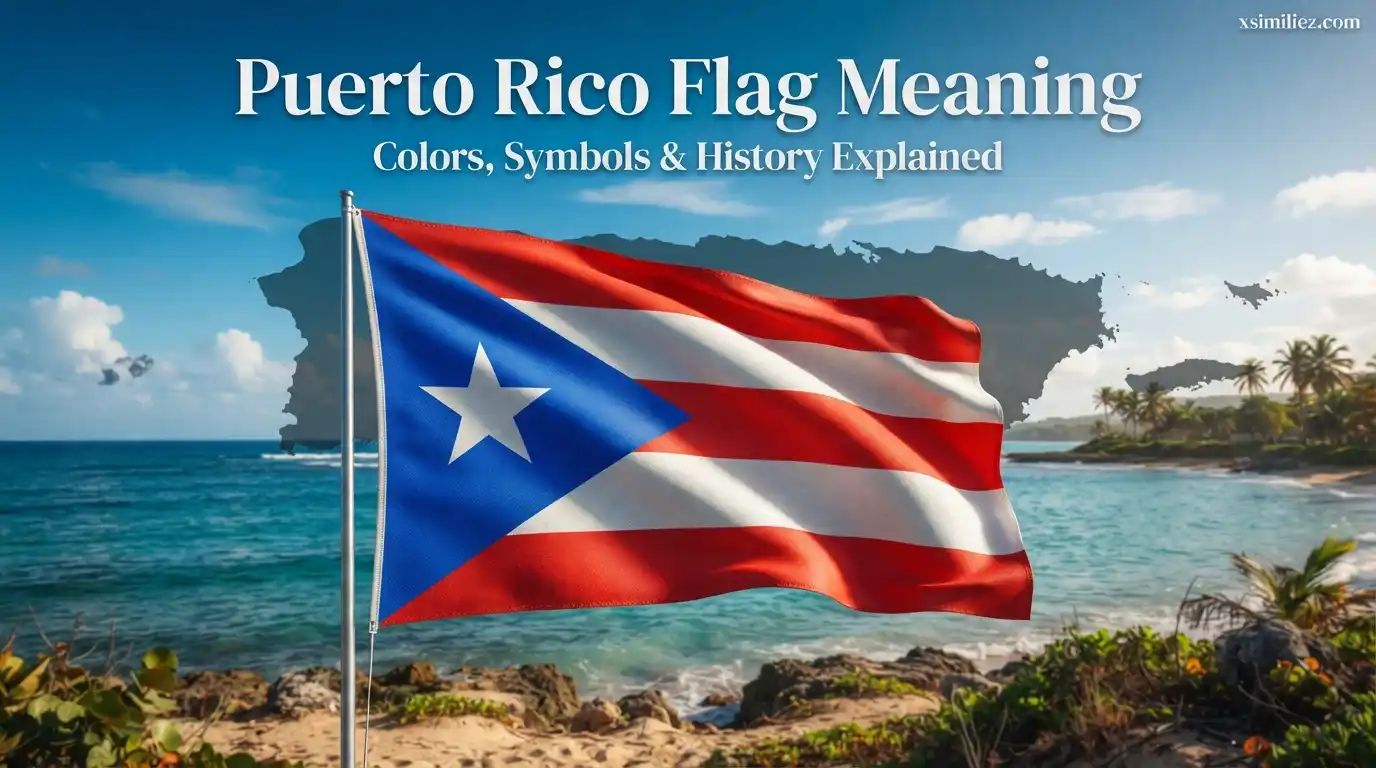
Have you ever looked at the Puerto Rico flag and wondered what its colors and star really mean? You are not alone. Millions of people search for the Puerto Rico flag’s meaning every year, If they are students working on a school project, travelers curious about the island, or Puerto Ricans wanting to learn more about their own history.
The short answer is this: the red stripes stand for the blood shed by people who fought for freedom, the white stripes stand for peace and rights, the blue triangle stands for the sky and coastal waters, and the white star stands for the island of Puerto Rico itself.
But there is a much bigger story behind those simple facts. In this article, you will learn where the flag came from, how its meaning has changed over time, and why it still matters so much to people today. By the end, you will understand this flag better than most people ever will.
Quick Answer: Puerto Rico Flag Meaning
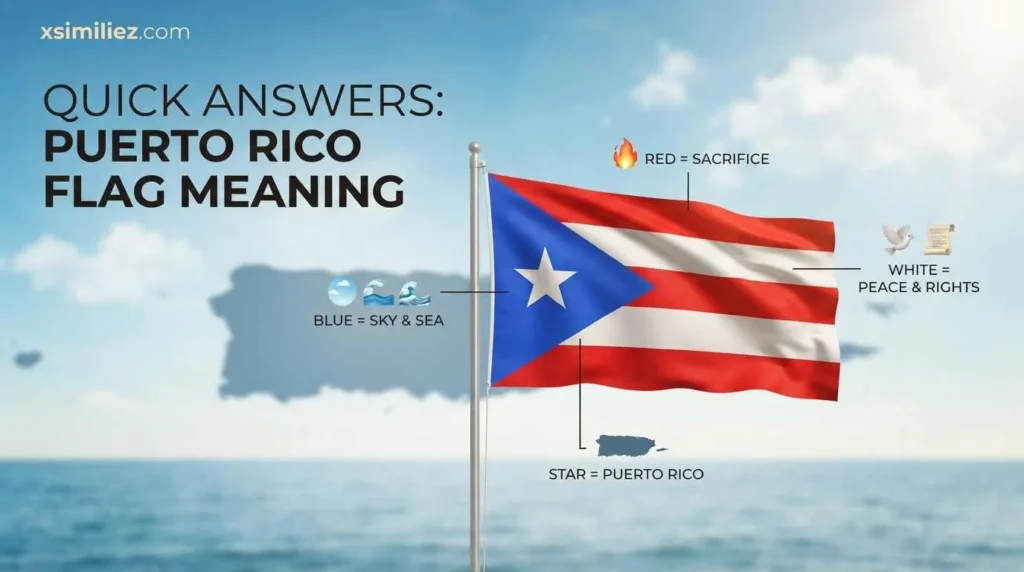
Here is the fast version. The Puerto Rico flag has five stripes, three red and two white, that go across the flag from side to side. A blue triangle sits on the left side, and inside that triangle is one white star with five points.
Each part of the flag has a meaning. The red stripes represent the blood of brave people who fought for freedom. The white stripes represent peace, hope, and personal rights. The blue triangle represents the sky above the island and the ocean around it. The white star stands for Puerto Rico itself, shining alone as one bright island.
That is the quick version. Now let’s dig into the full story, because the flag’s meaning is more interesting than most people realize.
Meaning of Each Color and Symbol
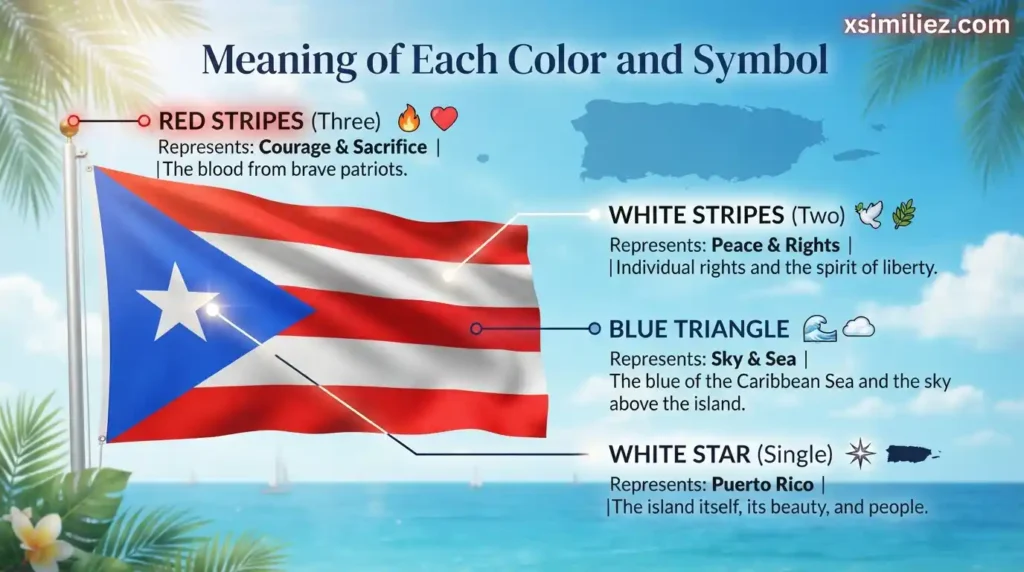
Let’s slow down and look at each piece of the flag one at a time. This helps the whole design make sense.
The Red Stripes. There are three red stripes on the flag, at the top, the middle, and the bottom. Red almost always stands for courage and sacrifice in flags around the world, and Puerto Rico’s flag is no different. The red stripes honor the people who fought and bled during the island’s long struggle for freedom and self-rule.
The White Stripes. Between the red stripes sit two white stripes. White is a color of peace in many cultures, and that idea shows up here too. The white stripes stand for peace, and they also stand for individual rights, the kind of freedom that lets a person speak, think, and live without fear.
The Blue Triangle. On the left side of the flag, closest to the flagpole, there is a blue triangle shape. This triangle points inward toward the stripes. Blue is often linked to water and sky, and on this flag, it represents both the clear sky over Puerto Rico and the blue Caribbean waters that surround it.
The White Star. Right in the center of the blue triangle sits one white star with five points. This single star represents the island of Puerto Rico. Just like Puerto Rico stands alone as one island with one identity, the star stands alone in the middle of the triangle.
Here is a simple table that breaks all of this down at a glance.
| Flag Part | Color | What It Means |
| Three horizontal stripes | Red | Blood and sacrifice for freedom |
| Two horizontal stripes | White | Peace, hope, and personal rights |
| Triangle on the hoist side | Blue | The sky and the surrounding sea |
| Single star in the triangle | White | The island of Puerto Rico itself |
History and Origin of the Puerto Rico Flag
To really understand the puerto rico flag’s meaning, it helps to know where the flag came from. The story starts in the late 1800s, when Puerto Rico was still a colony of Spain.
Around 1895, a group of Puerto Rican exiles living in New York City wanted a flag that could represent their island and their hopes for independence. They were inspired by the flag of Cuba, another island fighting for freedom from Spain at the same time. The Puerto Rican flag ended up looking a lot like the Cuban flag, just with the colors swapped. Where Cuba’s flag had blue stripes and a red triangle, Puerto Rico’s flag had red stripes and a blue triangle.
This early flag became a symbol of hope for people who dreamed of an independent Puerto Rico. It was flown by supporters of the independence movement and carried real emotional weight, even though it was not an official government flag at the time.
Then, in 1898, everything changed. The United States took control of Puerto Rico after the Spanish-American War. For decades afterward, from 1898 until 1952, displaying the Puerto Rican flag was actually against the law. The government worried it might encourage people to push for full independence, so the flag was pushed underground. People who loved the flag kept it alive quietly, at home, in private gatherings, and in their hearts.
Everything shifted again in 1952. On July 25 of that year, Puerto Rico officially became a commonwealth of the United States, known in Spanish as Estado Libre Asociado. As part of this change, the government officially adopted the flag as Puerto Rico’s national symbol. This was a huge moment. A flag once banned for being too rebellious was now flying proudly outside government buildings.
Old Meaning vs. Official Meaning of the Flag
Here is something many people do not know. When the flag became official in 1952, its meaning and even one of its colors were quietly adjusted. This table shows the difference.
| Flag Feature | Original 1890s Meaning | Official 1952 Meaning |
| Blue triangle color | Lighter, sky blue shade | Darkened to match the deep blue of the U.S. flag |
| White stripes | Symbolized the fight for full independence | Symbolized rights, balance, and a republican government |
| Overall flag purpose | A rebel symbol for total independence | A unifying symbol for the new commonwealth |
This change matters because it shows how a flag’s meaning can shift along with a country’s politics. The stripes, star, and triangle stayed in the same place, but what they represented to the government changed to fit Puerto Rico’s new status. Many Puerto Ricans today still connect with both meanings, the original spirit of independence and the modern message of unity.
Common Mistakes People Make About the Flag
A few mix-ups happen often when people talk about the Puerto Rico flag, so let’s clear them up.
One common mistake is confusing the Puerto Rico flag with the Cuban flag. Because the two flags share the same layout and shape, just with the red and blue swapped, people sometimes get them backward. A simple trick to remember: Puerto Rico’s flag has a blue triangle, while Cuba’s flag has a red triangle.
Another mistake is thinking the flag always looked exactly the way it does now. In reality, the shade of blue changed over time, going from a lighter sky blue to the darker navy blue used today.
People also sometimes assume the flag was designed by the current Puerto Rican government. In truth, it was designed by exiles and revolutionaries decades before it ever became official, and it carried a rebellious message long before it carried a governmental one.
Real-Life Examples of the Flag’s Meaning Today
The Puerto Rico flag’s meaning shows up in daily life across the island and among Puerto Rican communities everywhere.
You will see the flag flown at government buildings, schools, and homes across Puerto Rico. It appears at big celebrations like Puerto Rican Day parades in cities such as New York, Chicago, and Orlando, where huge crowds wave it with pride. Athletes representing Puerto Rico in events like the Olympics or the World Baseball Classic often carry the flag or wear it as a symbol of national pride, even though Puerto Rico is a U.S. territory rather than an independent country.
Artists use the flag’s colors and star in murals, clothing, and jewelry to express identity and connection to the island. After hurricanes and other hard times, the flag has also become a symbol of resilience, something people hold onto to show strength and hope for the future.
Tips for Remembering the Flag’s Meaning
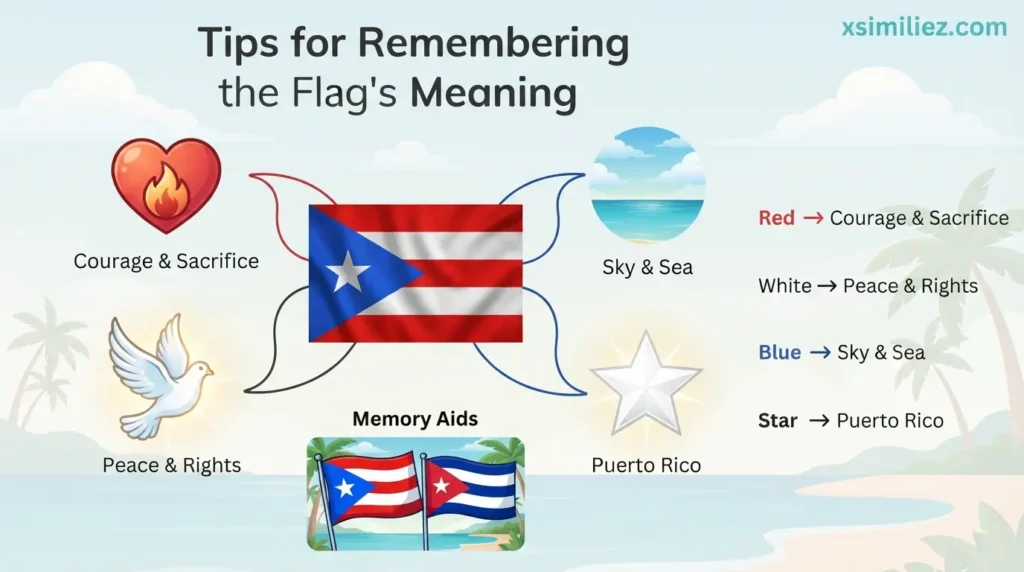
If you want the meaning to really stick in your memory, try these simple tips.
Picture the flag as a short story. The red stripes are the fight, the white stripes are the peace that follows, the blue triangle is the sky and sea surrounding the island, and the star is the island standing alone and proud.
Remember the color-swap trick with Cuba’s flag. Since the two flags are cousins, comparing them side by side can help both meanings stay clear in your mind.
Finally, connect the colors to feelings instead of just facts. Red for courage, white for peace, blue for hope, and one bright star for home. Feelings are often easier to remember than plain definitions.
FAQs
What does the star on the Puerto Rico flag mean?
The single white star represents the island of Puerto Rico itself. It stands alone in the center of the blue triangle, symbolizing the island’s unique identity.
Why are there three red stripes on the flag?
The three red stripes stand for the blood and sacrifice of people who fought for freedom and better rights on the island.
When was the Puerto Rico flag officially adopted?
The flag became official on July 25, 1952, the same day Puerto Rico became a commonwealth of the United States.
Is the Puerto Rico flag similar to another country’s flag?
Yes. It closely resembles the Cuban flag, since Puerto Rican exiles designed it using a similar layout in the 1890s, with the colors reversed.
Why was the Puerto Rico flag once illegal?
After the United States took control of Puerto Rico in 1898, officials banned the flag from 1898 to 1952, fearing it would fuel independence movements.
What do the colors blue and white mean on the flag?
Blue represents the sky and the sea around the island, while white represents peace, hope, and individual rights and freedoms.
Conclusion
The Puerto Rico flag’s meaning tells a story much bigger than five stripes, a triangle, and a star. It carries the memory of people who fought for freedom, the hope for peace, and pride in an island surrounded by bright blue sky and sea. Every part of the design connects to real history, real struggle, and real celebration.
What makes this flag so powerful is how its meaning has grown over time. It began as a rebel symbol, was banned for decades, and eventually became an official emblem of unity and identity. That journey mirrors the resilience of the Puerto Rican people themselves.
Next time you see this flag, If at a parade, on a t-shirt, or flying outside a building, take a second look. You now know the real story behind those colors, and that makes the flag mean even more.

Hi, I’m Harper Blake, and I write for Xsimiliez.com. I enjoy sharing clear and friendly simile examples that students and beginners can understand easily. My goal is to make English learning simple and enjoyable.