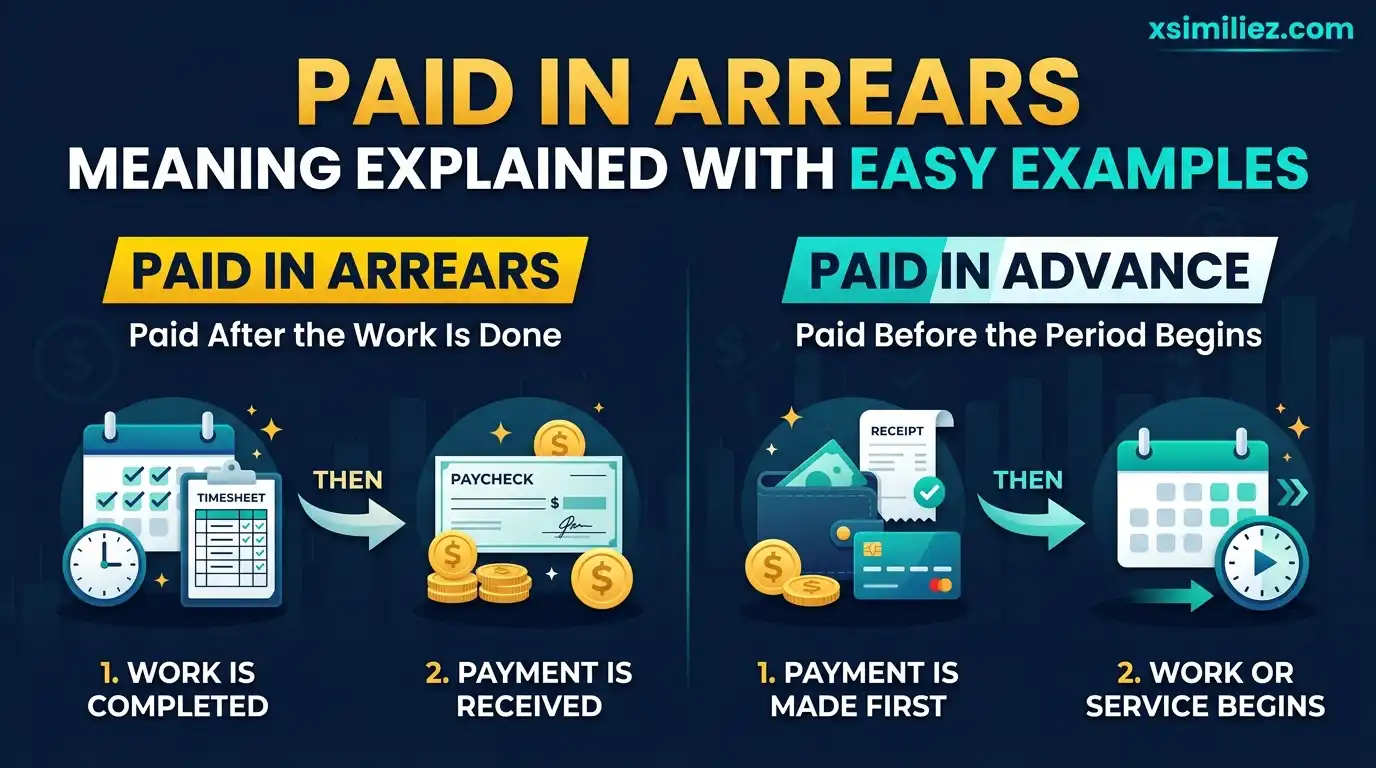
The paid in arrears meaning is simple: you get paid after the work is done, not before. The money comes at the end of a pay period, or a little later. Many jobs, loans, and rent deals work this way, and the phrase shows up in pay stubs, contracts, and bank papers.
Maybe you saw this phrase on a job offer or a lease. Maybe you wondered why your first paycheck took so long to arrive. That is a common worry, and it is why so many people search for this term.
In this guide, you will learn what it means, how it works, where it is used, and how to avoid mix-ups. We will keep it plain and clear.
Paid in Arrears Meaning: Quick Answer
“Paid in arrears” means payment comes after the work, service, or time period is finished. You do the job first. The money follows later.
Here is a quick picture. Say you work from the 1st to the 15th of the month. If you are paid in arrears, your check for those days arrives after the 15th, maybe on the 22nd. You did not get paid at the start. You got paid at the end, or just after it.
The opposite is “paid in advance.” That means the money comes before the work or the time period starts. Rent is a good example. Many renters pay on the 1st for the month ahead. That is paying in advance. A worker who gets a paycheck a week after the pay period closes is being paid in arrears.
That is the heart of it. If the money follows the work, it is paid in arrears.
Paid in Arrears Meaning and Definition
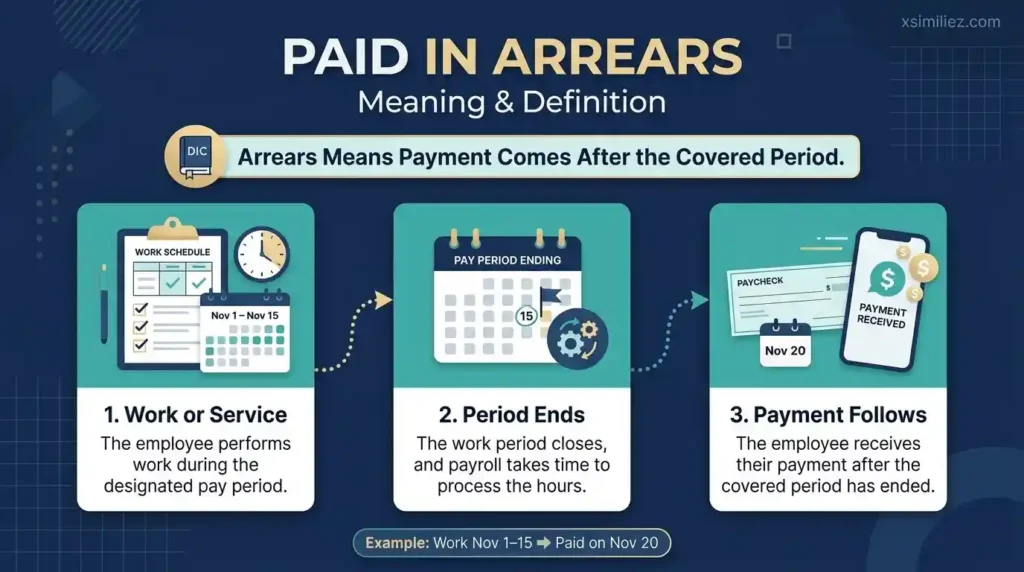
Let us look closer at the paid in arrears meaning. The word “arrears” points to something that is behind. When pay is “in arrears,” the payment trails behind the time or work it covers.
There are three parts to the idea. First, there is a period of time or a task, like two weeks of work or one month of loan interest. Second, that period ends. Third, the payment is made after the end.
The phrase is neutral. It is not good or bad. It is just a way to say when money moves. A company can pay its workers in arrears and still be fair and legal. A bank can charge interest in arrears and still follow every rule.
You may also see “payment in arrears” or “arrears payment.” These all lean on the same idea. The pay comes late in the cycle, after the thing it pays for has been done or used.
One more point helps here. “Paid in arrears” is about timing, not about size. It does not tell you how much money you will get. It only tells you when the money arrives compared with the work.
How Paid in Arrears Works in Payroll
Payroll is the place most people meet this phrase. Many US employers pay workers in arrears. It is very common, and it is usually legal when the employer follows state and federal rules.
Here is how it often goes. A company has a pay period, like the 1st through the 14th. The pay period ends. Then the payroll team needs time to add up hours, check for errors, take out taxes, and send the money. That work takes a few days. So payday lands a few days or a week after the period ends.
This gap is why your first paycheck at a new job can feel slow. If you start on the 1st and the company pays in arrears, you may wait three weeks or more to see money in your bank. Nothing is wrong. It is just the way the pay cycle is built.
The table below shows a simple example for a worker paid every two weeks.
| Pay Period | Days Worked | Pay Period Ends | Payday (In Arrears) |
| Period 1 | Oct. 1 to Oct. 14 | Oct. 14 | Oct. 21 |
| Period 2 | Oct. 15 to Oct. 28 | Oct. 28 | Nov. 4 |
| Period 3 | Oct. 29 to Nov. 11 | Nov. 11 | Nov. 18 |
See the pattern? Each check pays for work that ended a week earlier. That one-week gap is the “arrears.”
Hourly workers feel this most. If you are paid by the hour, the company has to count every hour first. Salaried workers can see it too, because the check still covers a period that has already passed.
One helpful tip: ask HR how long the gap is. Some firms have a lag of just a few days. Others have one or two weeks. Knowing this helps you plan your bills.
Paid in Arrears vs. Paid in Advance
To really understand the paid in arrears meaning, it helps to see its opposite. Paying in advance means you pay before you get the thing. Paying in arrears means you pay after.
The table below puts them side by side.
| Feature | Paid in Arrears | Paid in Advance |
| When money moves | After the work or time period | Before the work or time period |
| Who takes the early risk | The worker or seller | The buyer or payer |
| Common example | A paycheck for last week’s hours | Rent due on the 1st for the month ahead |
| Cash flow effect | Money arrives later | Money leaves earlier |
| Also called | Paid after, back pay cycle | Prepaid, paid up front |
Neither way is always better. It depends on who you are in the deal.
If you are the worker, being paid in arrears means you carry a little risk. You have already done the work, and you trust the other side to pay. If you are the boss or the buyer, paying in arrears gives you time. You see the finished work first, then you pay.
Many deals mix the two. A gym may charge you in advance, while your paycheck from your job comes in arrears. Life is full of both.
Where You See Paid in Arrears
Payroll is only the start. This idea shows up in many parts of money life. Once you know it, you will spot it all over.
The table below lists common places and how the term works in each.
| Area | How Paid in Arrears Works | Simple Example |
| Payroll | Pay comes after the pay period ends | Hours worked Oct. 1 to 14 are paid on Oct. 21 |
| Rent | Rent is due at the end of the month used | A tenant pays on Oct. 31 for October |
| Loans and mortgages | Interest is paid after it builds up | A payment on Nov. 1 covers October’s interest |
| Bonds | Interest is paid at the end of each period | A bond pays its coupon every six months |
| Freelance work | The client pays after the job is done | A designer sends an invoice after delivery |
| Utilities | You pay for what you already used | A power bill arrives after the month ends |
Let us walk through a few of these.
With a mortgage, many lenders count interest in arrears. When you make your payment on the 1st of November, it covers the interest that built up during October. You were living in the house all month, and you paid after. This is why the details of your first payment can feel confusing at closing. Your loan papers and lender can show you the exact dates.
With rent, most leases ask for pay in advance. Some leases, though, ask for rent at the end of the month. That is rent paid in arrears. Always read your lease to see which one you have.
Utilities are a very common case. You use power and water first, and the bill comes later. Almost everyone pays these in arrears without ever thinking about it.
Grammar and Correct Usage
The phrase is easy to use once you see the pattern. Here are the main ways people write it.
As a verb phrase, you say “paid in arrears.” For example: “Our staff is paid in arrears.” Or: “Interest is paid in arrears on this loan.”
As a noun phrase, you can say “payment in arrears.” For example: “The contract calls for payment in arrears.”
You can also use it as a describing phrase before a noun, with a hyphen: “an in-areas payment plan.” This use is less common, but it is right.
Notice the word “arrears” is almost always plural. People say “in arrears,” not “in arrear.” It is one of those words that keeps its “s.” Dictionaries show it this way, and so does everyday writing.
Here are a few clear sentences you can copy as a model:
- “We pay all hourly workers in arrears every other Friday.”
- “Rent is paid in arrears, due on the last day of each month.”
- “The bond pays interest in arrears.”
The word “in” matters. Say “paid in arrears,” not “paid at arrears” or “paid on arrears.” The set phrase is “in arrears.”
Origin of the Word Arrears
The history is worth a quick look, because it helps the meaning stick. The word “arrears” comes from an old French word that meant “behind.” That word grew from Latin roots that meant “toward the back.” Dictionary experts trace it this way, and it fits the idea well.
Think about it. If a payment is “behind,” it trails the work. It comes after. That picture matches the way we use the phrase today.
Over time, the word came to be used for money matters. People talked about debts that were behind, and later about pay that came behind the time it covered. The core idea of “behind” never left.
We do not have a clear record of exactly when the exact phrase “paid in arrears” first became common in business. So it is best not to guess on that part. What we can say is that the word has long been tied to money that comes after, or late.
Common Mistakes With Paid in Arrears
This phrase causes a few mix-ups. Here are the biggest ones, and how to avoid them.
Mixing it up with being behind on bills. This is the number one mistake. “Paid in arrears” is a normal timing method. But “in arrears” can also describe someone who is late on a payment. For example, “The tenant is two months in arrears” means the tenant owes overdue rent. That is a different use. Context tells you which one it is. If the phrase says “paid in arrears,” it is almost always about timing. If it says “is in arrears” or “fell into arrears,” it often means a debt is overdue.
Thinking it means you are being cheated. Getting paid after the pay period ends is not a trick. It is how many payrolls work. Still, your employer must follow the law on when and how often you are paid. Rules differ by state, so check with your state labor department if something feels off.
Mixing it up with “back pay.” Back pay is money an employer owes you for past work that was not paid correctly. Paid in arrears is the regular schedule. They are not the same thing.
Forgetting about the gap when you start a job. Many new workers do not plan for the first paycheck delay. They expect pay right after week one. Then rent is due, and money is tight. Plan ahead and ask about the pay schedule on day one.
Assuming every contract works this way. Some deals use advance pay. Some use a mix. Always read the words in your own agreement, not just what a friend told you.
Real-Life Examples of Paid in Arrears
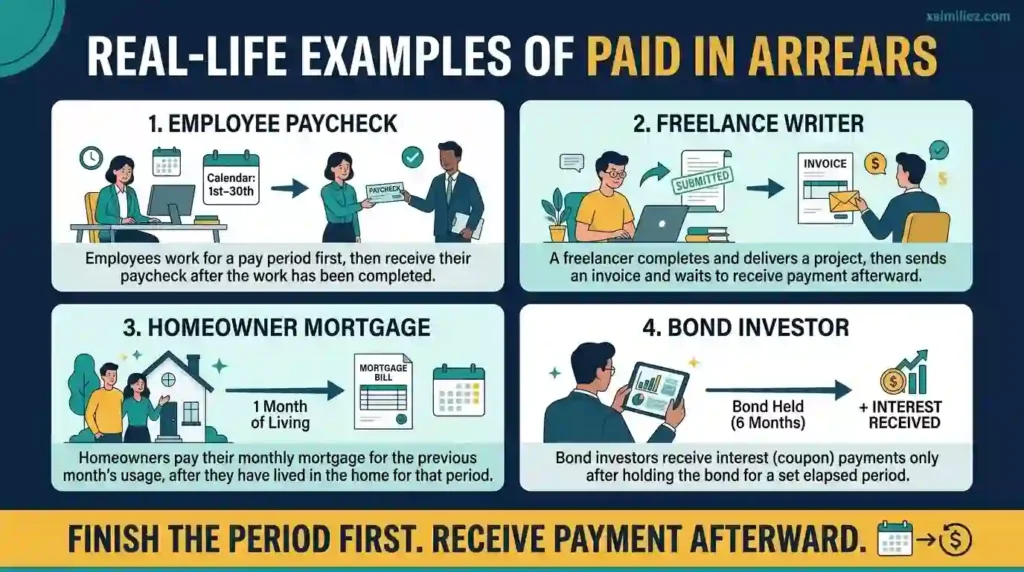
Examples make ideas easier to hold. Here are a few everyday stories.
A new cashier. Maria starts a job on the first of the month. The company pays every two weeks, one week after the period ends. Her first check arrives on the 22nd. She is surprised at first. Then she learns the company pays in arrears, and she plans her bills better.
A freelance writer. Dev writes blog posts for a small business. His contract says the client pays within 30 days after he delivers the work. That is payment in arrears. He sends the invoice, and he waits. To stay safe, he asks for a small deposit on bigger jobs.
A home loan. Jordan buys a house. Her lender says the loan payment is made in arrears. So when she pays on December 1, part of that money covers the interest from November. She lived in the house in November, and she paid after.
A small landlord. Sam rents out a room. His tenant pays at the end of each month. Sam gets rent in arrears. He has to cover costs like taxes and repairs before the money arrives, so he keeps a small cash cushion.
A bond investor. Lee owns a bond that pays interest twice a year. The interest is paid at the end of each six-month period. That is interest paid in arrears. He knows exactly when the money will land.
Each story has the same shape. A period passes. Work is done or a service is used. Then the money comes.
Current Usage and Trends
How common is paying in arrears today? Very. It remains the standard way for many payroll systems in the United States. Many firms use a short lag, because payroll takes time.
But things are shifting. Some companies now offer faster pay options. A worker may be able to take part of their earned pay before payday through certain apps or employer programs. Some of these programs charge fees, so it pays to read the terms. We do not have one clear national number for how many workers use them, so it is best not to quote a figure.
In the gig world, many apps pay workers weekly, or even daily, for jobs already done. That is still pay after the work, so in a loose sense it is still in arrears. It is just a much shorter gap.
In the business world, “arrears” billing is common in services. A firm may bill a client at the end of each month for work done that month. This is often called billing in arrears. It keeps things fair because the client pays only for work that is finished.
So while the tools change, the basic idea stays the same. Pay follows work.
Tips and Best Practices
If you are a worker, a renter, a boss, or a borrower, a few habits help you handle paid in arrears with ease.
First, ask about the pay schedule early. If you start a new job, ask when the first check comes. Get the exact date if you can.
Second, build a small cushion. Because money arrives after work, it helps to keep a little savings for bills in the gap. Even a few days of expenses can calm your nerves.
Third, read your contract. The words “in arrears” or “in advance” should be clear. If they are not, ask questions before you sign.
Fourth, keep records. Save pay stubs, invoices, and loan papers. If a payment is late or wrong, records help you prove it.
Fifth, if you run a business, be clear with your team. Tell workers the pay dates in writing. Clear words prevent stress and build trust.
Sixth, know the difference between “paid in arrears” and “in arrears.” One is a timing method. The other can mean you owe overdue money. Do not let the two ideas blur together.
Last, check your local rules. In the United States, pay laws can differ by state. The U.S. Department of Labor and your state labor office are good places to learn what your employer must do.
FAQs
What does paid in arrears mean in simple words?
It means you are paid after the work or time period ends. The work comes first. The money comes later.
Is being paid in arrears legal?
Yes, in most cases. Many employers pay in arrears. They still have to follow wage laws on pay dates and how often you are paid. Rules vary by state, so check with your state labor department.
What is the difference between paid in arrears and paid in advance?
Paid in arrears means payment comes after the work. Paid in advance means payment comes before. Rent due at the start of the month is paid in advance. A paycheck for last week’s hours is paid in arrears.
Does paying in arrears mean I am behind on a payment?
No. “Paid in arrears” is a normal timing method. But the short phrase “in arrears” can also mean someone is late on a bill. Read the full sentence to see which meaning is used.
Why do employers pay in arrears?
Payroll takes time. Hours must be counted, checks must be reviewed, and taxes must be taken out. Paying after the period ends gives the company time to do this right.
Are mortgages paid in arrears?
Often, yes. A mortgage payment commonly covers the interest from the month that just ended. Check your loan papers or ask your lender to see how your own loan works.
Conclusion
Now you know the meaning of “paid in arrears“. It means payment comes after the work, service, or time period is done. It is the opposite of paying in advance. You see it in paychecks, mortgages, bonds, utility bills, and freelance deals.
The key is to watch the timing. Paid in arrears is not a trick, and it does not mean you are in debt. It is just a way of saying when money moves. The only time to be careful is when you see “in arrears” used to describe an overdue bill. Then the meaning changes.
Here is the best practical advice. Before you sign a job offer, a lease, or a loan, find out when the money moves. Ask for dates. Keep a small cushion for the gap. With a little planning, paying in arrears will never catch you off guard.

Hi, I’m Harper Blake, and I write for Xsimiliez.com. I enjoy sharing clear and friendly simile examples that students and beginners can understand easily. My goal is to make English learning simple and enjoyable.