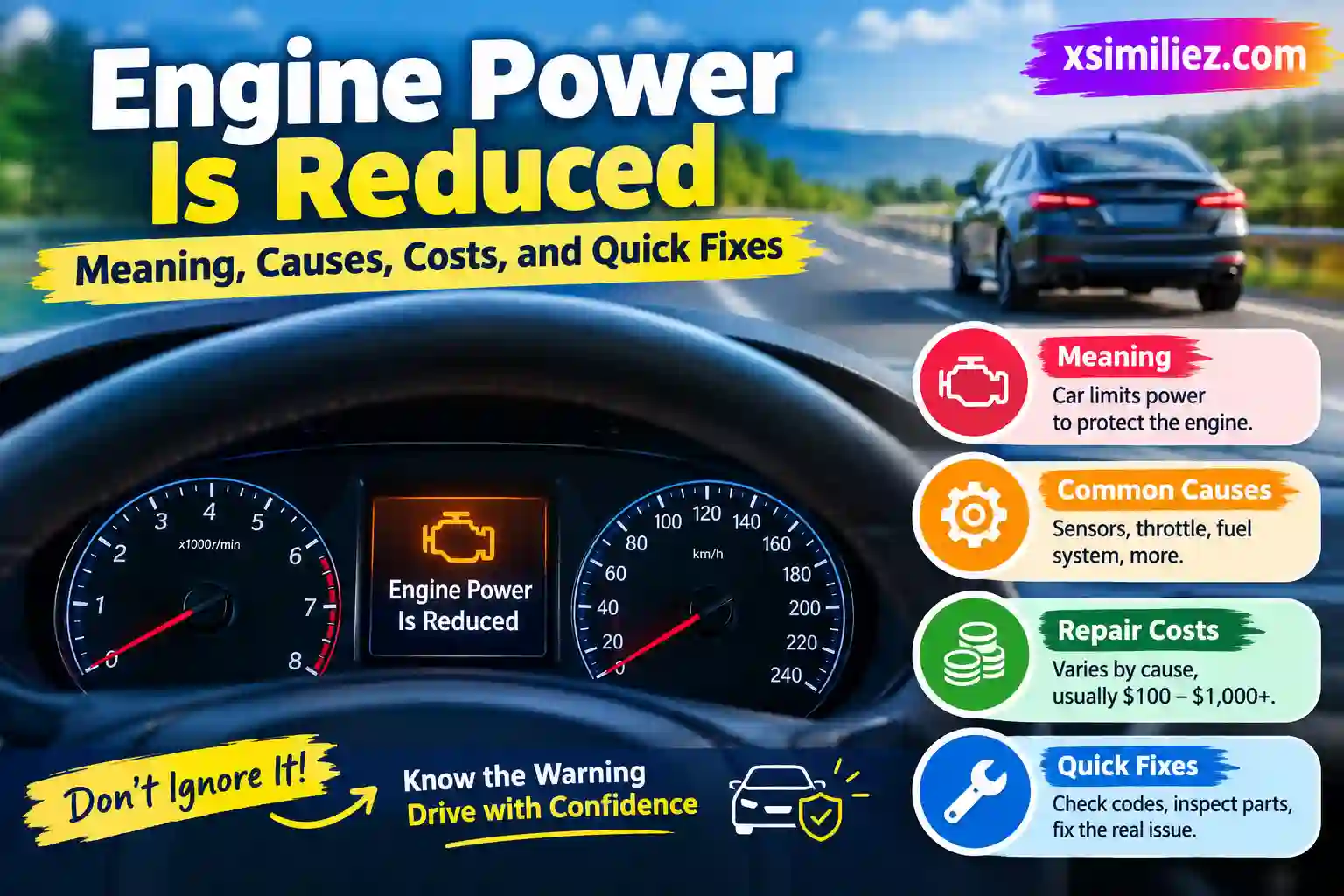
Engine power is reduced meaning: your car’s computer found a problem and cut the engine’s power to protect it. The car may feel slow and weak. This is a warning, not a full breakdown. Still, you should never ignore it.
Picture this. You are driving along, and a message pops up on your dash. The car will not speed up like before. It can feel scary, especially on a busy road. No wonder so many drivers search for answers right away.
In this guide, you will learn what the message means, why it shows up, and If it is safe to drive. You will also see common causes, repair costs, and simple steps to take next.
Quick Answer: Engine Power Is Reduced Meaning in Plain Words
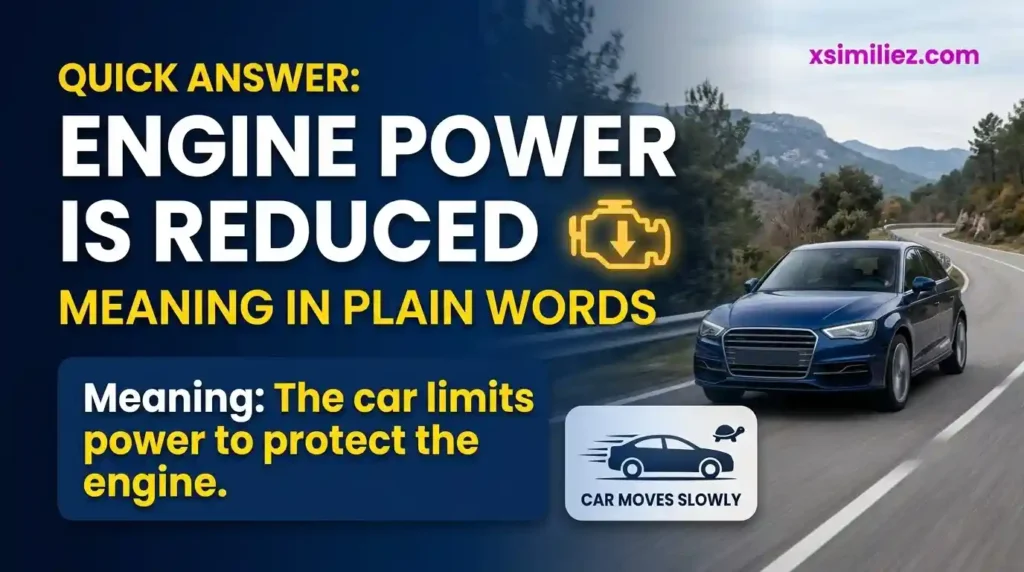
When you see “engine power is reduced,” the car has switched into a safety mode. Mechanics often call it limp mode or reduced power mode. The engine computer, called the ECM or PCM, spotted a fault in a sensor, the throttle, the fuel system, or the air system. To avoid damage, it limits how much power the engine can make.
In short, the car is saying, “Something is wrong, so I am going to protect myself.” You can usually still drive slowly to a safe place. But the problem needs checking soon.
Engine Power Is Reduced Meaning and How Your Car Thinks
To understand this message, it helps to know how a modern engine works. Today’s cars are run by computers. Dozens of sensors send data to the engine computer many times each second. The sensors watch things like how far you press the gas pedal, how much air flows into the engine, how hot the engine is, and how much fuel is being used.
The computer then makes small choices all day long. It decides how wide to open the throttle, how much fuel to spray, and when to fire the spark plugs. When all the sensors agree, the engine runs smoothly.
Trouble starts when the data does not make sense. Maybe the gas pedal sensor says you are pressing hard, but the throttle sensor says the throttle is barely open. The computer cannot tell which one is right. Rather than guess and risk harming the engine or the transmission, it plays it safe. It limits power, slows the car down, and turns on a warning.
So the meaning of “engine power is reduced” is simple. The car has found a fault, and it is limiting performance on purpose. Think of it like a runner who feels a sharp pain in the leg and starts to walk instead of sprint. The body is not broken. It is just being careful.
The message may appear alone, or it may come with other lights. Many cars show a check engine light too. Some show a wrench, a lightning bolt, or a car icon with an exclamation mark. Each brand picks its own symbol, but the idea is the same.
What Reduced Engine Power Mode Feels Like
Every car acts a little differently, yet most drivers notice the same signs. The biggest sign is weak acceleration. You press the gas, and the car barely responds. It may feel like you are driving up a hill even on flat ground.
Many cars also limit top speed. Some will not go faster than 30 to 45 miles per hour. Others cut engine revs so the car cannot climb past a set number. You may feel the engine stumble, shake, or run rough as well.
Here are other things drivers often report:
The transmission may stay in one gear, such as second or third. Shifts may feel harsh or delayed. The air conditioner may turn off. Cruise control may stop working. The car may idle roughly at stoplights, or it may even stall.
In some cases, the message shows up for only a few seconds and then goes away. Do not take that as good news. A fault that comes and goes is still a fault. It often returns, and it may return at a bad moment.
Common Causes Behind the Message
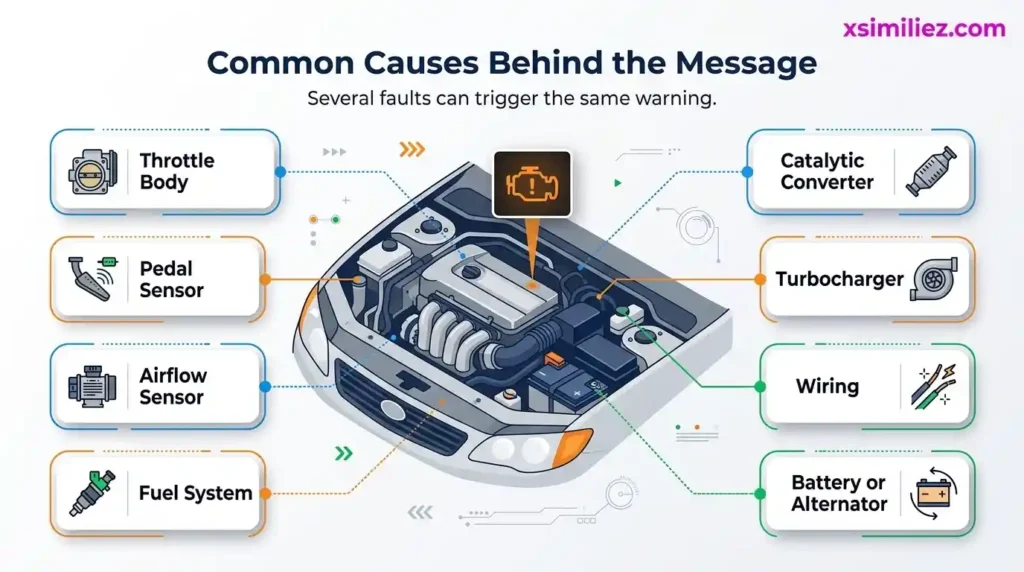
There is no single cause. The warning is a general alert, and many parts can trigger it. The table below lists the most common ones in simple terms.
| Possible cause | What it does | Other signs you may notice |
| Faulty throttle body | Controls how much air enters the engine | Rough idle, slow response, stalling |
| Bad accelerator pedal sensor | Tells the computer how hard you press the gas | Pedal feels dead, car will not rev |
| Dirty or failing mass airflow sensor | Measures air entering the engine | Poor mileage, hesitation, jerking |
| Clogged catalytic converter | Blocks exhaust from leaving the engine | Rotten egg smell, low power, heat |
| Weak fuel pump or clogged fuel filter | Limits fuel reaching the engine | Sputtering, hard starts, loss of power |
| Turbocharger problems | Fails to give the boost the engine needs | Whistling noise, smoke, low power |
| Damaged wiring or loose connectors | Breaks the signal between sensors and computer | On and off warnings, odd behavior |
| Weak battery or alternator | Gives the computer low or unstable voltage | Dim lights, slow starts, other warnings |
| Transmission faults | Sends bad data to the engine computer | Hard shifts, slipping, stuck gears |
| Failing engine computer | Cannot read or process data correctly | Many random warnings (this is rare) |
Of all these causes, throttle problems are among the most common. Many modern cars use an electronic throttle instead of a cable. If the throttle body gets dirty with carbon, or if its motor wears out, the car may drop into reduced power mode fast.
Another frequent cause is a sensor that is simply dirty or worn. A small piece of dirt on an airflow sensor can send wrong numbers to the computer. That alone can set off the warning. The good news is that a simple cleaning sometimes fixes the issue, though you should confirm that with a proper scan first.
Which Cars Show This Message
The exact wording changes by brand, but the problem is the same. Chevrolet, GMC, and Buick owners often see “Reduced Engine Power” along with a lightning bolt light. Ford drivers may see a similar message with a wrench icon. Dodge, Chrysler, and Jeep vehicles may show a message and set the check engine light. Many Honda, Toyota, Nissan, and European models also have a limp mode, though the wording may differ.
Messages you may see include “Engine Power Is Reduced,” “Reduced Engine Power,” and “Service Engine Soon.” Some cars only show a light with no words at all. Your owner’s manual will tell you what each symbol means for your exact model, and that is always the most reliable place to look.
Real-Life Examples of Reduced Engine Power
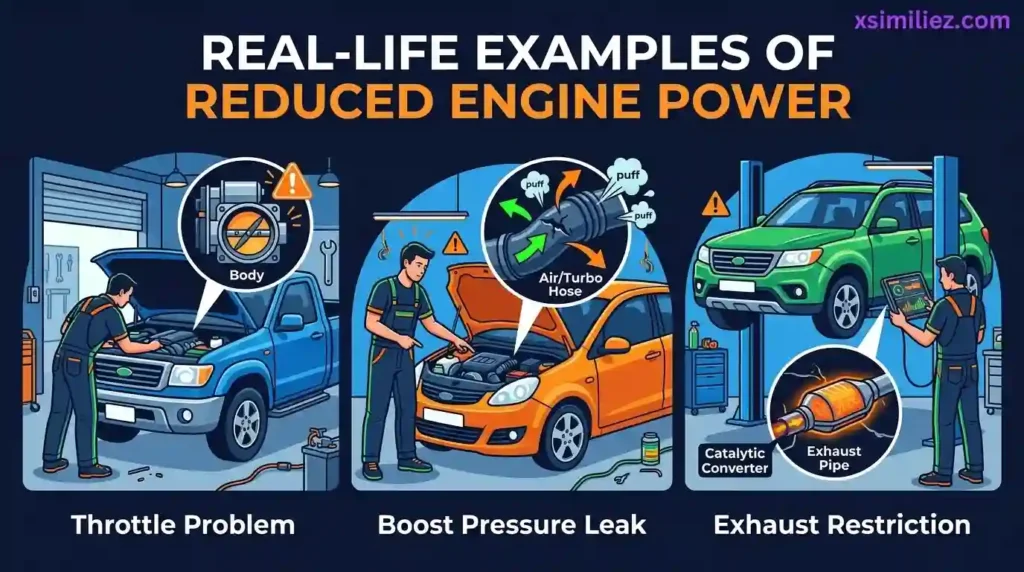
Examples make this easier to picture, so here are three common stories. These are general examples, not reports about one specific driver.
First, imagine a driver in a Chevy pickup merging onto a highway. As the truck speeds up, the message appears and the truck slows down. The cause turns out to be a worn throttle body. After cleaning and then replacing it, the truck runs normally again.
Second, picture a commuter in a small turbo car. The car feels sluggish after a cold morning start, and the message pops up. A scan shows low boost pressure. The real problem is a cracked hose that lets air leak out before it reaches the engine. A new hose fixes it for a small price.
Third, think of an older SUV with a clogged catalytic converter. The driver notices a smell like rotten eggs and weak power on hills. Eventually the reduced power message shows up. The exhaust cannot breathe, so the computer limits power. Replacing the converter solves the issue, though that repair costs more than most others on this list.
The lesson from all three? The same message can come from very different problems. That is why a scan matters more than guessing.
Is It Safe to Drive With Reduced Engine Power?
Short answer: only for a short trip, and only if the car is still driving steadily. The message exists to help you get somewhere safe, not to let you carry on with your normal week.
The biggest danger is not the engine. It is the traffic around you. A car that cannot speed up may be hit from behind on a fast road. If you merge onto a highway and the car loses power, you could be in real trouble.
If the message appears while you drive, stay calm and follow these steps. Turn on your hazard lights. Ease off the gas slowly. Look for a safe place to pull over, like a parking lot or a wide shoulder. Once stopped, put the car in park and turn it off. Wait a minute or two, then restart it. Sometimes the computer resets and the message clears. If it comes right back, drive slowly to a shop or call a tow truck.
You should call for a tow in these cases: the car is stalling, you smell burning or see smoke, the temperature gauge is climbing, the oil pressure light is on, or the car shakes badly. Driving through those problems can turn a small repair into a big one.
Also, do not treat a restart as a cure. Even if the message disappears, the cause is still there. Book a scan this week, not next month.
How to Find the Problem Step by Step
The best way to learn the cause is to read the trouble codes stored in the car’s computer. Here is a simple path most drivers can follow.
Start with the easy checks. Make sure the gas cap is tight. Look at the battery terminals for loose or crusty connections. Check that the engine oil and coolant levels are normal. Look under the hood for cracked hoses, chewed wires, or loose plugs. Rodents sometimes chew wiring, and that can trigger this warning.
Next, scan the codes. Any car built since 1996 in the United States has an OBD-II port, usually under the dashboard near your knees. A basic scanner costs little and plugs right in. Many auto parts stores will also read codes for free. Write down every code, not only the first one.
Then look up what the codes mean. A code points you to a system, not always to a single broken part. For example, a throttle code might mean a bad throttle body, but it could also mean a wiring problem. This is where a trained mechanic earns their pay.
Finally, fix the cause and clear the codes. Clearing codes without a repair only hides the problem. The message will usually return, often at the worst time.
Trouble Codes Often Linked to This Message
No list can cover every car, but certain codes show up again and again. Use the table below as a rough guide, and always check the exact meaning for your own make and model.
| Code | General meaning | Parts that may be involved |
| P2135 | Throttle or pedal sensor signals do not match | Throttle body, pedal sensor, wiring |
| P0121 | Throttle position sensor reading is out of range | Throttle position sensor, throttle body |
| P2111 | Throttle control system stuck open | Throttle body, motor, wiring |
| P2112 | Throttle control system stuck closed | Throttle body, carbon buildup |
| P0101 | Mass airflow sensor reading is out of range | Airflow sensor, air leaks, dirty filter |
| P0299 | Turbo or supercharger is making too little boost | Turbo, hoses, wastegate |
If your scanner shows a code that is not in this table, do not worry. There are thousands of codes. A quick search with your car’s brand and the code will usually explain it.
How Much Does It Cost to Fix Reduced Engine Power?
Costs vary a lot by car, by location, and by shop. The numbers below are rough ranges to give you a general idea, not firm quotes. Always ask for a written estimate before any work begins.
| Repair | Rough cost range (parts and labor) | Difficulty |
| Throttle body cleaning | About $75 to $200 | Easy to moderate |
| Throttle body replacement | About $300 to $900 | Moderate |
| Airflow sensor replacement | About $150 to $400 | Easy to moderate |
| Accelerator pedal sensor | About $150 to $450 | Moderate |
| Fuel pump replacement | About $500 to $1,200 | Hard |
| Catalytic converter replacement | About $1,000 to $2,500 or more | Moderate to hard |
| Turbocharger replacement | About $1,500 to $4,000 or more | Hard |
You can see that the range is wide. A simple cleaning may solve one car’s problem, while another car may need an expensive part. This is the reason to pay for a proper diagnosis first. Replacing parts at random can cost far more than one smart test.
If you drive an older car, ask If a used or remanufactured part makes sense. Also check your warranty. Some emissions parts, such as the catalytic converter, may be covered for a long time under federal rules, so it is worth asking.
Common Mistakes to Avoid When Engine Power Is Reduced
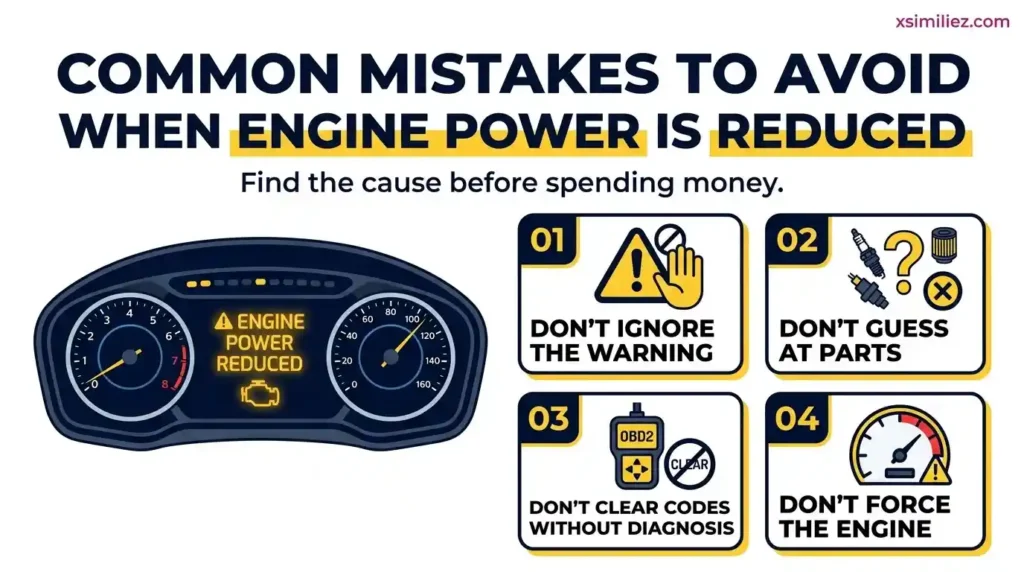
Drivers often make the same errors, and most of them are easy to avoid.
The first mistake is ignoring the message because the car “seems fine” after a restart. A hidden fault can grow and cause more damage.
The second mistake is clearing the code and hoping for the best. That erases useful clues, and it does not fix anything.
The third mistake is guessing and buying parts. Throttle bodies and sensors are not cheap, and the wrong part wastes money and time.
The fourth mistake is pushing the car hard to “get through” the limp mode. Forcing the engine can harm the transmission, the exhaust system, or the engine itself.
Another common error is skipping basic care. Old oil, a dirty air filter, and worn spark plugs can all make sensors and engines act oddly. Finally, some people drive long distances in reduced power mode. The mode is a short-term safety net, not a long-term plan.
Tips to Prevent the Message From Coming Back
You cannot stop every problem, but good habits lower the odds a lot.
Follow the service schedule in your owner’s manual. Change the engine air filter on time so dirt does not reach the airflow sensor. Use good quality fuel and replace the fuel filter when your car calls for it. Have the throttle body cleaned if your mechanic suggests it, especially on higher mileage cars.
Keep your battery healthy. Weak voltage can confuse a car’s computer, so test the battery once a year, especially before winter. Take care of small warning lights quickly, since a minor code today can become a reduced power message tomorrow.
If you live where mice or rats can reach your car, check the wiring now and then. Also, wash the engine bay carefully, because heavy water spray can harm connectors. And whenever a shop does work, ask them to scan for stored codes. A quick scan costs little and may save you from a surprise later.
FAQs
What does it mean when it says engine power is reduced?
It means the car’s computer found a fault and limited engine power to protect the car. The vehicle may feel slow and weak, but you can often still drive it slowly to a safe place.
Can I drive my car when engine power is reduced?
You can drive a short distance at low speed, such as to a nearby shop or home. Avoid highways and long trips. If the car stalls, smokes, or overheats, stop and call a tow truck.
What is the most common cause of reduced engine power?
A faulty throttle body or accelerator pedal sensor is one of the most common causes. Dirty airflow sensors, fuel problems, and exhaust blockages are also common. Only a code scan can tell you the real cause for your car.
Will the message go away by itself?
Sometimes it clears after you turn the car off and restart it. Other times it stays on until the problem is fixed. Even if it goes away, the fault may still be stored in the computer, so get it checked.
Is reduced engine power the same as the check engine light?
They are related but not the same. The check engine light says the computer stored a fault. The reduced power message says the computer found a fault serious enough to limit performance. Often both appear together.
How much does it cost to fix?
It can range from under $100 for a simple cleaning to several thousand dollars for a big part like a turbocharger. A proper diagnosis helps you avoid spending money on the wrong repair.
Conclusion
Now you know the engine power is reduced meaning. It is a safety message from your car’s computer. The car found a problem, and it cut power to protect the engine and keep you safe. It is a warning, not a final verdict on your car.
The causes can be small, like a dirty sensor, or bigger, like a failing catalytic converter or turbo. That is why guessing rarely helps. A quick code scan points you in the right direction and can save you real money.
So here is the practical advice. Pull over safely, restart the car once, and drive slowly only if it behaves. Then get a scan within a few days. Fix the cause, keep up with regular service, and you will likely keep that message off your dash for good.

Hi, I’m Harper Blake, and I write for Xsimiliez.com. I enjoy sharing clear and friendly simile examples that students and beginners can understand easily. My goal is to make English learning simple and enjoyable.