The love you have for a long time depends on who says it and where. In its literal form, it means “I will love you for a long time.” Today, though, most people link it to a famous movie line where it was a sexual offer. Because of that, it is now seen as a crude and offensive joke.
You may have heard it in a meme, a song, a video, or from someone who thought it was funny. Many people search for it because they feel confused. Is it sweet? Is it rude? Should they laugh or speak up?
This guide explains the meaning in plain words. You will learn where the phrase came from, why it hurts many people, how it is used today, and what to say instead. You will also find examples, tables, and clear answers to common questions.
Love You Long Time Meaning: The Quick Answer
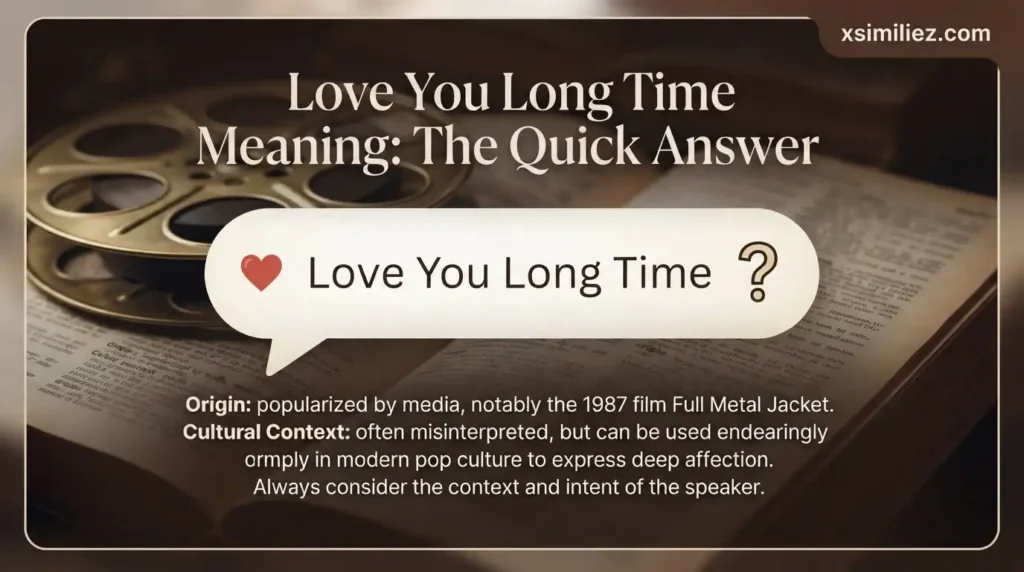
On paper, “love you for a long time” means “I will love you for a long time.” That is the simple, word-for-word meaning. In everyday American English, though, the phrase almost always points to a sexual offer from a famous movie scene. It is usually treated as vulgar and as an insult to Asian women.
That is the short version. The long version has more layers. The same few words can be a sweet promise, an old movie quote, a bad joke, or a way to harass someone. Context makes all the difference.
If you are asking because someone said it to you, you do not have to take it as a compliment. If you are asking because you want to say it, the safest choice is to skip it. We will cover better options later in this article. For now, remember this rule: the phrase is not a normal way to say “I love you.” It carries baggage, and that baggage is not friendly.
What Does “Love You Long Time” Mean Word by Word?
Let’s break the phrase into parts. “Love you” is a plain statement of affection. “Long time” tells us about length. Put together, a reader might guess the speaker is promising lasting love. That would be a fair guess if you had never heard the phrase before.
Now look at the grammar. A full, correct sentence would be “I will love you for a long time.” The famous version drops the subject, drops the helping word “will,” and drops the word “for.” This clipped style is the first clue that the phrase is not meant to sound like normal English. It was written to sound like broken English on purpose. That is a big part of why people find it offensive. It makes fun of how some non-native speakers talk.
The phrase also works as a kind of code. When people say it today, they rarely mean “I will love you for years.” They mean the movie joke. The table below shows the two main meanings side by side.
| Meaning Type | What It Says | Where You Might See It | How It Lands |
| Literal meaning | “I will love you for a long time.” | A very basic reading of the words | Sounds sweet, but it is not how people really use it |
| Pop culture meaning | A crude sexual offer from a film scene | Movies, memes, jokes, old songs | Often offensive and disrespectful |
| Harassing meaning | A line used to mock or bother Asian women | Street harassment, online comments | Hurtful and unacceptable |
As you can see, the sweet meaning is mostly theoretical. In real life, the second and third meanings are the ones people hear.
Grammar and Correct Usage of “Love You Long Time”
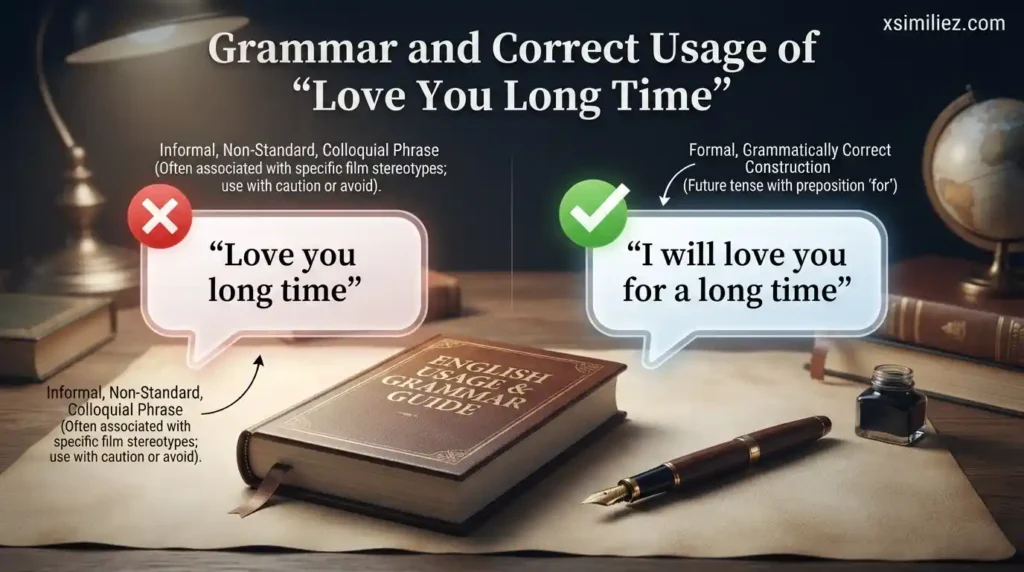
Is the phrase grammatically correct? Not really. Standard English wants a subject and a verb in a full sentence. “Love you long time” has a verb and an object but no subject. It also uses “long time” without the word “for,” which most speakers would add.
Here is how a teacher might fix it.
| Original Phrase | Grammar Problem | Correct Version |
| Love you long time | No subject, no “for” | I will love you for a long time. |
| Me love you long time | Wrong pronoun, no “for” | I will love you for a long time. |
| Love you long time, baby | Missing subject, slang added | I will love you for a long time, baby. |
Notice something important. Even after you fix the grammar, the stereotype does not disappear. Fixing the sentence only matters if you are talking about the plain English meaning. When most people hear the short, broken version, they think of the movie line, not a love promise.
There is a better way to talk about long-lasting love. You can say “I’ll love you forever,” “I’ll always love you,” or “I’m in this for the long haul.” Each of these is clear, warm, and free of old jokes. If you want to write a love letter or a card, these are the safer picks.
In casual speech, people sometimes shorten phrases. That is fine in many cases. “Miss you lots” or “Love you so much” are common examples. The trouble with “love you long time” is not only grammar. It is the history attached to it. A phrase can be short and still be friendly. This one just isn’t.
Origin and History: Where the Phrase Came From
Most people trace the phrase to the 1987 war film Full Metal Jacket, directed by Stanley Kubrick. The movie is set during the Vietnam War. In one scene, a young Vietnamese woman approaches two American soldiers on the street. She is a sex worker, and she says a line that includes “I love you for a long time.” That scene made the words famous around the world.
The film was a big hit, and its lines were repeated by viewers for years. The phrase soon left the movie and entered everyday jokes. Two years later, in 1989, the rap group 2 Live Crew released a song called “Me So Horny” that used a sample of the movie’s dialogue. That helped carry the line into pop music and made it even more common in school yards, parties, and comedy bits.
It is worth being careful here. Some people say that similar broken-English phrases were used around American military bases in Asia long before the movie. That may be true, but reliable records are thin, and I could not confirm a clear earlier source. What we can say with confidence is that the movie scene is the main reason the phrase is known today.
Another point matters. The scene was written by outsiders, not by the Vietnamese people it portrayed. The character speaks in a way that reflects how Western writers imagined her. Many critics have said this is part of the problem. A single movie moment ended up shaping how millions of people think about Asian women.
Why Many People Find the Phrase Offensive
To understand why the phrase hurts, you have to look past the words and at the stereotype behind them. The line paints Asian women as always available, always eager, and not very smart. That is a harmful picture. Real women from many cultures do not fit it. Yet this picture has followed them for decades.
Asian American writers and activists have spoken about this for years. They describe being greeted with the line by strangers on the street, in school, at work, and online. For them, it is not a harmless quote. It is a reminder that some people see them as a joke or a fantasy instead of as individuals.
Here are the main reasons the phrase causes harm.
| Reason | Why It Matters |
| It sexualizes a whole group | It treats Asian women as objects instead of people |
| It mocks accents | The broken English makes fun of non-native speakers |
| It links to real-world harassment | Strangers use it to bother and embarrass people |
| It repeats an old stereotype | The idea of the “non-native” and “easy” woman is very old and unfair |
| It uses a war setting | The scene comes from a war where real women faced real danger |
Some people say, “It’s only a movie line.” Others say, “I meant it as a joke.” But intent and impact are two different things. If a joke makes someone feel unsafe or small, the joke has failed. A good rule is to ask yourself who is laughing and who is not. If the person it targets is not laughing, it is not funny.
It also helps to remember that not every person reacts the same way. Some may brush it off, while others may feel angry. A few may simply be tired of hearing it for the hundredth time. You cannot know which one you are talking to, and you should not gamble.
Love You Long Time Meaning in Pop Culture and Current Usage
Over time, the phrase has shown up in many places: in comedy skits, on social media, in video game chat, and in jokes between friends. Because it is so well known, writers often use it as a shortcut for “this is a crude pickup line.” That shortcut does not always mean the writer approves. Sometimes a show uses the line to show that a character is rude or clueless.
Online, the picture is mixed. Some people repeat the phrase as a meme without thinking. Others call it out. Many younger users have learned about the history and avoid it. At the same time, groups that fight hate and harassment have pointed to such phrases as part of a wider pattern of mistreatment toward Asian communities, especially in the years since 2020.
It is hard to measure exactly how common the phrase is today, and I do not have reliable numbers to share. What we can say is that it still appears in jokes and in harassment, and that people are more willing to push back than they used to be. Schools, workplaces, and online platforms often treat it as inappropriate language.
There is also a quieter use. Sometimes a couple repeats the phrase as a private, playful joke, knowing the movie reference. If both people are comfortable, that is their choice. But even then, it is wise to keep it private. What feels harmless between two friends can feel hurtful when heard by others.
So the trend line looks like this. The phrase is still recognized everywhere. It is less accepted than it once was. And more people now understand why it stings.
Common Mistakes People Make With “Love You Long Time”
Many people get this phrase wrong, and the mistakes are easy to fall into. Here are the most common ones, explained in plain words.
The first mistake is thinking it is a sweet way to say “I love you.” It sounds like a promise of lasting love, so some people use it as a cute line for a partner. The trouble is that most listeners will think of the movie, not of romance. Even if you mean well, your message may not arrive the way you wanted.
The second mistake is believing it is just a harmless old movie quote. Old does not mean harmless. The line has been used to bother real people, and that history does not vanish because time has passed.
The third mistake is using it as a joke around someone of Asian background. This is the one that does the most damage. It can make the person feel singled out and uncomfortable. It can also end a friendship or cause trouble at work or school.
The fourth mistake is using a fake accent along with it. Adding a mocking voice makes the insult worse. It turns a bad phrase into a bad performance.
The fifth mistake is thinking, “If I explain that I was joking, it’s fine.” An explanation after the fact rarely fixes the hurt. A short, honest apology works better than a long excuse.
The last mistake is assuming everyone agrees on how offensive it is. People differ. But when you are not sure, it is smarter to pick the kinder choice. You lose nothing by leaving the phrase out.
Real-Life Examples of the Phrase in Use
Examples make the meaning clearer, so let’s look at a few made-up but realistic cases.
Picture a high school hallway. A student walks past a classmate and says the phrase in a funny voice, while friends laugh. The classmate stares at the floor and walks away. Here, the phrase works as mockery. The student may think it is a joke, but the classmate feels targeted.
Now imagine a movie night. Friends are watching Full Metal Jacketfor a film class. A teacher pauses the scene and explains how the line became a stereotype. A student asks why it hurts. The room talks about it openly. Here, the phrase is a topic of study, not a joke. This is a healthy use because it explains the history instead of repeating the insult.
Think about a social media comment section. A user posts a photo, and a stranger writes the phrase under it. Other users reply, “That’s not okay.” The stranger deletes the comment. This shows how online communities now push back.
Finally, picture a married couple. One partner says it in a private moment as an inside joke. They both know the movie and agree it is silly. Even here, they would likely avoid saying it in public. This case shows that context matters, but it also shows why many people choose to avoid the phrase altogether.
In each example, the same words create very different results. The words themselves are not magic. The people, the setting, and the history decide how they land.
Tips and Best Practices: How to Respond and What to Say Instead
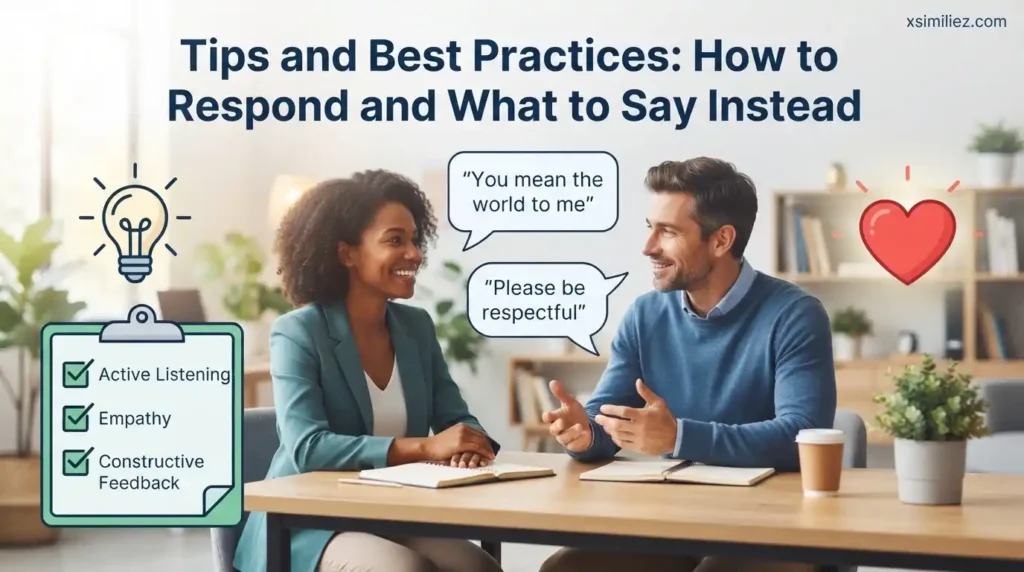
If someone says the phrase to you, you have options.You do not owe anyone a polite laugh. Stay calm and say, “That’s not funny,” or “Please don’t say that to me.” Walking away is also fine. At work or school, a manager, teacher, or another trusted adult can step in. Online, the best move is to report the comment and block the user.
If you hear it said to someone else, speaking up can help. Even a simple “Hey, that’s not cool” shows the target that they are not alone. You do not need a long speech. A short, firm sentence is enough.
Stop and ask yourself why you want to say it. Lasting love is better shown with other words, and plenty of jokes exist that do not hurt anyone. The table below gives some warm alternatives.
| Instead of This | Try This | Why It Works |
| Love you long time | I’ll love you forever. | Clear and sincere |
| Love you long time | I’m with you for the long haul. | Shows commitment |
| Love you long time | You mean the world to me. | Warm and personal |
| Love you long time | I’ll always be here for you. | Gives comfort and trust |
| Love you long time | I love you more every day. | Sweet and simple |
A few more tips can help. Learn the history behind phrases before you repeat them. Listen when someone tells you a joke that hurts them. Apologize quickly and mean it. And remember that kindness is never out of style.
Finally, if you work with the public, teach others. Many people repeat this phrase simply because they never learned the story behind it. A calm explanation can change a mind faster than an angry one.
FAQs
What is the love you have for a long time in simple words?
Literally, it means “I will love you for a long time.” In real life, most people link it to a movie line that was a sexual offer, so it is usually seen as crude and offensive.
Where does “love you for a long time” come from?
It is best known from the 1987 film Full Metal Jacket, directed by Stanley Kubrick. A character says a version of the line in a Vietnam War scene, and it quickly spread through pop culture and music.
Is “love you long time” a compliment?
No, not in most cases. Even if the speaker thinks it is a joke or a flirt, the phrase relies on a stereotype about Asian women. Many people feel insulted when they hear it.
Is it okay to say this phrase to my partner?
That is up to you and your partner. If you both know the history and agree it is a private joke, it may feel harmless. Still, plain phrases like “I’ll love you forever” are safer and sweeter.
Why do some people call the phrase racist?
They say it mocks how some non-native speakers talk and paints Asian women as objects. It has also been used to bother people on the street and online, which adds to the harm.
What should I do if someone says it to me?
You can say it is not okay, walk away, or report it if it happens at school, at work, or online. You do not have to laugh or explain yourself. Your comfort and safety come first.
Conclusion
The meaning of love for a long time looks simple at first. The words say “I will love you for a long time.” But real language lives in context, and this phrase has a heavy one. Thanks to a famous movie scene and years of jokes, most people now hear it as crude, and many hear it as an insult to Asian women.
Knowing the history helps you choose your words with care. You can understand a reference without repeating it. You can watch a film, discuss it, and still decide that some lines do not belong in daily talk. That is not about being too serious. It is about being kind and aware.
So here is the practical advice. If you want to say something loving, pick clear and warm words, like “I’ll love you forever.” If you hear the phrase used as a joke, you can gently say it is not funny. And if you are ever unsure, choose respect. A good rule for any phrase is simple: if it might hurt someone, leave it out.

Hi, I’m Mason Avery, a content writer at Xsimiliez.com. I like writing about similes, figurative language, and creative expressions. I believe learning English becomes easier when examples feel natural and relatable.