The crown of thorns meaning is simple at its heart. It stands for the pain, sacrifice, and love of Jesus Christ. Roman soldiers pressed a crown of thorny branches onto his head before his crucifixion. They meant it as a cruel joke, but Christians see it as a sign of a different kind of king.
You may have seen a crown of thorns in a church, a painting, a tattoo, or on a necklace. Maybe you heard the phrase in a song or a speech. It makes people curious, and that is a good thing.
In this guide, you will learn what the crown means, what the Bible says, which plants may have been used, and where the famous relic is kept today. You will also see how people use the symbol now.
Crown of Thorns Meaning: Quick Answer
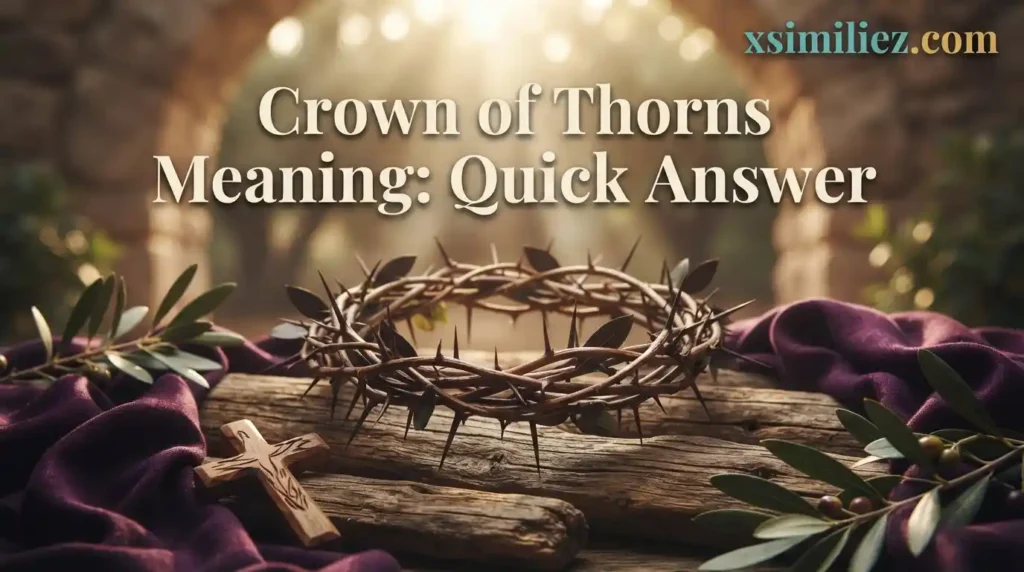
The crown of thorns is a symbol of suffering, sacrifice, mockery, and humble love. In the Christian story, soldiers wove thorny branches into a crown and pushed it onto Jesus’ head to make fun of him as “King of the Jews.” Christians believe he accepted this pain willingly to save people from sin.
Outside of religion, the phrase can also mean a heavy burden or a painful price someone must carry. In art and jewelry, it often shows faith, strength, or survival through hard times. So the meaning can change a little depending on who is using it and why.
What the Bible Says About the Crown of Thorns
Three of the four Gospels tell this part of the story. Matthew, Mark, and John all mention the crown. Luke does not. The scenes are short, but they are powerful.
In Matthew 27, Roman soldiers take Jesus into the governor’s headquarters after he has been sentenced. They gather a whole group of soldiers around him. They take off his clothes and put a robe on him. Then they twist thorns into a crown and place it on his head. They put a reed in his right hand like a king’s staff. They kneel in front of him and shout, “Hail, King of the Jews” Then they spit on him and hit him on the head.
Mark tells almost the same story. John adds one more moment. After the soldiers dress Jesus in a purple robe and crown him, the governor Pilate brings him out to the crowd. Pilate says, “Behold the man” That scene later became very famous in art and is often called Ecce Homo, which is Latin for those words.
Notice what the soldiers did. They copied the way people honored a Roman emperor. Emperors wore a crown of leaves or gold, wore purple, and were greeted with a shout. The soldiers copied all of this to laugh at Jesus. Christians read it with the opposite message. The people who mocked him told the truth without knowing it. He really was a king, but not the kind who rules with force.
The Deeper Symbolism of the Crown of Thorns
A symbol can carry more than one idea at once. The crown of thorns is a good example. Here are the main ideas that Christians and writers connect to it.
| Part of the Symbol | What It Stands For |
| The thorns | Pain, suffering, and the weight of human sin |
| The crown shape | Kingship, but a humble kind of kingship |
| The mockery | How the world often rejects true goodness |
| Jesus wearing it willingly | Sacrifice, love, and obedience |
| The blood | Cost, sacrifice, and cleansing in Christian teaching |
The first idea is suffering. A head is a tender place, and thorns cause sharp, lasting pain. The crown reminds believers that Jesus did not suffer only on the cross. His pain began long before that.
The second idea is a different kind of power. A normal crown is made of gold and jewels. This crown was made of weeds. Christians say this shows that Jesus’ kingdom is not built on wealth or fear. It is built on service and love.
The third idea is humility. He did not fight back or call down anger. Many people find this the most moving part. It shows strength under control rather than weakness.
Why Thorns? The Link to the Garden of Eden
Many Christian teachers see a deeper link between the thorns and the book of Genesis. In Genesis 3, after Adam and Eve disobey God, the ground is cursed. God tells Adam that the earth will grow thorns and thistles for him.
So thorns became a sign of a broken world. They stand for the hard parts of life, such as pain, work, and loss. When the soldiers placed thorns on Jesus’ head, some believers saw a picture of him taking on that curse. The thing that came from sin is worn by the one who is said to forgive sin.
The Bible does not say this directly in the crown scene. It is a reading that has been passed down for many centuries. It is helpful to know it is an interpretation, though a very common one. Many church writers, artists, and preachers have used it.
Another link comes from the book of Isaiah. A passage in Isaiah 53 describes a servant who suffers for others. Christians have long connected that passage to Jesus. The crown of thorns fits into this bigger picture of a king who suffers on behalf of his people.
What Plant Was the Crown of Thorns Made From?
This is a question many readers ask. The honest answer is that no one knows for sure. The Gospels say “thorns,” but they do not name the plant. Scholars and plant experts have offered several guesses. They are based on which thorny plants grew around Jerusalem in ancient times.
| Possible Plant | Notes |
| Christ’s thorn jujube (Ziziphus spina-christi) | Grows in the region and has long, sharp thorns. It is a common guess. |
| Syrian christthorn (Paliurus spina-christi) | Has flexible branches that could be bent into a ring. |
| Thorny burnet (Sarcopoterium spinosum) | A low, spiny shrub common in the area. |
| Date palm | Some writers suggest its sharp spines, though this is less common. |
Each plant has some reason in its favor. Flexible branches would be easier to twist into a ring. Very sharp thorns would make the mockery more painful. But without a record, these are only informed guesses. A careful writer says “may have been” rather than “was.”
Origin and History of the Crown of Thorns Relic
Many people want to know if the real crown still exists. There is a famous relic in Paris, and its story is a long one. Still, it is important to be clear about what can and cannot be proven.
Church tradition says early Christians in Jerusalem kept the crown. Later it was said to be in Constantinople, which is now Istanbul. In 1239, King Louis IX of France bought it from Baldwin II, the emperor there, who was deep in debt. Louis built a chapel in Paris called Sainte-Chapelle to hold it. It was finished in 1248.
During the French Revolution, the relic was kept in the national library for safekeeping. The Church got it back in 1804, and it went to the treasury of Notre-Dame in 1806. Today, the Holy Crown is a ring of woven rushes, which are plant stems. The thorns were removed over time and given as gifts, so several places claim to hold one.
In April 2019, a huge fire damaged Notre-Dame. Firefighters and a chaplain rescued the crown early on. The cathedral reopened in December 2024. The relic is shown at special times, so check the official schedule before you go.
Can historians prove it is the same crown from the first century? No. The Church has kept the tradition for a very long time, and many believers find deep meaning in it. Others see a historic object with an uncertain link to the original event. Both views are common.
Crown of Thorns Meaning in Christian Traditions
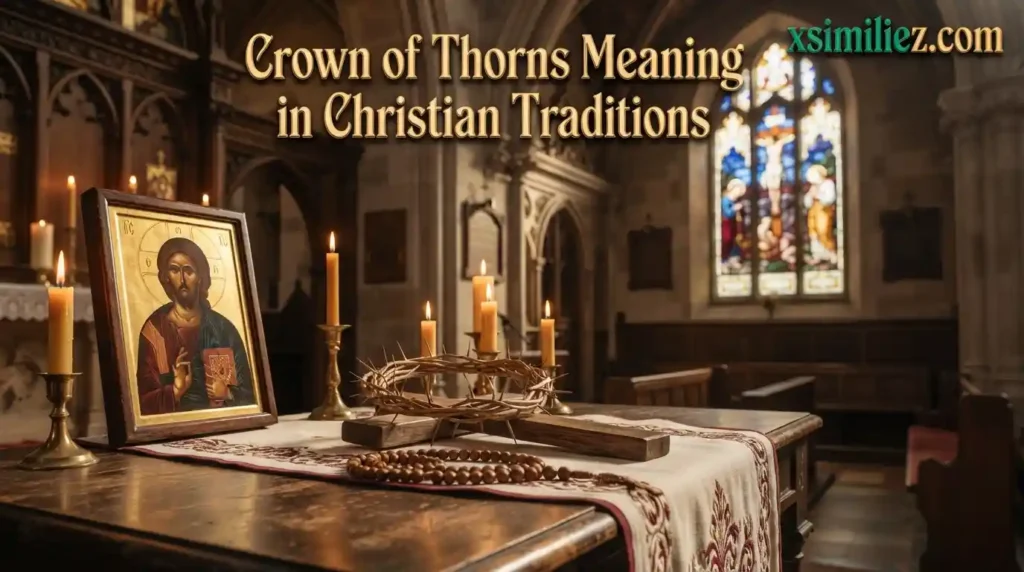
Different Christian groups honor the crown in their own ways, though the core idea stays the same.
In the Catholic tradition, the “Crowning with Thorns” is the third Sorrowful Mystery of the Rosary. People who pray the Rosary think about this scene as a way to grow in patience and humility. Catholics also remember the crown during Lent and on Good Friday, when the suffering of Jesus is the main focus.
Orthodox Christians include the crown in their hymns and in icons of the Passion. Many Protestant churches focus more on the cross, but they still read and teach the crown of thorns scene, especially during Holy Week.
Across these groups, the crown does three jobs. It teaches that Jesus suffered. It teaches that he was a king in a surprising way. And it invites each person to think about what sacrifice and forgiveness really mean.
The Crown of Thorns in Art, Tattoos, and Jewelry
Today the crown of thorns appears far beyond church walls. Painters have shown it for hundreds of years. Many famous paintings of the Ecce Homo scene show a bleeding head, tired eyes, and a calm face. Artists often use it to show how the pain and the peace of Jesus can exist together.
Tattoos are a very common modern use. Some people choose a crown of thorns to show their faith. Others pick it to remember a hard time they survived. Some wear it as a sign of strength or as a reminder that pain can lead to something good. Since the symbol is so strong, it helps to understand the religious meaning before choosing it.
Jewelry works the same way. Thorn-ring bracelets and necklaces can be a faith statement or simply a style choice. Some people also place a small crown of thorns on a cross, a rosary, or a home altar.
| Where You See It | What It Often Means to People |
| Church art and icons | The suffering and humility of Jesus |
| Tattoos | Faith, survival, or personal sacrifice |
| Jewelry | A reminder of belief or a spiritual style |
| Books and films | Pain, injustice, or a noble person who is mocked |
| Easter and Lent displays | A call to remember and reflect |
“Crown of Thorns” as a Phrase in Everyday Language
The words have also entered everyday English. When someone says a job, a duty, or a title is a “crown of thorns,” they mean it looks like an honor but brings pain. A leader who is praised in public yet blamed for everything might feel that way.
A famous example comes from American history. In 1896, William Jennings Bryan gave his “Cross of Gold” speech. He used the picture of a crown of thorns to say that working people should not be crushed by the economy of the time. The speech shows how the image could be used outside church to talk about unfair suffering.
So there are two common meanings. One is religious and about Jesus. The other is general and about a painful burden. If you are reading or writing, the setting will tell you which one is meant.
Common Mistakes People Make
A few mix-ups come up again and again when people search for the crown of thorns meaning.
The first is confusing the plant with the symbol. There is a houseplant called crown of thorns, Euphorbia milii. It has spiny stems and bright red or pink flowers. Its name comes from the legend. But the plant is native to Madagascar, so it was not used in the first century. It is a lovely plant, but the sap can irritate skin and is poisonous if eaten.
The second is mixing it up with the crown of thorns starfish. That is a sea animal covered in spines that eats coral on reefs. It has nothing to do with the religious symbol, other than the spiky look.
The third mistake is saying the crown was made of gold or metal. The Gospels say thorns. The fourth is claiming that everyone knows the exact plant. As you read earlier, nobody does.
| Term | What It Actually Is |
| Crown of thorns (symbol) | The thorny crown placed on Jesus before his crucifixion |
| Crown of thorns (relic) | A ring of rushes kept at Notre-Dame in Paris |
| Crown of thorns (plant) | Euphorbia milii, a spiny houseplant from Madagascar |
| Crown of thorns starfish | A coral-eating sea creature |
Real-Life Examples of How People Use the Symbol
Seeing the symbol in real situations can make the meaning clearer.
A family might hang a small wooden cross with a thorn ring on it in the weeks before Easter. It helps children ask questions and learn the story. A church choir might sing a hymn about the crown during Holy Week. A nurse who survived a serious illness might choose a thorn-and-flower design as a tattoo, to show pain that turned into new life.
A writer might say, “Being the team captain felt like a crown of thorns that season.” Here the phrase means the honor came with stress. A history teacher might show a painting of the Ecce Homoand ask students what the artist wanted them to feel.
Each of these uses points back to the same root. The crown is a picture of a heavy cost joined with a deep purpose.
Tips for Understanding and Using the Symbol Respectfully
If you want to learn more or use the symbol yourself, a few simple habits help.
Start with the source. Read the scenes in Matthew 27, Mark 15, and John 19 for yourself. They are short and clear. Then compare them. You will notice small differences, like the color of the robe, and this helps you see how careful readers study the text.
Next, separate fact from tradition. The Bible says soldiers made a crown of thorns. It does not name the plant or tell us what happened to the crown afterward. The relic story is a history of belief and care, not a proven chain of evidence.
If you are choosing a tattoo, a piece of jewelry, or a design, learn what it means to the people who hold it sacred. For many, it is not just a pretty shape. Using it with respect keeps its meaning strong.
Finally, if you are writing about it, avoid mixing it up with the plant or the starfish. A clear label saves confusion.
FAQs
What is the main meaning of the crown of thorns?
It mainly stands for the suffering, sacrifice, and humble kingship of Jesus Christ. It also reminds believers of the pain he accepted out of love.
Why did the soldiers put a crown of thorns on Jesus?
They wanted to mock him. He had been called “King of the Jews,” so they made a fake crown, gave him a robe and a reed, and pretended to honor him as a king.
Which Gospels mention the crown of thorns?
Matthew, Mark, and John mention it. Luke does not describe this scene.
Is the real crown of thorns still around?
A relic called the Holy Crown is kept at Notre-Dame Cathedral in Paris. Historians cannot prove it is the original crown, but it has been honored by believers for many centuries.
Is the crown of thorns the same as the cross?
No. The cross is the main symbol of the crucifixion. The crown of thorns is a separate symbol that points to the mockery and pain Jesus faced before and during it. They are often shown together.
What does a crown of thorns tattoo mean?
It often shows faith, sacrifice, or survival through pain. Meanings vary, so the best choice is to learn the religious background and think about what it means to you.
Conclusion
The crown of thorns meaning comes down to this: a symbol meant to shame became a symbol of love. Soldiers wanted to make a joke of a king. Christians say the crown instead shows a ruler who chose suffering for the sake of others. That is why the image has lasted for two thousand years.
Along the way, you learned the Bible scenes, the link to Genesis, the guesses about the plant, and the story of the relic in Paris. You also saw how the phrase is used in art, tattoos, and everyday speech. Some parts are firm history, and some are tradition or interpretation. Knowing the difference makes you a wiser reader.
If you want to go deeper, read the Gospel accounts yourself and visit a museum or a church with historic art when you can. Ask questions, stay curious, and treat the symbol with care. It carries a lot of meaning for a lot of people.

Hi, I’m Mason Avery, a content writer at Xsimiliez.com. I like writing about similes, figurative language, and creative expressions. I believe learning English becomes easier when examples feel natural and relatable.