
Send my regards meaning: it is a polite way to ask someone to pass your good wishes to another person. When you say it, you are saying, “Please tell them I said hello and that I think well of them.” It is warm, kind, and a little formal.
Maybe you heard it in a movie. Maybe a coworker said it at the end of a call. Or maybe a friend texted it, and you were not sure how to answer. Many people look up this phrase because it sounds old-fashioned, yet it is still used today.
In this guide, you will learn what the phrase means, how to use it, where it came from, and what mistakes to avoid. You will also see real examples, helpful tables, and quick answers to common questions.
Send My Regards Meaning in Plain English
The phrase “send my regards” means “please give my good wishes to someone.” You use it when you cannot talk to a person yourself, but you want them to know you are thinking of them kindly.
Here is a simple example. Say your friend Maria is visiting her mother. “You know her mother, but you will not see her this week. A friendly “Please send my regards to your mom” solves that. Maria now carries your hello across the distance.”
The word “regards” here does not mean “looks at” or “pays attention to.” It means respect, care, and good feelings. So when you send your regards, you send a small gift of kindness. It costs nothing, but it shows you remember the person.
The phrase is not a command in the rude sense. It is a polite request. It also does not need an answer, other than a simple “Sure, I will” or “I will tell her.”
What the Send My Regards Meaning Includes
The meaning has three parts. First, there is a message. You want a person to know you said hello. Second, there is a messenger. That is the person you are speaking to, who will carry the hello. Third, there is a receiver. That is the person who gets your good wishes in the end.
The phrase carries a gentle level of feeling. It is warmer than a cold “hi,” but it is not as close as “send my love.” You would send your regards to a teacher, a neighbor, a boss, a friend’s parent, or an old coworker. You would send your love to a sister, a best friend, or a partner.
This is why the phrase fits so well in many settings. It shows respect without sounding too personal. It is also safe. Almost nobody feels upset when they receive someone’s regards.
One more thing is worth knowing. The phrase works best when the receiver is not in the room. If the person is standing right next to you, you would just greet them. You use “send my regards” when there is some distance, either in space or in time.
How to Use Send My Regards Correctly
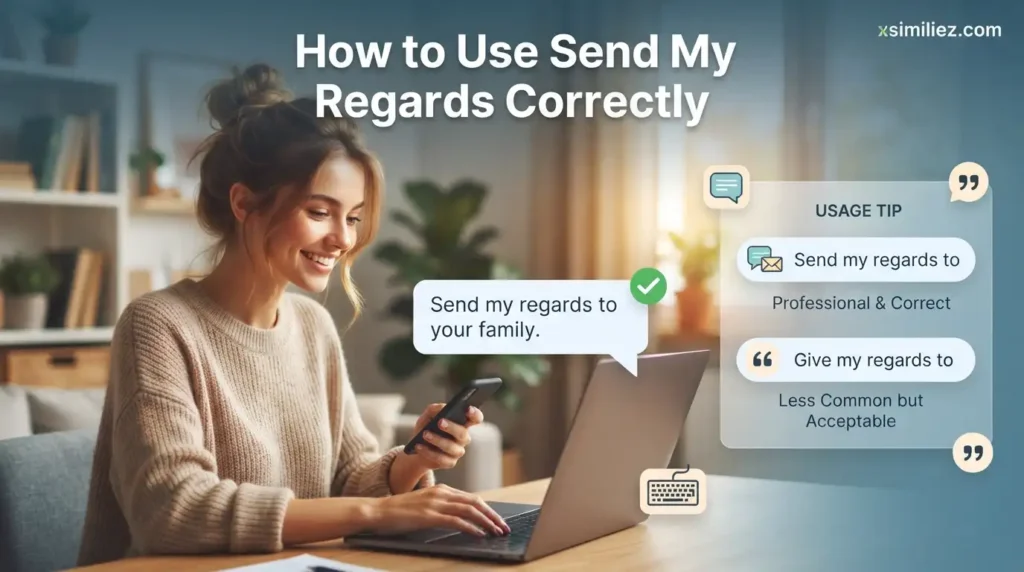
Grammar for this phrase is easy once you see the pattern. The most common form is “send my regards to” plus the name of a person. For example, you can say, “Send my regards to your family.” You can also say, “Please send my regards to Mr. Lee.”
The verb “send” can be changed to fit the time. “When you are asking now, use “send.” Once it is done, say “I sent my regards.” And if someone did it for you, say “Thanks for sending my regards.” The word “regards” almost always stays plural. Saying “send my regard” sounds wrong to most native speakers.
You can also swap “send” for “give.” Both are correct. Some people think “give my regards” sounds a bit more classic, but the meaning is the same. The table below shows common forms and what each one does.
| Form | Example | Who is speaking | Feeling |
| Send my regards to | “Send my regards to your sister.” | Person asking | Polite, warm |
| Give my regards to | “Give my regards to the team.” | Person asking | Polite, a bit classic |
| Please send my regards | “Please send my regards to Dr. Kim.” | Person asking | Very polite |
| I sent my regards | “I sent my regards to your dad.” | Person reporting | Neutral |
| Thanks for the regards | “Thanks for passing along his regards.” | Person receiving | Friendly |
| My regards to | “My regards to your mother.” | Person asking | Short and formal |
Notice that the short form, “my regards to,” is also fine. People often use it at the end of a letter or a speech. It sounds a little formal, so it fits best in work settings or with older people.
Where the Phrase Comes From
The history of this phrase is a mix of clear facts and unknowns, so it helps to be honest about both. The word “regard” comes to English from an old French word that was linked to looking at or watching something. Over many years, the English word grew to mean care, respect, and good feeling toward someone.
Once “regards” meant good wishes, it became a handy word in letters. People wrote notes by hand and often ended them with kind words for friends and family. Asking a letter reader to pass your regards to someone else was a natural step. It was a polite way to include people who were not part of the letter.
The exact first time anyone wrote “send my regards” is hard to prove, so it is best not to claim a date. What we do know is that the phrase has been common in polite speech and writing for a long time.
One famous use is the song title “Give My Regards to Broadway.” George M. Cohan wrote it for the 1904 musical Little Johnny Jones. The song helped make this style of phrase well known in American culture. It also shows how the phrase works: the singer asks someone to carry hello to a faraway place.
Send My Regards vs Similar Phrases
Many phrases sound close to “send my regards,” but they are not the same. Picking the right one can make your message feel just right. If you choose a phrase that is too strong or too weak, it may feel odd to the reader.
“Send my love” is warmer and closer. People use it with family and very close friends. “Say hi for me” is casual and friendly. It fits texts and chats. “Remember me to” is old-fashioned and rare today, but you may still see it in books. “Best regards” and “kind regards” are different, because those are closings at the end of an email, not requests to pass on a hello.
The table below compares these phrases side by side.
| Phrase | Level of closeness | Best used with | Where you might see it |
| Send my regards | Medium | Coworkers, neighbors, older relatives | Speech, email, letters |
| Send my love | High | Family, close friends, partners | Texts, cards, calls |
| Say hi for me | Low to medium | Friends, classmates | Texts, quick chats |
| Give my best to | Medium | Coworkers, friends | Speech, email |
| Best regards | Medium | Anyone at work | End of emails |
| Kind regards | Medium | Anyone at work | End of emails |
You can see that “send my regards” sits in the middle. It is friendly, but it keeps a little polite distance. That is the reason it works for so many people and places.
Common Mistakes to Avoid
Even a simple phrase can trip people up.
The first mistake is mixing it up with the closing “best regards.” If you end an email with “Best regards,” you are signing off. You are not asking anyone to pass along hello. These are two different jobs, even though the word “regards” appears in both.
The second mistake is using the wrong closeness. Telling your spouse to “send my regards” to your child would sound strange. That is a “send my love” moment. On the other hand, telling your boss “send my love to your wife” might feel too personal. “Send my regards” would fit better.
The third mistake is writing “regard” without the S. The phrase needs the plural form. A fourth mistake is using it when the person is right there. If you are talking to your coworker face to face, a simple “Good to see you” is better.
The fifth mistake is ignoring tone. Some people say the phrase in a cold or joking voice, and then it can sound mean. We will talk about that in the next section, because tone changes a lot here.
Finally, do not say it when you do not mean it. If you honestly do not wish a person well, a fake hello may feel false. It is fine to simply skip it.
Real-Life Examples of Send My Regards
Seeing the phrase in action makes it easier to learn. Here are some everyday situations, written in plain words.
Imagine you are on the phone with a former coworker named Sam. You used to work with Sam’s manager, Lisa, and you liked her. Before you hang up, you say, “It was great talking to you. Please send my regards to Lisa.” Sam will likely say, “I will!” and pass it on at the office.
Here is another case. Your neighbor is going to visit her grandmother in another city. You met the grandmother once at a block party. You might say, “Have a safe trip. Send my regards to your grandma.” It is short, kind, and fits well.
In an email, it might look like this: “Thank you for the update on the project. Please send my regards to the whole team, and I hope to see everyone next month.” This is polite and professional. It also makes the team feel remembered.
In a text, a friend might write, “Heading to dinner with my parents!” You could reply, “Have fun! Send my regards to them.” It is a small touch, but parents often like hearing it.
At a wedding or a party, a guest might say to the host, “I am sorry I could not stay longer. Please send my regards to the happy couple.” This works well when someone has to leave early and cannot say goodbye in person.
You may also hear it at a farewell. A teacher who is retiring might tell a student, “Send my regards to your parents. They have been wonderful.” The phrase here shows thanks and respect.
Tone and Current Usage Today
Today, “send my regards” is still alive, but it is used a bit less than it once was. Younger people often choose “say hi for me” or “tell them I said hi.” Still, the phrase is common in work emails, speeches, and polite talk with older family members. It has a classic feel that many people enjoy.
Tone matters a lot with this phrase. Said in a warm voice, it is sweet and kind. Said in a flat, cold voice, it can feel cool or distant. In movies and TV shows, writers sometimes use it in a dark or sarcastic way, such as a character who says it while walking away from an enemy. In those cases, the words are polite, but the feeling behind them is not friendly.
Because of that, people may notice your tone more in speech than in writing. In a text or email, the phrase almost always reads as kind. On the phone or in person, smile a little, and the meaning will be clear.
Another trend is that the phrase often shows up in goodbye moments, such as the end of a call or a visit. It is a gentle way to close a talk. It leaves the other person with a good feeling and shows you care about the people in their life.
Tips for Using Send My Regards Well
A few simple habits can help you use the phrase with confidence. Start by thinking about who is on the receiving end. If you know them well, pair your regards with a small detail. For example, “Send my regards to your dad, and tell him I loved his story about fishing.” That feels far more personal than a plain hello.
Next, match the phrase to the setting. In a work email, “Please send my regards to the team” is a good fit. In a quick text to a friend, you can relax a little and say, “Tell your mom I said hi.” Either one is fine, as long as it suits the moment.
It also helps to be sincere. A short, honest hello beats a long, empty one. Think of a real person you want to remember, and name them. Using a name makes the message warmer and easier to pass along.
Finally, say thank you when someone sends their regards to you. A short reply like “That is so kind, please tell him thank you” is perfect. You can also send regards back, which is a lovely way to keep a friendly chain going.
FAQs
What does “send my regards” mean?
It means “please give my good wishes to someone else.” You are asking the person you are talking to, or writing to, to carry your hello to a third person.
Is “send my regards” formal or casual?
It is somewhat formal but still warm. It fits work, family, and polite talk. For very casual chats, “say hi for me” may feel more natural.
What is the difference between “send my regards” and “send my love”?
“Send my love” shows deeper feelings and is best for close family and friends. “Send my regards” is more polite and respectful, and it works for people you know less well.
Can I use “send my regards” in an email?
Yes. It is a nice way to include people who are not on the email. For example, “Please send my regards to your team” is polite and clear.
Is “send my regards” the same as “best regards”?
No. “Best regards” is a closing line at the end of a message. “Send my regards” is a request to pass hello to another person.
How do I reply when someone says “send my regards”?
Keep it short. You can say, “I will, thank you,” or “I will tell her you said hello.” It also helps to follow up and pass the message along.
Conclusion
To wrap up, the send my regards meaning is simple. It is a kind and polite way to ask someone to carry your good wishes to another person. It sits in the middle of the friendship scale, warmer than a plain hello but lighter than “send my love.”
You have also seen how to use it, how it differs from similar phrases, and which mistakes to avoid. The phrase has a long history in polite speech and letters, and it is still helpful today in emails, calls, and chats. Just remember to match your tone and your words to the person and the moment.
The best advice is to keep it sincere. Think of someone you honestly care about, add their name, and say your regards with a smile. A tiny message like this can make another person feel remembered, and that is always worth a few seconds.
Explore Related Wishes
- 55555 Angel Number Meaning: Love, Money, and Spiritual Signs
- 0101 Angel Number Meaning: Fresh Starts, Balance, and Trust

Hi, I’m Harper Blake, and I write for Xsimiliez.com. I enjoy sharing clear and friendly simile examples that students and beginners can understand easily. My goal is to make English learning simple and enjoyable.