
Strong work ethic meaning is simple: it describes a person who works hard, stays honest, and finishes what they start. These people show up on time, take pride in their work, and do not need anyone watching them. It is a habit, not a talent.
You may have seen this phrase in a job ad, a school letter, or a note from a boss. Maybe someone told you that you have it, and you wanted to know what it really says about you. Many people search for this topic because the phrase sounds big but feels fuzzy.
In this guide, you will learn what the phrase means, where it came from, and how to use it in a sentence. You will also see real examples, common mistakes, and easy tips for building a stronger work ethic of your own.
Quick Answer: Strong Work Ethic Meaning in Plain Words

A strong work ethic means you believe in doing your job well, and you act on that belief every day.A strong work ethic means you do your job well and act on that belief every day. Real effort and a kept word matter most. Even when a task is boring, hard, or unseen, you get it done.
Think of it as a set of inner rules. Those rules say, “I will do my best, I will be fair, and I will not quit when things get tough.” The word “ethic” comes from the idea of right and wrong behavior. So a work ethic is your sense of what is right when it comes to your work.
Notice that it is not about how much money you make or how smart you are. A student, a nurse, a farmer, a cashier, and a company owner can all have a strong work ethic. What matters is how you treat the work in front of you.
What a Strong Work Ethic Looks Like in Real Life
The best way to understand strong work ethic meaning is to look at the habits behind it. People with this trait share a few things in common, and you can usually spot them quickly.
The first habit is reliability. They show up when they say they will. If they promise a report by Friday, it lands on Friday, not Monday. Coworkers learn that they can count on them, and that trust grows over time.
The second habit is self-discipline. This means doing what needs to be done even when you do not feel like it. A person with a strong work ethic still starts the hard task first thing in the morning instead of hiding from it.
The third habit is honesty. They do not lie about their hours, blame others for their mistakes, or take credit for work they did not do. They say, “That was my error, and here is how I will fix it.”
Another key trait is pride in quality. They do not rush just to get done. They check their work, fix small errors, and care about the final result. Finally, they keep learning. They ask questions, accept feedback, and work to get better, because they know skills do not stay sharp on their own.
How to Use “Strong Work Ethic” in a Sentence
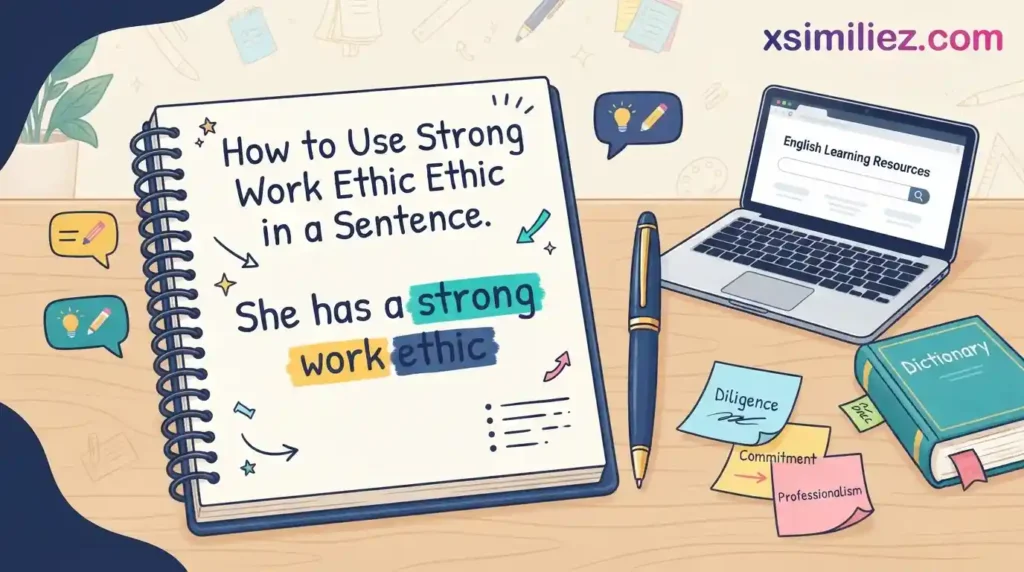
“Work ethic” is a noun phrase, and “strong” is the adjective that describes it. You can say someone “has” or “shows” a strong work ethic. Most people use the word “a” before it, as in “She has a strong work ethic.”
Here are a few ways the phrase works in everyday speech. A teacher might write, “Marcus has a strong work ethic and always turns in his homework on time.” A manager might say, “We want to hire someone with a strong work ethic.” You might even say it about yourself in an interview: “My parents taught me a strong work ethic when I was young.”
Some people write it with a hyphen, as in “strong-work-ethic employee,” but this is not needed in most cases. It is cleaner to say, “an employee with a strong work ethic.” You can also swap “strong” for words like “solid,” “great,” or “excellent.” They all mean nearly the same thing.
One small grammar tip: “work ethic” is singular. You say “her work ethic is strong,” not “her work ethic is strong.” If you talk about more than one person, you can say, “They all have a strong work ethic,” and that is correct too.
Where the Idea of Work Ethic Came From
People have praised hard work for thousands of years, so no single person invented the idea. Many cultures and faiths teach that honest effort is a good thing and that laziness hurts the person and the community.
The phrase “work ethic” became popular in a more modern way. In the early 1900s, a German thinker named Max Weber wrote a famous book called The Protestant Ethic and the Spirit of Capitalism. He argued that certain religious beliefs in parts of Europe encouraged people to work hard, save money, and treat their jobs as a calling. That is why you will often hear the term “Protestant work ethic.”
Over time, the phrase spread far beyond that book. Today it is used in every country and in every kind of workplace, and it does not belong to any one religion. Historians still debate how much Weber’s ideas explain, so it is best to see his work as one important starting point and not the whole story.
Strong Work Ethic vs. Weak Work Ethic
Sometimes a side-by-side look makes an idea easier to grasp. The table below shows how a strong work ethic and a weak one often differ in daily life.
| Area | Strong Work Ethic | Weak Work Ethic |
| Time | Arrives on time and meets deadlines | Often late and misses deadlines |
| Effort | Gives full effort, even on small tasks | Does the bare minimum |
| Mistakes | Admits errors and fixes them | Hides errors or blames others |
| Feedback | Listens and improves | Gets defensive or ignores it |
| Focus | Finishes one task before jumping to another | Gets distracted easily |
| Trust | Keeps promises | Makes excuses |
Of course, nobody fits only one column. Everyone has a lazy day or a missed deadline now and then. A strong work ethic does not mean you are perfect. It means your usual pattern leans toward the left side, and you bounce back quickly when you slip.
Strong Work Ethic Meaning Compared to Similar Words
Several words sound close to “work ethic,” and people often mix them up. Knowing the differences will help you use each one the right way.
| Word | Simple Meaning | How It Differs From Work Ethic |
| Hard work | Putting in lots of effort | Work ethic includes the attitude behind the effort |
| Diligence | Careful, steady effort | Very close, but work ethic also covers honesty and reliability |
| Productivity | How much you get done | You can be busy and still not be productive |
| Ambition | A strong wish to succeed | Ambition is the goal; work ethic is the daily action |
| Discipline | Control over your actions | Discipline is one tool that supports a work ethic |
The biggest point is that a strong work ethic is about character, not just output. Someone could finish a huge pile of tasks by cutting corners or being dishonest. That person is productive, but they do not have a strong work ethic. The phrase always carries a sense of doing things the right way.
Common Mistakes People Make
Many people misunderstand this phrase, and a few wrong ideas can cause real problems. Let us clear up the most common ones.
The biggest mistake is thinking that a strong work ethic means working nonstop. Some people believe that the more hours you log, the stronger your ethic. That is not true. A person who works smart, rests well, and finishes quality work may have a stronger work ethic than someone who is always tired and making errors.
Another mistake is confusing busyness with effort. Checking email all day or sitting in meetings can feel like work, but it may not move anything forward. A strong work ethic points your energy at what truly matters.
A third mistake is believing you are either born with it or not. In truth, work ethic is learned. Children pick it up from parents, teachers, and early jobs, and adults can keep building it at any age.
Some people also think that a strong work ethic means never asking for help. That actually hurts you. Smart workers ask questions early because it saves time and avoids bigger mistakes.
Finally, some employers treat the phrase as a reason to demand unpaid overtime. A real work ethic should be respected and paid fairly. Good effort deserves good treatment in return.
Real-Life Examples of a Strong Work Ethic
Examples make the idea feel real, so here are a few everyday pictures.
Picture a high school student named Amina. She works a part-time job at a grocery store after class. Even when she does not feel like going, she goes. Her section stays neat, customers get a kind greeting, and her homework gets done on the bus.Her manager notices and gives her more hours.
Now think about a nurse working a long shift. Her feet hurt, and the hospital is busy. Still, she double-checks each patient’s medicine and writes clear notes for the next nurse. Nobody is clapping, but she does it right because it matters.
Consider a small bakery owner who wakes at four in the morning. He bakes fresh bread, cleans the counters, and talks with each customer. When he makes a mistake with an order, he fixes it and offers a free roll as an apology.
Even a remote worker can show it. Imagine a designer working from home. No boss is looking over her shoulder, yet she starts on time, sets goals for the day, and sends updates without being asked. These stories show that a strong work ethic can live in any job, big or small.
Strong Work Ethic Meaning in Today’s World
The way we work has changed a lot, and so has the way people talk about work ethic. More people now work from home, which makes self-discipline even more valuable. When no one can see you, your habits do the talking.
At the same time, many workers and writers have started to question “hustle culture,” the idea that you should always be grinding. Terms like “burnout” and “quiet quitting” became part of everyday talk in recent years. Quiet quitting, in simple terms, means doing only the tasks in your job description and no extra. People argue about If it is lazy or If it is a healthy boundary.
Here is a balanced view. A strong work ethic today is less about suffering and more about steady, honest, high-quality effort. Many employers still list it as a top trait in job ads. But more of them also understand that rest, fair pay, and clear limits help people keep a strong work ethic for years instead of burning out in months. I do not have exact numbers on how often employers ask for it, so it is best to check current job listings in your own field.
Tips to Build a Stronger Work Ethic

The good news is that you can grow your work ethic with small, steady steps. You do not need a big life change.
Start by setting one clear goal for each day. Write it down in the morning and make it small enough to finish. Checking it off feels good and builds momentum. Over time, those small wins add up.
Next, do your hardest task first. Our energy and focus are usually best early in the day, and getting the tough job done early removes the weight from your mind. Many people find that the rest of the day feels easier after that.
Then, cut distractions. Put your phone in another room, close extra tabs, and tell people when you need quiet time. Working in focused blocks of twenty-five to fifty minutes, followed by a short break, helps many people stay sharp.
Keep your promises, even small ones. If you say you will send a message by noon, send it by noon. Each kept promise tells your brain that you are someone who follows through.
Ask for feedback and use it. When a teacher, coach, or boss gives you advice, thank them and try it. Growth happens faster when you stay open.
Last, take care of your body and mind. Sleep, eat well, and rest on purpose. A tired person cannot sustain a strong effort for long. Treat rest as part of the job, not a reward you earn only after burning out.
FAQs
What is the simple meaning of a strong work ethic?
It means you work hard, stay honest, and take pride in doing a good job. You also keep your promises and finish what you start, even when the task is difficult or boring.
Is a strong work ethic the same as being a workaholic?
No. A workaholic works too much and often ignores health and family. A person with a strong work ethic works with care and quality, and they also know when to rest.
Can you learn a strong work ethic?
Yes. Most people learn it from family, school, and early jobs, but adults can build it too. Small daily habits, like setting goals and keeping promises, grow it over time.
Why do employers want people with a strong work ethic?
Employers want workers they can trust to do good work with little pressure. These workers tend to be reliable, learn fast, and help the whole team do better.
What are some words that mean the same as a strong work ethic?
Close words include diligence, dedication, commitment, and reliability. None match perfectly, but they all point to steady, honest effort.
How can I show a strong work ethic in a job interview?
Share a real story about a time you met a hard deadline, learned a new skill, or fixed a mistake. Concrete examples are far more convincing than saying, “I am a hard worker.”
Conclusion
Strong work ethic meaning comes down to this: it is the habit of giving honest, steady effort and caring about the quality of what you do. It shows up in small choices, like arriving on time, owning your mistakes, and finishing a task when it would be easier to quit. It is a matter of character more than speed or hours.
The best news is that anyone can build it. You do not have to be born with it, and you do not have to work yourself to exhaustion. You only need to start with small goals, protect your focus, and keep the promises you make to others and to yourself.
So pick one habit from this guide and try it this week. Maybe you will do your hardest task first or write down a daily goal. Over time, those small steps can turn into a reputation that opens doors, builds trust, and helps you feel proud of your work.

Hi, I’m Mason Avery, a content writer at Xsimiliez.com. I like writing about similes, figurative language, and creative expressions. I believe learning English becomes easier when examples feel natural and relatable.