Ciao meaning is simple. It is an Italian word that people use to say both “hello” and “goodbye.” You say it to friends, family, and people your age. It sounds like “chow,” and it works in a quick chat, a text, or a wave across the street.
So why do so many people search for it? Because ciao is everywhere. You hear it in movies, songs, shops, and even English emails. Many people use it without knowing where it came from or when it feels right.
In this guide, you will learn what ciao means, how to say it, and where it began. You will also see common mistakes, real examples, and tips to use it with confidence.
Quick Answer: Ciao Meaning in Plain English
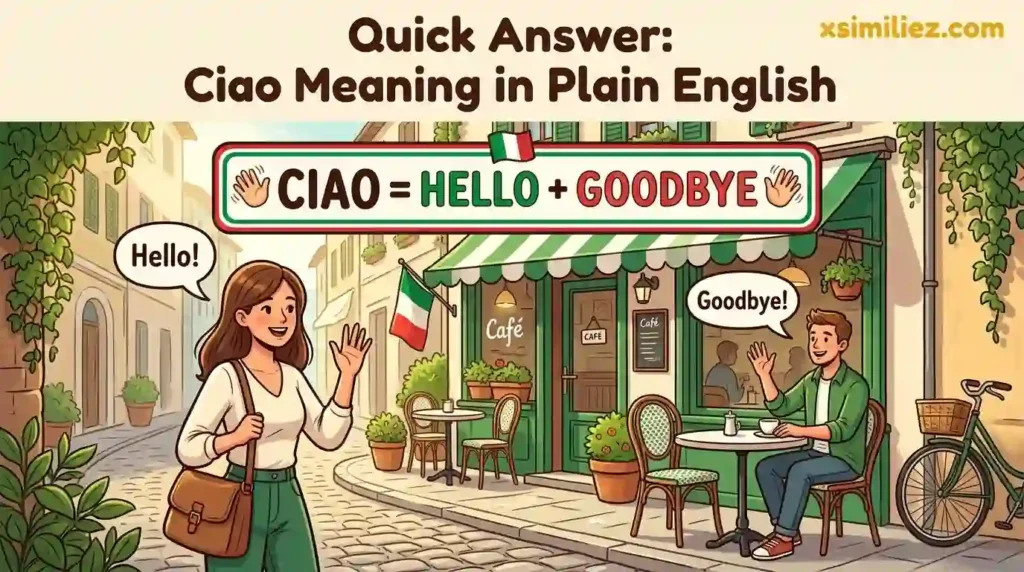
Ciao meaning comes down to two things: hello and goodbye. In Italy, it is the easy, friendly word you use when you meet someone and again when you leave. That is why learners sometimes get confused. One word does two jobs.
The word is casual. Think of it as “hi” and “bye” in one. You would say it to a friend, a cousin, a neighbor your age, or a child. In Italy, you would not usually say it to a boss, a judge, or an older stranger.
Here is a quick look at how ciao works in daily life.
| Situation | What Ciao Means | Example |
| Meeting a friend | Hello or hi | “Ciao, Marco!” |
| Leaving a friend | Goodbye or bye | “Ciao, see you tomorrow!” |
| Waving to a child | Hi or bye | “Ciao, Sofia!” |
| Sending a text | A quick hello or bye | “Ciao! Running late.” |
| Talking to a stranger formally | Often too casual | Use “buongiorno” instead |
Ciao Meaning and Definition: What the Word Really Says
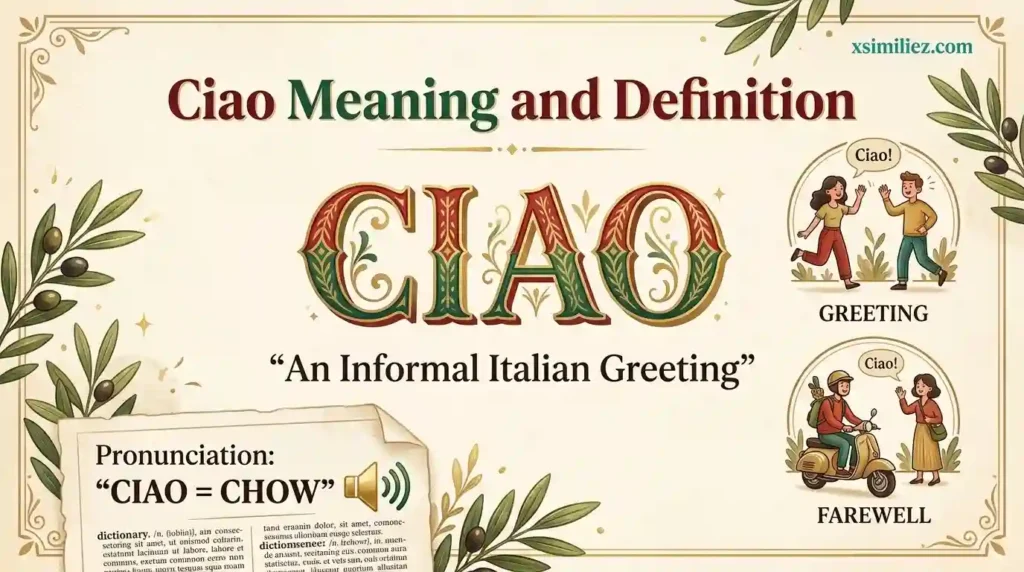
Dictionaries call ciao an informal greeting. It is used when people meet and when they part. English dictionaries now list it as a word of its own, and most people understand it even if they have never studied Italian.
The tone makes a big difference. A bright “Ciao!” sounds warm and happy. A soft “ciao” at the end of a phone call sounds calm and kind. If someone says “ciao ciao,” it often sounds sweet and playful. Italians often use it with small children and close friends.
In casual Italian, people sometimes say “e ciao” to mean “and that’s that.” It is a way of closing a topic, like saying “and that’s the end of it.” You will hear this mostly in relaxed talk, not in school books.
Let’s talk about how to say it. The word looks tricky, but it is easy once you know the rule. In Italian, the letters “ci” before a vowel make a “ch” sound, like the start of “cheese.” The “ia” then glides into an “ow” sound. Put it together and you get “chow,” which rhymes with “now.” Many English speakers say it correctly without trying.
One more thing helps. The word has just one beat. Say it fast and light. “Chow!” If you stretch it into “chee-ow,” it sounds odd to Italian ears.
Ciao Meaning and Grammar: How to Use It Correctly
Grammar is easy with ciao. It is an interjection, meaning a short word that can stand alone, like “hey” or “wow.” The word remains the same regardless of gender or whether you are speaking to one person or a group. The word stays “ciao” every time.
You can use it by itself. You can also add a name or a group. For example, “Ciao, Anna” greets one person. “Ciao a tutti” means “hello, everyone. “Ciao ragazzi” is like saying “hi, guys.” If you want to ask how someone is doing, you can say “Ciao, come stai?” That means “Hi, how are you?”
Ciao also goes with the casual “you” in Italian, which is “tu.” Italians use a polite “you,” which is “Lei,” for people they do not know well or who deserve extra respect. Ciao fits the casual group, not the polite one.
Punctuation is flexible. An exclamation point makes it exciting. A comma after it makes it calm. In English writing, you can put it at the start of a note or at the very end as a sign-off.
The table below shows how ciao compares with other common Italian greetings. This helps you pick the right word.
| Italian Word | Meaning | Tone | Best Used With |
| Ciao | Hello or goodbye | Casual, friendly | Friends, family, kids |
| Salve | Hello | Neutral, polite | Shops, new people |
| Buongiorno | Good morning or good day | Polite | Anyone, any time before afternoon |
| Buonasera | Good evening | Polite | Anyone in the evening |
| Arrivederci | Goodbye | Polite | Shops, work, new people |
| A presto | See you soon | Warm | Friends, coworkers |
| Addio | Farewell | Very serious | Long goodbyes, forever |
Origin of Ciao Meaning: Where the Word Comes From
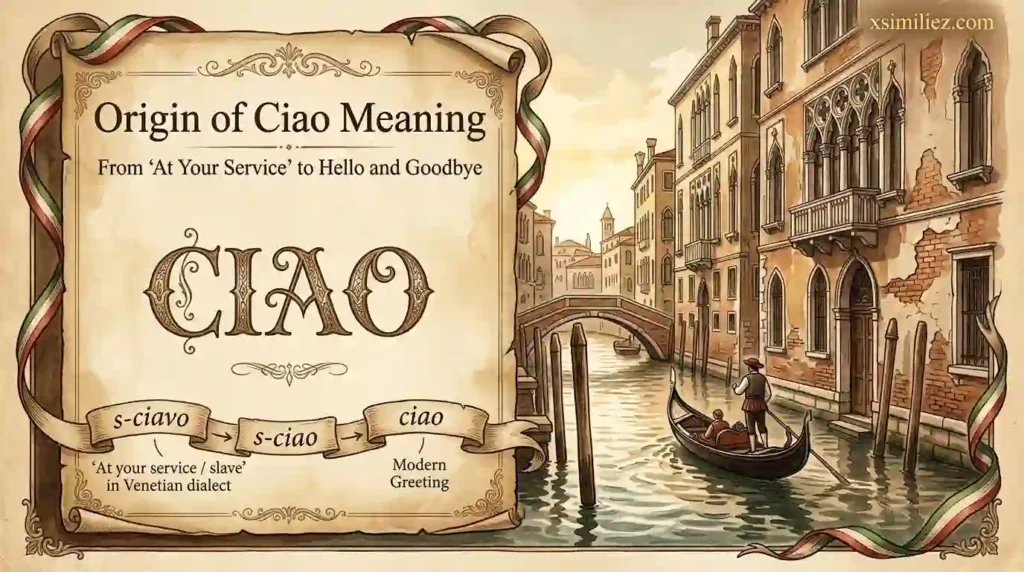
The story of Ciao is interesting. Most dictionaries trace the word to a Venetian phrase, “s-ciao vostro” or “s-ciavo,” which came from the Latin word “sclavus.” In plain English, the old phrase meant something like “I am your servant.” It was a polite way of saying “at your service.”
That may sound strange today. Nobody thinks about servants when they say ciao. Over time, the phrase got shorter and softer. It lost its old meaning and became a friendly hello. Later, people began to use it as a goodbye too.
History is a good reminder that words change. A phrase that once showed humble respect became a quick, cheerful sound. That is how language works.
Ciao Meaning in American vs British English
English speakers in both the United States and the United Kingdom understand ciao. They use the same spelling and the same pronunciation. The big differences are small ones of style.
In the United States, ciao often sounds playful, fun, or a little fancy. Someone might say it as a cute way to end a phone call or a text. It can also show up in restaurant names, ads, and cooking shows. In the United Kingdom, people use it in much the same way, often as a light, casual sign-off between friends.
I did not find strong proof that one country uses ciao far more than the other, so I will not guess. What matters more is the setting. In both places, ciao feels informal. It suits friends and relaxed emails. It is not the best choice for a job application, a legal letter, or a note to someone you hardly know.
Another small point: English speakers use ciao only as a loan word. They rarely mix it with other Italian grammar. They say “ciao” and move on, and that is perfectly fine.
Common Mistakes People Make With Ciao Meaning
The first mistake is thinking ciao only means goodbye. Many learners hear it as a farewell and use it that way. But it also means hello, and Italians use it both ways every day.
The second mistake is using it in the wrong setting. In Italy, walking into a bank or meeting an older stranger and saying “ciao” can sound too casual. A polite “buongiorno” or “buonasera” works better there. Ciao is for people you know or people your age in relaxed places.
The third mistake is spelling. Some people write “chow” or “chau” because that is how it sounds. But the correct Italian spelling is c-i-a-o. Also, “chow” in English can mean food, so it may confuse your reader.
The fourth mistake is the pronunciation. Say “chow,” not “see-ow” or “key-ow.” The “c” is soft here.
The fifth mistake is a phrase many people love: “ciao bella.” It means something like “hello, beautiful.” Said to a stranger, it can sound too forward or even rude. It is better to skip it unless you know the person well and the mood is friendly.
The last mistake is overusing the word in English. If you say ciao in every message, it can feel like you are trying too hard. A little goes a long way.
Real-Life Examples of Ciao Meaning

Seeing the word in real situations makes it easier to learn. Here are a few simple ones.
Imagine two friends meeting at a café in Rome. One says, “Ciao, Luca! Come stai?” That means, “Hi, Luca! How are you?” Luca answers, “Bene, grazie. E tu?” which means “Fine, thanks. And you?” When they part, one says, “Ciao, a domani!” That means “Bye, see you tomorrow!”
Now picture a mom dropping off her child at school. She kneels down and says, “Ciao, amore. Ciao ciao!” The word works as a gentle goodbye. The child waves and says it back.
Ciao also works in text messages. A short note like “Ciao! Sto arrivando” means “Hi! I’m on my way.” A message that ends with “Ciao per ora” means “Bye for now.” Even in English, people write “Ciao for now” at the end of a casual email.
In the United States, you may hear a host on a cooking show say, “Ciao, everyone, and thanks for watching!” Here the word is a fun nod to Italy. A friend might also text “Ciao!” at the end of a chat as a light, stylish way to say bye.
Finally, think about a workplace. A manager in Italy meets a new coworker who is the same age. They might start with “Salve” or “Buongiorno” and move to “ciao” once they feel more comfortable. This slow shift is common and shows how Italians match their words to the closeness of the relationship.
Ciao Meaning Around the World and in Use Today
Ciao has traveled far beyond Italy. Many languages now use a version of it as a friendly hello or goodbye, though the exact meaning and feeling can vary from place to place.
| Language or Place | Common Form | Typical Use |
| English | Ciao | Casual bye, sometimes hello |
| Spanish (many Latin American countries) | Chao | Casual bye |
| Brazilian Portuguese | Tchau | Casual bye |
| German-speaking areas | Ciao or Tschau | Casual hello or bye |
Treat this table as a general guide. Local habits differ, and a local dictionary is the best check if you need to be sure.
As for trends, ciao still feels alive and useful. It shows up in texts, social media captions, ads, shop names, and everyday talk. I do not have firm numbers on how often people use it today, so I will not claim any. What I can say is that it remains easy to spot in both Italian and English. Its short sound and happy tone make it a natural fit for fast, friendly messages.
Tips for Using Ciao Meaning Naturally
Start with people you know. Use ciao with friends, family, and classmates. This is the safest way to get comfortable.
Match the mood of the person. If they say “buongiorno” and sound formal, answer the same way. If they smile and say “ciao,” you can answer with ciao too.
Keep the sound simple. Say “chow” quickly and lightly. Practice it out loud a few times, and it will feel natural.
In English writing, use it as a friendly sign-off. A line like “Thanks again, and ciao for now!” sounds warm. Save it for relaxed notes, not formal ones.
If you travel to Italy, listen first. Watch how locals greet each other in shops, cafés, and hotels. You will quickly learn when ciao fits and when a more polite word works better.
Finally, do not worry about being perfect. Italians usually enjoy it when visitors try their words. A smile and a cheerful “ciao” go a long way.
FAQs
What does ciao mean in English?
Ciao means both “hello” and “goodbye.” It is an informal word, so it fits best with friends, family, and people you know well.
Is ciao Italian or Spanish?
Ciao is Italian. Spanish speakers in some places use “chao,” which is a similar word that came from the same source and has the same casual feeling.
How do you pronounce ciao?
Say it like “chow,” which rhymes with “now.” The “ci” makes a “ch” sound, and the word is said in one quick beat.
Is ciao rude or polite?
Ciao is not rude, but it is casual. Use it with people you know. In formal settings in Italy, choose “buongiorno,” “buonasera,” or “arrivederci” instead.
Can I use ciao in an email?
Yes, in a relaxed email to a friend or a coworker you know well. For a job application, a legal note, or a message to a stranger, a standard English greeting is a better choice.
What is the difference between ciao and arrivederci?
Ciao is casual and works as hello or goodbye. Arrivederci only means goodbye and sounds more polite, so it suits shops, offices, and new acquaintances.
Conclusion
Ciao meaning is short and sweet: it is a friendly Italian word for both “hello” and “goodbye.” It started as a polite phrase in Venice, then lost its old sense and became a warm, quick greeting. Today, people use it all over the world.
The key is to match the word to the moment. Ciao is perfect for friends, family, kids, and relaxed chats. For formal moments or new people in Italy, polite words like “buongiorno” and “arrivederci” are the safer choice. Say it as “chow,” spell it c-i-a-o, and use it with a smile.
Now you know the ciao meaning, its history, and how to use it with confidence. Try it the next time you greet a friend or end a message. A small word like this can add a little warmth to your day.

Hi, I’m Harper Blake, and I write for Xsimiliez.com. I enjoy sharing clear and friendly simile examples that students and beginners can understand easily. My goal is to make English learning simple and enjoyable.