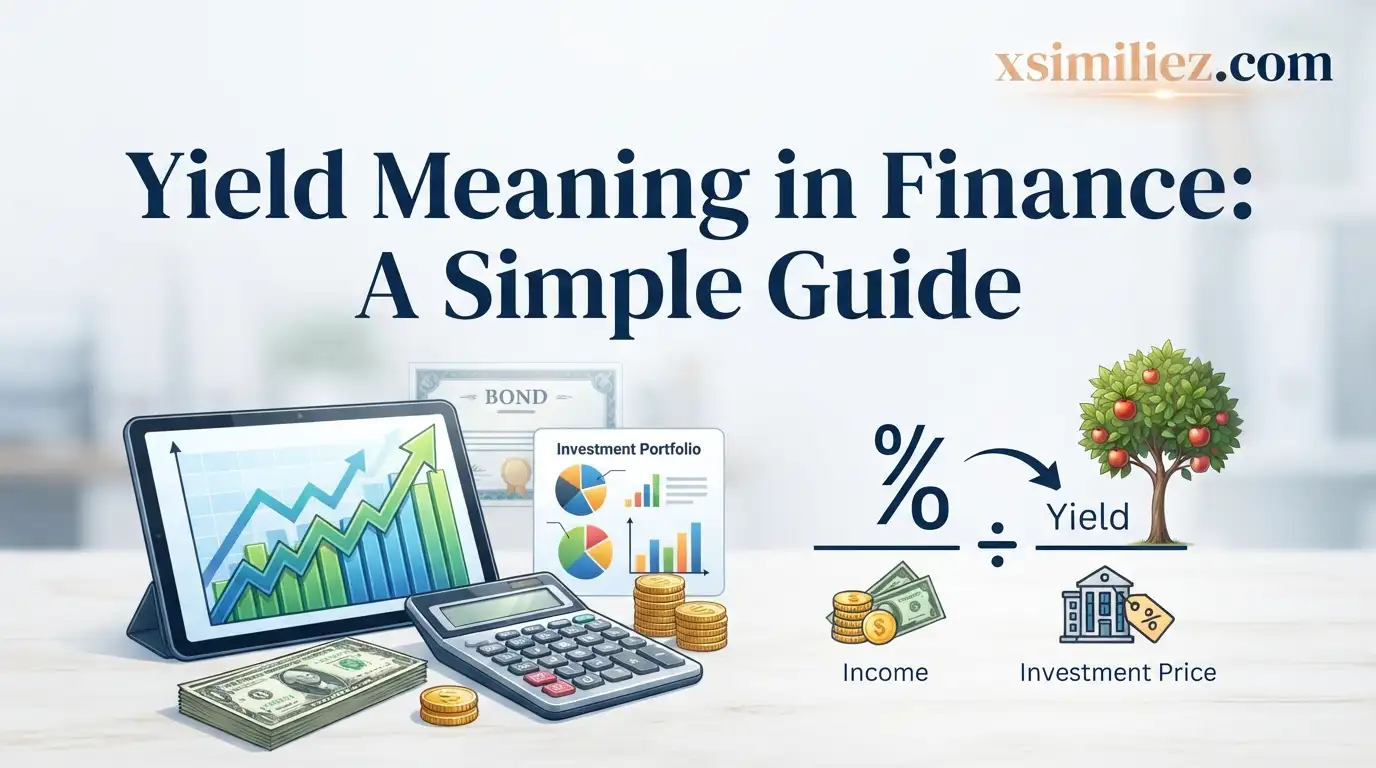
Yield meaning in finance is simple. It is the income an investment pays you each year, shown as a percent of its price. If you buy a $100 investment and it pays $5 a year, the yield is 5%. It tells you how much cash the investment produces, not how much its price goes up or down.
You will see the word yield everywhere. Bond news, savings ads, stock pages, and rental talk all use it. Many people search for it because it sounds hard, and a wrong idea can cost real money.
In this guide, you will learn what yield means, how to figure it out, and the main types. You will also see real examples, common mistakes, and easy tips.
Quick Answer: Yield Meaning in Finance
Yield is the income earned on an investment, shown as a percent of its cost or current price. It is almost always stated per year. The basic formula is yearly income divided by price, times 100.
Yield does not include price changes. If a stock price jumps, that gain is not part of the yield. Only the cash payments count, such as interest, dividends, or rent. That is why yield and total return are different things.
Think of an apple tree. The yield is the apples you pick each year. If the tree itself is worth more or less is a separate story.
What Yield Means in Simple Words
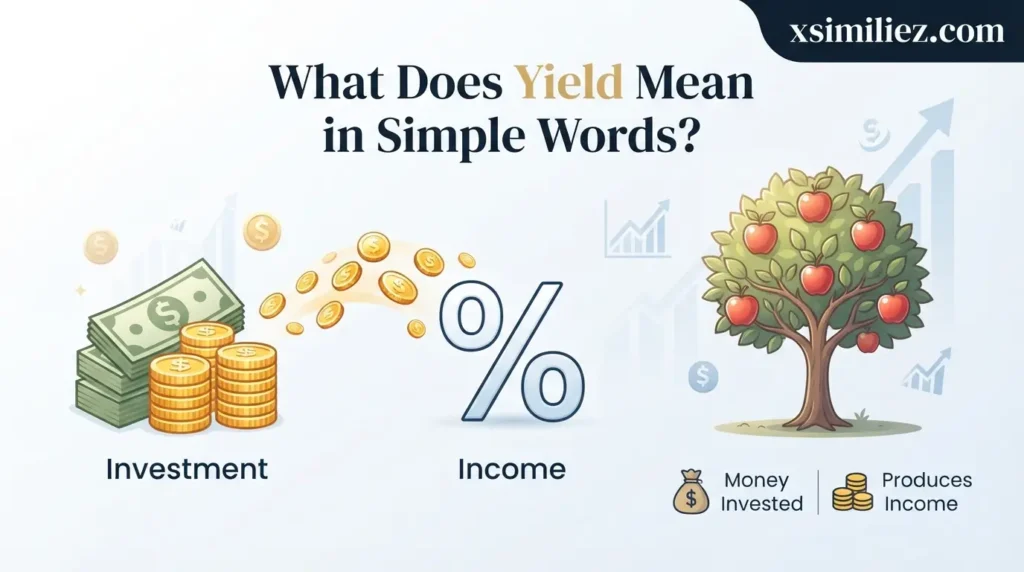
Yield answers one question: “How much cash does this thing pay me for the money I put in?” A higher yield means more cash for each dollar invested. A lower yield means less.
The word itself is old. It comes from an Old English word meaning “to pay.” That fits well, because yield is about what an investment pays back to you. Farmers also use the word for how much a crop produces, and the money works the same way.
Yield is a rate, not a dollar amount. Say one bond pays you $50 a year and another pays you $80. The second one looks better at first. But if the second bond costs $2,000 and the first costs $1,000, the first bond has a higher yield. Turning cash into a percent makes fair comparisons possible.
Yield is also a snapshot. It can change from day to day because prices change. A bond that yields 4% today may yield 5% next month if its price drops. This is one of the most important ideas to remember, and we will come back to it.
How to Calculate Yield Step by Step
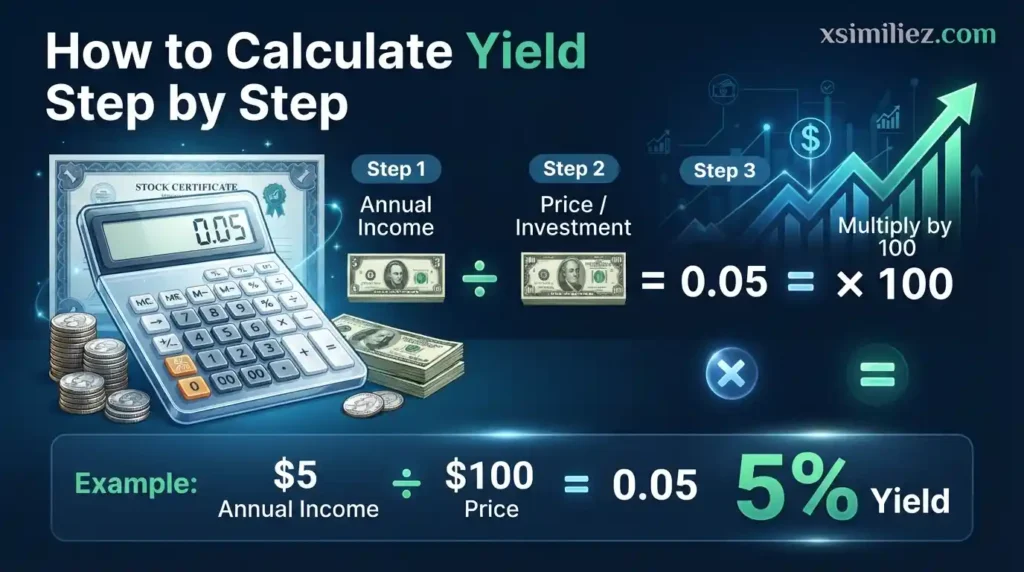
The math is friendly. You only need two numbers: the income you get in a year and the price of the investment.
Here is the formula: Yield = (Annual Income ÷ Price) × 100.
Let’s try an example. You buy a share of stock for $50. The company pays $2 in dividends each year. Divide $2 by $50 and you get 0.04. Multiply by 100 and the yield is 4%.
Now try a bond. A bond has a face value of $1,000 and pays 5% interest, which is $50 a year. If you pay $1,000 for it, the yield is 5%. If you buy it on the market for $950, the yield is $50 ÷ $950, or about 5.26%. If the price rises to $1,050, the yield falls to about 4.76%. The payment stayed the same, but the price changed, so the yield changed too.
Which price should you use? It depends on what you want to learn. Using the current price shows what a new buyer would earn today. Using your original cost shows what you are earning on the money you first put in. Both are useful. Just be clear about which one you are looking at.
Main Types of Yield You Should Know
Finance uses the word yield in many ways. Each type fits a different kind of investment. The table below gives a quick view.
| Type of Yield | What It Measures | Simple Formula or Idea |
| Dividend yield | Stock dividends compared to share price | Yearly dividends ÷ share price |
| Current yield | A bond’s yearly interest compared to its price | Yearly interest ÷ bond price |
| Yield to maturity | Total expected yield if a bond is held until it ends | Uses interest, price, and time left |
| Rental yield | Rent compared to property price | Yearly rent ÷ property price |
| Earnings yield | Company profit compared to share price | Earnings per share ÷ share price |
| APY | Savings interest, including compounding | Interest plus interest on interest |
| SEC yield | Standard yield for bond funds | A 30-day method set by rules |
Let’s look at a few of these more closely. Dividend yield is popular with people who want steady income from stocks. Rental yield is popular with people who buy property. APY shows up on savings accounts and certificates of deposit. It matters because it counts compounding, meaning you earn interest on your interest.
Earnings yield is a bit different. It flips the well-known price-to-earnings ratio upside down. If a stock has a P/E of 20, its earnings yield is 1 ÷ 20, or 5%. Some investors use it to compare stocks with bonds.
Fund yields deserve a quick note. The SEC yield gives investors one standard way to compare bond funds, because the method is the same for every fund. That makes it easier to line them up side by side.
Bond Yield Explained
Bonds are where the word yield gets the most use. When you buy a bond, you lend money to a company or a government. In return, you get regular interest payments and your money back at the end.
The interest rate on a bond, called the coupon rate, is fixed when the bond is created. But the yield moves. That is because bonds trade on the market, and their prices go up and down.
Here is the key rule: bond prices and yields move in opposite directions. When the price falls, the yield rises. When the price rises, the yield falls. Picture a seesaw. This happens because the payment is fixed. Paying less for the same payment gives you a bigger percent.
Yield to maturity is the number many bond investors watch most. It estimates your total yearly gain if you hold the bond until it ends. It counts the interest payments, any gap between what you paid and the final payoff, and the time left. It assumes the issuer pays as promised.
You may also hear about the yield curve. It is a line that shows yields on bonds of different lengths, such as three months, two years, and ten years. Usually, longer bonds pay more. Sometimes short bonds pay more than long ones. That is called an inverted yield curve, and it has often shown up before economic slowdowns. It is a warning sign that people watch, not a promise of what will happen.
Dividend Yield and Stocks
Some companies share part of their profit with owners. That payment is called a dividend. Dividend yield shows how big that payment is compared to the share price.
A stock priced at $100 that pays $3 a year has a 3% dividend yield. Older, steady companies often pay dividends. Fast-growing companies often keep their profits to grow the business, so their yields may be low or zero.
There is one trap here. A high dividend yield is not always good news. Remember the seesaw. If a stock price crashes, the yield jumps, even if the dividend did not change. Sometimes the market is sending a signal that the company is in trouble. If the company cuts its dividend later, the high yield you saw disappears.
That is why smart investors look at more than the number. They ask if the company earns enough profit to keep paying. They also check if the dividend has been steady over many years. A modest yield that lasts is often better than a big yield that vanishes.
Yield vs. Return vs. Interest Rate
These three words get mixed up all the time. They are related, but they are not the same. This table clears it up.
| Term | What It Means | Includes Price Changes? |
| Yield | Income earned compared to price | No |
| Total return | All gains: income plus price change | Yes |
| Interest rate | The rate set on a loan or bond | No |
Here is a way to see the difference. Say you buy a stock for $100. It pays $3 in dividends, and its price rises to $107 by year end. Your yield is about 3%. Your total return is 10%, because you gained $3 in income and $7 in price.
Now flip it. The stock pays $3, but the price drops to $95. Your yield still looks like 3%. Your total return is negative 2%, because you lost $5 in price and gained $3 in income. This is why yield alone never tells the whole story.
The interest rate is the rate written into a loan or bond. The yield on that bond may be different if you bought it above or below its face value.
Real-Life Examples of Yield
Examples make ideas stick, so let’s walk through four.
A savings account. A bank offers 4% APY on a savings account. You put in $1,000. After one year, you would have about $1,040. That 4% is a yield, and it is fairly safe because deposits are often insured up to set limits. Rates like this change over time, so always check today’s offer.
A rental home. Maria buys a small house for $200,000. She rents it for $1,000 a month, which is $12,000 a year. Her gross rental yield is $12,000 ÷ $200,000, or 6%. After taxes, repairs, and insurance, her real yield will be lower. That is a good reminder that some yields are “gross” and some are “net.”
A stock. James buys 100 shares at $40 each. The company pays $1.60 per share each year. His dividend yield is $1.60 ÷ $40, or 4%. He gets $160 a year, no matter what the price does day to day, as long as the company keeps paying.
A bond. A city sells a bond for $1,000 with a 3% coupon. When interest rates rise elsewhere, new bonds pay more, so the price of the old bond drops to $920. A buyer now pays $920 and still gets $30 a year. The current yield is about 3.26%. Same bond, different yield.
Why Yield Matters to Investors
Yield helps you compare choices on equal terms. Without it, you would be stuck comparing dollars from very different investments.
It also helps people who live on investment income. Retirees, for example, often want steady cash. Yield shows how much cash to expect for each dollar invested. It also helps planners guess how large a portfolio they need to cover their bills.
Yield can also tell you what the market thinks. When many buyers rush into a bond, its price rises and its yield falls. When buyers run away, prices fall and yields rise. Watching yields gives you a small window into how confident or nervous people are.
Finally, yield helps you judge risk. In general, higher yields come with higher risk. A safe government bond may pay a small yield. A bond from a shaky company must pay more to attract buyers. That is why bonds from weaker companies are called high-yield bonds. The yield is high because the risk is high.
Common Mistakes About Yield Meaning in Finance
Even careful people slip up here. Watch out for these traps.
Chasing the highest number. A very high yield is often a warning. Ask why the yield is so high before you buy. The answer is often a falling price or a risky borrower.
Mixing up yield and total return. Yield only counts income. If the price falls a lot, a nice yield may still leave you with a loss.
Forgetting that yield changes. A yield you see today is not locked in unless you buy a fixed product and hold it to the end. Stock dividends can be cut. Bond yields move with prices.
Ignoring inflation. If your yield is 3% and prices rise 3%, you have not really gained buying power. Some people call the difference the real yield. It is your yield minus inflation.
Ignoring taxes and fees. Your take-home yield may be lower than the number on the screen. Fund fees, property costs, and taxes all eat into it.
Comparing different kinds of yield. An APY on a savings account and a dividend yield on a stock are not the same thing. They carry different risks. Compare them with care.
Current Usage and Trends

Yield is a hot word whenever interest rates move. When central banks raise rates, yields on new bonds and savings products usually rise. When rates fall, yields usually fall too. News outlets often report on the yield of U.S. Treasury bonds, especially the ten-year note, because it acts as a benchmark for many other rates, including home loans.
Because yields change often, exact numbers in any article go out of date fast. For today’s figures, check a live source such as the U.S. Department of the Treasury or your bank’s website.
Another trend is that more everyday investors use funds that focus on income. Bond funds, dividend funds, and money market funds all advertise their yields. That makes it even more important to read the fine print and know which yield is being shown.
Tips for Using Yield Wisely
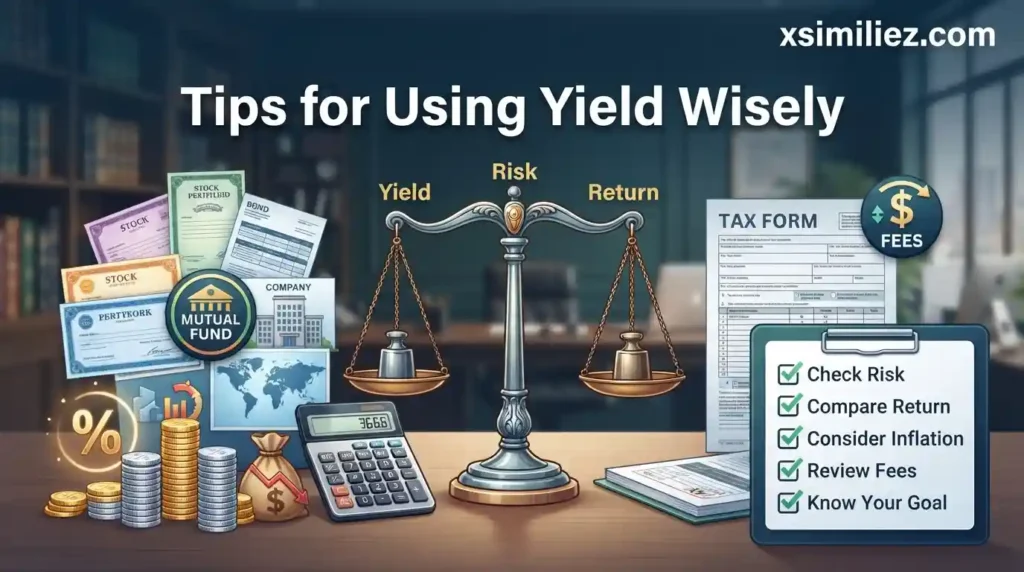
Start by asking what kind of yield you are looking at. Is it current yield, yield to maturity, or APY? The name matters.
Next, look at the full picture. Check the price trend, the risk, and the total return, not just the yield. A steady, fair yield from a strong borrower often beats a flashy one.
Spread your money around. If you hold different kinds of investments, one weak yield will not hurt as much. Also think about your goals. Need cash now? Focus on income. Saving for the long run? Growth may matter more than yield.
Always subtract taxes, fees, and inflation in your head. That gives you a more honest number. Finally, remember that this article is for learning and is not personal financial advice. For big choices, talk with a licensed financial advisor.
FAQs
What is the simple meaning of yield in finance?
Yield is the income an investment pays each year, shown as a percent of its price. It counts interest, dividends, or rent, but not price changes.
Is a higher yield always better?
No. A high yield often means higher risk. It can also happen when a price falls sharply. Always ask why the yield is high before you invest.
What is the difference between yield and interest rate?
An interest rate is the rate set on a loan or bond. Yield is what you actually earn compared to the price you pay, which can be different if the price changes.
What is yield to maturity?
It is the total yearly return you would earn on a bond if you hold it until it ends. It counts interest payments and any gain or loss between your price and the payoff.
How do you calculate dividend yield?
Divide the yearly dividend per share by the share price, then multiply by 100. A $2 dividend on a $50 stock gives a 4% yield.
Is yield the same as return?
No. Yield only counts income. Return, or total return, counts income plus any change in price. A stock can have a good yield and still lose money if its price drops.
Conclusion
The yield meaning in finance comes down to one idea: how much income you earn for the money you put in. It is shown as a percent so you can compare a bond, a stock, a savings account, and a rental home on fair terms.
Remember the big lessons. Yield leaves out price changes. It moves in the opposite direction of bond prices. And a very high yield can be a warning sign, not a prize.
Use yield as one helpful tool, not the only one. Check the risk, the total return, taxes, fees, and inflation. Take your time, ask questions, and match your choices to your goals. That is the smartest way to put the yield meaning in finance to work for you.

Hi, I’m Harper Blake, and I write for Xsimiliez.com. I enjoy sharing clear and friendly simile examples that students and beginners can understand easily. My goal is to make English learning simple and enjoyable.