
“Saved by the bell” is simple. It describes a person who gets rescued from a bad moment at the very last second by something unexpected. A school bell rings before a pop quiz starts. A phone call stops an argument. Trouble ends just in time.
You have probably heard this phrase in movies, at school, or from a grandparent. It sounds fun, but many people wonder where it came from and when to use it. Some even mix it up with the famous TV show from the 1990s.
In this guide, you will learn what the phrase means, how to use it in a sentence, where it started, and which mistakes to avoid. You will also see real examples and easy tips to help you remember it.
Quick Answer: Saved by the Bell Meaning in One Minute
If you only need the short version, here it is. The saved by the bell meaning is ‘rescued at the last second.’ Someone is in trouble, and then a bell, a buzzer, a call, or a lucky break stops the trouble before it gets worse. The person did not fix the problem. Time or chance did it for them.
Think of a student who did not study for a test. The teacher starts calling on people to read their answers out loud. Just before it is the student’s turn, the school bell rings. The student was saved by the bell. The problem is still there, but it has to wait for another day.
That last part matters. The phrase usually means a short break, not a full fix. The trouble might come back later. That is why people often say it with a smile or a sigh of relief.
Saved by the Bell Meaning and Definition Explained
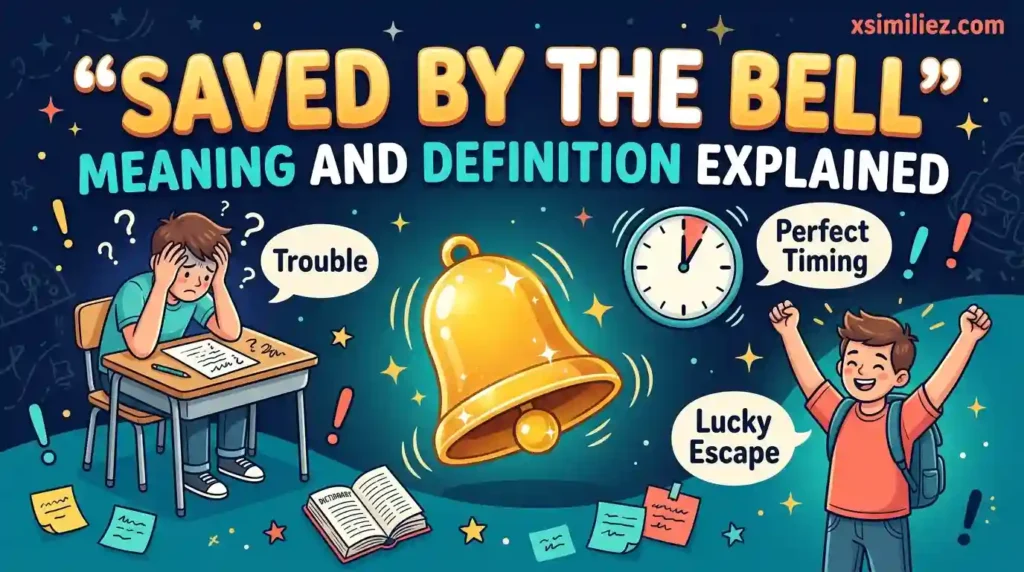
An idiom is a group of words that means something different from what the words say alone. ‘Saved by the bell‘ is a classic example. Nobody is truly being saved, and a real bell does not have to be involved. The phrase paints a picture in your mind, and that picture stands for a lucky escape.
Dictionaries describe it as being rescued from trouble by a sudden event right at the last moment. In everyday talk, people use it in a light and friendly way. It is casual language, the kind you hear at the dinner table, on the playground, and in the break room.
Three ideas sit inside this meaning. First, there is trouble. Second, the timing is almost perfect. Third, the rescue comes from outside, not from the person’s own smart move. The table below breaks it down.
| Part of the Meaning | What It Looks Like | Example |
| Trouble | Something bad or awkward is about to happen | A pop quiz, an argument, a hard question |
| Perfect timing | The rescue arrives at the last moment | The bell rings, the phone buzzes |
| Outside help | The person did not cause the rescue | Luck, a friend, a clock |
If one of these parts is missing, the phrase may not fit. For example, if you solve a hard problem with your own skill, you were not saved by the bell. You did the work yourself.
Grammar and Correct Usage of Saved by the Bell Meaning
The grammar for this phrase is easy. Most of the time, people use it in the passive voice. That means the action is done to the subject. In ‘I was saved by the bell,’ the bell does the saving, and I am the one who gets saved. The word ‘saved’ is the past participle of ‘save,’ and the word ‘by’ points to the helper.
You can use the phrase in several ways. The table shows the most common forms.
| Form | Example | Notes |
| I was saved by the bell. | I was saved by the bell when class ended. | Past tense. This is the most common form. |
| He got saved by the bell. | He got saved by the bell during the quiz. | Very casual and friendly. |
| The bell saved her. | The bell saved her from a hard question. | Active form. Less common, but still clear. |
| Saved by the bell! | Phew! Saved by the bell! | A short cry of relief. |
| We might be saved by the bell. | We might be saved by the bell if the meeting runs long. | Talks about maybe. |
Write it as four words with no hyphens: saved, by, the, bell. Do not use capital letters unless the phrase starts a sentence. The only time you capitalize the main words is when you mean the TV show, as in Saved by the Bell. Also, keep the word ‘the’ in the middle. ‘Saved by bell’ sounds wrong to most readers.
This idiom is informal. It fits emails to friends, stories, light speeches, and social media. In a legal paper, a medical report, or a business contract, pick a plainer phrase such as ‘a timely interruption.’
Origin of the Saved by the Bell Meaning: Boxing and Beyond

Most word experts point to boxing. In a boxing match, a bell rings to end each round. If a fighter is hurt and about to lose, the bell can come just in time. The fighter gets a short rest, a drink of water, and advice from the corner. In a way, the bell really did save him.
Writers began using the phrase in print in the late 1800s. One major dictionary gives 1893 as its first known use. Over time, people took the words out of the ring and used them in daily life. Today the phrase can describe any lucky break at the last minute.
You may also hear a different story. It says people once feared being buried alive, so they tied a bell to the coffin, and someone could ring it for help. The tale is fun, but researchers have found no proof that the phrase came from it. Since reliable evidence is missing, it is safest to treat the coffin story as a myth.
Another idea links the phrase to school bells that end class. That use is real and very common today. Still, the boxing link is older and is the one most experts trust. The honest answer is that nobody can name the exact first person who said it.
Saved by the Bell Meaning in American vs British English
Here is the good news. You do not need to worry about spelling or meaning. The phrase is written the same way in American and British English, and major dictionaries on both sides of the Atlantic list it. People in the United States, the United Kingdom, Canada, and Australia all understand it.
The small differences are about feeling and habit. In the United States, many people connect the phrase with school, because school bells are such a big part of daily life. The 1990s TV show also made the words even more famous there. Speakers in the United Kingdom understand the phrase just as well, and they may also reach for other sayings, such as ‘in the nick of time,’ when they talk about last-minute moments.
Because the words stay the same, you can use the phrase with readers anywhere. If you write for an American audience, simple school or sports examples work best. If you write for a mixed audience, a boxing or classroom example is easy for everyone to picture.
Common Mistakes With the Saved by the Bell Meaning
Even a simple phrase can trip people up. Here are the mistakes seen most often.
The first mistake is taking the words too literally. Some learners think a real bell must ring. It does not. A text message, a knock on the door, or a fire drill can all do the job.
The second mistake is using the phrase when no trouble exists. If a bus arrives right on time, you were lucky, but you were not rescued from anything. ‘Saved by the bell’ needs a problem to escape.
The third mistake is changing the words. People sometimes write ‘saved by the bells,’ ‘saved by a bell,’ or ‘saved from the bell.’ Those versions sound off. Stick with the original wording.
The fourth mistake is using the phrase for a serious tragedy. If someone survived a real accident, the phrase can feel too jokey. Choose kinder words, such as ‘lucky escape,’ in those moments.
The fifth mistake is thinking the problem is gone for good. Usually the trouble only waits. The student with unfinished homework still has homework after the bell rings.
Last, some people confuse the idiom with the TV show. The show borrowed the idiom for its title, but they are not the same thing. One is a saying. The other is a series about teenagers.
Real-Life Examples of Saved by the Bell Meaning
Examples make any idiom easier to remember, so let us look at a few from daily life.
At school, Maya had not finished the book. Her teacher asked her to explain the ending. Just as she opened her mouth, the bell rang. She grinned and whispered, ‘Saved by the bell.’
At work, Carlos was in a meeting when his boss asked why a report was late. Before he could answer, the time ran out and everyone stood up to leave. Carlos had a few more hours to finish the report. He was saved by the bell, even though no bell rang.
At home, two brothers were arguing about who got to use the game console. Their mother called them to dinner. The fight stopped right there. Both boys felt saved by the bell, and both knew the argument might start again later.
In sports, a basketball team was losing badly at the end of the first half. The other team was getting hot. Then the halftime horn sounded, and the losing team could breathe. A sports writer might say they were saved by the bell. You may also hear ‘saved by the buzzer’ in this case.
In money matters, a man was about to miss a bill deadline. That very morning, a tax refund landed in his account. The bill got paid on time. In a loose and friendly way, you could say a lucky break saved him at the last moment.
Notice the pattern in every story. There is trouble, the timing is tight, and help comes from outside.
Current Usage and Pop Culture: Saved by the Bell Meaning Today
The phrase is alive and well. People use it in headlines, jokes, sports talk, and social media posts. A sports writer might say a team was saved by the bell when the final horn blew before the other side could score. A comedian might use it when a boring talk ends early.
Much of the phrase’s modern fame comes from the TV show Saved by the Bell. It followed a group of teens at Bayside High School, including Zack Morris, Kelly Kapowski, A.C. Slater, Jessie Spano, Lisa Turtle, and Screech Powers. The series began on NBC in 1989 and grew out of an earlier Disney Channel show called Good Morning, Miss Bliss. It aired on Saturday mornings and is still loved through reruns. Where you can stream it changes over time, so check your favorite service. A new version arrived on the Peacock streaming service in 2020, and it introduced the title to a fresh group of viewers.
Because of the show, many young people first meet the words as a title, not as an idiom. That is one reason so many people search for the meaning. If you see the phrase in a headline today, check whether it talks about the show or about a lucky escape. The rest of the sentence usually tells you right away.
Phrases That Match the Saved by the Bell Meaning
English has many sayings about close calls. Some are almost the same as ‘saved by the bell,’ and some are only cousins. The table helps you pick the best one.
| Phrase | What It Means | How It Differs |
| Saved by the buzzer | Rescued at the last second, often in sports or games | Uses a buzzer sound instead of a bell |
| In the nick of time | Just barely on time | Does not always mean escaping trouble |
| By the skin of your teeth | Barely managed to succeed or survive | Focuses on a narrow win, not an outside rescue |
| Dodge a bullet | Avoid something bad | You may have chosen to avoid it yourself |
| Off the hook | Freed from blame or a duty | No tight timing needed |
| A close call | Almost had a bad result | No rescue is needed |
So which one should you pick?
When something outside stops a problem at the very last moment, ‘saved by the bell’ is the best fit. To say you just barely made it, ‘in the nick of time’ works well. And if your own smart choice helped you avoid trouble, ‘dodged a bullet’ is closer.
Using a variety of phrases also keeps your writing fresh. Nobody wants to read the same idiom five times in one story.
Tips and Best Practices for Using Saved by the Bell Meaning

Here are some easy ways to use the phrase well and remember it for good.
Picture a clock at the very last second. The room is tense, then a bell rings, and everyone relaxes. If you can see that picture, you will never forget the meaning.
Match the phrase to a small problem. It works best for pop quizzes, tough questions, short arguments, and tight deadlines. For big, painful events, pick gentler words.
Check that you did not cause the rescue. If your own quick thinking solved the issue, ‘saved by the bell‘ is not the right fit. If the clock, a call, or luck did it, you are on track.
Keep the wording exactly the same. Say ‘saved by the bell,’ not any other version. Idioms work because everybody knows the same words.
Add a tiny story. A phrase lands better when it comes with a mini scene, such as ‘The teacher was about to call on me when the bell rang.’ The story shows the meaning without extra explaining.
Practice with three sentences of your own. Write one about school, one about work, and one about home. This small habit helps the phrase stick.
Finally, if you teach children or English learners, explain the idiom the first time you use it. Many learners think the words are about a real bell, so a quick note saves confusion.
FAQs
What does saved by the bell mean?
It means being rescued from a bad or awkward situation at the last moment by something unexpected. The trouble stops just in time, but it may return later. It is an idiom, so the words are not meant to be taken literally.
Where does the phrase saved by the bell come from?
Most experts link it to boxing, where a bell ends a round and can rescue a hurt fighter. It appeared in print in the late 1800s. The story about bells on coffins has no solid proof, so treat it as a myth.
Does a real bell have to ring?
No. A bell is only part of the picture. A phone call, a knock, a horn, an alarm, or a lucky event can all save the day. What matters is the last-second rescue from trouble.
Is saved by the bell formal or informal?
It is informal. It works well in friendly emails, stories, and conversation. In formal papers, such as contracts or reports, use plain words like ‘a timely interruption’ instead.
Is saved by the bell the same as saved by the buzzer?
They are very close. Both describe a rescue at the very last second. ‘Saved by the buzzer’ is more common in sports and games, while ‘saved by the bell’ is common in school, boxing, and daily life.
Is the TV show Saved by the Bell the same as the idiom?
No. The show is a teen comedy about students at Bayside High School that began on NBC in 1989. It took its title from the idiom. When the words appear in capital letters as a title, people usually mean the show.
Conclusion
Now you know the saved by the bell meaning from start to finish. It describes a last-second rescue from trouble, usually by something outside your control. A school bell, a phone call, or plain luck can do it. The problem might still be waiting, but you got a break.
We also learned that the phrase most likely comes from boxing, where a bell can end a round and protect a tired fighter. The coffin story is a fun tale without proof. The TV show made the words famous, but the idiom is much older than the show.
Here is the best practical advice. Use the phrase for small, light moments, keep the wording exactly as it is, and make sure an outside event did the saving. Do that, and your writing and speaking will sound natural, friendly, and clear.

Hi, I’m Harper Blake, and I write for Xsimiliez.com. I enjoy sharing clear and friendly simile examples that students and beginners can understand easily. My goal is to make English learning simple and enjoyable.