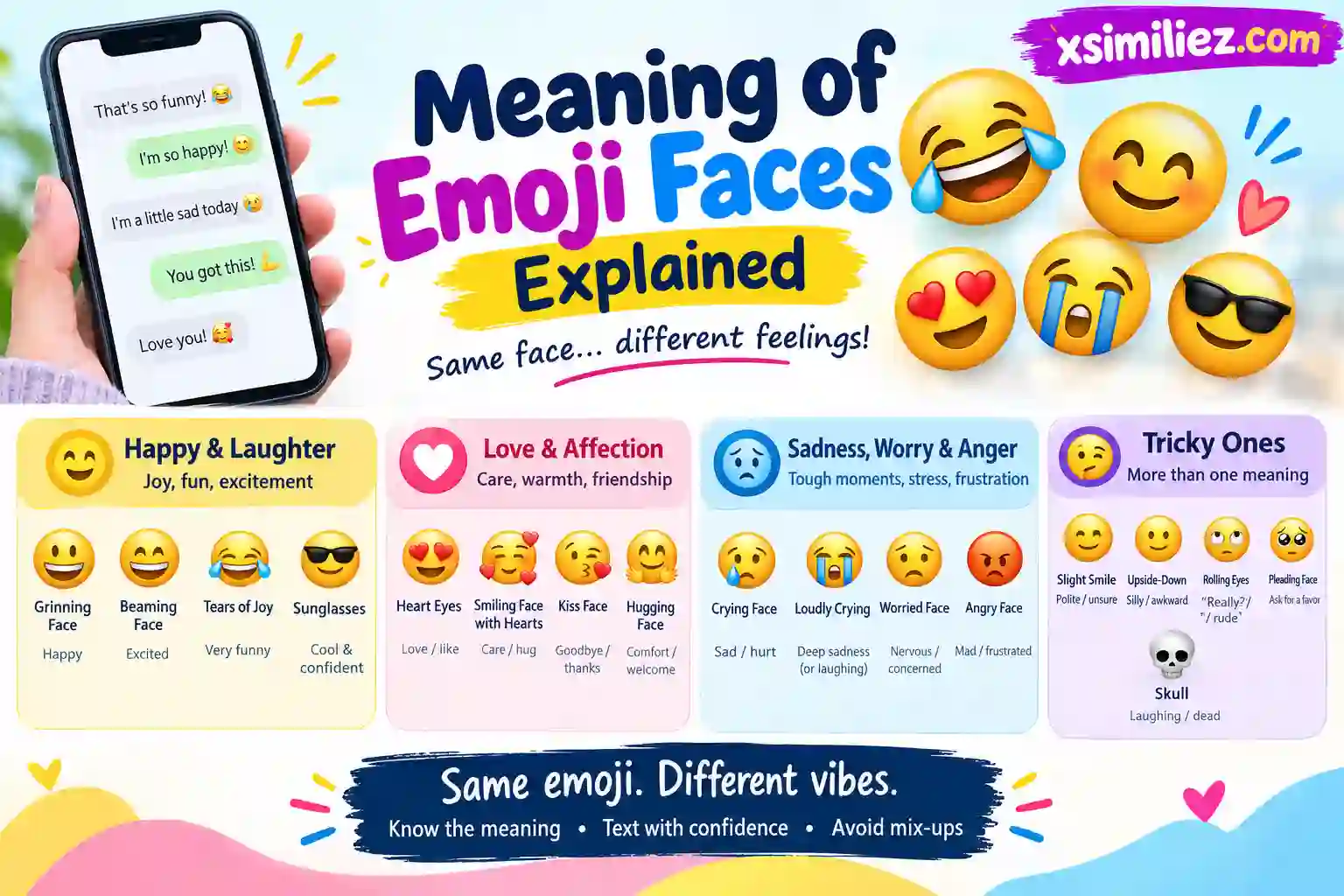
The meaning of emoji faces is simple: each little face shows a feeling, a mood, or a reaction in a message. A smile shows joy, a crying face shows sadness, and an angry face shows frustration. Still, some faces can mean more than one thing, so the words around them matter.
Have you ever sent a face emoji and then wondered if it sounded rude? You are not alone. Millions of people use emojis every day, yet the same face can feel friendly to one person and odd to another. That is why so many people search for what these faces really mean.
In this guide, you will learn what the most popular faces mean, where emojis came from, which mistakes to avoid, and how to pick the right face every time. Let’s get started.
Meaning of Emoji Faces: The Basics
Emoji faces are tiny pictures that show how a person feels. People add them to texts, posts, and emails because plain words can sound flat. A smile can turn a short ‘Okay’ into a warm reply. A sad face can show that you care. In real life, we use our faces and voices to share feelings. Online, emojis do that job.
Every emoji has an official name chosen by a group called the Unicode Consortium. For example, 😀 is called Grinning Face, and 😢 is called Crying Face. Many people use their own names for them, though. Real life is messy, and so is slang.
One more thing is worth knowing. Emojis can look different on different phones. An iPhone, a Samsung phone, and a Google phone each draw their own version. The feeling is usually close, but the look can change. A face that seems cheerful on one phone may look a little nervous on another. If you are not sure how your emoji will look, keep the message clear in words, too.
Meaning of Emoji Faces That Show Happiness and Laughter
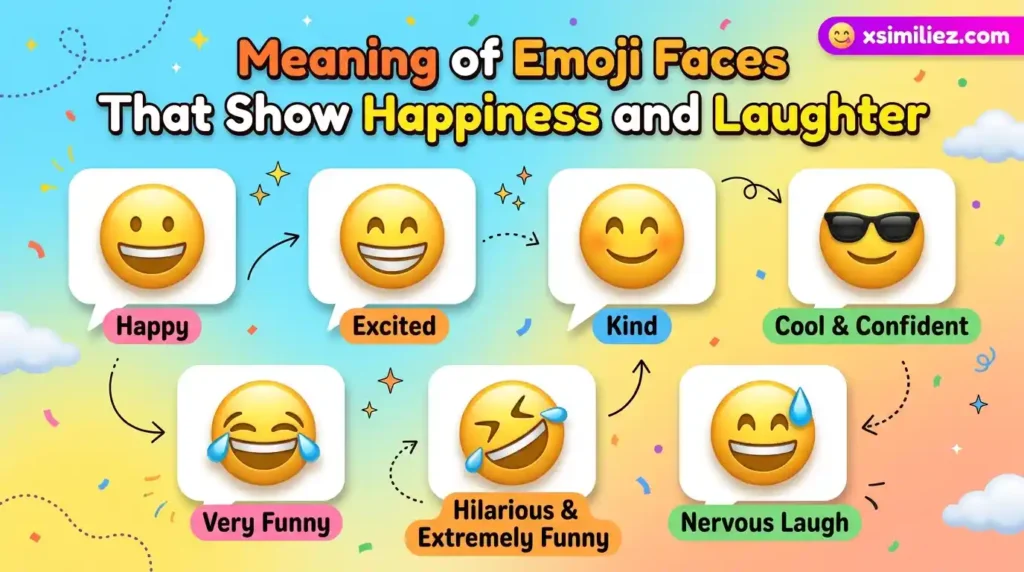
Happy faces are the most popular ones. They make up a big part of what people send. Yet even among smiling faces, small details change the message.
The plain smile, 🙂, is a calm and gentle face. It often means ‘I’m fine’ or ‘Thanks.’ The bigger smile, 😀, shows more joy, and 😁 looks even more excited, with a wide grin and teeth. The face with smiling eyes, 😊, is often seen as the warmest of the group. It feels kind and sincere.
For laughing, people have many choices. 😂 shows tears of joy, which means something was very funny. 🤣 shows someone rolling on the floor, which means something was extremely funny. 😆 shows a squinting laugh, and 😅 shows a nervous laugh with a drop of sweat. You might use 😅 after a small mistake, like when you forget a friend’s birthday and show up late with a gift.
The table below gives a quick look at common happy faces.
| Emoji | Official Name | Common Meaning |
| 🙂 | Slightly Smiling Face | Calm, polite, or okay |
| 😀 | Grinning Face | Happy and friendly |
| 😁 | Beaming Face With Smiling Eyes | Very pleased or excited |
| 😊 | Smiling Face With Smiling Eyes | Warm, kind, and thankful |
| 😂 | Face With Tears of Joy | Something is very funny |
| 🤣 | Rolling on the Floor Laughing | Something is hilarious |
| 😅 | Grinning Face With Sweat | Relief or a nervous laugh |
| 😎 | Smiling Face With Sunglasses | Cool, confident, or proud |
Meaning of Emoji Faces That Show Love and Affection
Some faces are made for kind and loving messages. They are great for friends, family, and people you care about.
😍 has heart-shaped eyes. It shows that you love something or think it looks amazing. You might send it when a friend shares a photo of a new puppy. 🥰 shows a smiling face with little hearts floating around it. It feels softer and more caring, like a warm hug in a picture.
😘 is a face blowing a kiss. People often use it to say goodbye or thank you to close friends and family. It can also be used in a romantic way, so think about who is getting the message. 🤗 shows a face with open hands, like a hug. It is a good choice when a friend needs comfort or when you want to say welcome.
Then there is 🥹, which many people call the face holding back tears. It shows that someone is touched or moved. You might use it after reading a sweet message from a friend. It can feel emotional and happy at the same time.
A good rule is to match the face to your bond with the person. A hug emoji sent to a close friend feels sweet. The same one sent to a new boss might feel a little too friendly.
Meaning of Emoji Faces for Sadness, Worry, and Anger
Not every message is cheerful. Sometimes you need a face that fits a harder moment. These emojis help people share sadness, stress, or frustration without writing a long message.
😢 shows a single tear and means plain sadness. 😭 shows a face crying loudly. Most of the time it means deep sorrow, but many younger people also use it to mean ‘I’m laughing so hard I’m crying’ or ‘this is too cute to handle.’ 😞 and 😔 look down and disappointed. 😟 shows worry, and 😰 shows worry with a cold sweat.
For anger, 😠 is an angry face, and 😡 is a red, pouting face that shows stronger anger. 🤬 shows a face with symbols over the mouth, which stands for swearing. 😤 shows a face with steam from the nose. Many people use it to mean ‘I’m determined’ rather than ‘I’m furious,’ so it can be a little confusing.
| Emoji | Official Name | Common Meaning |
| 😢 | Crying Face | Sad or hurt |
| 😭 | Loudly Crying Face | Very sad, or laughing too hard |
| 😞 | Disappointed Face | Let down |
| 😟 | Worried Face | Nervous or concerned |
| 😰 | Anxious Face With Sweat | Stressed or afraid |
| 😠 | Angry Face | Annoyed or mad |
| 😡 | Enraged Face | Very angry |
| 😤 | Face With Steam From Nose | Frustrated or determined |
When you are upset, be careful about sending an angry emoji. A red face can feel much harsher on a screen than it would in person.
Tricky Emoji Faces With More Than One Meaning
Some faces cause the most confusion. Their meaning depends on who is sending them and who is reading them.
Take 🙂 again. Many people mean it as a simple, polite smile. But some readers feel it looks fake or cold, like a smile that hides annoyance. If you want to sound warm, 😊 is usually safer.
🙃 is the upside-down face. It can mean silliness or a joke. It can also mean ‘this is awkward’ or ‘I’m pretending everything is fine.’ The mood of the whole message tells you which one it is.
🙄 shows rolling eyes. It means ‘Oh, please’ or ‘Really?’ and it can feel rude if the other person is not in on the joke. 😏 is a smirk. It can be playful, flirty, or a little smug. 😒 looks unamused and says ‘I’m not impressed.’
🥺 is the pleading face, with big puppy-dog eyes. People use it to ask for a favor or to show they feel soft and sweet. 🫠 is the melting face. It shows embarrassment, stress, or feeling like you want to disappear. And 💀, though it is a skull and not a face in the strict sense, is often used by younger people to say ‘I’m dead’ from laughing.
Because these faces can be read in different ways, it helps to use them with people who know your style. If you are not sure, pick a simpler emoji or add a few words.
Where Emoji Faces Came From
The word emoji does not come from the word emotion. That is a common mix-up. It comes from Japanese words that mean picture and character. In 1999, a designer named Shigetaka Kurita made a set of 176 tiny emojis for a Japanese mobile phone service called i-mode. They were just 12 by 12 pixels, but they helped people share feelings in short messages.
Before that, people used text faces, also called emoticons, like 🙂 and :-(. These were made from letters and symbols. The smiley face itself goes back even further. Artist Harvey Ball drew the famous yellow smiley in 1963.
Emojis spread beyond Japan once Unicode, the group that sets text standards for computers, added them to its system in 2010. Apple put an emoji keyboard on the iPhone in 2011, and the rest of the world soon caught on. In 2015, the Oxford Dictionaries picked 😂 as its Word of the Year, which shows how big emojis had become.
Common Mistakes When Using Emoji Faces
Emojis are fun, but a few small slips can cause big confusion. Here are the mistakes people make most often.
The first mistake is using too many. A message with ten faces can feel messy and hard to read. One or two is usually enough. The second mistake is using a face that does not match the topic. Sending 😂 after bad news can seem unkind, even if you did not mean it that way.
Another mistake is guessing what a face means. If you have not seen an emoji used before, take a moment to look it up. Plenty of people have sent 😬 thinking it was a big smile, when it really shows a nervous grimace. People also forget that the audience matters. A teen friend, a grandparent, and a coworker may all read the same face in different ways.
Finally, some people use emojis to replace words that need to be said clearly. If you need to say sorry, a sad face alone is not enough. Write the words, then add the face if you like.
Real-Life Examples of Emoji Faces in Texts
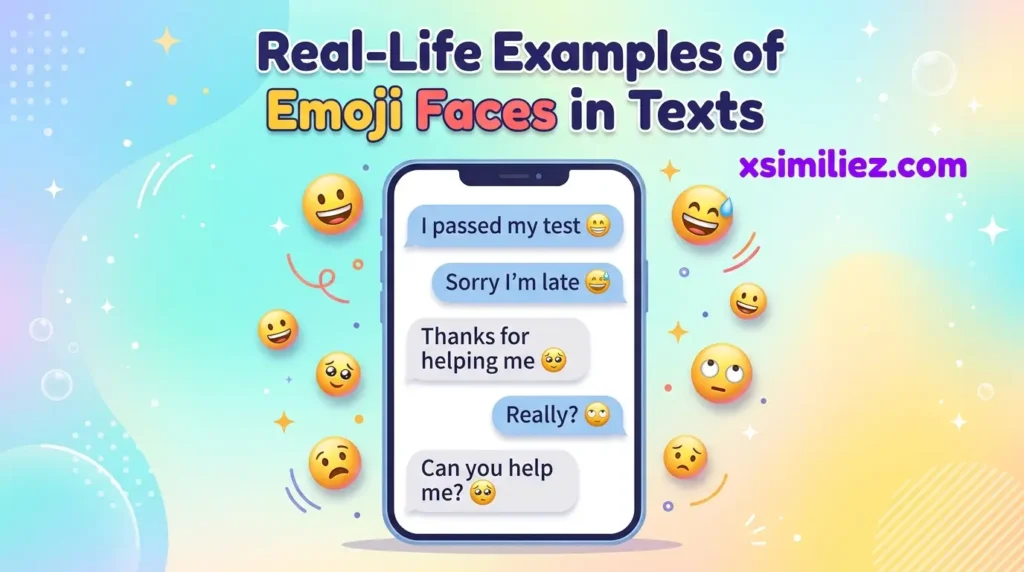
Seeing emojis in action makes their meaning easier to understand. Here are a few simple examples of how people use them.
| Message | What It Means |
| ‘I passed my test 😁’ | Big excitement and pride |
| ‘Sorry I’m late 😅’ | A light, nervous apology |
| ‘Thanks for helping me today 🥹’ | Deep, heartfelt thanks |
| ‘We have to clean the garage again 🙄’ | Mild annoyance or boredom |
| ‘Can you drive me to practice? 🥺’ | A sweet, pleading request |
| ‘Fine. 🙂’ | Possibly upset, so check the tone |
Notice how the same short message can change with one small face. The plain ‘See you at five’ sounds neutral. Add a 😊 and it turns friendly. Switch to 😬 and the same words sound worried That is the power of a tiny picture.
At work, a thumbs-up or a simple smile is often safe. With close friends, you can try louder faces like 🤣 or 😭. The key is to know your reader.
Current Usage and Trends in Emoji Faces
Emoji meanings keep changing, just like slang. New faces are added to the Unicode list almost every year, including 🥲 for a smile with a tear, 🫡 for a salute, and 🫣 for peeking through your fingers. Each new face brings fresh ways to share feelings.
Age groups also use emojis in their own ways. Many younger people say 😭 and 💀 for laughter, and some think 😂 is a bit old-fashioned. Many older adults use 😂 happily and read 🙂 as a plain smile. Neither group is wrong. They simply learned the language in different places.
Because there is no single rulebook, I can’t give one exact meaning for every face. The best approach is to watch how the people around you use them, then follow their lead.
Tips for Using Emoji Faces Well
First, keep your reader in mind. Ask yourself if the face fits their age, their mood, and your bond. A funny face for a friend may not fit a message to a teacher.
Second, let words do the heavy lifting. Use the emoji to add feeling, not to replace the whole message. Third, stick to a small group of faces you know well. That way, you will not send a mixed message by accident.
Fourth, check how a face looks on different phones if you are unsure. Last, when in doubt, choose the kinder option. A warm 😊 rarely causes trouble, and it can brighten someone’s day.
FAQs
What is the most popular emoji face?
The face with tears of joy, 😂, has been one of the most used emojis for years. Newer faces and slang have changed things a bit, but it is still very well known.
What does the 🙂 emoji mean?
It usually means a calm, polite smile. Some people read it as cold or fake, so use 😊 if you want to sound warmer.
What is the difference between 😂 and 🤣?
Both show laughing. 😂 means something is very funny, while 🤣 means it is so funny that you are rolling on the floor.
Why do people use 😭 when something is funny?
It is a way to say ‘I’m laughing so hard I’m crying.’ It can also mean something is very cute. Look at the rest of the message to be sure.
Do emoji faces look the same on every phone?
No. Each company, like Apple, Google, and Samsung, draws its own version. The main feeling is similar, but the look can change.
Can I use emoji faces at work?
Yes, in many places. Simple faces like 🙂 or 😊 are usually fine in friendly messages. Skip them in very formal emails, and follow the style of your workplace.
Conclusion
The meaning of emoji faces is easier to understand once you see them as small pictures of feelings. Happy faces show joy, loving faces show care, and sad or angry faces show harder moods. Tricky ones like 🙂, 🙃, and 🙄 depend on tone and context.
Mistakes happen when we guess, use too many, or forget who is reading. A little care goes a long way. Remember that emoji meanings shift over time, and different age groups may read the same face in different ways.
So here is the best advice: pick faces that match your words, keep your reader in mind, and choose kindness when you are not sure. Do that, and your messages will sound clear, warm, and just like you.

Hi, I’m Harper Blake, and I write for Xsimiliez.com. I enjoy sharing clear and friendly simile examples that students and beginners can understand easily. My goal is to make English learning simple and enjoyable.