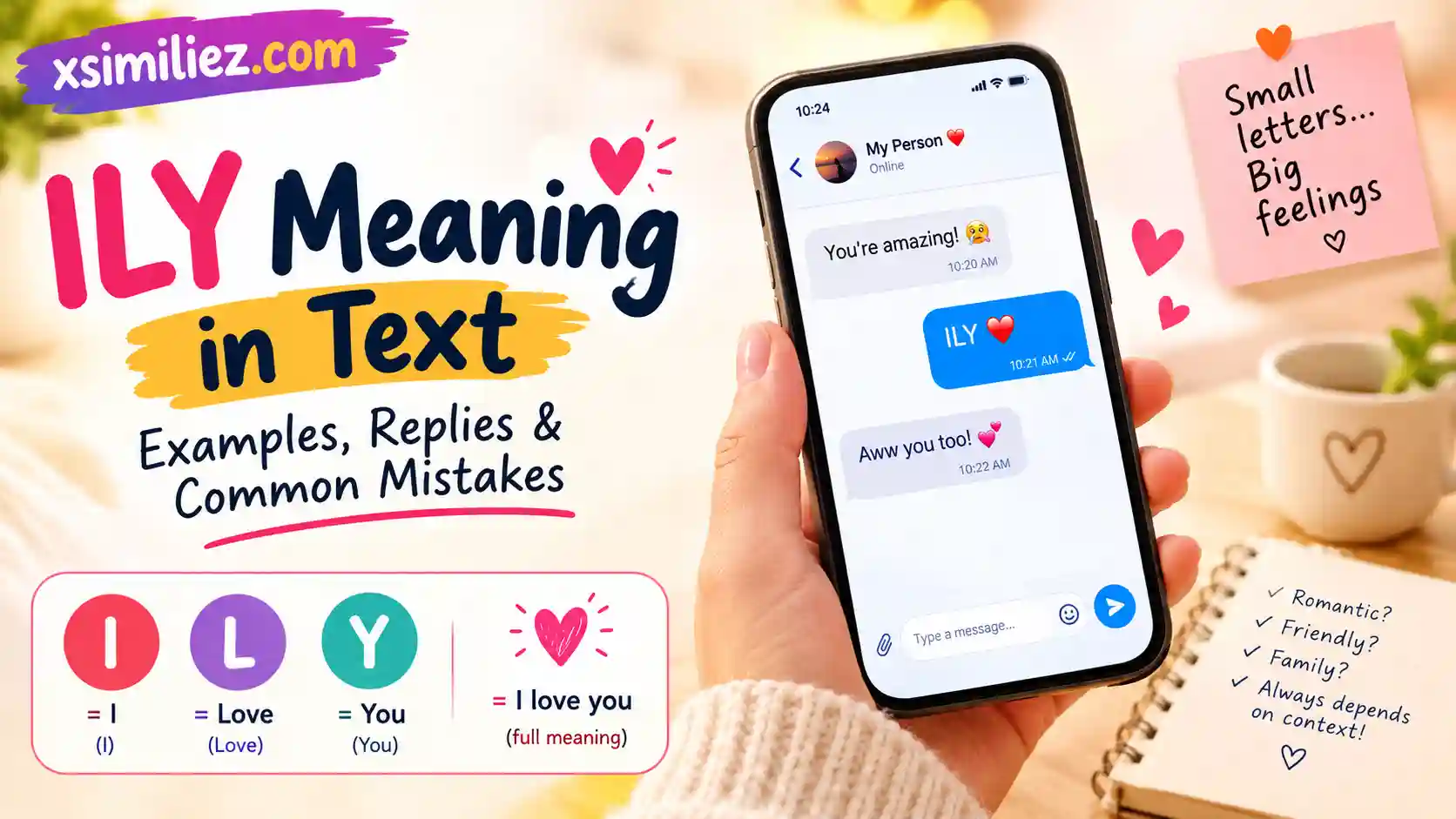
ILY meaning in text is simple: ILY stands for “I love you.” People type it as a quick, short way to share love or care. You will see it in messages between partners, family members, and close friends.
But three tiny letters can carry big feelings. That is why so many people pause and wonder what it really means when it pops up on their phone. Is it romantic? Is it just friendly? Does it need a reply?
This guide answers those questions in plain words. You will learn the meaning, the right way to use it, common mistakes, real examples, and smart replies. By the end, you will feel ready to send or answer ILY with confidence.
Quick Answer: ILY Meaning in Text
In texting, ILY means “I love you.” It is the short form people use when they want to say those three words without typing them all out. You will see it in texts, chats, photo captions, and comments.
It is often written in capital letters, but lowercase “ily” means exactly the same thing. The ILY meaning in text can be romantic, family-based, or friendly, so the feeling behind it depends on who sends it and how the two people usually talk to each other.
ILY Meaning in Text Explained
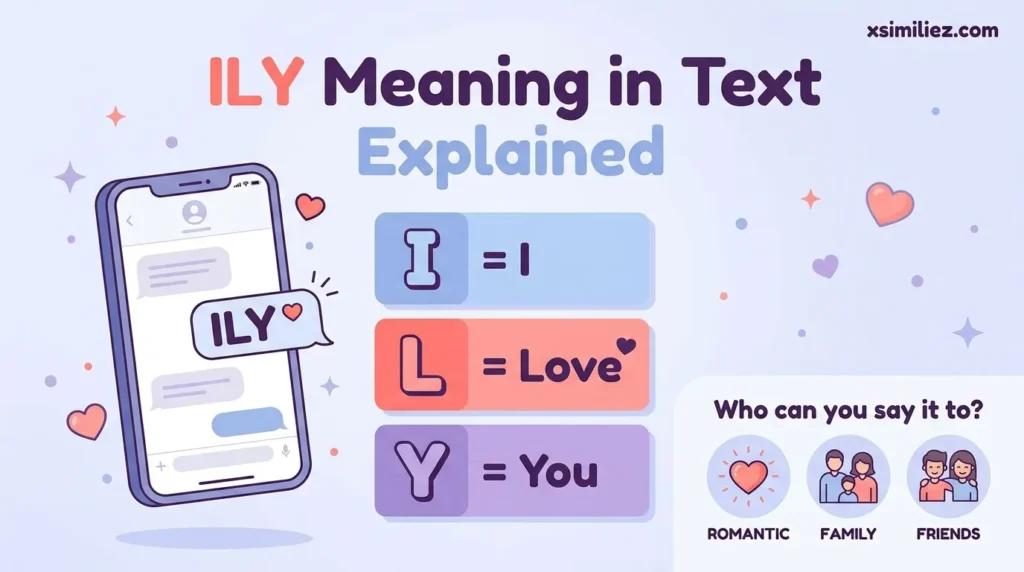
ILY is what writers call an initialism. That means each letter stands for a word: I for “I,” L for “love,” and Y for “you.” Most people say the letters one by one if they say it out loud, like “I-L-Y.” They do not say it as a single word.
The word “love” is the part that makes ILY so special. Love is a big word, but it does not always mean romance. A mom can send ILY to her son. A student can send it to a best friend after a long week. A grandparent can send it at the end of a call. In each case, the message says, “You matter to me.”
Because ILY is short and quick, it often feels lighter than the full phrase. Some people see that as a good thing. It lets them share warm feelings without making the moment feel too heavy. Others feel the full “I love you” sounds stronger, so they save it for big moments.
That does not mean ILY is fake or cold. Many people mean it deeply when they type it. The best way to read it is to look at the person, the past chats, and the mood of the conversation. Context tells you almost everything.
How to Use ILY Correctly in a Message
Using ILY is easy, and there are no strict grammar rules. It can stand alone as a full message, or it can come at the end of a longer one. For example, “Good luck on your test today, ily” works fine. So does a simple “ily.”
People usually write ILY in one of three ways. Capital letters (ILY) can feel bold and clear. Lowercase (ily) feels softer and more casual. Adding a person’s name or a heart emoji can make it feel more personal, like “ily, Mom ❤ ️.”
It is also a good idea to match the person you are texting. If your friend writes long, careful messages, a quick ILY may feel too casual. If your sister sends you memes all day, ILY fits right in. Think about the tone first, then type.
When it comes to timing, ILY works best in these moments:
When it comes to timing, ILY works best when you say goodbye or good night, when someone does something kind for you, when someone is sad, stressed, or having a hard day, or when you want to cheer someone up for no special reason
It works less well in a fight, in a work email, or in a message to someone you barely know. We will cover those mistakes in a moment.
Where Did ILY Come From?
Nobody can point to one person who first typed ILY, and no reliable record shows the exact date it began. What we do know is that short forms like this grew along with early texting and online chat. Old cell phones limited how many characters a text could hold, and typing on number keypads was slow. Short phrases save time and effort.
Chat programs and instant messaging in the late 1990s and early 2000s helped these abbreviations spread. Later, apps like Snapchat, Instagram, WhatsApp, and TikTok made them even more common. Today, ILY is one of the best-known texting abbreviations in the English language.
There is one more interesting link. In American Sign Language (ASL), a hand shape combines the letters I, L, and Y into one sign that means “I love you.” People in the Deaf community and many hearing people use it. It is not clear that the text version came from the sign, so it is best to treat the two as separate things that share the same letters and the same warm message.
ILY vs ILYSM vs ILU: What Is the Difference?
ILY has several cousins. They all share the same heart, but they differ a little in strength and style. This table shows the most common ones.
| Abbreviation | Full Phrase | How It Feels |
| ILY | I love you | Warm and simple |
| ILU | I love you | Same meaning, a bit more casual |
| ILYSM | I love you so much | Stronger and more excited |
| ILYM | I love you more | Playful, often a reply |
| ILYT | I love you too | A direct answer to ILY |
| ILY2 | I love you too | Short reply, same as ILYT |
The biggest jump in feeling is from ILY to ILYSM. The extra “so much” makes the message sound deeper. People often use ILYSM with close friends, family, or partners when they feel extra thankful or happy.
ILU and ILY mean the same thing. The only real difference is the last letter, and which one you pick is mostly a habit. Some people say ILU feels a little more relaxed. Others never use it at all.
Real-Life Examples of ILY in Text
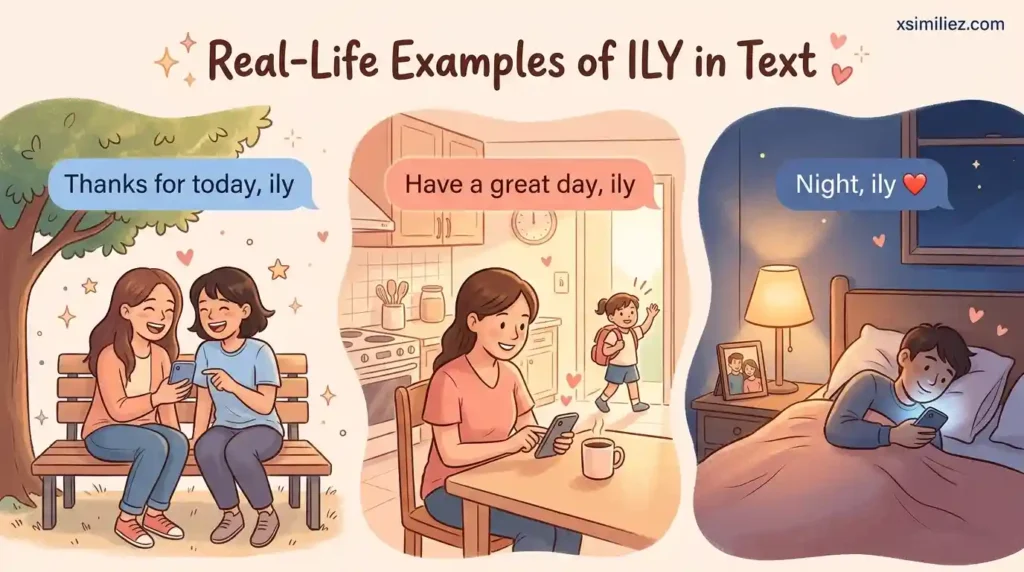
Examples make the meaning clear. Here are common situations, what the sender likely means, and a good way to reply.
| Situation | Message | What It Likely Means | Good Reply |
| Partner at bedtime | “Night, Lily ❤️” | Romantic love and care | “Ily too, sleep well” |
| Parent to child | “Have a great day, ily” | Family love and support | “Ily too, Mom” |
| Best friend after help | “Thanks for today, ily” | Deep thanks and friendship | “Always here for you, ilysm” |
| Group chat joke | “You made me laugh, ily lol” | Playful, light affection | “Haha, ily2” |
| Sad day | “Rough day. Ily for listening.” | Gratitude and comfort | “Anytime. I’m here.” |
Notice how the words around ILY change its feeling. The heart emoji pushes it toward romance. The “lol” pushes it toward fun. The thank you pushes it toward gratitude. The same three letters can mean slightly different things in each message.
Here is a short story. Maya sent her older brother a text after he drove her to the airport: “Thanks for the ride, ily.” He was not mushy, but he wrote back, “Lily too, text me when you land.” That tiny exchange said a lot about how close they were, without any long speeches.
How People Use ILY Today
Today, ILY shows up almost everywhere people talk online. It appears in captions on photos, replies to stories, comments on videos, and quick chats in apps. Many people also use it with emojis such as hearts, hugs, and sparkles to add feeling.
Younger people often use ILY more freely than older groups do. Among friends, it can feel like a normal way to say goodbye or to show thanks. Many users also say it to pets, to creators they enjoy, or even in jokes, such as “ily, pizza.” In these cases, the meaning is playful, not serious.
At the same time, many people still use ILY in a serious way. It is common in long-distance relationships, between parents and kids who live apart, and between friends who rarely meet. For these people, a quick ILY is a small daily reminder that someone is thinking of them.
Social norms can also change by culture, age, and community. Because language changes fast, there is no single rule for every person. When in doubt, follow the style of the person you are talking with.
FAQs About ILY Meaning in Text
1. What does ILY mean in a text message?
ILY means “I love you.” It is a short way to share love, care, or thanks with someone.
2. Is ILY romantic?
Not always. It can be romantic, but people also use it with family and friends. Look at the person and the way you normally talk to understand what is meant.
3. How do I reply to ILY?
If you feel the same, you can reply with ILY too, ILYT, ILY2, or “love you too.” If you are unsure, a kind message like “Thank you, that means a lot” works well.
4. What is the difference between ILY and ILYSM?
ILY means “I love you,” while ILYSM means “I love you so much.” ILYSM sounds stronger and more exciting.
5. Can I send ILY to a friend?
Yes. Many friends say ILY to show thanks and care. Just make sure your friend would feel comfortable with it and that your tone is clear.
6. Is it rude to ignore an ILY text?
It is not rude, but a quick, kind reply is nicer. You can answer warmly without saying love back if that does not feel right.
Conclusion
Now you know the ILY meaning in text: it stands for “I love you,” and it can show romance, family love, or friendship. The words around it, the emoji beside it, and the bond between the two people all shape how it feels.
The best way to use it is to keep it honest and fit it to the person. Send it when you truly feel it, add a small detail when you can, and avoid using it to dodge hard talks. Overusing it can make it lose its charm.
If you receive an ILY, take a moment to read the context before you reply. A warm, honest answer is always better than a rushed one. Small words can carry big feelings, so use them with care.

Hi, I’m Harper Blake, and I write for Xsimiliez.com. I enjoy sharing clear and friendly simile examples that students and beginners can understand easily. My goal is to make English learning simple and enjoyable.