Graduation cords color meaning depends on your school, but the usual pattern is simple. Gold often shows top grades, silver shows high honors, and other colors show clubs, service, sports, or military ties. No single national rulebook exists, so always check with your school.
Graduation day is a big moment. Then you see classmates wearing ropes of every color around their necks, and you start to wonder what each one says. Maybe you earned a cord and want to explain it. Maybe you are a parent trying to keep up.
This guide breaks it all down in plain words. You will learn what the colors usually mean, how cords differ from stoles, how to wear them, and which mistakes to avoid.
Quick Answer: Graduation Cords Color Meaning at a Glance

Here is the short version. A graduation cord is a twisted rope with tassels on the ends. Students wear it over their gown to show an honor, a club, a sport, or a kind of service. The color tells people which one.
At many schools, gold means the highest academic honors. Silver often means the next level down. Red, white, and blue together often honor military service. Green may show environmental work or community service. Purple, black, and orange can mean leadership, culture clubs, or school pride, depending on the school.
The key word is “many.” One school may give blue cords for math, while another gives them for choir. That is why the table below says “usually” and “often.” Think of it as a helpful guide, not a law.
What Are Graduation Cords and Why Do Schools Use Them?

A graduation cord is a braided or twisted rope. It hangs around the neck and falls down the front of the gown. Most have a tassel at each end. Some have knots, and some mix two or three colors in one rope.
Schools use cords because a gown makes everyone look the same. Black or school-color gowns are neat and fair. But they hide the hard work each student did. Cords let a student show a little of that work without a word being spoken.
Cords can honor many things. Some show grades. Some show time spent in a club or honor society. Others show hours of volunteer work, a sport, a language skill, or a job-training program. A few show that a student served in the military.
It helps to know that cords are usually earned, not just bought. Most schools have rules. A student may need a set grade point average, a set number of service hours, or a teacher’s sign-off. In most cases, wearing a cord you did not earn is frowned on.
Common Graduation Cords Color Meaning Chart
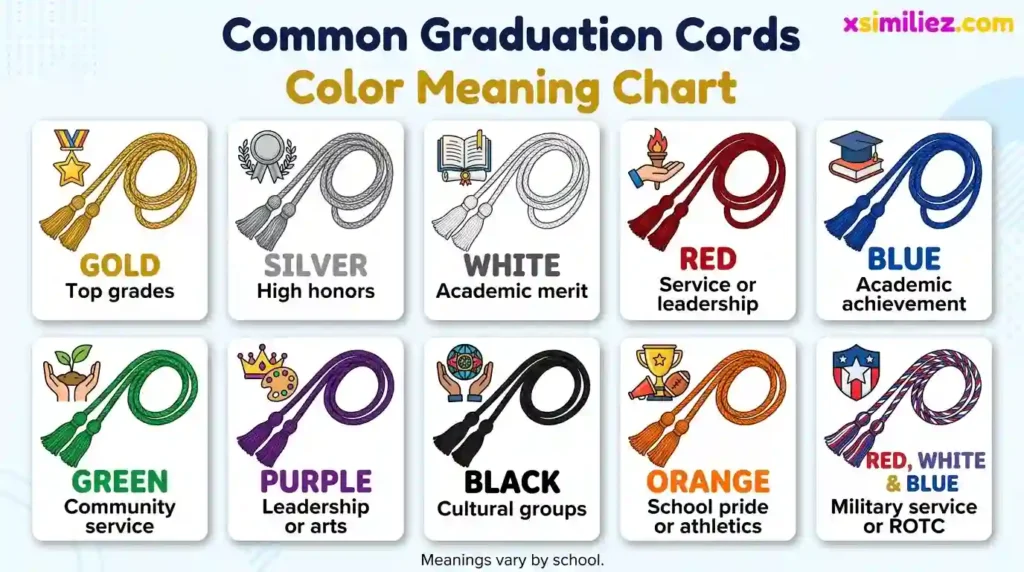
The chart below lists the meanings you will see most often. Remember, these are common patterns, not rules that every school follows.
| Cord Color | Common Meaning | Where You Might See It |
| Gold | Highest academic honors, top grade point average | High schools and colleges |
| Silver | High academic honors, often second level | High schools and colleges |
| White | Honor roll, academic merit, or a specific club | High schools |
| Red | Service, leadership, or vocational programs | High schools |
| Blue | Academic achievement, math, science, or an honor society | High schools and colleges |
| Green | Environmental work, community service, or agriculture | High schools and colleges |
| Purple | Leadership, arts, or school spirit | High schools |
| Black | Cultural groups, leadership, or student government | Colleges and high schools |
| Orange | School pride, athletics, or a specific club | High schools |
| Red, white, and blue | Military service or ROTC | High schools and colleges |
Use this table as a starting point. Then ask your school for its own list. Most schools print one in the graduation packet or post it on the website.
Gold and Silver Cords: The Most Famous Academic Honors

Gold is the color most people think of first. At many schools, a gold cord tells everyone the student earned very high grades. Often that means a grade point average of about 3.5 or higher, though the exact number changes from school to school. Some schools save gold for the very top students, like those with the highest rank in the class.
Silver usually comes next. A student with a silver cord has strong grades, but a little below the gold cutoff. Some schools do the reverse or use silver for a special program. That is why you should never guess.
Many colleges use a Latin system instead. You may hear the words “cum laude,” “magna cum laude,” and “summa cum laude.” These mean “with honor,” “with great honor,” and “with highest honor.” Some colleges give a different cord for each level. Others give one cord to all honors students.
It is also worth knowing that gold and silver are not just for grades. A school might give a gold cord for a perfect attendance record or a special project. The best way to be sure is to read the school’s own handbook.
Other Colors and What They Often Show
Beyond gold and silver, the meanings spread out. Here is a look at the colors people ask about most.
Red cords often show service or leadership. Some schools give red to students in career and technical programs. Others use it for student government or a special club.
Blue cords can show strong grades in a subject like math or science. They also show up with honor societies. Many honor societies use blue and gold together, so a two-color cord is common.
Green cords usually point to the planet or the community. A student might earn one for recycling work, garden projects, or many hours of volunteering. In farm-focused programs, green can show that kind of study.
White cords may mean the student made the honor roll. At some schools, white is used for a certain club or for a special kind of honor. Black cords often honor cultural groups, student leaders, or a student’s work in a particular program.
Purple and orange are more flexible. They may match school colors or stand for a certain team or club. When you see them, ask the school or look at the printed program.
Honor Society Cords, Stoles, Tassels, and Medallions
Cords are not the only thing students wear. Stoles, tassels, and medallions also carry meaning. People mix them up all the time, so this table can help.
| Item | What It Looks Like | What It Usually Shows |
| Cord | Twisted rope that hangs around the neck | Honors, clubs, sports, service |
| Stole | Wide cloth band draped over the shoulders | Honor society, culture, or a major |
| Tassel | Small bundle of threads on the cap | Graduation year, school colors, degree |
| Medallion | Metal or fabric disc on a ribbon | A major honor or award |
Honor societies often have their own cord or stole. The National Honor Society is one well-known group, and it has its own colors. Other groups, such as college honor societies, do the same. If a student belongs to one, the group usually tells them which item to wear and how.
The best rule is to wear the items your school approves. Some schools allow many cords at once. Others limit the number to keep the ceremony neat.
Military and Service Cords
Some of the most respected cords honor people who served the country. Red, white, and blue cords are often used for students who have joined the military, are in ROTC, or are veterans. Some schools use other colors for this, so the local meaning still matters.
Service cords also honor volunteer work. A student who spent many hours helping at a food bank, hospital, or animal shelter might earn one. Schools often set a minimum number of hours. The student then turns in a form to prove the work.
These cords tend to mean a lot to families. They show that a student gave time and effort without being paid. Many schools announce these honors during the ceremony so everyone can cheer.
Origin and History of Graduation Cords

Graduation clothing has a long past. Caps and gowns come from old European universities, where scholars wore robes for warmth and to show their rank. Over time, those robes became part of formal ceremonies.
The exact start of graduation cords is harder to pin down. Reliable sources do not agree on one clear date or place, so it is best not to claim one. What we do know is that today’s system grew from the wider tradition of academic dress. In the United States, a group called the American Council on Education has published a guide to academic dress, but it does not set rules for cord colors.
In short, schools decide for themselves. That is why the meanings can change so much from one place to another.
How to Wear Graduation Cords the Right Way
Wearing a cord is easy once you know the steps. Put the gown on first. Then place the cord around your neck so it hangs down the front, with the tassels evenly spaced. Smooth it so it lies flat.
If you have more than one cord, layer them neatly. Many students put the most important one on top or closest to the neck. Others keep them even, side by side. Some schools have a set order, so check the graduation packet.
A small clip or safety pin can keep a cord in place. This is handy if you will be walking, bending, or taking photos. Just keep the pin hidden under the gown.
Here are a few more tips:
- Wear the cord at the ceremony, not before. Some schools hand them out that day.
- Do not wear cords from another school unless you are told to.
- Keep cords dry and flat before graduation, so they stay free of wrinkles.
- Ask for help if the cord feels too long or too short.
Common Mistakes People Make With Graduation Cords
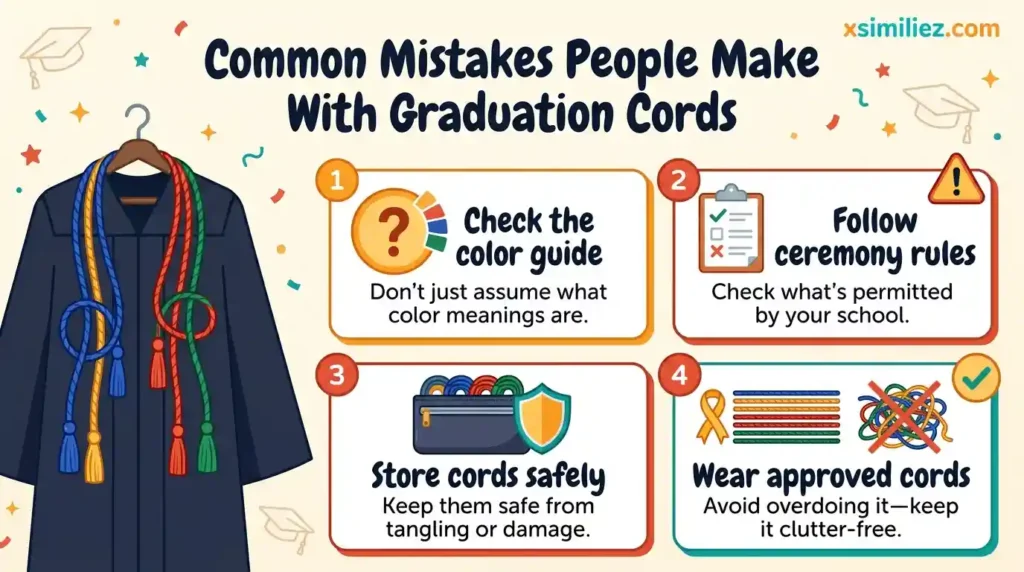
The biggest mistake is assuming the meaning. A parent might see a red cord and think “service,” when the school meant “career program.” Always ask or read the program.
Another mistake is wearing cords you did not earn. This can cause trouble at the ceremony. Some schools take cords back or even block a student from walking if they break the rules.
Students also lose cords or forget to pick them up. If the school gives them out early, put yours in a safe place. A zip bag works well. Some students tie a note to it so they remember which one is which.
A fourth mistake is wearing too many. A pile of cords can look messy and may block the view of your gown. Pick the ones that matter most, and follow the school’s limit.
Finally, some students forget to ask about extras. Certain honors come with a medallion or stole as well. It is smart to ask early so nothing is missed.
Real-Life Examples of Graduation Cords Color Meaning
Seeing real cases makes the colors easier to understand. Here are a few examples drawn from how schools often do things.
Maya, a high school senior, kept a high grade point average for four years. Her school gave her a gold cord. She also helped at a local shelter for over 100 hours, which earned her a green cord. She wore both, with gold on top.
Jordan joined the Army after his senior year. His school let him wear a red, white, and blue cord to honor his service. His family cried with pride when his name was called.
Sofia belonged to a cultural club and led several events. Her school gave her a black cord, and her club gave her a matching stole. She wore both, and her friends asked what each one meant. She loved explaining it.
These examples show how varied cords can be. Two students can wear the same color for different reasons. That is why the story behind each cord matters as much as the color.
Current Trends in Graduation Cords
Graduation cords are getting more personal. Schools now offer more kinds of honors than ever. Students may earn cords for coding, bilingual skills, volunteer work, and even leadership in online clubs.
Many schools are also adding cords for students who overcame hard times or who are the first in their family to go to college. These cords tell a deep story and often get the loudest cheers.
Another trend is a more careful approach to cost. Some schools hand out cords for free. Others sell them. Families can ask if the school offers help for students who cannot afford them.
As more honors appear, schools are also making clear lists. Many now post a color guide online before the big day. That helps families know what to expect and keeps the ceremony smooth.
Tips for Earning and Choosing Your Cords
If you are still in school, start early. Look at the list of cords your school offers. Pick the ones that fit your interests and plan how to earn them.
Keep track of your hours and records. If a cord needs 50 volunteer hours, write down each visit and get a signature. A simple notebook works fine.
Talk to a counselor or teacher. They know the rules and deadlines. Some cords need an application, and missing the date can cost you the honor.
Be proud of the cords you earn, but do not worry if you earn none. Plenty of great students graduate without a single cord. What matters most is the work you did and the person you became.
FAQs
What does a gold graduation cord mean?
At most schools, a gold cord shows the highest academic honors, usually tied to a high grade point average. Some schools also use gold for special awards, so check the local rules.
What does a silver graduation cord mean?
A silver cord often shows high academic honors, just below gold. At some schools it can mean a special program or honor instead.
What does a red, white, and blue graduation cord mean?
This cord most often honors military service, ROTC, or veterans. Not every school uses it the same way, so ask what it means at yours.
Can I buy a graduation cord if I did not earn it?
You can often buy a cord from a store or online. But wearing one you did not earn can break school rules. It is best to wear only approved cords.
Can I wear more than one cord?
Yes, most schools allow it, though some set a limit. Layer them neatly, and follow any order your school gives.
Do graduation cord colors mean the same everywhere?
No. There is no single national rule. Gold and silver are the most common for grades, but other colors change from school to school.
Conclusion
Graduation cords color meaning comes down to one idea: each color tells a small part of a student’s story. Gold and silver usually point to strong grades. Other colors show service, clubs, sports, or military ties.
The most important thing to remember is that schools set their own rules. A color that means one thing at your school may mean something else at the school across town. That is normal, and it is why a quick check always helps.
So before the big day, ask for your school’s color guide. Wear your cords with pride, and be kind to classmates who wear different ones. Every cord took effort to earn, and every one deserves a cheer.

Hi, I’m Harper Blake, and I write for Xsimiliez.com. I enjoy sharing clear and friendly simile examples that students and beginners can understand easily. My goal is to make English learning simple and enjoyable.