Davy Jones’ locker is an old sailor’s way of saying the bottom of the sea. The Davy Jones locker meaning is simple. It is the final resting place of drowned sailors, lost ships, and anything that sinks into deep water. If something goes into Davy Jones’ locker, it is gone for good.
You may have heard this phrase in a pirate movie, a book, or a joke. Maybe someone said their phone fell into Davy Jones’ locker after a boat trip. People search for this topic because the words sound spooky and a little funny at the same time.
In this guide, you will learn what the phrase means, who Davy Jones is, and where the legend may have started. You will also see how to use it the right way, with examples, common mistakes, and answers to popular questions.
Quick Answer: What Is the Davy Jones Locker Meaning?
The Davy Jones locker meaning is “the bottom of the ocean,” seen as the grave of sailors and sunken ships. In old sea stories, Davy Jones is an evil spirit of the deep. His “locker” is the place where he keeps those who die at sea, along with everything that sinks.
Think of it as a giant storage chest on the sea floor. When a ship goes down, it goes into the chest. When a sailor drowns, he goes there too.
The words are slang, not a real place on any map. Sailors have used them for hundreds of years. Today, people also use the phrase as a joke for anything lost in water. So if you drop your keys off a dock, you can say they went to Davy Jones’ locker.
The Full Meaning of Davy Jones’ Locker
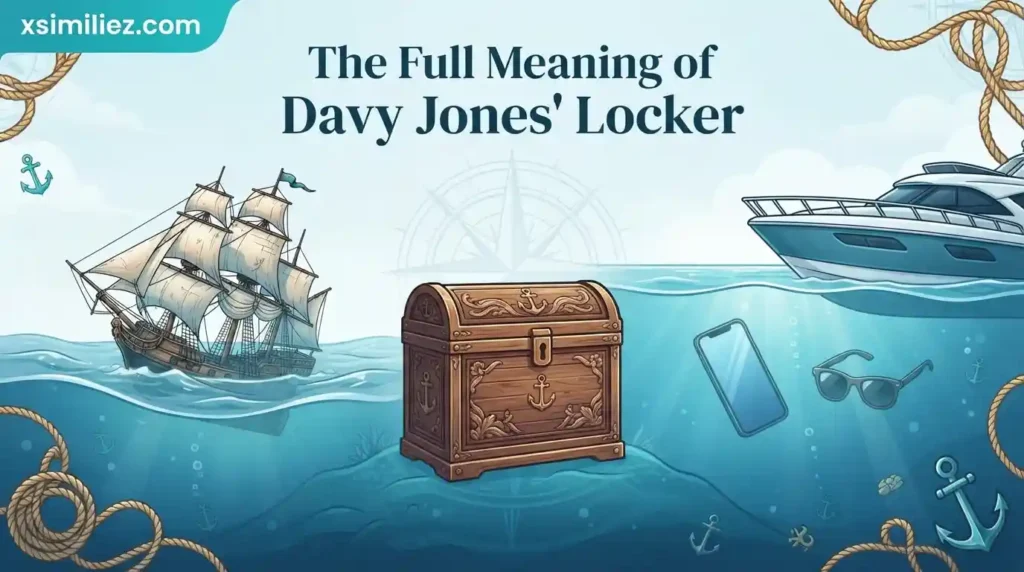
Let’s break the phrase into two parts. The word “locker” means a storage box or small closet. Sailors have always used lockers to keep clothes, tools, and personal items safe on a ship. So when the sea became a “locker,” it meant the ocean was a big box that holds whatever it takes.
The name “Davy Jones” is the owner of that locker. He is not a normal man. He is a ghost story, a sea devil, a kind of ruler of the deep. Sailors did not say, “He drowned.” They said, “He went to Davy Jones’ locker.” That sounded softer, and it also sounded a bit like a story rather than a sad fact.
The phrase can be used in two main ways. The first way is serious. It describes death at sea, or a ship that sinks and never returns. The second way is playful. It describes a lost object, like a phone, a ring, or a fishing rod that falls into the water. The table below shows the difference.
| Way of Using It | What It Means | Tone |
| Serious or historic | Death at sea or a ship lost under the waves | Respectful, dark, or dramatic |
| Playful or modern | An item lost in deep water | Light, funny, casual |
| Story or movie | A spooky place or world tied to the sea | Fantasy, adventure |
Notice that the phrase always connects to the sea. If nothing is lost in water, the phrase does not fit well.
Who Is Davy Jones in Sea Legends?
Davy Jones is a character from sailor folklore. He is not a real person who has been proven in history. Think of him like a campfire monster, but one told on wooden ships.
One of the earliest detailed descriptions comes from a novel by Tobias Smollett, published in 1751. In that book, a sailor explains that Davy Jones is the evil spirit who rules the dangers of the deep. The story says he can appear in different shapes to warn people of death and trouble. He is also described in a scary way, with huge eyes, many teeth, horns, a tail, and blue smoke from his nose.
That description sounds like a monster, and that was the point. Sailors lived with real danger every day. Storms, rocks, and sickness could end a voyage fast. A spooky legend gave them a name to put on their fear.
Sailors also told jokes and tales about Davy Jones to new crew members. Many old sea customs, like crossing-the-line ceremonies, used his name. It was part storytelling and part tradition. The legend helped sailors talk about the sea in a way that felt a little less heavy.
So when you read “Davy Jones,” picture a sea spirit, not a real captain from a history book.
Origin and History: Where Did the Phrase Come From?
Here is where honesty matters. Nobody knows for sure where the name began. Language experts agree that the phrase was in use by the early 1700s. A commonly cited early example appears in writing from 1726, and the Smollett novel in 1751 helped spread the idea. By the 1800s, the phrase was well known in sea stories and sailor talk.
What we do not have is proof of who Davy Jones was, or why that name was chosen. Many fun stories exist, but most come from guesses made long after the phrase was already popular. That is why careful writers say “possible origin” and not “true origin.”
It helps to remember that sailors passed stories by mouth. Few of them wrote things down. So the exact start of the phrase was likely lost long ago. What we can say safely is this: the phrase is old, it comes from sailor culture, and it has stayed alive for about three hundred years.
Popular Theories About Who Davy Jones Was
Many people love to guess where the name came from. Here are the most common ideas. Treat them as stories, not facts.
| Theory | The Idea | How Strong Is the Proof? |
| Saint David and Jonah | “Davy” comes from Saint David, a Welsh saint, and “Jones” comes from Jonah, the Bible man tied to bad luck at sea | Popular guess, no firm proof |
| The tavern keeper | A pub owner named Davy Jones tricked drunk sailors, locked them in a storage space, and sold them to ships | A fun tale, but no solid records |
| A real pirate | A pirate named David Jones lived long ago and became a legend | No clear proof he is the source |
| A West Indian ghost word | “Jones” may come from “Jonah,” and “Davy” may come from a word for a ghost used in the Caribbean | An interesting idea, not proven |
Each theory has a charm. The Jonah link makes some sense, since sailors long believed Jonah brought bad luck. The tavern story is the most entertaining. Still, none of them has been confirmed by strong evidence. If you see a website that says one of these is a fact, be careful.
How to Use Davy Jones’ Locker Correctly
The good news is that the phrase is easy to use. You just need to match it with water and loss. Here are a few simple rules.
First, pick one spelling style. Both “Davy Jones’ locker” and “Davy Jones’s locker” are seen in writing. Either is fine. Just use the same one all the way through your writing. Always capitalize “Davy Jones,” since it is a name.
Second, use the common verbs. People say someone “went to,” “ended up in,” “was sent to,” or “is in” Davy Jones’ locker. You can also say a ship “now rests in” it.
Third, match the tone. If you are writing about a real shipwreck, stay respectful. If you are joking about a lost phone, a light tone is fine. The table below gives some easy examples.
| Example Sentence | What It Means |
| “The old ship sank in a storm and went to Davy Jones’ locker.” | The ship sank and was lost at sea |
| “My sunglasses are in Davy Jones’ locker now.” | I dropped them in the water |
| “Many brave sailors ended up in Davy Jones’ locker.” | Many sailors died at sea |
| “Careful with that ring, or it will visit Davy Jones’ locker.” | It might fall in the water and be lost |
Keep your sentences clear. The phrase works best when the reader already understands that something sank or drowned.
Common Mistakes People Make
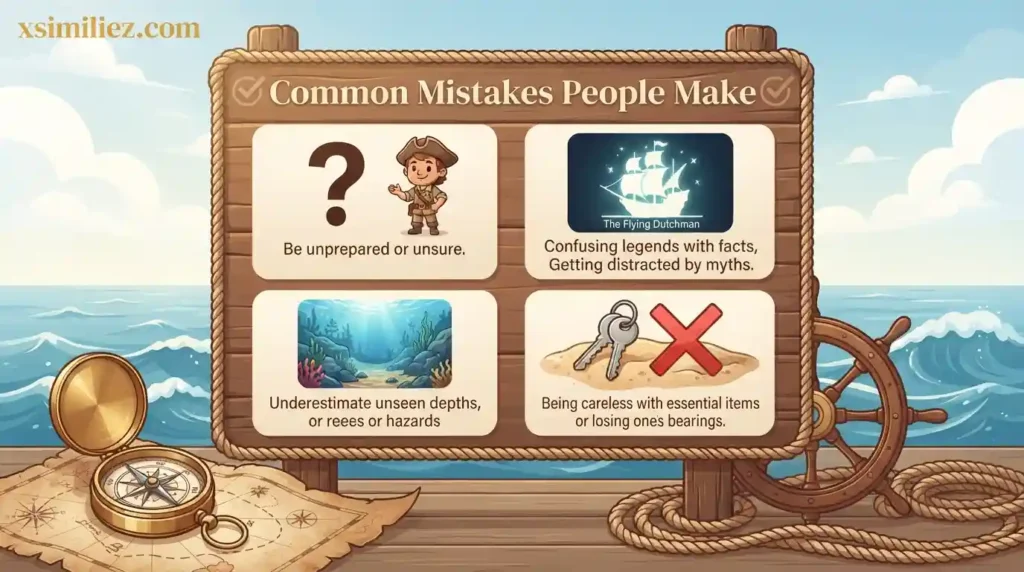
Even a simple phrase can be mixed up. Here are the most common errors.
The first mistake is thinking Davy Jones is a real historical person. He is a folklore figure. It is fine to enjoy the stories, but they should not be taught as proven history.
The second mistake is mixing him up with the Flying Dutchman. The Flying Dutchman is a different legend about a ghost ship that can never reach home. Movies sometimes connect the two, which adds to the confusion. In old folklore, they are separate stories.
The third mistake is treating the locker like heaven or hell. In the traditional meaning, it is not a religious place. It is simply the sea floor, seen as a grave. Some stories and films give it a fantasy twist, but the base meaning stays tied to the ocean.
The fourth mistake is using it for things lost on land. If your keys vanish on your couch, they are not in Davy Jones’ locker. The phrase needs water. Otherwise, the joke does not land.
The fifth mistake is stating one origin story as fact. Since no one knows the true source, it is better to say “one theory says” or “some people believe.”
The last mistake is simple spelling trouble. Many people drop the apostrophe and write “Davy Jones locker.” Search engines understand it, but in careful writing, the apostrophe belongs there.
Real-Life Examples of the Phrase
You can find this phrase in many everyday places. Once you know the davy jones locker meaning, you will start to hear it more often.
In history books and sea stories, writers use it when they talk about shipwrecks. A line might say that hundreds of ships lie in Davy Jones’ locker off a famous coast. It gives the story a bit of old-time color.
On family trips, it shows up as a joke. A child drops a toy off a boat, and a parent says, “That one is in Davy Jones’ locker now.” The child may laugh, or may cry, but they will remember the phrase.
Among fishermen and boaters, it is common talk. Someone loses a lure, a hat, or a cooler in a lake and says it went to the locker. It is quick, friendly, and easy to understand.
Divers use it too. When they find old wrecks, they might say they are visiting the ship in Davy Jones’ locker. This use is a little more respectful, since it points to real loss.
Even in school lessons, teachers may explain the phrase when they teach about pirates, ships, or sea history. It is a fun way to learn how sailors saw the world.
Davy Jones’ Locker in Movies, Books, and Pop Culture
Pop culture has kept this legend alive. The biggest boost in modern times came from the Pirates of the Caribbean films. In Dead Man’s Chest, released in 2006, Davy Jones is a ghostly sea captain who sails the Flying Dutchman. He is played by actor Bill Nighy and is shown with tentacles on his face. The next film, At World’s End, from 2007, takes the characters to a strange place called Davy Jones’ Locker, which feels like a lonely world for the lost.
These movies changed some details. In the old folklore, Davy Jones is a sea devil. In the films, he is a cursed captain with a sad past. That is a creative twist, not the original legend.
The phrase also appears in cartoons, video games, songs, and children’s stories. Writers like it because it is short, mysterious, and easy to picture. A single line can place the reader at sea.
One small note may help. The singer Davy Jones of the 1960s band The Monkees shares the name, but there is no link to the sea legend. It is only a name that happens to match.
Current Usage and Trends
Today, the phrase is mostly playful. People use it in casual speech, on social media, and in gaming chats. It is a handy joke for lost items, failed plans, or something that “sank” badly.
You may also see it in travel writing, boating blogs, and wreck-diving guides. In those places, it adds a bit of sea flavor.
Because the phrase is old and well known, it is not going away soon. I do not have exact numbers on how often people say it today, so I will not guess. But its steady use in films, games, and everyday talk shows that it is still alive.
Tips to Remember the Meaning
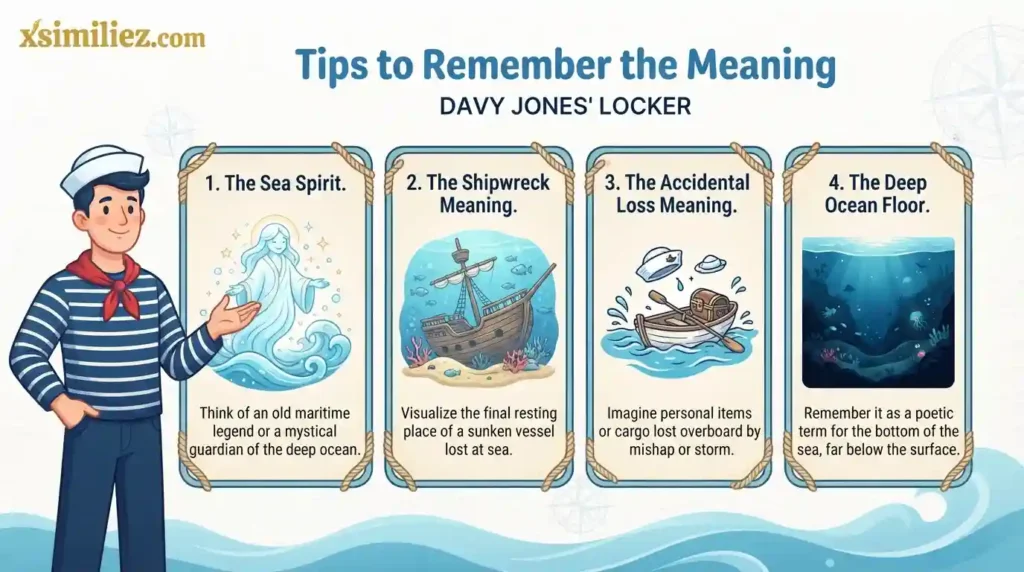
Here are a few simple ways to keep the phrase clear in your mind.
Think of a locker at school. It holds your things. Now picture the ocean as a giant locker that holds sunken things. That mental picture is the whole meaning.
Remember “sea plus lost equals Davy Jones.” If something is lost in water, the phrase fits. If it is not water, skip it.
When you write, add context. A short line like “the ship sank” before the phrase makes the meaning clear to every reader.
Finally, enjoy the story. Learning where phrases come from makes language more fun. Davy Jones is a great example, since it mixes fear, humor, and sea history in just three words.
FAQs
What does Davy Jones’ locker mean in simple words?
It means the bottom of the sea. Sailors used it to describe the place where drowned people and sunken ships end up. Today, it can also mean something you lost in the water.
Is Davy Jones a real person?
No one has proven that he was. He is a character from sailor folklore, described as an evil spirit of the sea. Several stories try to explain the name, but none has strong proof.
Is Davy Jones’ locker heaven or hell?
In the traditional meaning, it is neither. It is the ocean floor seen as a grave. Some movies and stories give it a fantasy meaning, but that is a creative choice.
Where did the phrase begin?
It comes from sailor talk in the early 1700s. A well-known novel from 1751 helped spread the legend. The exact start is unknown, so be careful with any website that claims to know it for sure.
What is the difference between Davy Jones’ locker and the Flying Dutchman?
Davy Jones’ locker is the sea bottom where the lost end up. The Flying Dutchman is a ghost ship legend. Movies often mix them, but in older folklore they are separate tales.
Can I say my phone is in Davy Jones’ locker?
Yes, if you dropped it in the water. It is a playful, common use. Just avoid it for items lost on land, since the phrase depends on the sea.
Conclusion
The davy jones locker meaning is easy to hold on to. It is the sea floor, imagined as a grave for sailors and sunken ships. The phrase comes from old sailor folklore, and its main character, Davy Jones, is a spirit of the deep.
Remember that the origin is still a mystery. Many stories try to explain it, but none has been proven. That is part of its charm. It reminds us that language grows from people, jokes, fears, and tales passed along over time.
When you use the phrase, keep it simple. Match it with water, loss, or the sea, and choose a tone that fits. A serious voice works for shipwrecks, and a light voice works for dropped phones. If you do that, you will sound clear, natural, and just a little bit like an old sailor.

Hi, I’m Harper Blake, and I write for Xsimiliez.com. I enjoy sharing clear and friendly simile examples that students and beginners can understand easily. My goal is to make English learning simple and enjoyable.